Career Astrology Consultation: A Step-by-Step Guide

An offer letter is open on a phone, but the decision still feels unsettled. The salary looks better, the new city means extra expenses, and family members have different opinions about whether this is the right time to move. A career astrology consultation may offer a way to discuss that uncertainty, provided the session leads to practical questions rather than a promise about the future.
The most useful approach is to treat the reading as a planning conversation. An astrologer offers interpretations and timing windows; the person making the decision tests those suggestions against job offers, finances, skills and real opportunities. A focused 90-day test gives the conversation somewhere concrete to go.
Table of Contents
- Choose the Right Reading for Your Career Question
- Gather Birth Details and Career Documents First
- What to Expect in the Session
- Questions That Get Useful Answers
- How to Read Timing Advice Without Over-Trusting It
- Turn One Reading Into a 90-Day Test Plan
- Follow Up at 30, 90 and 180 Days
- Save the Reading and Book Only When Needed
Choose the Right Reading for Your Career Question
A kundli is a birth chart calculated from a person's birth date, exact time and birthplace. A dasha is a planetary period used in Vedic astrology to interpret themes and timing within that individual chart.
The traditional Vimshottari dasha system has a 120-year cycle, divided into major periods called mahadashas and shorter sub-periods called antardashas, as explained in AstroRiver's guide to dasha systems. Its starting point depends on the Moon's birth nakshatra, or lunar constellation, and the Moon's exact position within it. Differences in birth time or place can therefore affect timing calculations.
Career question and the reading to request
| Career question | Reading to request | Chart factors reviewed | What the reader gets back |
|---|---|---|---|
| Job offer or promotion decision | Full chart with dasha timing | 10th house, its ruler, active dasha | Supportive and cautious periods for the decision window |
| Career direction or change | Full chart reading | 10th house, 2nd and 6th houses, Moon nakshatra | Work themes and fields interpreted as suitable |
| Relocation abroad | Full chart with timing | 12th house, 9th house, active dasha | Periods interpreted as favourable for settling abroad, and points to verify |
| Business launch | Muhurta plus dasha review | Panchanga elements, 10th house, active dasha | Recommended and avoidable start dates |
| Income stuck or unstable | Full chart with money focus | 2nd and 11th houses, dasha and transits | Priorities for the next year and review points |
Muhurta means an astrologically selected starting time. Houses are areas of the chart traditionally associated with different life topics; transits describe current planetary movements considered alongside the birth chart.
For someone without an earlier reading, a full-chart consultation is a more complete starting point than dasha timing alone. Someone comparing astrologer profiles can check whether the practitioner offers the relevant reading.
Booking rule: A specific decision produces a more focused conversation than a general request for career predictions.
Gather Birth Details and Career Documents First
Preparation helps separate a chart interpretation from the facts of the decision. The reader needs both, particularly when an offer deadline or financial commitment leaves little room for delay.
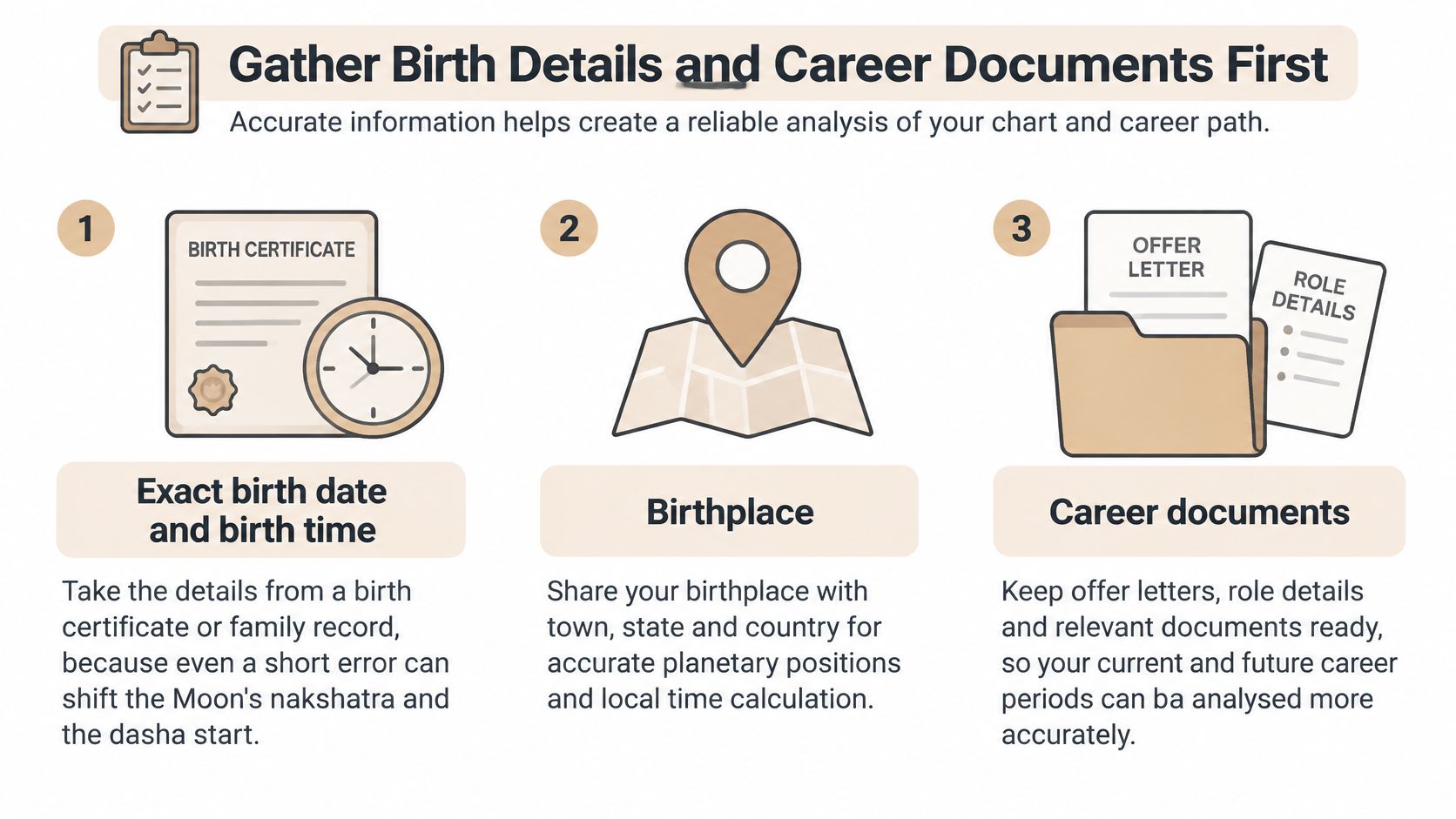
The following checklist brings those details together.
Details worth having ready
- Birth date and time: A birth certificate or family record is preferable to a guess. Even a short error can change the calculated timing balance, particularly near a nakshatra boundary. An uncertain time should be labelled uncertain.
- Birthplace: Town, state and country help identify the correct location for the chart calculation.
- Current employment: Job title, employer type, time in the role and monthly take-home pay establish the starting position.
- Written offer: Role, salary package, work location, joining date, notice requirements and any bond terms need checking.
- Decision and alternatives: The deadline matters, along with realistic options such as staying, negotiating or declining.
- Financial responsibilities: Savings expressed in months of essential expenses, dependants and loans show how much risk is manageable.
- Skills and qualifications: Certifications, recent projects and relevant experience make the career discussion concrete.
Make the question easy to answer
The main question should fit into a sentence, such as whether accepting an overseas role fits the person's career priorities and financial responsibilities. The offer letter should remain available during the call, with confidential identifiers hidden. Earlier readings and what happened afterwards can also help prevent selective recollection.
A careful astrologer verifies the inputs before interpreting the individual birth chart. The calculation's precision depends on those details, although precise inputs don't establish predictive accuracy.
A critical examination of Indian astrology in Skeptical Inquirer provides a useful reason to keep interpretation separate from independently checked career information. A written summary should identify uncertainties rather than disguise them as certainty.
What to Expect in the Session
Kismo connects users with verified astrologers for personalised chat or call sessions. The person booking should check the profile's language options and the displayed price beforehand, then choose the format that suits the discussion.
At the start, the astrologer should confirm the birth details, identify the decision and establish its deadline. The conversation can then move from chart themes to alternative timing windows, rather than ending with a single verdict.
Signs of a careful session
- Clear distinctions: Astrological interpretation is labelled separately from information requiring verification, such as offer terms, visa requirements or customer demand.
- A usable record: Notes or a written chat summary preserve the reasoning, suggested windows and caveats.
- Limited disclosure: Only relevant birth details and career facts are needed. Bank passwords, card details and identity numbers should remain private.
A useful reading leaves room for questions, disagreement and an unhurried decision.
Fear-based predictions, guaranteed outcomes and pressure to purchase urgent remedies are reasons to pause or end the session. The client doesn't need to accept an additional service because it is presented during a reading.
Questions That Get Useful Answers
Useful questions connect an interpretation to a decision that can be made. A discussion about professional themes becomes more valuable when the astrologer also identifies what needs checking outside the chart.
A chart-and-calendar discussion can help organise those questions.

Job offers and promotion decisions
The discussion should distinguish accepting an opportunity from predicting success in it.
- Signing window: Which period is interpreted as supportive within the employer's actual deadline?
- Stability: Does the interpretation suggest consolidation or a review point within the coming year?
- Priorities: Which themes deserve attention, such as learning, location, team responsibilities or salary growth?
Each answer should finish with an action for the next thirty days, such as clarifying reporting lines or negotiating the joining date. A favourable interpretation doesn't replace a written offer.
Relocation and business launches
For relocation, useful questions concern periods associated with settling abroad and whether timing can accommodate an existing family or visa commitment. The practical action might be confirming immigration eligibility and preparing a location-specific household budget.
For a business launch, the question is whether the current period is interpreted as suitable for planning, a limited trial or a fuller commitment. Registration dates can be discussed, but a paid pilot and supplier checks may be more urgent than selecting a ceremonial beginning.
The accompanying video offers another format for considering the consultation conversation.
Unstable income and mixed employment
Career planning also needs to accommodate freelancers, gig workers and people combining a salary with independent work. The Economic Survey 2025–26, summarised by the Press Information Bureau, reported that gig workers represented more than 2% of India's workforce.
Questions should therefore include whether salaried employment can continue during a business trial, which income stream merits attention and what financial conditions must be met before resignation. A chart-based suggestion about caution can prompt a cash-flow review, but the required cushion must come from actual expenses, debt, dependants and insurance needs.
Binary questions about becoming rich or succeeding rarely produce a workable plan. An astrologer can discuss timing and themes but can't confirm customer demand, future earnings, or visa approval.
How to Read Timing Advice Without Over-Trusting It
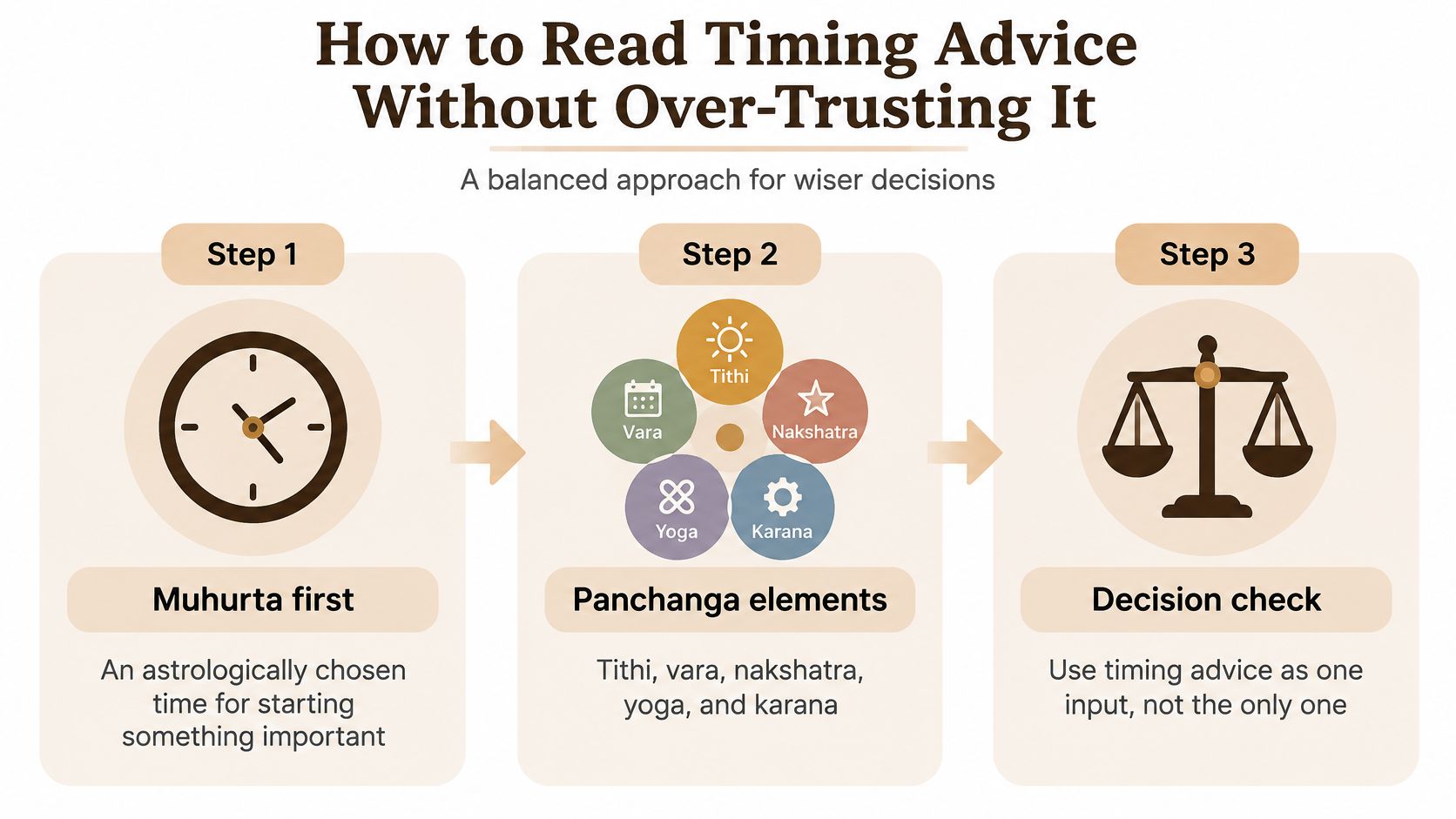
Muhurta selection traditionally considers the Panchanga, a calendar framework with five elements: tithi, the lunar day; vara, the weekday; nakshatra; yoga, a calculated Sun–Moon combination; and karana, a subdivision of a lunar day.
DeKho Panchang's muhurta guide describes a preference for the waxing lunar half and explains that marriage-related traditions commonly avoid the 4th, 9th and 14th tithis, called Rikta, or empty. Those marriage conventions shouldn't automatically become universal rules for employment or business activities.
The practical distinction is between a selected date and the decision itself.
Turn timing language into a test
Advice commonly arrives as a supportive or cautious window, a recommended or avoidable date, or a general warning. The examples below are practical experiments, not validated astrological thresholds.
Timing advice, test to run and evidence that should override it
| Advice type | Test to run | Evidence that should override the chart |
|---|---|---|
| Supportive period for a job change | For example, apply to two or three suitable roles and track interview invitations | Interview rates, offer terms, notice period |
| Favourable window for a business launch | For example, run a small pilot with about ten real customers | Demand signals, cash runway in months |
| Cautious period for relocation | Seek a decision extension where possible and check visa and housing costs | Visa status, rent, a confirmed job abroad |
| Recommended muhurta for registration | Use the date only if paperwork and fees are ready | Legal deadlines, fees, filing rules |
| Financially stuck period | For example, cut one fixed cost and track monthly cash flow for 60 days | Bank statements, emergency fund months |
A warning is a reason to check facts, not a reason to panic or abandon a worthwhile opportunity. Waiting can also carry costs, including losing an offer or missing a filing deadline.
Someone reviewing planetary transits should ask how the astrologer relates current movements to the individual chart, rather than assuming a general forecast applies personally. A careful explanation also accounts for the event, location and local time.
Decision safeguard: A preferred date should fit a viable plan. It shouldn't make an unviable plan seem safe.
Turn One Reading Into a 90-Day Test Plan
A reading about communication skills becomes useful only when someone tests that theme through actual work. Completing a presentation, building a portfolio or speaking with a hiring manager provides evidence that an interpretation alone cannot supply.
Deloitte's 2025 survey of 809 Indian Gen Z and millennial professionals, reported by IBEF, found that 94% of Gen Z respondents and 97% of millennials valued hands-on experience over classroom theory; roughly half wanted active mentorship but reported receiving substantially less support. Those preferences support a practical emphasis on projects and informed feedback, rather than another prediction.
Build a test around a real decision
- Choose the decision. The plan might concern moving from customer support into operations, testing freelance design or evaluating an overseas role. It shouldn't attempt to solve every career concern simultaneously.
- Write the baseline. Current role or income, target role, minimum acceptable salary and preferred location provide clear boundaries. Non-negotiable family responsibilities belong alongside them.
- Select a skill gap. As a worked example, a candidate could identify three gaps, then spend the first thirty days addressing one through a short course and a portfolio project. Completing the course matters less than demonstrating the skill.
- Seek informed feedback. A mentor or experienced professional can explain what hiring managers currently expect. Useful questions concern which skills matter most for hiring in 2026 and what evidence would make a portfolio credible.
- Define the review decision. Before starting, the candidate records what would justify continuing, adjusting or stopping. Positive recruiter feedback may support continuing; repeated concerns about missing qualifications may justify retraining.
- Name evidence that changes the plan. For example, no callbacks after ten well-matched applications could trigger a CV review, not an automatic conclusion that the period is unfavourable.
Keep the experiment reversible
A person exploring entrepreneurship might retain salaried work while testing a paid service. Someone considering a new field could complete a small project before paying for substantial retraining.
The test succeeds when it improves the decision, even if the person rejects the original interpretation. Evidence that contradicts the chart is useful information, not a personal failure.
Follow Up at 30, 90 and 180 Days
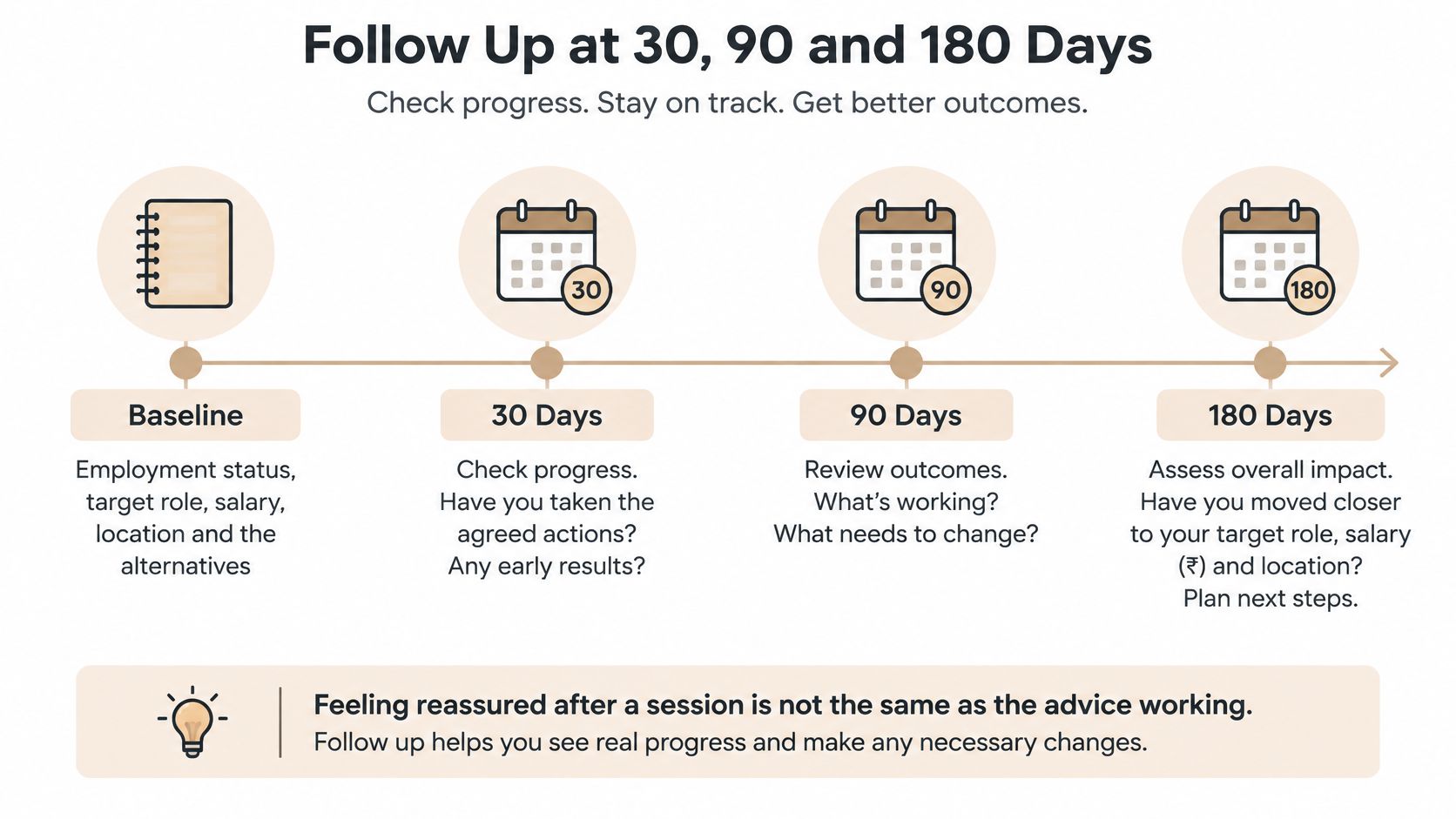
Feeling reassured isn't the same as achieving a career outcome. Before the session, the client should record employment status, target role, salary, location and available alternatives, then define what success would mean.
The National Career Service had recorded more than 55 lakh online and offline career-guidance sessions by January 2026, according to the Press Information Bureau. That figure measures service volume, not proof that a particular advisory method improves employment outcomes.
A dated record helps distinguish activity, results and hindsight.
Compare progress with the starting position
Follow-up checkpoints and what to record
| Checkpoint | What to record | Decision it informs |
|---|---|---|
| Before the session | Employment status, target role, salary, location, alternatives | Whether the reading answered the question asked |
| Day 30 | Applications sent, skill progress, mentor replies | Continue, adjust or pause the test |
| Day 90 | Interview progression, offers, salary movement, business revenue | Commit, pivot or extend the plan |
| Day 180 | Confirmed outcome, and whether advice was followed or ignored | Whether another reading is worth booking |
At the early checkpoint, effort and feedback matter more than a final outcome. Later reviews can assess whether interviews progressed, an offer became employment or a business attracted paying customers.
Record implementation separately
Each recommendation should be marked as followed, partly followed or ignored, with a short explanation. Keeping those categories separate prevents an untested suggestion from being counted as successful advice.
Even a favourable result doesn't establish that astrology caused it. Hiring conditions, personal effort, professional contacts and family support may all contribute, while differences between implemented and ignored advice can reflect which suggestions were easier to act on.
A useful review records unsuccessful attempts too. Otherwise, memorable successes can overshadow the rest of the experience.
Save the Reading and Book Only When Needed
The session record belongs in a dated folder alongside relevant career documents. Within a day, a short note can capture the original question, suggested window, reasoning and caveats, with chat notes saved under the same date.
The note should preserve what was said rather than a revised version shaped by later events. Keeping the original wording makes comparison with progress records more meaningful.
Reasons for a follow-up
- A new alternative: Another job offer changes the choice.
- A changed constraint: An extended deadline or visa outcome changes what is possible.
- A revised business plan: New costs, partners or customer feedback create a different decision.
Repeated sessions about an unchanged question can add confusion rather than clarity. Before accepting a remedy, additional fee or urgent payment, the client should request the explanation and full cost in writing, with time to consider it.
Chart-based guidance depends on the person's individual birth chart and the reliability of its inputs. No career astrology consultation guarantees a result, and a saved reading should remain a reference, not an obligation.
For readers considering a career discussion, Kismo offers personalised birth-chart guidance through chat or calls with verified astrologers. A focused question about a job switch, relocation or business launch can provide a useful starting point, followed by practical checks and a documented test plan.