Scorpio in Kannada Rashi: Vrishchika Sign Explained
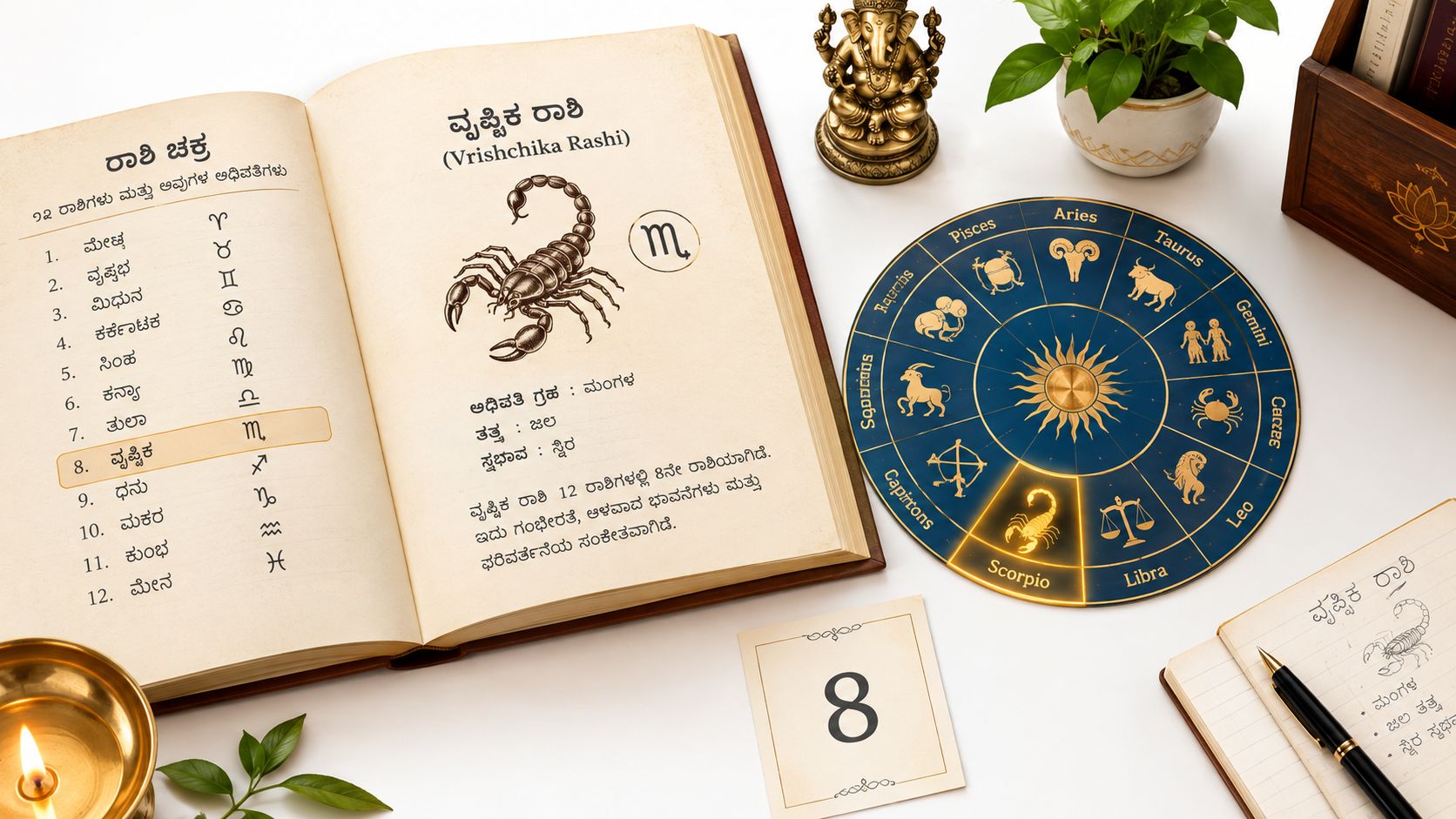
Scorpio in Kannada Rashi is called Vrishchika Rashi (ವೃಶ್ಚಿಕ ರಾಶಿ), the eighth sign of the Vedic sidereal zodiac, ruled by Mars. So why does a November birthday sometimes produce a different rashi in a Kannada horoscope than the Scorpio label shown on a Western website? That mismatch confuses many first-time readers, yet it's not a mistake. It usually means two different systems are using two different starting points, and often two different planets, to decide the sign.
Table of Contents
- What Scorpio in Kannada Rashi Actually Means
- How Vrishchika Rashi Works in a Vedic Birth Chart
- The Nakshatras That Shape Vrishchika Rashi
- Vrishchika Rashi Traits and Career Tendencies
- Marriage Compatibility and Kundli Matching for Vrishchika
- Vrishchika Rashi in Kannada Festivals and Muhurta
- Reading Beyond Your Rashi With a Full Birth Chart
What Scorpio in Kannada Rashi Actually Means
A matrimonial profile may say Vrishchika Rashi (ವೃಶ್ಚಿಕ ರಾಶಿ) while a Western app says Scorpio, and both labels can point to different chart inputs. In Kannada astrological use, Vrishchika is the eighth of the 12 sidereal signs, linked with Mars and commonly tied to the Moon placed in that sign at birth; the explanation of Scorpio and its Kannada identification also gives the familiar contrast between the tropical Scorpio period near 23 October to 21 November and the sidereal solar period near 16 November to 15 December.
Why the Dates Look Different
The two zodiacs start from different reference points. Western listings usually ask where the Sun was by tropical reckoning on the birthday. A Kannada janma rashi usually asks where the Moon was by sidereal reckoning at the exact birth time. So an early November baby can carry a Scorpio label abroad and still have a different Moon sign, or a different sidereal Sun, at home.
The birthday alone doesn't settle a Kannada rashi. The chart first asks where the Moon stood at birth.
What Kannada Families Usually Mean by Rashi
In everyday speech, rashi often means the Moon sign used for names, matching talk, festival notes, and panchanga, the traditional almanac, references. Kartika is associated with the Vrischika to Dhanus transition, which is why sign conversations often surface as that season approaches.
For a first-time reader, treat Scorpio as the English label and Vrishchika as the Kannada Vedic label, then ask one question: Sun, Moon, or ascendant? That small check keeps trait reading, compatibility talk, and yearly prediction separate until the full chart confirms the input.
How Vrishchika Rashi Works in a Vedic Birth Chart
What does Vrishchika do inside a kundli, or birth chart? The chart freezes the sky at the moment of birth and records which planets stood inside each sign. Vrishchika itself runs from 210°00′ to 240°00′ of sidereal longitude, carries a fixed, or sthira, water nature, and answers to Mars, or Mangala, as set out in the technical definition of Vrishchika Rashi. Each label becomes a working tool the moment a planet lands inside the sign.
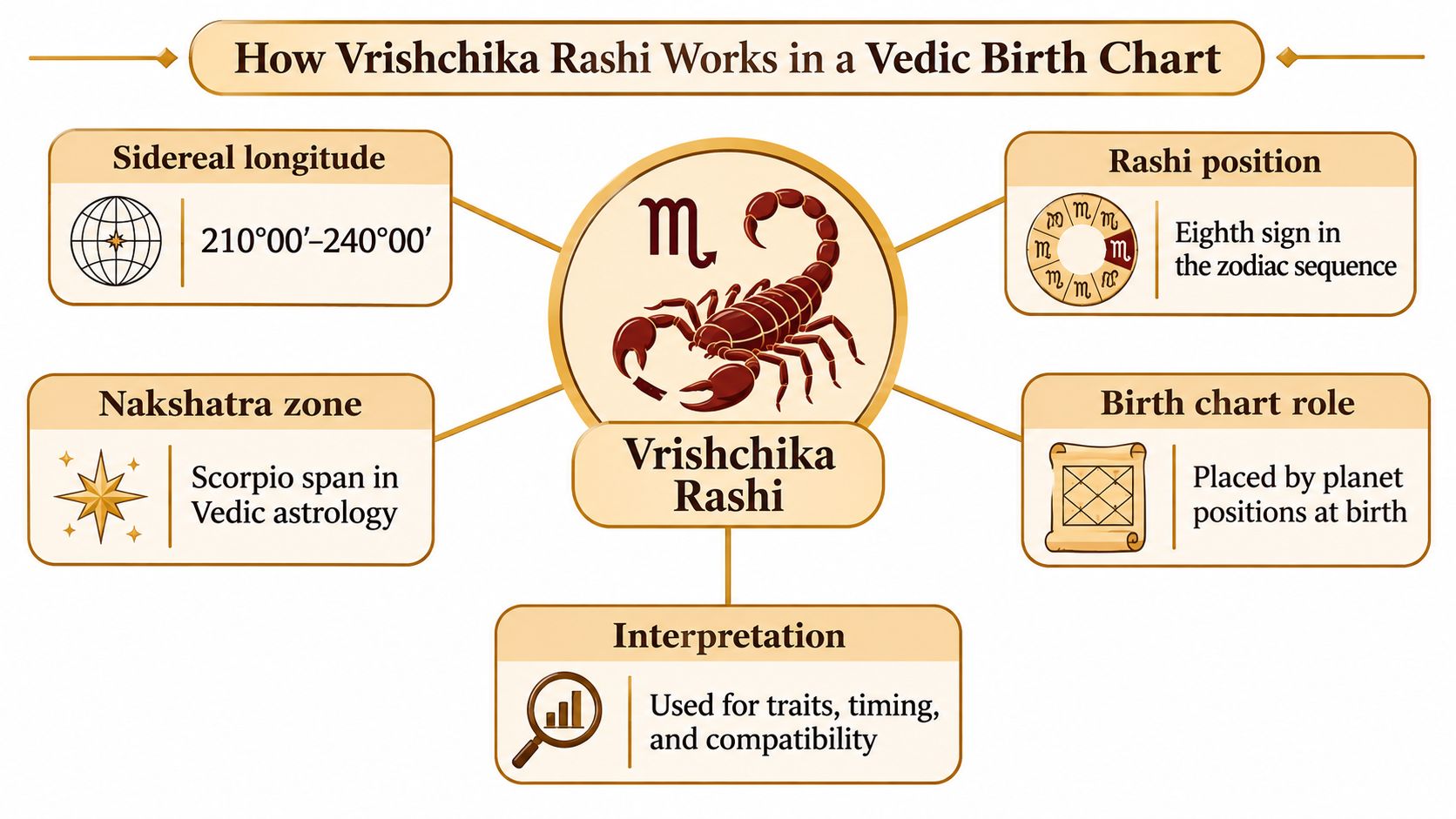
The zodiac works as a circle of equal rāśis, and Vrishchika is one sector of that circle. A sign acts like the lighting in a room. Any planet placed inside Vrishchika gets read through its fixed, watery quality, while the house that planet occupies decides which part of life receives it.
Three Different Things People Call Scorpio
Readers moving between Western and Kannada horoscopes often use one word, Scorpio, for three separate chart points. Separating them removes most of the confusion a beginner meets.
- Janma Rashi, the Moon sign: the sign the Moon occupied at birth. This is the rashi behind most Kannada predictions and daily readings.
- Lagna, the ascendant: the sign rising on the eastern horizon at birth. It fixes the house layout, so it decides how every other placement gets organised.
- Sun sign: the sign the Sun occupied. Western newspaper columns rely on this point, while a Vedic reader treats it as one placement among several.
A single chart can hold three different answers at once. The Moon may sit in Vrishchika while the lagna and the Sun fall in other signs. Each placement answers a different question: the Moon sign speaks to emotional habits and rashi predictions, the lagna organises the houses, and the Sun gains weight when it occupies a key house or runs a relevant period.
Why Birth Details Change the Answer
The sidereal zodiac sits offset from the tropical one, which produced the roughly three-week gap described above. That same offset means a Western date list cannot reliably confirm a Kannada rashi. The remedy is precise input: birth date, exact birth time, and birthplace.
Each detail does a different job. Birthplace fixes the lagna, because the rising sign depends on where the eastern horizon stood. Birth time matters on two counts. The Moon moves through degrees during a single day, and the lagna can change signs inside a shorter window than the Moon does.
Practical rule: if a reading says Vrishchika without naming Moon, lagna, or Sun, the reader still doesn't know which Scorpio is meant.
Mars completes the picture. Since Mars rules Vrishchika, its house placement, dignity, aspects, conjunctions, and operating dasha, a planetary period, decide much of how the sign behaves when it holds the Moon, the lagna, or a major planet. Two people can share the same Vrishchika Moon and still hear very different readings, because a well-placed Mars and a pressured Mars tell different stories inside the same sign.
The Nakshatras That Shape Vrishchika Rashi
A rashi name works like a surname: it places a person in a broad family, yet it can't identify the individual. The finer layer is the nakshatra, a lunar star division that sits inside each sign and helps explain why two Vrishchika people can receive noticeably different readings. As noted earlier, the zodiac carries 27 nakshatras spread across the 12 signs, so each sign holds a little more than two nakshatras on average.
Every nakshatra divides into four padas, or quarters, and each quarter covers an equal slice of the sky. Vrishchika holds the tail of one nakshatra and then two complete ones, which surprises many first-time chart readers who expect clean boundaries.
Nakshatra Segments Inside Vrishchika Rashi
| Nakshatra | Pada Coverage | Degree Span in Vrishchika |
|---|---|---|
| Vishakha | Pada 4 only | 0°00′ to 3°20′ |
| Anuradha | Padas 1 to 4 | 3°20′ to 16°40′ |
| Jyeshtha | Padas 1 to 4 | 16°40′ to 30°00′ |
These lines describe chart mechanics: where each nakshatra begins and ends inside the sign. The Scorpio portion of Vishakha is only its final pada, while Anuradha and Jyeshtha each run through all four padas within Vrishchika. The Moon's exact degree at birth decides which segment it occupies.
Why Two Vrishchika Moons Can Differ
Take two people, both born with the Moon in Vrishchika. One Moon sits early in Vishakha pada 4; the other sits late in Jyeshtha. The rashi name on paper is identical. Yet the nakshatra, the pada, and the starting dasha can all differ, so a careful astrologer won't hand them the same marriage or career reading.
Anuradha covers 13°20′ of the sign, Jyeshtha takes the final 13°20′, and the opening 3°20′ belongs to Vishakha, as shown in the nakshatra mapping for Scorpio. That internal map gives readers a sharp question for any prediction that sounds too broad: which nakshatra is the Moon in?
Birth time matters even more at this finer level. A small correction can shift the Moon's degree and move it across a pada boundary, changing the nakshatra recorded in the chart. When the Moon sits within a degree of a boundary, a difference of a few minutes can redraw the details later used for matching.
For everyday use, the sign gives the family resemblance and the nakshatra gives the fingerprint. A Kannada reading becomes genuinely personal when both are named together, rather than stopping at Vrishchika alone.
Vrishchika Rashi Traits and Career Tendencies
A young reader in Mangalore once told her jyotishi that her rashi page made her sound like a villain: intense, secretive, suspicious. His reply was simple. A rashi describes habits of the inner layer, the Moon's territory, not a verdict on the person. Kannada and English rashi pages commonly describe Vrishchika as intense, private, loyal, and suspicious, and link it with research, investigation, medicine, defence, or strategy, wording that appears often in traditional discussions of this sign. Those words only become useful when translated into ordinary behaviour.
In an office, intensity may look like quiet focus. A Vrishchika Moon person may not speak first in a meeting, but tends to notice the missing figure in a report, the unclear promise in an email, or the risk nobody else has named. The fixed water quality is often read as feeling strongly while holding a position steadily, which suits long projects that demand patience and discretion.
One caution matters before any of this applies. A person who identifies as a Western Scorpio by Sun sign may not have a Vrishchika Moon at all, so a trait list can describe someone else's chart entirely.
How the Traits Show Up in Daily Life
Privacy doesn't always mean secrecy for its own sake. It can mean sharing personal news only after a decision feels settled, such as telling close family about a job change after the offer letter arrives rather than while interviews are still uncertain. Friends who understand that pattern usually don't take the silence personally.
Loyalty often appears in small, consistent acts. Remembering a parent's medical appointment. Defending a sibling during a family disagreement. Staying in contact with an old friend long after a wider group has drifted apart. Strong memory supports that loyalty, although it can also make old hurts harder to forget.
Suspicion needs gentle handling. At its best, it works like careful verification: checking documents before signing, asking who else has access to shared money, reading the terms of a property agreement twice. At its difficult end, the same habit becomes reluctance to trust even after enough evidence is available.
A trait is a tendency in one layer of the chart, not a verdict on character.
Career Leanings Linked With Mars and Fixed Water
Career discussions often connect Vrishchika with work that rewards depth, stamina, and controlled courage. Research suits the probing style because useful answers sit under layers of data. Medicine can suit the same focus, especially where diagnosis, careful observation, and calm action under pressure matter.
Investigation, defence, audit, quality testing, cybersecurity, and strategy roles also fit the traditional picture, since these fields value privacy, pattern spotting, and the ability to wait for the right moment. A Vrishchika lagna person in a strategy team may prefer presenting a complete plan rather than sharing half-formed ideas every day.
The rashi alone cannot settle a career question, though. Education, family circumstances, skills, the tenth house, its lord, and the running dasha all shape direction. A teacher, artist, farmer, or software designer with Vrishchika placements may express the same intensity through mastery of a subject, emotional honesty, or careful protection of students and clients.
Mars deserves a close look before any conclusion. Its placement shows where drive is applied, while its condition colours confidence, patience, and response to conflict. Two people with the same Moon sign may choose very different work, or do similar work in very different styles.
Marriage Compatibility and Kundli Matching for Vrishchika
Marriage questions bring many Kannada families to a rashi page. A common question sounds simple: both partners are Vrishchika, so is the match good? The honest answer is that the information isn't enough yet.
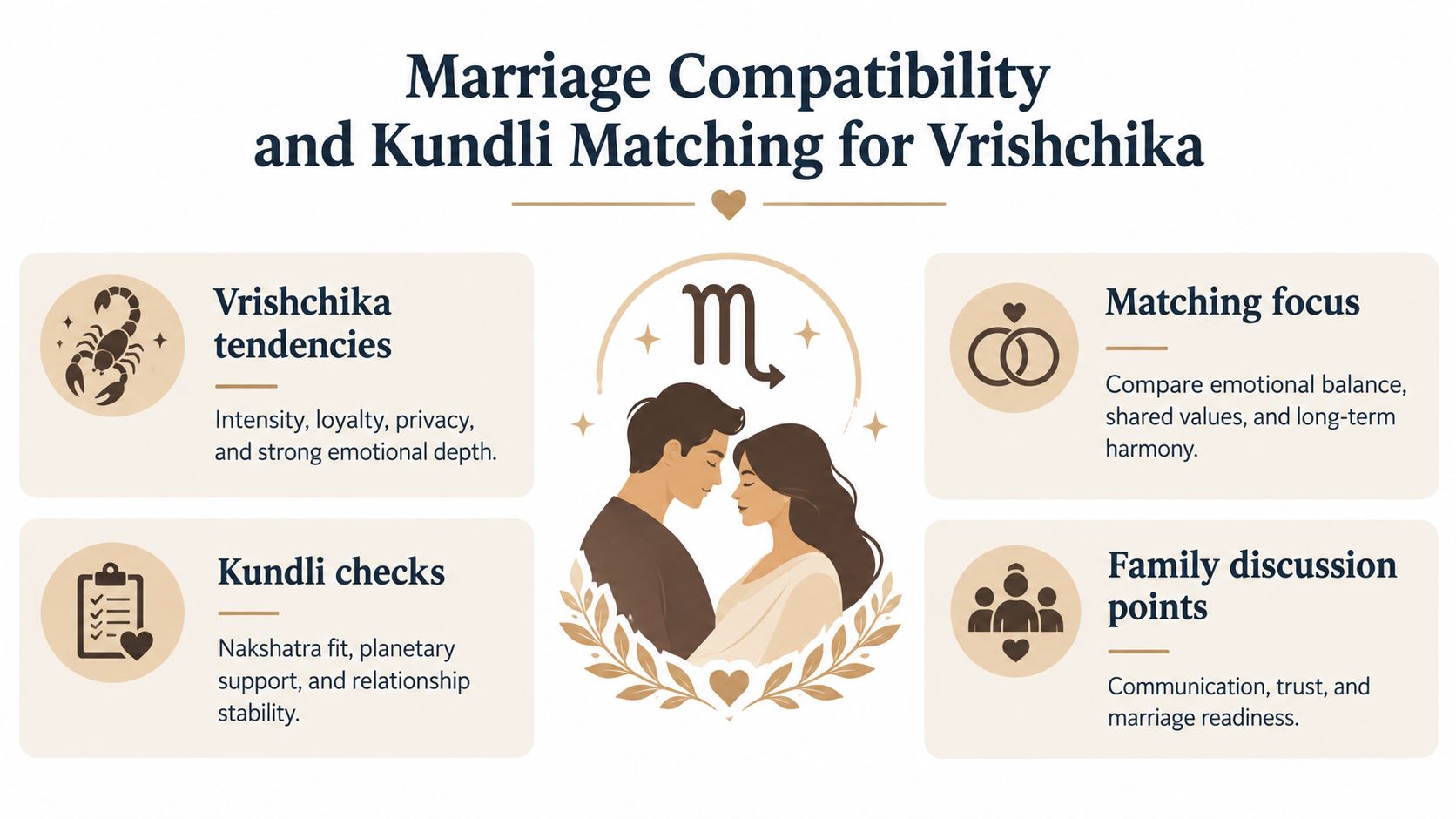
At sign level, Vrishchika is often discussed in terms of loyalty, privacy, emotional depth, and strong attachment. Two such partners may understand each other's need for trust and personal space. They may also need extra care around jealousy, unspoken expectations, and the habit of waiting too long before discussing a hurt.
There is a subtler problem to clear up first. If one partner's "Vrishchika" came from a Western Sun sign and the other's came from a Moon sign in a Kannada horoscope, the two labels may not describe the same chart factor at all. Traditional matching works from the Moon sign and its nakshatra, so the input has to be confirmed before any score means anything.
What Rashi-Only Matching Misses
As noted earlier, rashi alone is insufficient for judging a match. Moon nakshatra, Gana, Bhakoot, Graha Maitri, Venus, the seventh-house lord, and Manglik status can all change the interpretation. Each factor examines a different part of the relationship picture.
- Moon nakshatra: Adds a finer comparison than the Moon sign and is central to many traditional matching points.
- Gana, Bhakoot, and Graha Maitri: These matching components compare temperament, sign relationship, and planetary friendship within the chosen system.
- Venus and the seventh-house lord: These help the astrologer discuss attraction, partnership patterns, and relationship responsibilities in each individual chart.
- Manglik status: This is checked in context rather than treated as a frightening label, because placement and cancellations can matter.
A proper detailed kundli matching comparison reads both charts together. It doesn't reduce either person to one sign, and it shouldn't turn a score into a final order about whether a marriage must happen or must not happen.
Questions Worth Asking Before Accepting a Match Result
Families can ask whether each person's Vrishchika label comes from the Moon sign, lagna, or Sun sign. They can also ask whether both birth times were verified, whether the nakshatras were scored, and whether any difficult factor was checked for exceptions or balancing placements.
Those questions protect against false certainty. An imperfect sign-level result isn't a doom prediction, and a pleasing score isn't a guarantee of happiness. Communication, health, finances, family expectations, and mutual respect remain real-life parts of the decision.
Vrishchika Rashi in Kannada Festivals and Muhurta
A family may see Vrishchika in a Kannada panchanga and ask whether the whole month is favourable. The better question is more specific: favourable for whom, for which activity, and according to which chart placement? Muhurta means choosing an auspicious time, and that choice uses several calendar factors together.
The panchanga may consider tithi, or lunar day, the nakshatra active that day, yoga, weekday, local sunrise, and the nature of the event. Birth details can matter too, but first the astrologer needs to know whether a person's Vrishchika label comes from the Moon sign, lagna, Sun sign, or another planet. This explains why a Kannada horoscope can disagree with a Western Scorpio horoscope. They may be describing different placements.
One Ritual Example Shows the Method
An official explanation of Ghatasthapana specifies Pratipada tithi, the first lunar day, and recommends the ritual during the first one-third of the day, with Abhijit Muhurta named as an alternative when that period cannot be used, as described in the Maharashtra Tourism guidance for Ghatasthapana. The same official guidance also identifies Chitra nakshatra and Vaidhṛti yoga as conditions to avoid for that ritual.
This example makes the method easier to understand. A date is judged through the combination of lunar day, nakshatra, yoga, timing within the day, and ritual rules. Vrishchika by itself cannot answer whether a wedding, housewarming, vehicle purchase, registration, or business launch is well timed.
A useful muhurta question names the activity, place, date range, and people involved. A rashi name alone is too broad.
Applying That Idea to New Beginnings
For a wedding, the calendar may be read alongside both partners' charts. For a housewarming, the astrologer may also consider the family's charts, local custom, and whether the home is ready. For a registration or launch, the chosen time can be assessed with the founder's chart and the purpose of the work.
Planetary movement adds another timing layer, which is why readers often check current planet transits and their chart context before fixing a date. Transits help show which periods deserve closer examination, while the panchanga and birth chart supply the context.
This keeps the process calm. Vrishchika is one coordinate within a wider calendar and chart calculation, helping a beginning feel timely, orderly, and carefully chosen.
Reading Beyond Your Rashi With a Full Birth Chart
A clear mental model helps readers use Scorpio in Kannada Rashi information without over trusting it. Vrishchika gives the sign. The Moon, lagna, or Sun identifies which placement carries that sign. The nakshatra and pada add detail, Mars shows an important ruler to examine, houses show life areas, and dashas add timing.
That layered view answers the three questions many Kannada readers bring to an astrologer. Is the rashi based on the Moon or only on date of birth? Why does a Kannada horoscope differ from a Western Scorpio horoscope? Can two Vrishchika people receive different marriage or career guidance? Once the input is named, the answers become calmer and more logical.
A Simple Self Check Before Taking Advice
Readers can begin with practical housekeeping rather than prediction.
- Confirm the placement: Write down whether Vrishchika refers to the Moon sign, lagna, Sun sign, or another planet.
- Collect birth details: Keep the birth date, exact time, and birthplace together, and note the source of the time if it came from a hospital record, family book, or memory.
- Name the nakshatra: Record Vishakha, Anuradha, or Jyeshtha and the pada, because that detail matters for matching and dasha discussion.
- Match the question to the method: Use a sign description for general reflection, and use a full chart for marriage, career timing, relocation, or muhurta.
A complete personal kundli based on birth details lets those layers be read together. It can show whether Mars supports the Vrishchika placement, which houses are activated, and whether the present dasha makes a career or relationship question more urgent. None of that can be seen from a date range on a general horoscope page.
For readers who want that fuller conversation, Kismo (kismo.app) is one option where users can chat or call verified astrologers for personalised birth chart readings, kundli matching, career questions, and muhurta guidance. The useful part of such a session is not a dramatic prediction. It's the chance to ask which chart factors support a conclusion, which factors weaken it, and what practical choices remain open.
The rashi is best treated as a doorway. It gives the reader a name, a place in the zodiac, and a starting set of tendencies. The full birth chart is the room beyond it, with the Moon's degree, houses, planetary relationships, and timing periods arranged together.
No sign description decides a marriage, career, or future on its own. Used carefully, Vrishchika can help a person ask better questions about loyalty, privacy, drive, and trust. Used with a complete chart and sound judgement, it becomes a helpful language for reflection rather than a source of fear.
If the Vrishchika label still feels unclear, bring the exact birth date, time, and place to a personalised reading on Kismo, where verified astrologers can explain the Moon sign, lagna, nakshatra, and dasha together by chat or call. Use that full chart view for kundli matching, career timing, or muhurta decisions, and treat the rashi as the starting point rather than the whole answer.