Aaj Chand Kis Time Niklega: Moonrise Times in India

If India follows one clock, why can't the whole country share one moonrise time? That's the gap behind the search aaj chand kis time niklega. A single time zone doesn't mean a single horizon. The Moon crosses the eastern sky at a different clock time in each city, and that time also changes every date. A useful answer therefore needs three things together, the city, the date and a reliable local listing. The good news is that checking takes only a minute once the method is clear.
Table of Contents
- Find the Moonrise Time for Your City
- How to Read a Moonrise Listing
- Estimate Moonrise From the Moon Phase
- Why Moonrise Matters for Muhurta and Rituals
- What Changes Moonrise and Common Mistakes
- Confirm Your Moonrise Time Before You Plan
Find the Moonrise Time for Your City
Where will you be watching the Moon? That location determines which moonrise time to use. The India Meteorological Department's astronomical ephemeris lists moonrise and moonset for specific locations in Indian Standard Time (IST). Since IST is the same across India, the clock standard stays constant while the listed time changes with the city and date.
Where to Check Moonrise in Major Indian Cities
| City | Time Standard | Where to Check |
|---|---|---|
| New Delhi | IST | IMD astronomical ephemeris, New Delhi station |
| Mumbai | IST | IMD ephemeris or city almanac for Mumbai |
| Kolkata | IST | IMD ephemeris or city almanac for Kolkata |
| Chennai | IST | IMD ephemeris or city almanac for Chennai |
| Bengaluru | IST | City almanac or timeanddate city page |
| Hyderabad | IST | City almanac or timeanddate city page |
| Pune | IST | City almanac or timeanddate city page |
| Lucknow | IST | City almanac or IMD ephemeris for the nearest station |
| Indore | IST | City almanac or IMD ephemeris for the nearest station |
Use the row for the place where you will observe, rather than assuming a nearby city has the same time. If an exact city listing is unavailable, check the nearest station and treat its time as an estimate.
Three Steps to a Local Time
- Choose the city and date. Use the location where you plan to watch the Moon.
- Find a matching listing. Select the IMD station or city almanac for that place.
- Read the time in IST. Check whether the listing says “apparent moonrise,” which includes the effect of atmospheric refraction.
For a ritual or a photograph, use the closest available city-level listing. A broad estimate may differ from the time at your location.
How to Read a Moonrise Listing
A listing looks simple, but three small details cause most confusion, the 24 hour clock, the listing date and the word apparent. Take a value written as 20:11 IST. That means 8:11 PM. A value of 12:00 means noon, and 00:40 means 12:40 AM.
The date needs equal care. The date printed on the listing is the date of observation, so it should match today before any time is trusted. A time such as 00:40 belongs to the early hours of the date shown. It doesn't belong to the evening before, even though many people still feel that moment is part of the previous night.
Read One Line at a Time
- Find the city row. Don't borrow a row for a nearby large city if a closer station exists.
- Confirm the date. Check the day and month before reading across.
- Convert the clock. Turn the 24 hour value into AM or PM to avoid a twelve hour mistake.
- Place it in the day. Note whether moonrise falls before sunrise or after sunset, since that changes when and where to look.
Apparent means the listed time is when the Moon's upper edge appears, with atmospheric refraction included. Refraction bends light slightly, so the Moon can appear a little before a purely geometric calculation would suggest.
IST is the same across India, so readers inside India don't need any conversion. A reader in another country should convert from IST to local time before planning, otherwise a correct listing can still produce a wrong plan.
Estimate Moonrise From the Moon Phase
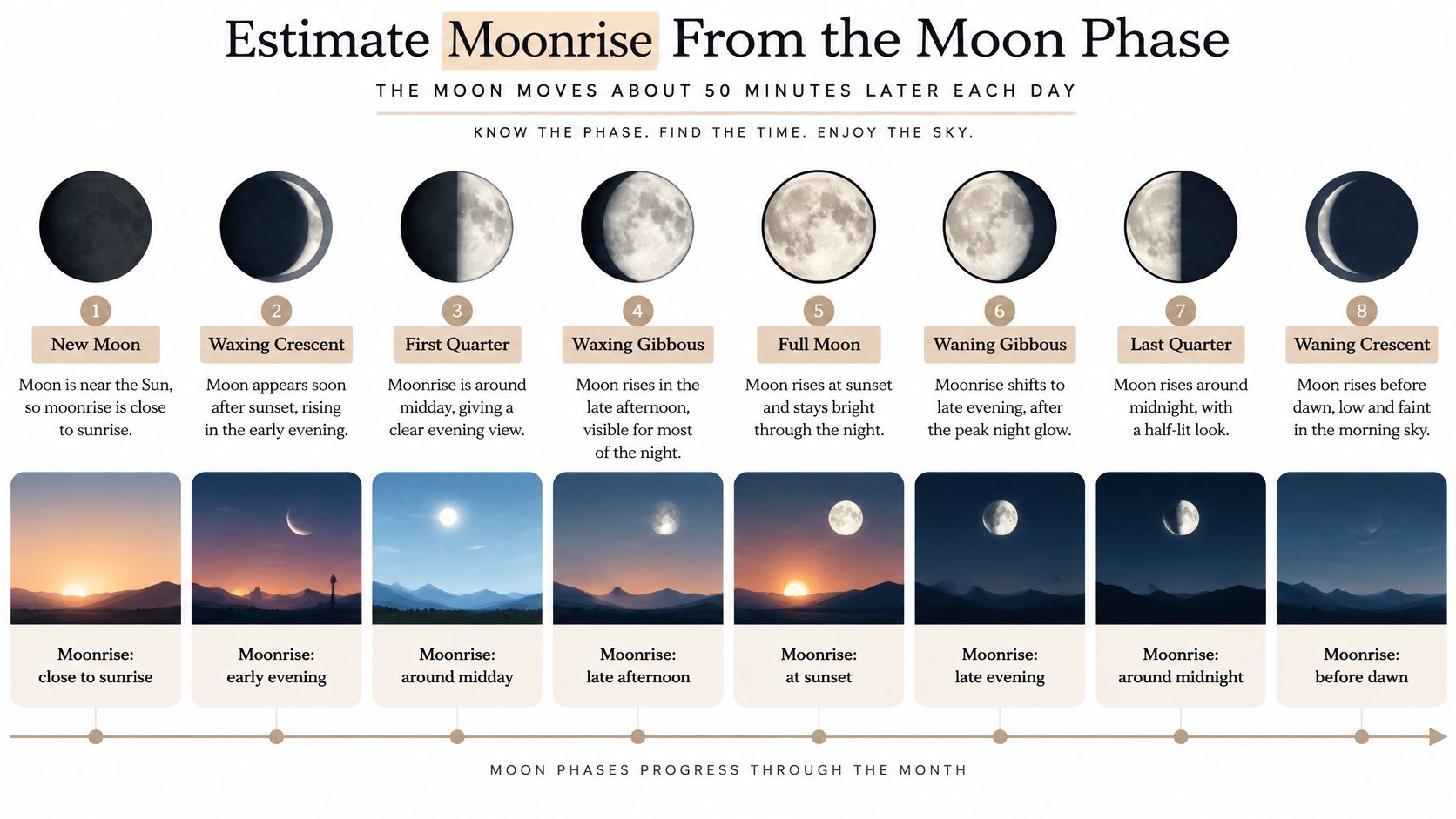
When no listing is at hand, the Moon phase gives a strong rough estimate because lunar elongation sets the Moon's position relative to the Sun. The timeanddate Indian subcontinent moon schedule shows a thin crescent with about 2.4% illumination rising at approximately 04:50, while earlier dates with substantially greater illumination had moonrise around midday or afternoon. Its azimuth indicates the compass direction of rise, and illumination estimates brightness.
Typical Moonrise Window for Each Moon Phase
| Moon Phase | Approximate Moonrise | What You Can See |
|---|---|---|
| New Moon | Around sunrise | Hard to see, because the moon is close to the sun |
| Waxing crescent | After sunrise, afternoon or early evening | Thin crescent seen in the evening sky |
| First quarter | Around noon | Visible in the afternoon, sets around midnight |
| Waxing gibbous | Afternoon to sunset | Bright moon in the early evening |
| Full Moon | Around sunset | Rises at dusk and stays up through the night |
| Waning gibbous | Late evening to midnight | Rises after dark |
| Last quarter | Around midnight | Visible in the late night and early morning |
| Waning crescent | Late night or before dawn | Visible in the pre-dawn sky |
The Moon moves eastward against the stars by roughly 13 degrees per day, so successive moonrises usually occur later by about 45 to 60 minutes, although the interval changes with latitude, season and lunar declination.
A practical estimate takes four short steps. Find today's phase, match it in the table, add about fifty minutes for each day since a known moonrise, then confirm with a city listing before any ritual. The panchang helps here because it lists the tithi, a lunar day. Thirty tithis make one lunar month, and each covers about twelve degrees of the Moon's distance from the Sun. Tithi fifteen in the bright half is usually the full Moon, and tithi thirty is usually the new Moon.
The phase gives a window, not an exact minute.
Why Moonrise Matters for Muhurta and Rituals
In Vedic astrology, also called Jyotish, the Moon helps build the traditional calendar. The tithi and the nakshatra, one of twenty seven lunar mansions dividing the zodiac, are both read from the Moon's position. A muhurta is an auspicious time chosen for a beginning, such as a wedding, a griha pravesh or housewarming, or a business launch.
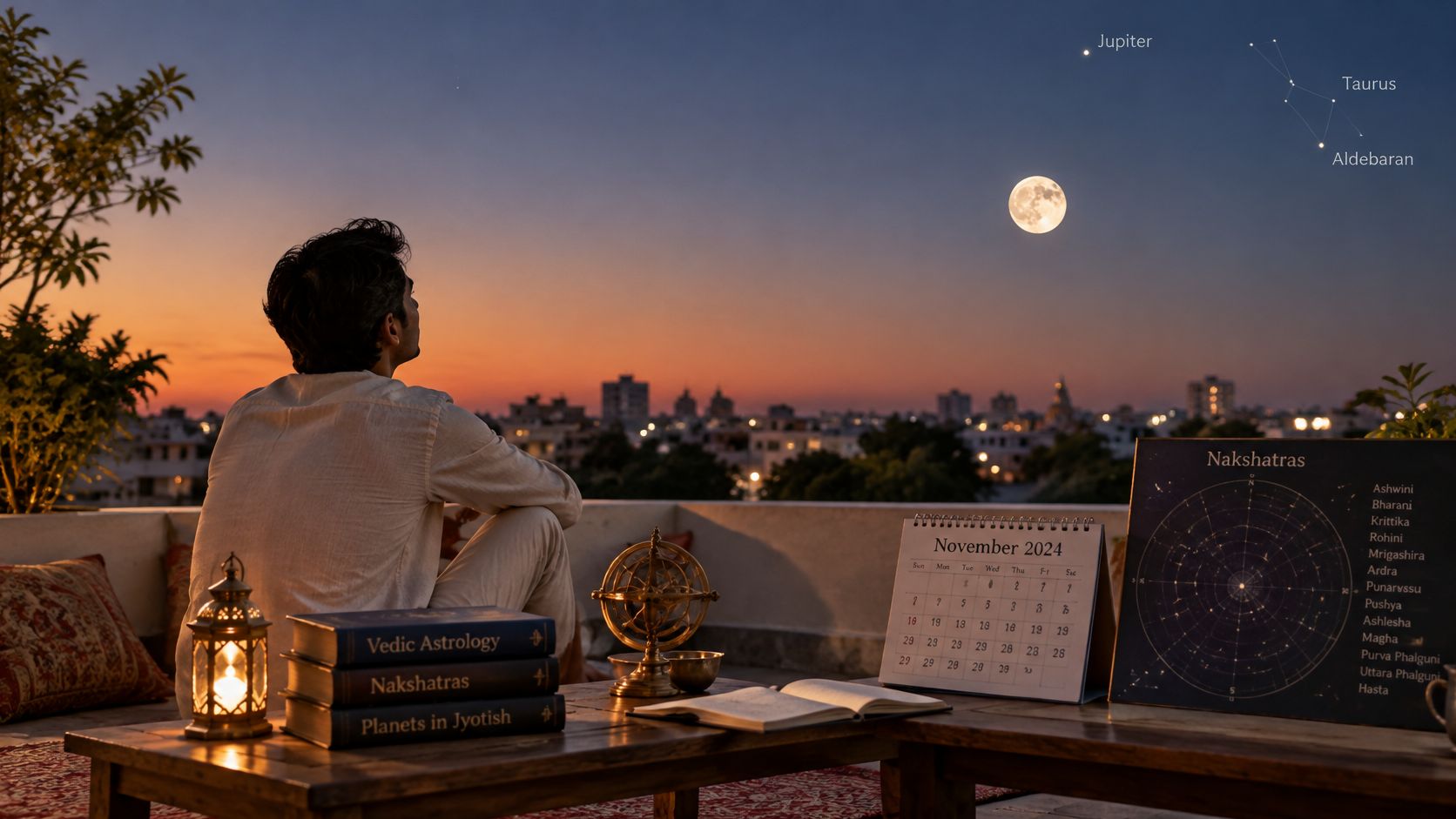
The Rashtriya Panchang published through the India Meteorological Department has been published since 1879 Saka, corresponding to 1957 to 58 CE, and provides calculated sunrise, sunset, moonrise and moonset timings for four Indian metropolitan cities. It also includes the Julian date, Kali Ahargana, the Moon's age, phases, tithis, nakshatras, yogas and planetary transit data, calculated using modern scientific principles.
Families often check moonrise for a fast that ends after the Moon is seen, such as Karva Chauth or Sankashti Chaturthi. Moonrise itself is the astronomical event. Its ritual meaning comes from the tradition a family follows.
Customs differ by region and family, so the local panchang and family priest remain the final authority. Readers who want personal timing help can speak with verified astrologers, while remembering that any useful answer should state the city, date and time zone. The sky gives the time, and tradition gives its meaning.
What Changes Moonrise and Common Mistakes
A city listing marks the approximate moment the lunar upper limb becomes visible above a mathematically modelled horizon. The timeanddate moonrise schedule notes that published Indian schedules use local time and account for refraction, so Mumbai, Delhi, Kolkata and Chennai predictions can differ even on the same date. Almanacs calculate the event using the Moon's changing right ascension and declination, Earth's rotation, atmospheric refraction and the observer's location.
Four Things That Move the Real Sighting
- Latitude and longitude. These set the clock time for each place, which is why one national answer can't work.
- Elevation. A higher viewpoint can reveal the horizon a little earlier than street level.
- Atmospheric refraction. Air bends moonlight and lifts the Moon's apparent position slightly.
- The local horizon. Buildings, hills, trees, haze and monsoon cloud can delay or hide the first sighting.
Say a tall building blocks the eastern sky from a balcony. The listed time can be correct, yet the Moon may not appear from that balcony until it has climbed above the building many minutes later. Moving to a rooftop or open ground removes that false delay.
Moonrise Mistakes, Results and Fixes
| Mistake | What Happens | Fix |
|---|---|---|
| Using another city's time | Off by several minutes or more | Use the listing for your own city |
| Mixing IST with UTC or a local clock | Time looks off by hours | Read every listing in IST |
| Assuming moonrise means visibility | Clouds, haze or buildings hide the moon | Find a clear eastern horizon and check the weather |
| Using the same time each day | Moonrise shifts about 45 to 60 minutes later per day | Check the exact date every day |
| Using an old printed table | Wrong date or month | Use the table for the current year |
Yesterday's time therefore isn't today's time. Readers following slower planetary movement alongside daily Moon timings can also check planet transits, but the daily moonrise still needs its own date specific check.
A calm routine: Choose a clear eastern horizon, arrive ten to fifteen minutes early, and let the sky confirm the listing.
Checking the eastern view on the previous day also helps, because obstacles are easier to spot in daylight. The listed time is the reliable guide, and the sky is the final test.
Confirm Your Moonrise Time Before You Plan
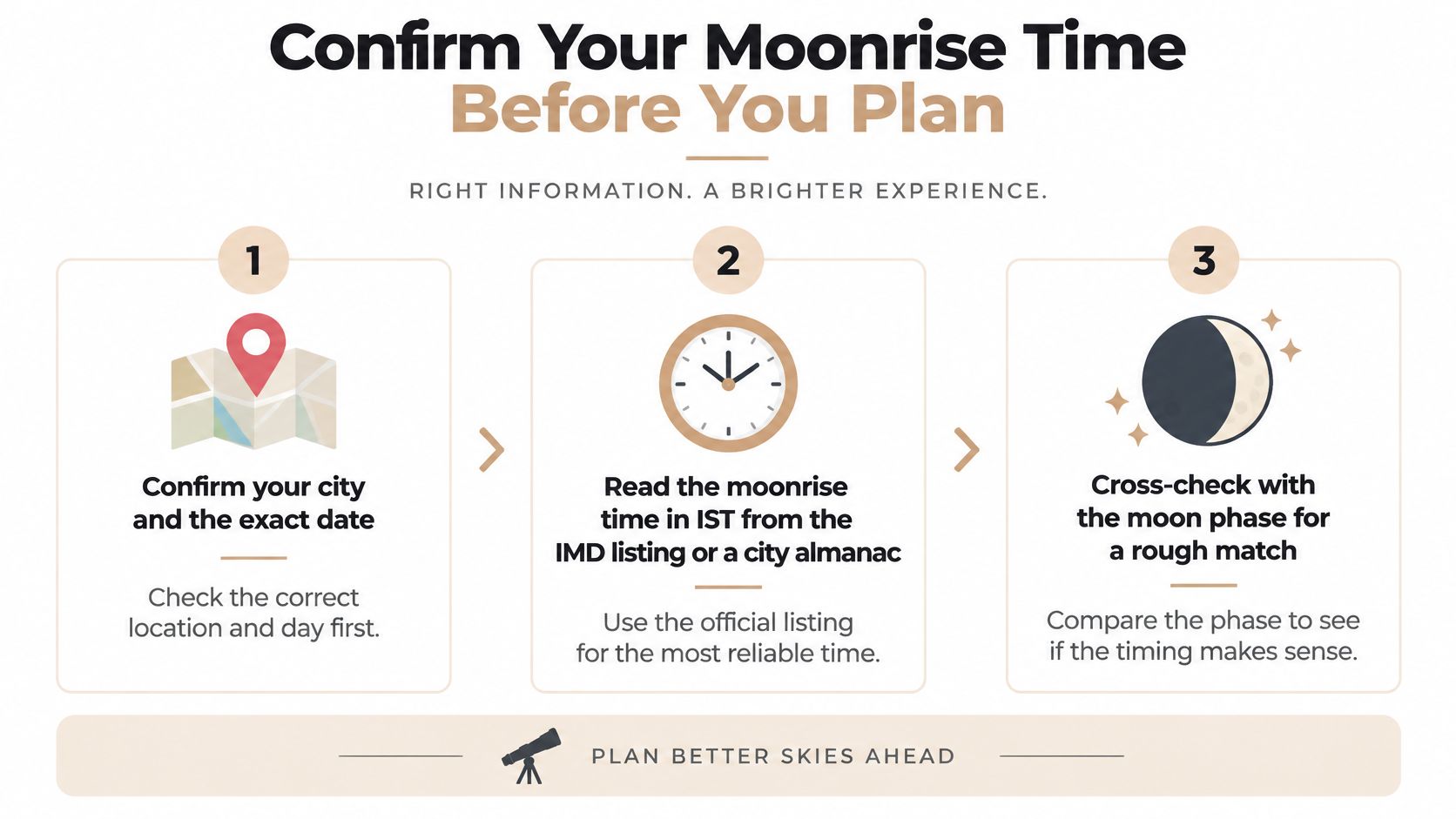
A short final check prevents most disappointment. It combines the official listing, a phase based sense check and a realistic viewing plan.
Final Checklist
- Confirm city and date. Use the actual viewing place and today's exact date.
- Read the time in IST. Use the IMD listing or a city almanac, not a forwarded message without a city name.
- Cross-check the phase. A full Moon near sunset or a waning crescent before dawn should broadly match the listing.
- Choose the horizon early. Pick a clear eastern view and arrive ten to fifteen minutes before the listed time.
- Check ritual practice. For a fast or festival, follow the local panchang and family custom for the place of observance.
- Plan bigger beginnings separately. A wedding, housewarming or launch date involves more than one evening's moonrise.
That last step is where a specialist can help. Through Kismo, the Timing and muhurta reading gives specific dates that work and dates to avoid, with the reasoning explained. Accurate guidance depends on the individual birth chart, so users must enter accurate birth date, time and place, because these are the input for every chart the astrologer prepares.
Simple free tools can support daily checking, while a personal reading suits a larger timing decision. Neither replaces the city listing for tonight's practical question. A moonrise time answers today's question, and a muhurta reading helps with the bigger decision.
For most daily needs, three things are enough, a checked local time, a small buffer and a clear view. That calm combination turns aaj chand kis time niklega from a repeated guess into a plan that can be trusted.
For readers planning a wedding, griha pravesh or another important beginning, Kismo connects them with verified astrologers by chat or call for personalised chart and muhurta guidance. Visit Kismo to enter accurate birth details, choose a suitable reading and select dates with clear reasoning rather than guesswork.