Lal Kitab Predictions: Houses, Planets and Meaning
Why do so many lists of Lal Kitab predictions recommend a remedy before explaining how the prediction was made? A colour, donation or household habit means little without the house rule behind it. A clearer starting point is the chart itself: which house is being read, which planet occupies it, and what the astrologer believes that combination suggests.
Table of Contents
- What Lal Kitab Predictions Actually Tell You
- How Fixed Houses Turn Planets into Predictions
- Nine Planets and the Labels in the Books
- Where Lal Kitab Parts Ways with Vedic Astrology
- Sample Readings for Career Marriage and Home
- How to Judge a Prediction and a Remedy
- Check Your Own Chart Before You Act
What Lal Kitab Predictions Actually Tell You
A Lal Kitab prediction is an interpretation built from planetary house rules, usually followed by a practical remedy, rather than a statement of fixed fate. It can offer a traditional way to reflect on a concern, but it can't make an outcome unavoidable.
Consider someone worried about a stalled career. A useful consultation begins by establishing the chart and interpreting the relevant placements, not by immediately prescribing an object to carry. The distinction matters because a general statement about authority or work isn't yet a personal forecast.
A tradition with a publication history
Lal Kitab is a twentieth-century astrological and palmistry tradition associated with Punjab, distinct from classical Sanskrit Jyotisha. According to Kundli Today's account of Lal Kitab, its core literature comprises five Urdu works, mainly attributed to Pandit Roop Chand Joshi, published in 1939, 1940, 1941, 1942 and 1952.
That sequence matters more than claims of mysterious antiquity. The books developed through revisions and expansion, so readers consulting different editions may encounter different wording or rules. Authorship and connections to older oral practices remain debated; treating the literature as a layered tradition is more careful than assuming a single, unchanging canon.
From a printed rule to personal guidance
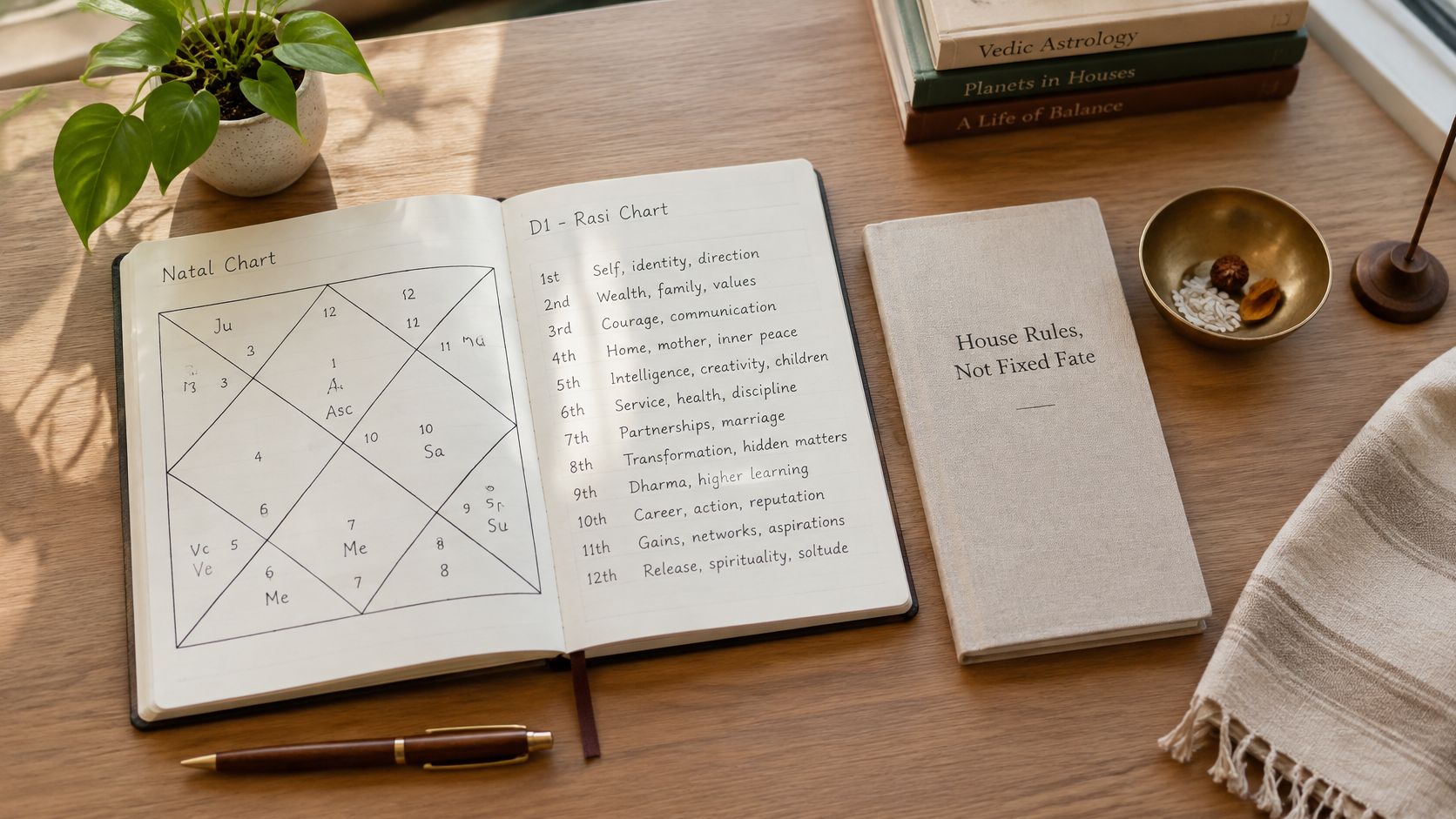
The traditional reading combines grahas, or astrological planets and points, with houses representing areas of life. An upay is a remedy associated with the interpretation, sometimes involving conduct, colour, food or a household object.
For a gentle, practical approach, an upay is best understood as a voluntary cultural habit, not a spell that forces events. Respectful behaviour may have value in itself, without establishing that a planetary mechanism caused the result.
Starting point: A printed planetary description becomes an individual interpretation only when the person's birth details and the chart-building method are applied.
A kundli, or birth chart, provides that individual context. Understanding the fixed-house map, distinguishing it from a Vedic chart, and testing examples against everyday decisions makes the reading easier to assess without surrendering personal judgement.
How Fixed Houses Turn Planets into Predictions
In the Lal Kitab convention described here, Aries is permanently associated with the first house, Taurus with the second, and the sequence continues to Pisces. The person's rising sign doesn't replace that fixed symbolic sequence.
The Astrodai specialist reference on Lal Kitab describes this house-centred approach and its emphasis on permanent-house symbolism, including the tenth-house association with Saturn. These associations are interpretive rules, not demonstrated physical mechanisms.
An important distinction prevents confusion: a permanent sign association isn't automatically an instruction to move every planet into a new house. The astrologer must explain how the birth chart's house placements were established and how Lal Kitab's fixed symbolism is being applied.
Fixed houses used in Lal Kitab predictions
| House | Permanent sign | Sign lord | Life theme in a prediction |
|---|---|---|---|
| 1 | Aries | Mars | Body, temperament, start of life |
| 2 | Taurus | Venus | Family, speech, stored money |
| 3 | Gemini | Mercury | Siblings, courage, short journeys |
| 4 | Cancer | Moon | Home, mother, property, peace of mind |
| 5 | Leo | Sun | Children, learning, creativity |
| 6 | Virgo | Mercury | Daily work, health routines, debts, rivals |
| 7 | Libra | Venus | Spouse, partnerships, public dealings |
| 8 | Scorpio | Mars | Sudden change, shared resources, longevity themes |
| 9 | Sagittarius | Jupiter | Luck, elders, long travel, dharma |
| 10 | Capricorn | Saturn | Career, authority, work, public status |
| 11 | Aquarius | Saturn | Gains, income, networks, aspirations |
| 12 | Pisces | Jupiter | Expenses, sleep, foreign stays, letting go |
Here, sign lord means the traditional ruler of the permanent sign. It doesn't mean that planet must occupy the house. Dharma refers broadly to duty, ethical purpose and a meaningful direction in life.
For example, the tenth house has a Saturn-associated framework even when another planet occupies it. The occupying planet supplies a symbolic role; the house supplies the area of life under discussion. Confusing the house's ruler with its occupant can produce an entirely different interpretation.
The reading sequence before any remedy
- Identify the occupant. The astrologer records which graha occupies the relevant house and checks the surrounding chart, rather than relying on a single isolated placement.
- Establish the fixed theme. Career, family money or partnership becomes the subject because of the house being interpreted, not merely because a planet has a familiar reputation.
- Explain any special classification. If the interpretation invokes a dormant planet, blindness or ancestral debt, the astrologer should identify the rule and explain its meaning plainly.
- Consider an upay only afterwards. The proposed action should have an understandable connection to the interpretation and remain safe, affordable and voluntary.
A career, property or marriage interpretation should name its house convention before offering advice.
This order makes a consultation easier to question. If a reader can't tell whether an astrologer is describing a house, its permanent sign or the planet placed there, the explanation needs clarification before a remedy is considered.
Nine Planets and the Labels in the Books
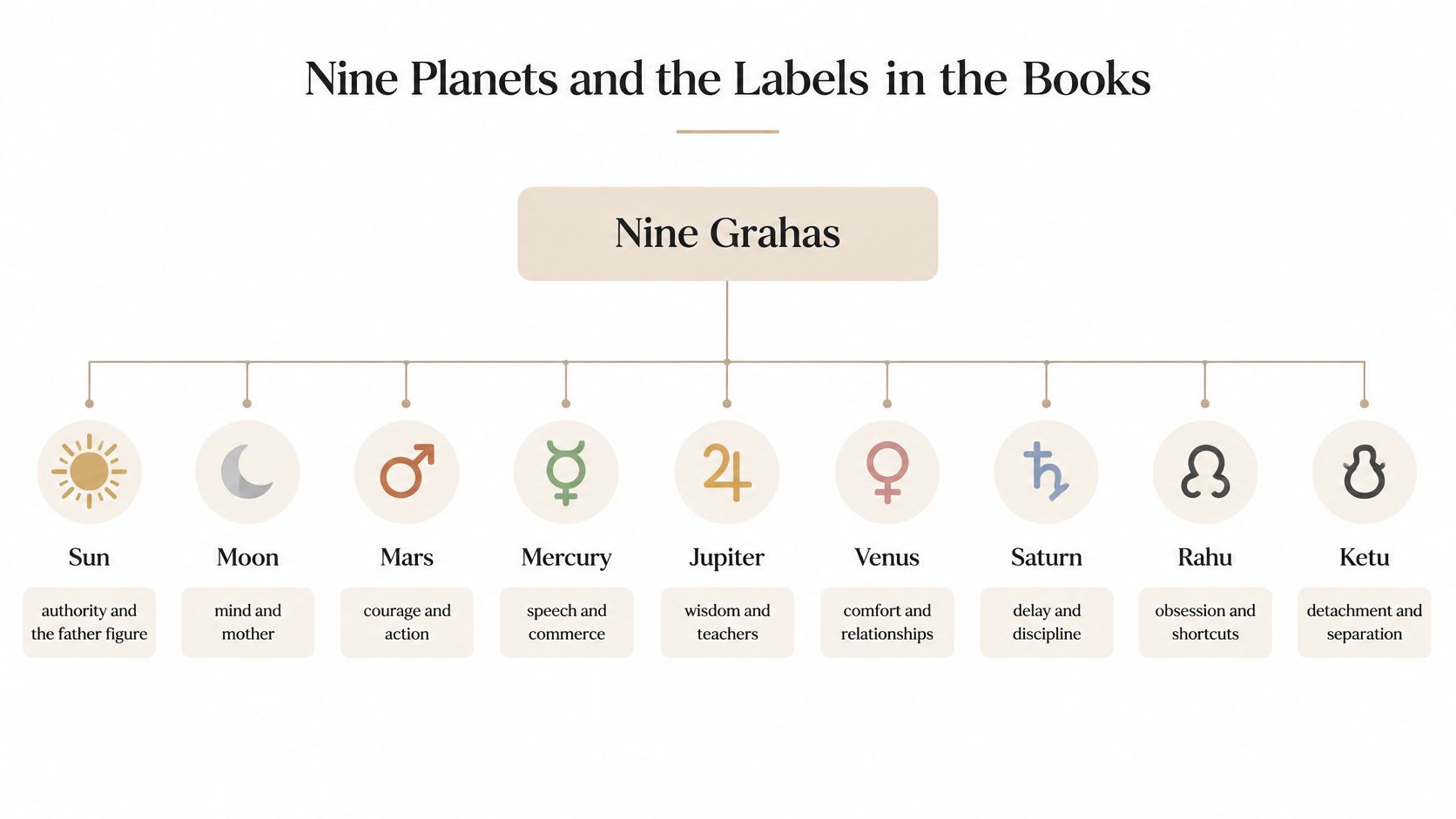
The grahas function as symbolic actors in Lal Kitab predictions. They aren't interchangeable, and their traditional roles shouldn't be mistaken for literal descriptions of a person's character.
The Sun and Moon are called grahas in astrology, although astronomy classifies them differently. Rahu and Ketu are the lunar nodes, often called shadow planets, rather than physical planets.
The symbolic roles of the grahas
- Sun: Authority, recognition and the father figure.
- Moon: Mind, emotional responses and the mother figure.
- Mars: Courage, action, drive and conflict.
- Mercury: Speech, reasoning, trade and commerce.
- Jupiter: Teachers, elders, wisdom and guidance.
- Venus: Spouse, relationships, beauty and comfort.
- Saturn: Duty, delay, discipline and sustained work.
- Rahu: Unusual appetite, obsession, shortcuts and foreign connections.
- Ketu: Detachment, separation and sudden cuts.
These are starting meanings, not complete forecasts. A Venus interpretation isn't automatically a marriage prediction, just as a Saturn interpretation isn't automatically a warning about delay. The astrologer still has to connect the planet's role to the placement being read.
What the unusual labels mean
A dormant planet is treated as symbolically asleep or quiet. Some interpretations connect its activation with conduct or life circumstances, but this isn't a measurable sleeping state in a celestial body.
A blind planet is described metaphorically as unable to see its own result. Such language may be used to explain why a remedy refers to another planet's associations; it shouldn't be read as a diagnosis or a judgement about disability.
An artificial or compound planet is an interpretive combination of planetary factors. It isn't an additional object in the sky. The exact combination and its application need explanation rather than an unexplained technical label.
- Ancestral debt, or rin: A moral or symbolic account of recurring family patterns, not proof that an ancestor caused present difficulties.
- A useful boundary: No such label creates a bill that must be paid to an astrologer or stranger.
The Wikipedia overview of Lal Kitab's editions describes the 1939 material as connecting nine planets with twelve houses, and lists the 1941 Gutka at 428 pages, the 1942 revision at 384 pages, and the 1952 edition at 1,173 pages.
The changing texts help explain why specialist terminology needs context. When readers encounter conflicting definitions, the useful question is which edition and rule the astrologer is applying, not which description sounds most alarming.
Where Lal Kitab Parts Ways with Vedic Astrology
Someone arriving with an existing Vedic kundli may expect a Lal Kitab consultation to use every chart label in the same way. That expectation can cause confusion, especially when software displays sign numbers inside house boxes.
The lagna, or ascendant, is the sign rising at the birth time and place. In a standard Vedic lagna chart, houses are organised from that ascendant; Lal Kitab's permanent-house symbolism uses a different interpretive frame.
Lal Kitab and classical Vedic readings compared
| Question | Lal Kitab | Classical Vedic |
|---|---|---|
| What sets house 1 | Aries is the permanent first-house association | The rising sign, or lagna, at birth |
| Main unit of a prediction | Planet interpreted through a fixed-house framework | Planet in sign, house and divisional charts |
| Strength language | Dormant, blind or artificial planet ideas | Dignity, aspects, yogas and Shadbala |
| Timing method | Planetary phases in later books | Vimshottari dasha and transits |
| Lunar mansion | Often absent from a simple upay list | Nakshatra often establishes the starting dasha |
| Typical output | A life theme plus a conduct or household remedy | A timed interpretation and sometimes a muhurta |
Yogas are named planetary combinations, while Shadbala is a traditional framework for assessing planetary strength. These terms describe methods within astrology, not independently established measures of how reliably an event will occur.
Why the chart labels need checking
Say a chart shows Saturn beside a number that the reader assumes means the tenth house. In some chart formats, the number identifies a zodiac sign instead. The astrologer must establish the actual house placement before discussing work, authority or another life theme.
Likewise, assigning Capricorn symbolism to the tenth house doesn't, by itself, justify relocating a natal Saturn. If chart conversion or a different house calculation changes its placement, the practitioner should explain that calculation explicitly.
Chart-reading safeguard: Different interpretations deserve labelled methods, not an unexplained mixture of chart conventions.
Timing requires a separate explanation
A dasha is a planetary period system used in Vedic interpretation. Vimshottari dasha commonly begins from the Moon's birth nakshatra, a lunar mansion or division along the zodiac.
A muhurta is an auspicious starting time selected for an activity such as a wedding or house move. It's a different question from whether a planet symbolises partnership, property or public standing.
A broad upay list therefore can't substitute for an individual timing consultation. A statement about career responsibility doesn't establish when an offer will arrive, and a relationship theme doesn't establish a wedding date.
Neither approach is a laboratory result. The practical choice is to use a clearly identified method for a clearly stated question, with uncertainty acknowledged rather than hidden behind technical vocabulary.
Sample Readings for Career Marriage and Home
The following are teaching sketches, not forecasts for the reader. Each begins with a stated house convention and an assumed placement, then separates the symbolic interpretation from an ordinary action that someone might choose.

Career with the Sun in the fixed tenth house
Under the fixed-house convention, a Sun placed in the tenth house combines authority and recognition with a Saturn-associated work framework. An astrologer might discuss public responsibility, dealings with managers or the balance between ambition and discipline.
A conduct-based upay could be framed around respectful dealings with elders and a consistent work habit. In practical terms, the person might prepare better for review meetings, record completed work and address disagreements without insults.
This isn't a promise of promotion. A fair interpretation leaves room for qualifications, vacancies, organisational decisions and the person's own effort.
Marriage with Venus in the fixed seventh house
With the same house convention, Venus in the seventh brings partnership and comfort into the discussion. A practitioner might suggest gentler speech at home or discuss a colour or object traditionally associated with Venus.
The behavioural suggestion can be translated into something observable: fewer interruptions during disagreements, clearer discussion of household duties, or respectful boundaries. A symbolic object shouldn't become a test of a spouse's loyalty.
This placement doesn't score a couple or establish compatibility on its own. Kundli matching for marriage concerns both individuals' charts; an Ashtakoota-style assessment, a traditional compatibility framework, is a separate exercise from interpreting an isolated Venus placement.
Home with Saturn in the fixed fourth house
For Saturn in the fourth house, the teaching theme is home, property, the mother figure and a sense of emotional weight or responsibility. A careful practitioner might explore whether domestic duties feel burdensome, without presenting that feeling as a certain consequence of the planet.
Popular remedies involving water, feeding or household cleanliness belong to cultural practice. A simple tidiness habit may be chosen voluntarily, while any feeding practice should protect animal welfare and avoid littering or polluting water.
There is no sound basis for telling someone that a missed bowl or interrupted habit will make a parent ill. Property documents, building condition and family health still require their own practical attention.
- Reusable reading pattern: House convention and placement → planet → life theme → optional upay → an agreed review.
- Hypothetical review: After three months, the person records whether workplace communication, partnership discussions or household organisation changed, without treating the interval as a promised planetary deadline.
The value of these sketches lies in making the reasoning visible. They don't establish a universal remedy for everyone sharing a placement.
How to Judge a Prediction and a Remedy
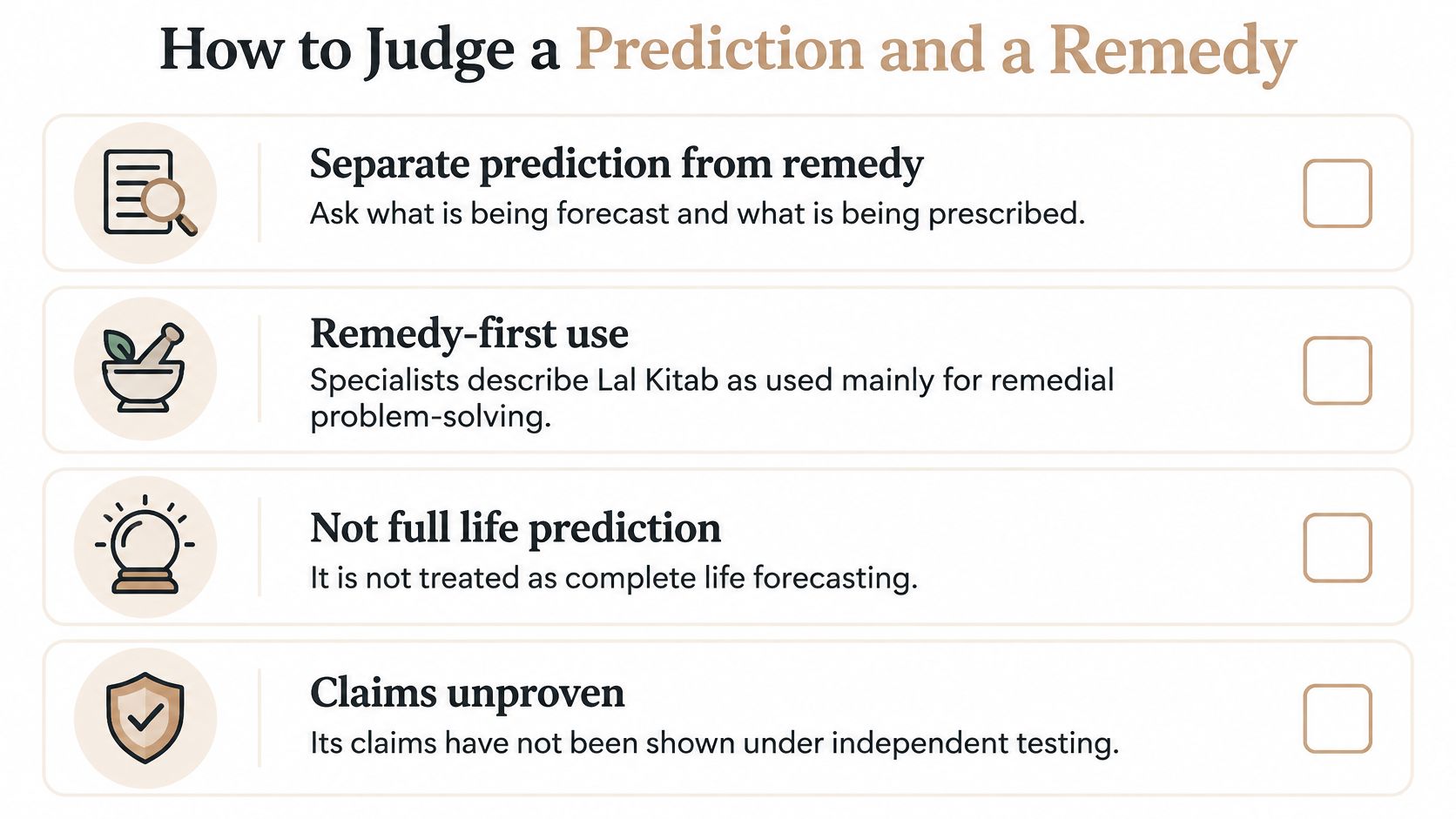
A prediction describes an expected event or pattern; a remedy proposes an action. They need separate evaluation, because completing an action doesn't establish that a forecast was correct.
The Dsetu overview of Lal Kitab describes its use as mainly remedial problem-solving rather than broad life prediction, and notes that its claims haven't been demonstrated under controlled conditions. Cultural meaning and personal reassurance shouldn't be confused with evidence of predictive accuracy.
A review that requires no purchase
- Record the actual question. A job change, a proposed marriage or uncertainty about a home purchase is clearer than a general request for better luck. The surrounding circumstances belong in the record too.
- Write down the forecast and window. A hypothetical review might cover three or six months, agreed in advance. Vague wording shouldn't be converted afterwards into a successful prediction.
- Separate symbolism from evidence-based decisions. Illness needs medical care, financial commitments need written terms, and education choices need a careful review of interests, costs and opportunities. Relationship danger calls for appropriate safety support, not a remedy intended to make someone tolerate abuse.
- Review without changing the rules. At the agreed point, the person notes what changed, what didn't and what other actions occurred. Continuing, adjusting or pausing the practice remains a choice.
A better outcome after an upay doesn't, by itself, prove the upay caused it. Applications, treatment, conversations, changing circumstances and chance may also explain what happened.
Boundaries against fear and pressure
Claims that an incorrect or missed remedy will harm relatives should be treated as unproven, not as instructions to spend more. A voluntary practice can be paused; uncertainty doesn't create an obligation to repeat it indefinitely.
When considering an astrologer consultation, the useful standard is a plain explanation of what is being interpreted and what isn't known. Kismo treats readings as guidance and entertainment and doesn't promise that a reading will be accurate or that a prediction will come true.
Review boundary: An unsuccessful remedy isn't evidence that the person lacked faith or needs a more expensive intervention.
A calm review preserves both cultural respect and personal choice. It allows someone to find meaning in a practice without making it responsible for every event in family life.
Check Your Own Chart Before You Act
The starting point is the person whose question is being considered. A career concern needs that individual's birth details and actual work situation; a marriage question needs clarity about whether the task is an individual reading, compatibility assessment or date selection.
The date, time and place of birth should be checked before generating an individual kundli. If the time is uncertain, that uncertainty should remain visible rather than being replaced with a convenient guess.
Match the chart to the decision
- For learning: A clearly labelled fixed-house interpretation can help explain planetary symbolism.
- For a significant beginning: A wedding or griha pravesh, a housewarming ceremony, requires a timing question tied to the individual circumstances.
- For an unexpected interpretation: The astrologer should explain the placement, rule and uncertainty in ordinary language, including conclusions the person hadn't hoped to hear.
A year-ahead question also needs more than a planet slogan. The interpretation should distinguish general themes from event claims and explain how any proposed timing was reached.
The practical preparation is straightforward: confirm birth time and place, choose the house convention deliberately, and set a review point for any optional upay. Those actions make it easier to recognise the difference between a thoughtful interpretation and a frightening assertion.
Kismo offers Vedic, KP, Nadi, Lal Kitab, tarot, numerology and other readings, with verified astrologers available by chat or call for personalised guidance. For a Lal Kitab consultation, a useful starting question is how the astrologer establishes the houses and connects each suggested upay to the individual chart. Visit Kismo to discuss that question with a practitioner while keeping practical decisions and personal choice firmly in view.