Saturn in Aquarius: Meaning, Houses and Timing
In Indian sidereal astrology, Saturn left Aquarius for Pisces on 29 March 2025, so in 2026 “Saturn in Aquarius” describes a birth-chart placement or a recently finished transit, not the current sky. Advice that treats it as everyone's present period of delay or difficulty starts from the wrong assumption.
Even for someone born with this placement, Saturn in Aquarius isn't a verdict about career, marriage or happiness. A useful Jyotish reading, meaning a reading in the Indian astrological tradition, distinguishes the planet's sign from its house, the Moon's position and the planetary period operating in the individual chart.
The practical question isn't whether this Saturn is good or bad. It's where responsibility appears, which habits need strengthening, and how the person's circumstances affect the choices available.
Table of Contents
- Saturn in Aquarius in Plain Language
- Your Moon Sign and Saturn's House
- Three Nakshatras Inside Aquarius
- Lagna, Dignity and the Running Dasha
- Work, Marriage and Community in Practice
- Retrograde Reviews Before Pisces
- Check Your Chart Before You Decide
Saturn in Aquarius in Plain Language
Shani is the Sanskrit name for Saturn, traditionally associated with time, duty, persistence and slowly earned results. Kumbha, or Aquarius, concerns groups, shared ideas, institutions and the systems people build together. Saturn in Aquarius therefore combines responsibility with participation in something larger than the individual.
For a birth-chart reading, this can suggest learning how to turn principles into workable arrangements. Someone may care about fairness yet need practice with the ordinary tasks that make fairness possible, such as setting clear rules, sharing duties and keeping reliable records.
Sidereal Saturn in Aquarius dates
Saturn's roughly 29.5-year orbital period makes its return to a sign a generational event rather than an annual forecast, as explained in Vedicmarga's Aquarius transit calendar. That calendar provides the latest passage's approximate Indian Standard Time timings below, alongside the previous listed cycle.
| Passage | Entered Aquarius | Left Aquarius | What to remember |
|---|---|---|---|
| Latest first phase | 29 April 2022, about 08:09 IST | 12 July 2022, about 15:04 IST | About 74 days, then retrograde into Capricorn |
| Latest main phase | 17 January 2023, about 18:20 IST | 29 March 2025, about 22:01 IST | About 2 years and 71 days, then Pisces |
| Previous listed passage | March 1993 | February 1996 | Several intervals, not one clean stay |
| Next projected passage | 25 February 2052 | February 2055 | Retrograde re-entry from September 2054 |
The phase durations and the next projected entry date in this table follow Aditya Drishti's Saturn transit schedule, which uses the Lahiri ayanamsha. An ayanamsha is the adjustment used to convert tropical zodiac positions into sidereal positions.
Makara means Capricorn, while Meena means Pisces. The temporary return to Makara explains why the latest Aquarius passage shouldn't be described as one uninterrupted stay.
Why different websites give different answers
A Western tropical chart and an Indian sidereal chart use different zodiac reference points. They can therefore place Saturn in different signs on the same birth date without either page necessarily making a calculation error.
Before comparing interpretations, a reader needs to check the zodiac system and ayanamsha. For someone living outside India, the birth location and local time also matter when calculating the chart.
Calendar rule: A transit table establishes where Saturn was placed within a chosen calculation system. It doesn't establish what happened in an individual life.
The calendar answers when. The personal chart provides the context for interpretation.
Your Moon Sign and Saturn's House
| Moon sign | House from Moon | Sade Sati phase | Practical theme |
|---|---|---|---|
| Aries | 11th | No | Networks, gains and elder siblings |
| Taurus | 10th | No | Work, status and public duty |
| Gemini | 9th | No | Study, travel, teachers and beliefs |
| Cancer | 8th | No | Shared money, change and research |
| Leo | 7th | No | Marriage, contracts and partnerships |
| Virgo | 6th | No | Daily work, service and health routines |
| Libra | 5th | No | Children, study and creative work |
| Scorpio | 4th | No | Home, mother and emotional foundations |
| Sagittarius | 3rd | No | Skills, courage, siblings and short travel |
| Capricorn | 2nd | Closing phase | Family, speech and savings |
| Aquarius | 1st | Middle phase | Self, body and personal responsibility |
| Pisces | 12th | Opening phase | Rest, expenses, solitude and foreign links |
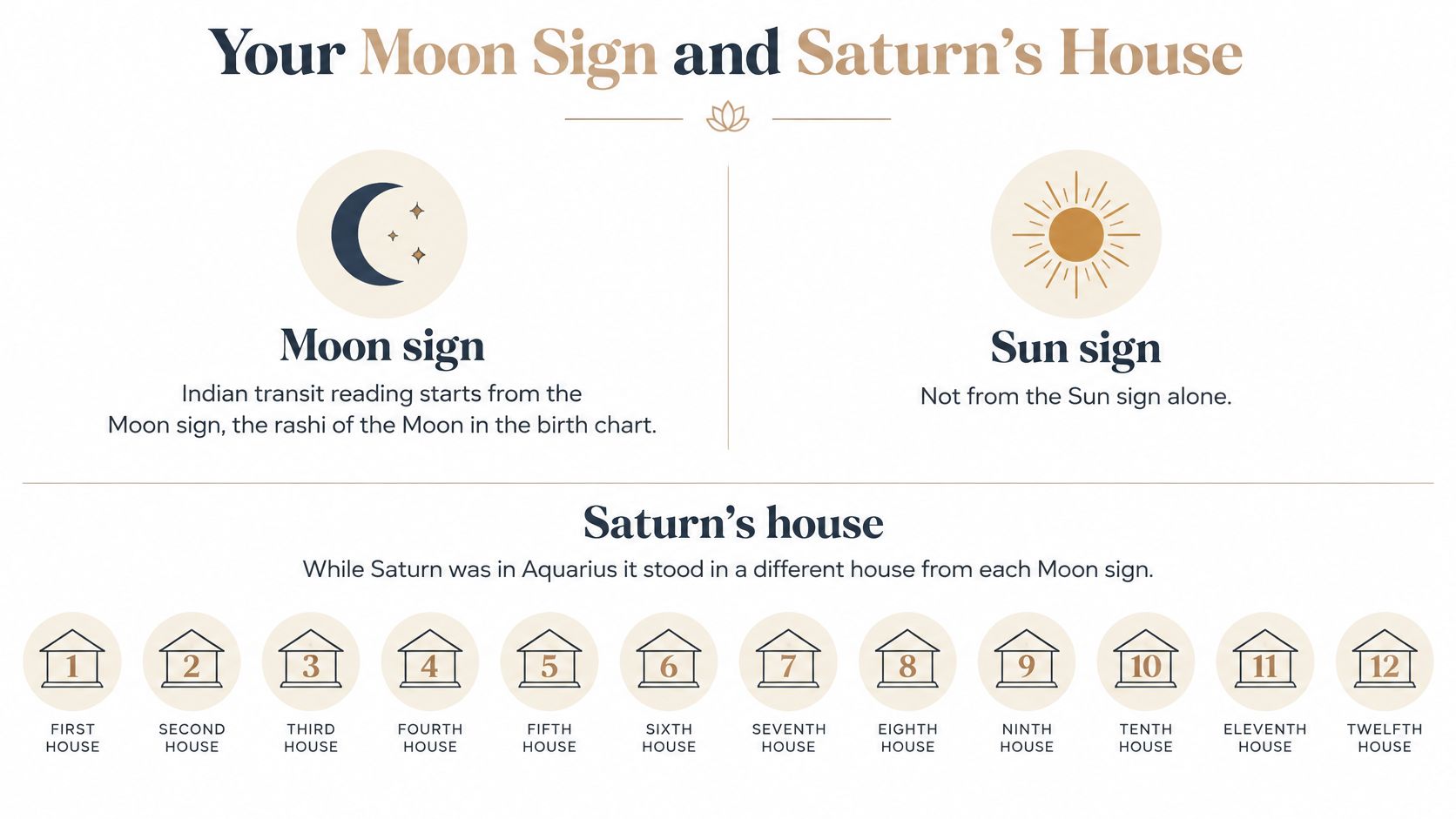
This table uses whole-sign counting, with the Moon's sign counted as the starting house. Indian transit interpretation commonly begins with the Moon sign, meaning the zodiac sign occupied by the Moon at birth, rather than the Sun sign alone.
A house represents an area of life. The same Aquarius transit therefore brings different topics into consideration for different Moon signs, rather than assigning everyone the same experience.
Sade Sati without fear
Sade Sati is the traditional name for Saturn's roughly seven-and-a-half-year passage through the sign before the natal Moon, the Moon's own sign and the sign after it. During the Aquarius passage, Pisces Moon corresponded to the opening phase, Aquarius Moon to the middle phase and Capricorn Moon to the closing phase.
These labels describe a position in a cycle, not a scale of inevitable suffering. Opening-phase themes can be approached through budgeting and rest; middle-phase themes through manageable responsibilities; closing-phase themes through measured speech and steady family finances.
Someone outside these Moon signs wasn't experiencing Sade Sati from Saturn in Aquarius. That doesn't make every other house automatically easy, nor does it make these phases automatically harmful.
Turning a house into a useful question
For an Aries Moon, the network theme might prompt an assessment of professional associations and friendships. For a Taurus Moon, work and reputation might become the focus of reflection, including whether duties and recognition are fairly balanced.
A Leo Moon reading might examine partnership expectations. A Scorpio Moon reading could consider household responsibilities, care for a parent or the practical demands of establishing a home.
A house identifies the subject worth examining. It doesn't supply a guaranteed event.
These are traditional interpretive themes, not tested predictions. Astromathi's transit discussion likewise places personalised interpretation alongside the Moon, ascendant and planetary periods rather than treating the sign alone as sufficient.
For the completed passage, the table supports reflection on that chapter. If Saturn occupies Aquarius at birth, the same counting describes its natal relationship to the Moon, but it still isn't a wedding or job-change calendar.
Three Nakshatras Inside Aquarius
A nakshatra is a lunar mansion, a smaller division used in Vedic astrology to refine a planetary placement. Aquarius covers 30 degrees and contains parts of three of the 27 nakshatras, according to LivePanditJi's Saturn in Aquarius guide.
A pada is a quarter of a nakshatra, measuring 3°20′. The same guide identifies nine Aquarius padas, distributed across the degree bands below.
Nakshatras Saturn crosses in Aquarius
| Degree span | Nakshatra | Padas used | Traditional ruler |
|---|---|---|---|
| 0°00′–6°40′ | Dhanishta | Padas 3 and 4 | Mars |
| 6°40′–20°00′ | Shatabhisha | All four padas | Rahu |
| 20°00′–30°00′ | Purva Bhadrapada | Padas 1, 2 and 3 | Jupiter |
The first task is locating Saturn's sidereal degree. A nakshatra calculator can help identify the relevant lunar mansion from birth details, but the resulting label still needs chart context.
The ruler listed in the table is a traditional interpretive association. It doesn't mean that Mars, Rahu or Jupiter physically occupies that section of Aquarius.
Different flavours within the same sign
Dhanishta is traditionally associated with rhythm, coordinated effort, resources and public timing. A useful everyday example is someone learning to contribute consistently to a team, rather than appearing only when an exciting project begins.
Shatabhisha is associated with healing, research, large networks and unconventional approaches. In practical reflection, Saturn here may represent the patience needed to test an unusual solution, develop technical skill and remain connected to colleagues instead of retreating into isolation.
Purva Bhadrapada carries associations with strong principles, transformation and the cost of commitment. Someone working with this symbolism might examine whether an important cause leaves enough room for dialogue, rest and ordinary human limits.
None of these placements deserves a simple lucky or unlucky ranking. Each offers a different language for discussing discipline.
Reading the finer boundary
Shatabhisha is traditionally the 24th nakshatra, ruled by Rahu, and its pada boundaries are 6°40′–10°00′, 10°00′–13°20′, 13°20′–16°40′ and 16°40′–20°00′ Aquarius, as set out in Astrogyana's Shatabhisha explanation.
These coordinates are locators, not personality scores. A Saturn in Dhanishta and a Saturn in Purva Bhadrapada can receive different interpretations even though both charts display Aquarius.
Accurate birth date, time and place help establish the full chart around that placement. The degree adds precision, but it can't replace consideration of the house, planetary relationships and the person's lived circumstances.
Lagna, Dignity and the Running Dasha
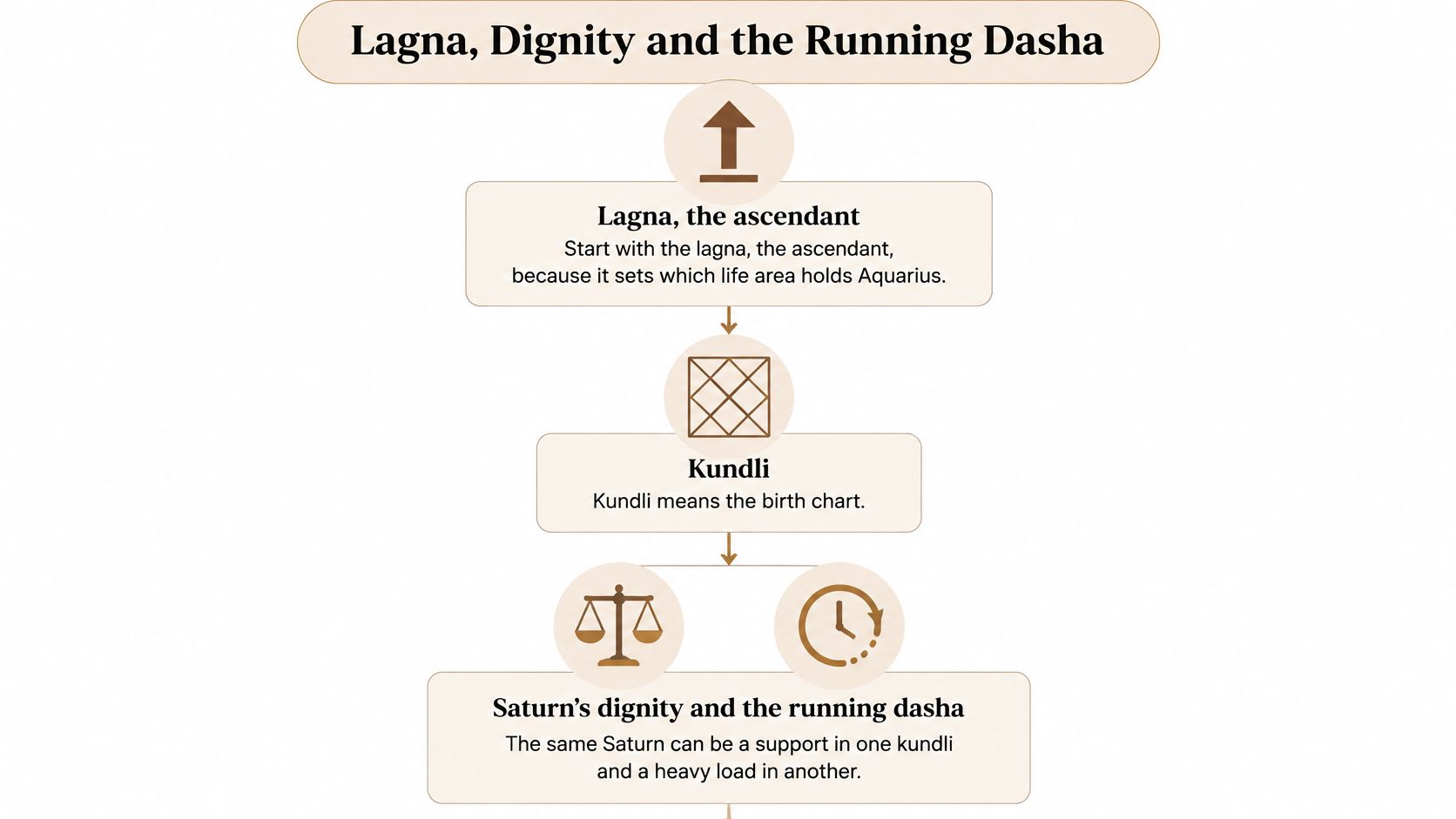
A kundli means a birth chart. Its lagna, or ascendant, is the sign rising on the eastern horizon at birth, and it establishes the arrangement of houses in a whole-sign chart.
This is why an Aquarius Moon and an Aquarius ascendant aren't interchangeable. The Moon provides one reference point for experience and transit interpretation; the ascendant organises the chart's life areas.
Lagna identifies the field of responsibility
Saturn traditionally rules Capricorn and Aquarius. For an Aquarius ascendant, it therefore rules the house of self and the house associated with withdrawal, expenses and foreign connections, while a natal placement in Aquarius puts it in its own sign.
An astrologer might discuss gradual personal maturity alongside solitude, overseas ties or behind-the-scenes work. This lens identifies relevant subjects; it can't decide whether a particular foreign job offer is sensible.
For another ascendant, Aquarius may correspond to career, partnership or home. The same sign placement doesn't mean the same life assignment.
Dignity describes condition, not ease
Dignity describes how a planet is traditionally situated by sign and related chart conditions. Aquarius is Saturn's own sign, so astrologers generally treat it as a placement with resources for persistence, organised thinking and loyalty to a group.
That doesn't mean effortless results. A person can be capable of carrying responsibility while still carrying too much of it.
Planetary aspects, meaning the relationships astrologers read between planets, and close conjunctions can modify the interpretation. Natal retrograde status may also be considered, but none of these factors should become a frightening label.
Dasha identifies the active period
A dasha is a planetary period used in Vedic timing, commonly through the Vimshottari system. A mahadasha is a major period, while an antardasha is a subperiod within it.
When Saturn's period coincides with a relevant Saturn transit, astrologers may give its themes greater attention. Under another planet's period, that planet's placement and relationships may be more central, although Saturn doesn't become irrelevant.
A dasha calculator helps establish the running sequence. It provides a timing framework, not an appointment with a guaranteed event.
The question determines the interpretation
A career reading should examine work responsibilities, available offers and financial stability. A marriage reading needs partnership factors and the circumstances of both people.
SupAstro's transit reference similarly distinguishes sign movement from an individual assessment involving the ascendant, Moon, natal Saturn, houses and dasha. Colleagues born in the same year can therefore receive different guidance without contradiction.
Work, Marriage and Community in Practice
The most useful interpretation ends with a sensible action, not an alarming prediction. The following hypothetical situations show how Saturn symbolism can support reflection without replacing evidence.
The workplace image below provides a setting for considering shared responsibility and changing professional roles.

A software lead facing new tools
A software lead in Bengaluru has natal Saturn in Aquarius in the career house and worries about automation. A responsible reading might explore accountability, technical learning and mentoring, rather than treating Saturn as a prediction of redundancy.
The concern has a recognisable social context: a CXO Today release about Astrotalk's query report describes anxiety about AI and employment among people seeking astrology guidance. Platform enquiries reveal concerns, not proof that a planetary placement causes job loss.
Practical action: The professional can audit skills against current job descriptions, document completed work and discuss training with a manager. Astrology can't promise job security or justify resigning without an offer and a financial plan.
A couple considering marriage
A couple's reading includes Saturn in Aquarius in the partnership house. Instead of assuming rejection or permanent delay, an astrologer can use the symbolism to discuss commitment, duties, patience and boundaries with extended family.
Kundli matching means comparing the prospective partners' birth charts. It shouldn't replace conversations about consent, money, children, location or care responsibilities.
Practical action: The couple can write down shared expectations and unresolved decisions before selecting a date. Neither Saturn's placement nor compatibility analysis can guarantee a successful marriage.
The following video offers another format for considering the topic.
A community organiser building continuity
A community organiser may connect with Aquarius themes through public service and shared ideals. The useful Saturn question is whether volunteers have clear roles, the accounts are understandable and the project can continue when its founder takes leave.
Practical action: The organiser can document responsibilities, introduce spending approval rules and arrange a dependable handover. Astrology can't guarantee funding, public support or a lasting organisation.
Across these situations, age, savings, family duties and actual opportunities deserve direct attention. Traditional health symbolism sometimes includes joints, cold-related discomfort or overwork, but a chart can't diagnose any condition; persistent symptoms need clinical assessment.
Practical safeguard: Symbolic guidance should support preparation, communication and informed choices, never replace medical, financial or legal advice.
Retrograde Reviews Before Pisces
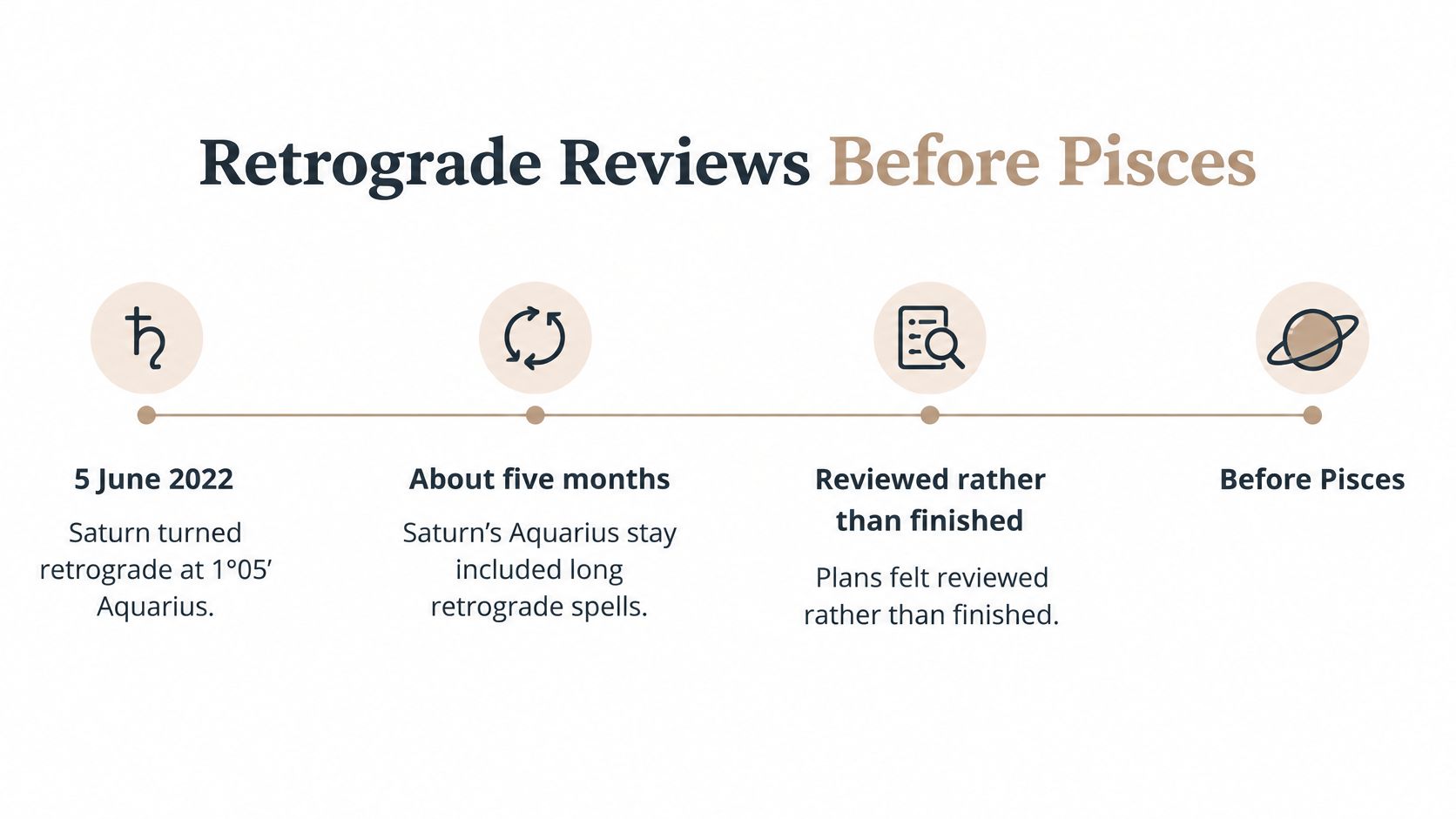
Retrograde motion is a planet's apparent backward movement as observed from Earth. Saturn doesn't physically reverse its orbit, but its measured zodiac position can move back across degrees it has already crossed.
The retrograde spells associated with this Aquarius passage lasted roughly five months, according to Vedicmarga's Saturn retrograde calendar. Its station positions are listed below.
Saturn retrograde stations during the Aquarius passage
| Year | Turned retrograde | Turned direct | Nakshatra note |
|---|---|---|---|
| 2022 | 5 June at 1°05′ Aquarius | 23 October at 24°24′ Capricorn | Started in Dhanishta, stationed in Capricorn |
| 2023 | 17 June at 13°01′ Aquarius | 4 November at 6°19′ Aquarius | Shatabhisha back to Dhanishta |
| 2024 | 30 June at 25°13′ Aquarius | 15 November at 18°29′ Aquarius | Purva Bhadrapada back to Shatabhisha |
A station is the point at which the apparent direction changes. The table shows why an astrologer might discuss the same degree or nakshatra more than once during a longer passage.
The timeline below illustrates the review symbolism commonly attached to this apparent movement.
Repetition isn't proof of failure
Traditional interpretation associates retrograde revisits with review, repetition or unfinished work. This can be a useful reflective framework, but it doesn't establish that every stalled application, contract revision or family disagreement resulted from Saturn.
For example, a professional might revisit a promotion discussion because the employer changes its budget. A couple might reopen a housing decision because care responsibilities change.
The practical response is to identify what remains unresolved. Missing documents, unclear terms and unrealistic workloads can be addressed directly, regardless of the astrological interpretation.
- For employment: Keep written records of responsibilities, feedback and agreed next steps.
- For contracts: Review obligations and obtain qualified advice before signing.
- For family decisions: Separate an urgent practical need from pressure to settle everything immediately.
Natal placement and finished transit are different
A natal Saturn in Aquarius remains part of the birth chart throughout life. A transit describes a temporary position in the sky, so an old Aquarius forecast shouldn't be treated as a continuing instruction.
For Capricorn, Aquarius and Pisces Moons, the Sade Sati labels attached to that passage also need updating rather than repeating unchanged. A person may still be navigating consequences of an earlier decision, but continuing consequences aren't evidence that Saturn remains in its former sign.
For present-day timing, an astrologer should examine the current transits, running dasha and, where appropriate, the solar return, the chart calculated for the Sun's return to its natal position. A headline from an earlier transit can't substitute for that assessment.
Check Your Chart Before You Decide
Before changing a job, fixing a wedding date or committing business savings, a reader needs a clear distinction between chart information and a practical decision. A birth-chart calculation can establish the placements, but the decision also requires accurate facts about the person's situation.
An uncertain birth time should be disclosed rather than treated as exact. A recorded time, a family estimate and an unknown time don't offer the same basis for house-based interpretation.
A three-layer checklist
- Identify the placement. Establish whether Aquarius contains Saturn in the natal chart or whether the question concerns an experience during the completed transit. This prevents an outdated forecast from being mistaken for a permanent personal condition.
- Locate the relevant context. Record the Moon sign, ascendant house and Saturn's nakshatra. The aim isn't to collect labels, but to understand which life area deserves closer consideration.
- Define the decision and timing. Name the running dasha and a concrete question, such as evaluating a relocation offer, discussing marriage or stabilising irregular income. Include deadlines, financial commitments and family responsibilities.
Preparing for a useful consultation
At Kismo, astrologers work from the user's birth details and actual situation. Each profile states the astrologer's languages, specialities and rate, and the customer chooses an astrologer before spending anything.
The Full chart reading covers the birth chart end to end, including houses, dashas and recurring life patterns. A useful conversation should leave the reader with clear priorities, questions that still need evidence and manageable next actions.
If auspicious timing is relevant, muhurta means selecting a suitable time for an important beginning. Even then, consent, preparation and practical availability remain essential.
Saturn is best approached as a symbol of patience and fair responsibility, not a sentence passed on someone's future. A careful reading should make the situation easier to understand, not harder to face.
For personalised guidance on Saturn in Aquarius, Kismo offers chat or call sessions with verified astrologers for birth-chart readings, marriage compatibility, career questions and auspicious timing. Readers can bring accurate birth details and a specific decision to a consultation, with the aim of identifying practical actions rather than seeking a guaranteed outcome.