Ashlesha Nakshatra Male Personality and Life Path Guide
Some readers arrive here after meeting a man who says little in a group, yet notices everything. Others arrive after opening a birth chart and seeing Ashlesha next to the Moon, then wondering if that single line means brilliance, secrecy, emotional complexity, or all three at once.
That confusion is normal. In Vedic astrology, a nakshatra is a lunar mansion, one of the star divisions used to read the mind, habits, instincts, and deeper emotional pattern beneath the more familiar zodiac sign. For a male native, Ashlesha often raises practical questions very quickly. How does he love? What kind of work suits him? Why does trust take time? Can marriage become steady if the chart shows emotional intensity?
A good answer has to move beyond labels. An Ashlesha Nakshatra male isn't helped much by hearing only that he is “mysterious” or “strategic”. What matters is how those qualities work in real life, especially in relationships, family decisions, health habits, and career choices.
A kundli is the birth chart used in Vedic astrology. A dasha is a planetary period that can activate certain life themes. A muhurta is a carefully chosen auspicious time for an important action. These terms matter because Ashlesha becomes much clearer when its symbolism is tied to actual life events rather than treated as poetry.
Table of Contents
- Meeting Ashlesha in Everyday Life
- Where Ashlesha Sits in the Vedic Sky
- Ashlesha Male Traits in Real Situations
- Career Paths Where Ashlesha Males Thrive
- Marriage, Compatibility, and Family Decisions
- Health, Remedies, and Supportive Habits
- Bringing the Ashlesha Themes Together
Meeting Ashlesha in Everyday Life
An Ashlesha Nakshatra male often doesn't announce himself loudly. He may be the colleague who spots the issue in a meeting before anyone else does. He may be the friend who listens with full attention but shares his own pain slowly, and only after trust feels earned.
That guarded quality can confuse people. Some read it as distance. Others read it as intelligence mixed with caution. Both impressions can be true.
Why people notice Ashlesha before they understand it
In daily life, Ashlesha tends to show up as observation, restraint, and inner intensity. A man with strong Ashlesha influence may not react quickly on the outside, yet his mind is already connecting motives, moods, and hidden patterns. He often senses emotional undercurrents that more direct personalities miss.
This is one reason people feel both drawn to and uncertain around him. There is warmth there, but it usually comes with a protective shell.
A person with Ashlesha energy often forms trust in layers, not all at once.
Traditional Vedic astrology treats nakshatra placement as one of the key birth-chart markers used to judge temperament, compatibility, and timing. In that framework, Ashlesha has a very specific identity. It is linked with serpent symbolism, hidden strategy, emotional depth, and themes.
The deeper tone beneath the surface
Many readers know their zodiac sign but not their nakshatra. That's where misunderstanding begins. Two men may both have Cancer influence, yet the one born in Ashlesha can behave very differently from someone whose Moon falls in another lunar mansion. The outer personality may seem calm or even polite, while the inner world is tightly coiled, alert, and highly private.
For that reason, the Ashlesha Nakshatra male is often best understood through actions rather than labels:
- He reads rooms carefully. He notices shifts in tone, loyalty, and motive.
- He protects his vulnerable side. Even when he cares, he may reveal it slowly.
- He dislikes shallow dealings. Surface talk can tire him if there is no substance behind it.
When this nature matures, it becomes wisdom, emotional insight, and loyalty. When it becomes stressed, it can turn into suspicion, control, or silence that others struggle to read.
Where Ashlesha Sits in the Vedic Sky
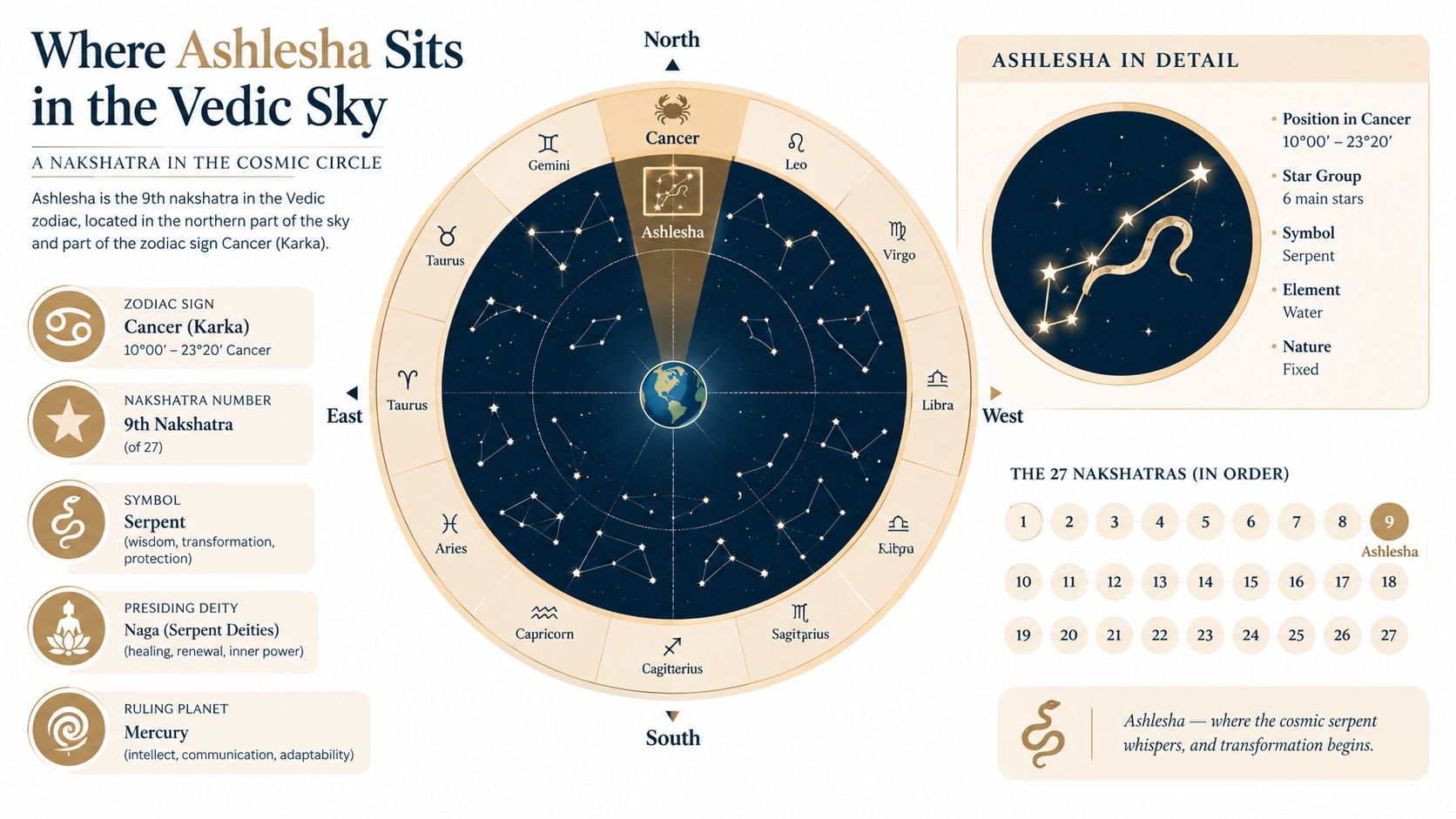
Ashlesha has a precise place in Vedic astrology. It is the 9th of the 27 nakshatras, and it spans 16°40' to 30°00' of Cancer in the sidereal zodiac, covering the final 13°20' of Cancer according to this Ashlesha nakshatra reference.
Cancer, Mercury, and the serpent pattern
This placement matters because Ashlesha sits fully in Cancer (Karka), a sign connected with feeling, protection, memory, and emotional response. At the same time, Ashlesha is traditionally ruled by Mercury, and it is commonly linked with the Naga serpent deities and the coiled serpent as its main symbol, as noted in this nakshatra overview.
That combination creates a distinctive pattern. Cancer gives sensitivity. Mercury adds quick thinking, language, and pattern-recognition. The serpent symbolism adds concealment, strategy, and transformation.
A traditional astrologer may therefore read an Ashlesha Nakshatra male as someone who thinks quickly but doesn't always reveal what he knows. He can be emotionally perceptive, verbally sharp, and psychologically complex.
Practical rule: When Mercury and a water sign combine through Ashlesha, the mind often works through feeling as much as logic.
The constellation mapping is also specific. Ashlesha is associated with the Hydra star group, with references naming stars such as Epsilon Hydrae, Delta Hydrae, Mu Hydrae, Rho Hydrae, Sigma Hydrae, and Zeta Hydrae in the earlier cited source.
The four padas and why they matter
Ashlesha has four padas, and one source notes that each pada measures 3°20' in span in this technical breakdown. In practical chart reading, these quarters refine how the nakshatra expresses itself.
A male native with Ashlesha may therefore show the same core themes, but one pada can make him more philosophical, another more reserved, another more socially strategic, and another more emotionally fluid. That's why a full kundli reading matters more than a one-line nakshatra summary.
A second technical point is also worth noting. Traditional interpretation describes Ashlesha's Mercury rulership inside Cancer as a Mercury-in-water-sign influence, often linked with rapid pattern-recognition, strategic speech, and sensitivity to emotional context in male natives, according to this Vedic astrology explanation.
Ashlesha Male Traits in Real Situations
Traits become easier to understand when they are seen in motion. The Ashlesha Nakshatra male rarely fits into a simple list of “good” and “bad” qualities. His strengths and challenges often come from the same root.
At work and under pressure
A negotiation becomes tense. One person keeps smiling while changing the terms. The Ashlesha male notices the shift before the others do. He doesn't interrupt at once. He waits, watches, and then asks the one question that exposes the hidden agenda.
That is Ashlesha in a productive form. It shows pattern-reading, emotional control, and the ability to work below the surface.
In the right situation, this man can be excellent in conflict, crisis, or confidential problem-solving. He may not enjoy noisy competition, but he often handles complicated human dynamics better than people who only focus on facts.
In friendship and private life
A friend calls him during a difficult family period. He listens carefully, remembers details, and gives practical advice that feels unusually precise. Weeks later, that same friend realises he still knows very little about the Ashlesha male's own struggles.
This isn't always dishonesty. Often, it is self-protection. Many Ashlesha men trust slowly and prefer to reveal themselves in stages.
That quality can create two very different experiences in relationships:
- When handled well, it creates loyalty, discretion, and emotional steadiness.
- When handled poorly, it creates secrecy, distance, and confusion.
- When fear takes over, it may lead to suspicion, silent resentment, or testing other people instead of speaking openly.
He often feels deeply before he speaks clearly.
In love and family dynamics
A partner may feel strongly cared for by an Ashlesha man. He notices moods, protects privacy, and often takes emotional responsibility seriously. Yet the same partner may sometimes wonder why he goes quiet instead of saying what hurts him.
Many readers get confused. Ashlesha intensity doesn't always look dramatic. Sometimes it looks like withdrawal, overthinking, or subtle control.
Family life can reflect the same pattern. He may be attached to loved ones while still struggling to express softness directly. He might show care through problem-solving, practical protection, or silent sacrifice more than through open sentiment.
The practical lesson inside the pattern
The healthy expression of Ashlesha is not “be less deep”. It is make the inner world easier for trusted people to enter.
Useful self-checks include:
- Does silence protect peace, or hide fear?
- Is caution helping discernment, or feeding mistrust?
- Are loved ones being protected, or managed?
An Ashlesha Nakshatra male usually grows most when he learns that emotional honesty doesn't weaken his intelligence. It makes his intelligence easier to trust.
Career Paths Where Ashlesha Males Thrive
Professionally, the Ashlesha Nakshatra male often does best where depth matters more than display. He usually prefers meaningful complexity over repetitive visibility. Work that involves hidden patterns, confidential material, or sensitive judgment can suit him well.
The professional profile
Several themes often repeat in career stories linked with Ashlesha:
- Investigative thinking helps him notice what others overlook.
- Comfort with confidentiality makes him steady around private or delicate information.
- Emotional reading supports work that depends on understanding motive, pressure, and human nuance.
- Persistence helps with difficult, layered tasks that take time to unravel.
By contrast, highly superficial environments can drain him. Constant performance without depth may leave him detached or impatient.
Ashlesha Male Strengths Mapped to Career Fit
| Core Strength | High-Fit Roles | Common Friction Areas |
|---|---|---|
| Analytical observation | Research, auditing, diagnostics, investigation | Repetitive clerical work with little thinking space |
| Confidential handling | Compliance, legal support, risk review, advisory roles | High-volume public-facing roles with constant exposure |
| Reading emotional subtext | Counselling, psychology-related work, mediation, people strategy | Transactional sales based only on speed and charm |
| Strategic communication | Policy writing, specialised writing, intelligence analysis, consulting | Environments that reward talking more than substance |
| Calm under complexity | Crisis management, medical support fields, security analysis | Workplaces built on constant noise, gossip, or scattered priorities |
High-fit and lower-fit patterns
Ashlesha men often thrive where a problem has layers. Psychology, counselling, law, compliance, medical analysis, financial review, specialised strategy, and crisis work all make sense because they use both perception and restraint.
Some also do well in writing roles, especially where the work needs precision, subtext, or careful framing rather than flashy self-promotion.
Lower-fit areas aren't “bad careers”. They create more friction when they demand relentless surface-level social energy. A role built around endless cold outreach, repetitive administration, or constant public visibility may feel mismatched if it never uses the person's deeper strengths.
A useful career clue is simple. If the job never uses observation, discretion, or strategic thinking, it may not be drawing on the strongest part of the chart.
A strong self-check question is this: Does the current role reward what comes naturally, or only what feels forced?
Marriage, Compatibility, and Family Decisions
Most readers want clear guidance. Personality labels are interesting, but marriage decisions are immediate. Families want to know whether an Ashlesha Nakshatra male can form a stable partnership, whether late marriage is a concern, and how to read compatibility without exaggerating fear.
One practical clue comes from the broader demand for relationship-centred astrology. An industry note cited by this Indastro page on Ashlesha states that about 65% of daily astro-app queries were on marriage and relationships, and that a separate 2025 survey found 51% of Indian singles consider zodiac compatibility significant in attraction and compatibility. That doesn't prove any one match will succeed. It does show why readers want practical answers.
What kind of partner usually fits best
An Ashlesha male often does well with a partner who is emotionally mature, patient, and steady under pressure. He usually needs someone who doesn't panic when he becomes quiet, but also doesn't excuse unhealthy secrecy.
Early bonding can be cautious. Trust tends to deepen in layers. Because of that, emotionally direct but stable partners are often easier for him than highly reactive or inconsistent ones.
A useful compatibility assessment goes beyond whether two people seem intense or romantic on paper. It asks harder questions.
- Can the partner handle guarded phases without creating drama?
- Does the relationship reward honesty, or does it run on testing and guessing?
- Is there enough emotional bandwidth on both sides for depth without control?
Timing and kundli matching in plain language
Marriage timing in Vedic astrology depends on the full chart, not the nakshatra alone. Astrologers usually examine the 7th house, its lord, Venus, Jupiter, and the relevant dasha periods. Supportive Venus or Jupiter phases can open clearer relationship windows, while other periods may bring hesitation, family pressure, or emotional confusion.
Some Ashlesha men marry earlier through family arrangement. Others delay commitment until work stabilises and they feel safer emotionally. Neither pattern is automatically better.
For actual kundli matching, a thoughtful reading should look at more than a simple score. Detailed kundli matching is more useful when it includes mangal dosha, the emotional tone of the partner's Moon, communication style, and whether intensity in one chart is balanced or amplified in the other.
Paper compatibility is only the beginning. Emotional steadiness and communication habits decide whether the match can breathe.
Family life and fatherhood
As husbands or fathers, Ashlesha men are often protective, alert, and serious about responsibility. They may provide strongly for the family while still appearing reserved in emotional expression. Children may experience them as reliable but not always easy to read.
That isn't a sign of weak family feeling. In many cases, it is the opposite. The attachment runs deep, but it may come through structure, problem-solving, and vigilance rather than open softness.
Two reflective questions help more than any stereotype:
- Is the relationship becoming safer with time, or more secretive?
- Are both people choosing shared values, or only responding to pressure from family timelines?
Health, Remedies, and Supportive Habits
Traditional astrology often associates the Ashlesha Nakshatra male with physical sensitivity that shows up through internal stress. Rather than treating this only as psychology, classical and modern Indian astrology sources commonly connect Ashlesha males with digestive and lower-body complaints such as flatulence, jaundice, stomach trouble, and knee or leg pain, as described in this traditional health note on Ashlesha.
That doesn't mean every Ashlesha male will face all of these issues. It means practitioners often watch digestion, stress storage, sleep rhythm, and somatic tension more carefully in such charts.
Remedies in the traditional spirit
Supportive remedies are best approached calmly. They are meant to steady the mind and refine awareness, not to create fear.
Some traditional practices associated with Ashlesha include:
- Wednesday observances: Mercury is Ashlesha's ruler, so Wednesday practices are often used to support clarity, speech, and nervous balance.
- Naga worship or offerings: Since Ashlesha is linked with serpent deities, respectful prayer to Naga forms is sometimes recommended in traditional settings.
- Mantra discipline: Short Mercury or serpent-related mantras may be used regularly, especially during emotionally loaded periods.
- Gemstone caution: Stones should only be considered after a learned astrologer checks the entire chart. A gemstone that helps one chart may disturb another.
This video offers one traditional perspective on Ashlesha remedies and symbolism:
Grounded habits that often help more than people expect
Astrological remedies work best when daily habits support them. For many Ashlesha males, the following are practical and sensible:
- Regular sleep timing: An overactive mind often worsens when nights become irregular.
- Moderate movement: Swimming, walking, stretching, or yoga may feel more balancing than aggressive competition during stressful periods.
- Cooling food choices during pressure: Heavy emotional strain often shows up in digestion first.
- Structured journaling: Private writing can help release thoughts that would otherwise stay coiled inside.
A chart-based timing check through current planetary transits can also help a person notice when emotional strain may be peaking, though medical guidance should always come first.
Astrological remedies are supportive. Medical diagnosis and treatment take priority whenever symptoms are persistent or serious.
Bringing the Ashlesha Themes Together
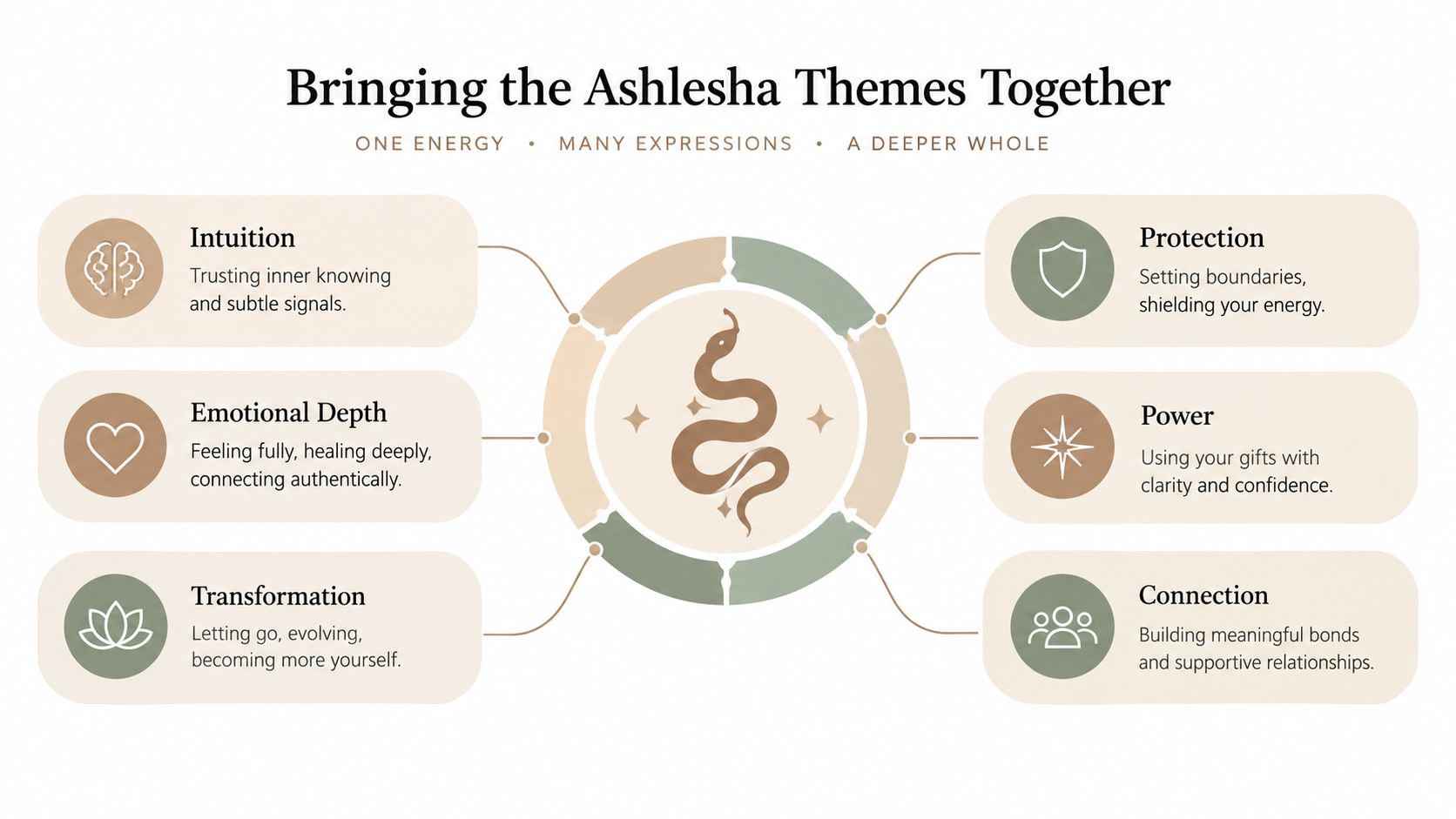
The Ashlesha Nakshatra male is often easiest to understand when his traits are viewed as a single pattern rather than separate labels. Cancer gives emotional depth. Mercury brings alert intelligence. The serpent symbolism adds instinct, privacy, and the power to transform under pressure.
The life themes that tend to repeat
When these influences mature well, they can create a man who is perceptive, loyal, psychologically strong, and capable of handling complexity that overwhelms others. In work, he often does well where confidentiality and insight matter. In relationships, he usually needs trust that is deep enough to handle caution without feeding silence.
When the same traits become strained, the trouble points are also clear:
- Insight can turn into suspicion
- Privacy can turn into emotional distance
- Protection can turn into control
- Intensity can turn inward and affect the body
These are tendencies, not fixed outcomes. Astrology describes pattern. It doesn't cancel free will, maturity, or self-awareness.
The full chart always decides the final reading
No nakshatra should be read in isolation. The full birth chart still matters most. House placement, the condition of Mercury and Moon, aspects, the 7th house, lord placements, and running dashas all shape how strongly Ashlesha operates and when its themes become more active.
That is why one Ashlesha male becomes a trusted counsellor, another a sharp strategist, and another a protective but private family man. The core symbolism may be similar, but the life expression changes with the whole chart.
A useful next step is simple. Note which descriptions feel active now. Is the current challenge about work fit, trust in love, family pressure, health rhythm, or emotional expression? Those observations usually lead to much better questions when speaking with an astrologer.
Kismo offers personalised astrology guidance through chat or call with verified astrologers, including birth-chart readings, kundli matching, marriage timing, and practical life questions tied to nakshatras like Ashlesha. For someone trying to understand how Ashlesha shows up in relationships, career direction, or family decisions, a full-chart session can add the missing context. Readers who want that personalised view can visit Kismo.