Astrologist or Astrologer: Which Is Correct?
Astrologer is the correct and universally accepted term for a professional who practises astrology. Astrologist is a common misspelling, and it's rarely used by professionals.
Why do people still search for both? Because English often forms profession words with endings like -ist or -er, so the mistake feels natural. The actual issue is simple: if someone is offering a serious reading in the Vedic tradition, the word you want is astrologer.
Table of Contents
- Astrologist or Astrologer - The Correct Term
- The Historical Roots of the Astrologer
- Core Vedic Concepts Explained Simply
- How to Verify an Astrologer's Credentials
- Choosing the Right Reading for Your Needs
- Recognising Ethical Boundaries and Red Flags
Astrologist or Astrologer - The Correct Term
A person who gives chart readings, discusses kundli and dasha, or interprets timing and compatibility is called an astrologer. Astrologist looks plausible, but in ordinary professional usage it isn't the standard term.
That small language choice matters because it shapes what readers search for, how they judge expertise, and whether they can tell a genuine service from a careless listing. It also helps avoid confusion when comparing profiles, articles, or platform listings.
Why the confusion happens
English has many job titles that end in -ist, such as biologist or geologist, so people often assume astrology follows the same pattern. It's an understandable guess, especially for readers who meet the word through search engines rather than through formal study.
A simple rule helps. If the person reads birth charts, explains planetary periods, or helps with marriage compatibility, the correct word is astrologer. That term is the one used in professional settings and in the history of the field.
Practical rule: if the profile says “astrologist”, treat it as a spelling error unless the practitioner clearly uses the word in a non-standard, personal way.
For users booking a reading on Kismo, the safest habit is to search for astrologers, then look at method, experience, and verification rather than stopping at the job title. The title matters, but the evidence behind it matters more.
The Historical Roots of the Astrologer
The Indian astrologer comes from Jyotisha, a tradition shaped by celestial cycles, ritual timing, and calendar science. Scholars place lunar-calendar practice based on nakshatras, the 27 or 28 lunar asterisms, very early in Indian history, with evidence suggesting systems may date to roughly 2240 to 1760 BCE. The Vedanga Jyotisha, traditionally linked to Lagadha, later formalised calculations around lunar and solar cycles, and by around the 5th century BCE Indian calendrical astronomy had become a luni-solar framework for ritual and seasonal timekeeping. Campion and Dreyer on Indian astrology
How the tradition expanded
That history matters because it shows the astrologer did not begin as a standalone fortune-teller. The role grew out of a wider knowledge system that joined astronomy, ritual calendars, and interpretation.
Later, Greek astronomical and astrological ideas entered India during the early centuries BCE and CE. The Yavanajataka, dated to the early centuries CE, is treated by scholars as the first Sanskrit astrological treatise and the earliest Indian evidence for the twelve-sign Greco-Babylonian zodiac. The Yavanajataka as the first Sanskrit astrological treatise Varahamihira's 6th-century works, especially the Brihat Samhita and Brihat Jataka, then brought Indian and imported traditions into influential systems for natal charts, omens, calendars, and planetary movement.
That long evolution explains why the word astrologer carries more than a job title. It points to a tradition shaped by calculation, transmission, and adaptation across centuries.
A simple visual way to think about it
An astrologer is not only reading symbols. The practitioner works with a map of time, place, and pattern, then turns that map into guidance for a specific person.
A good reading starts with the chart, not with a dramatic promise.
Core Vedic Concepts Explained Simply
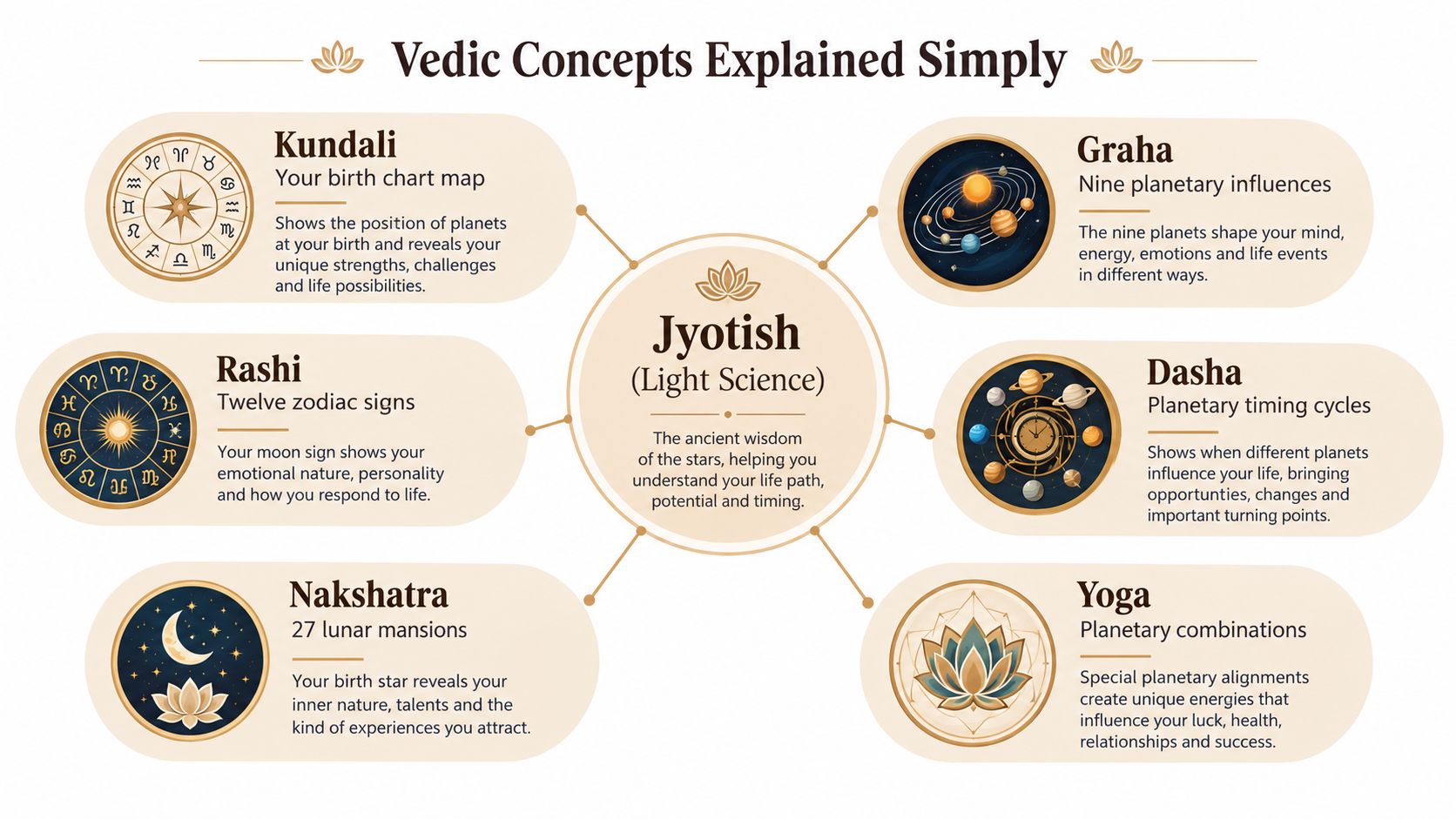
A kundli is a birth chart, a map of the sky for the time and place of birth. An astrologer studies it to see how houses, planets, and timing patterns fit together, much like a doctor reads a scan before giving advice. On Kismo, users can open a kundli reading when they want that full-chart view.
The terms that sound harder than they are
A nakshatra is one of 27 lunar mansions. In Vedic astrology, the Moon's nakshatra at birth helps set the opening point for the dasha sequence, which is the system of planetary time periods used in interpretation. Because nakshatras sit in fine slices of the zodiac, accurate birth time matters more than a general sun sign alone. Nakshatra basics
Muhurta means choosing an auspicious time to begin something, such as a wedding, housewarming, or business launch. Traditional selection looks at tithi, nakshatra, weekday, and local solar timing, so the date must be calculated for the place where the event will happen. Muhurta timing basics
Kundli matching for marriage uses Ashtakoota scoring, with a combined maximum of 36 points across eight factors. The factors are Varna 1, Vashya 2, Tara 3, Yoni 4, Graha Maitri 5, Gana 6, Bhakoot 7, and Nadi 8. The conventional threshold is more than 18 points, but the score is only one part of the judgement. Kundli matching explained
Useful habit: if a reader gets a rushed answer about marriage or timing, a stronger reading will still return to the individual chart rather than rely on a single score.
The point of these terms is practical. They help the astrologer move from broad language to specific guidance that fits one person's chart, one event, and one moment.
How to Verify an Astrologer's Credentials
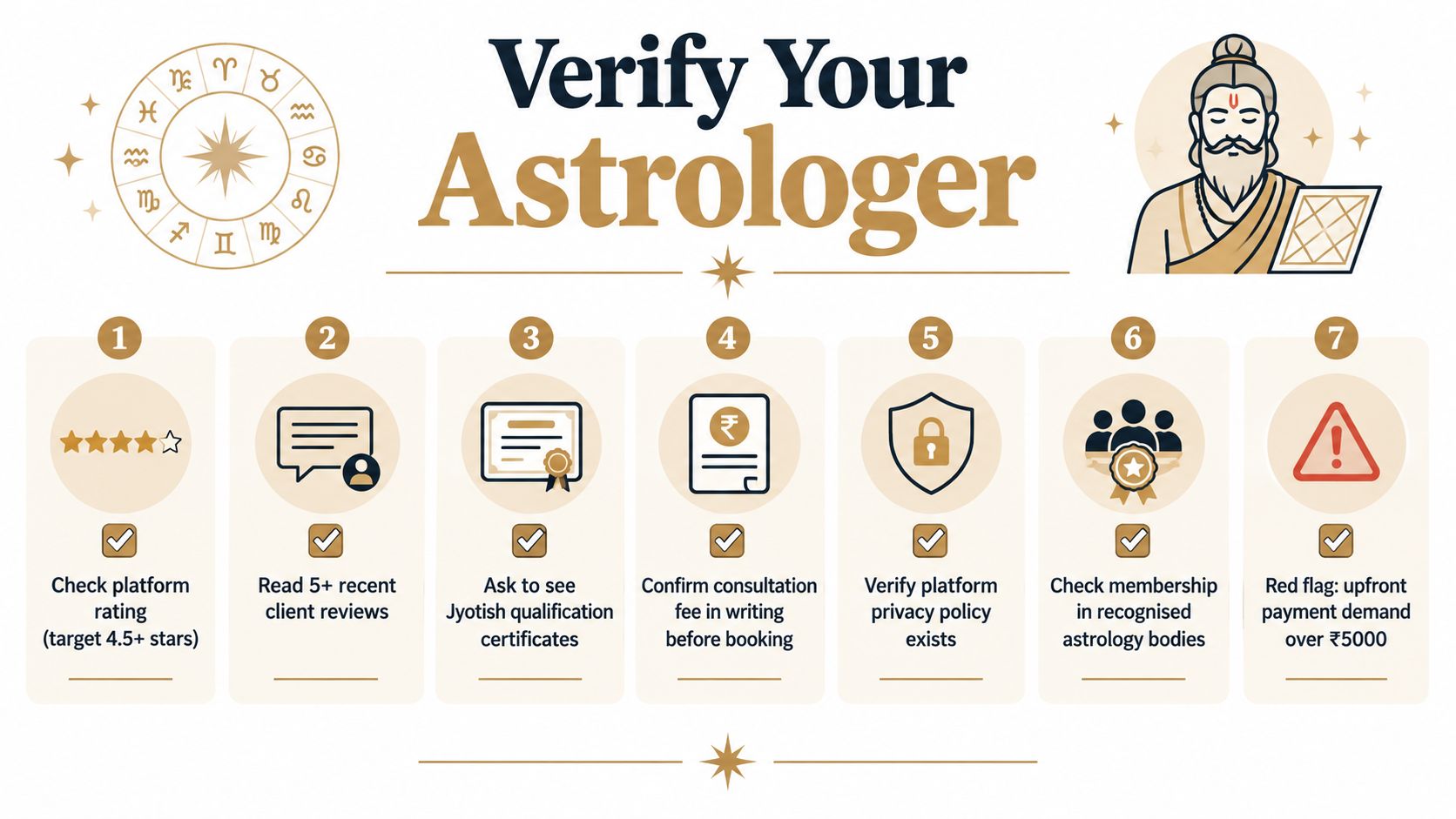
India's astrology field is not governed by one universal licensing system, so verification has to happen through the platform and through the reader's own judgement. That makes credential checks, written pricing, and clear session rules more important than a flashy profile.
What a careful check looks like
A reliable astrologer should be able to show more than confidence. Look for formal study, clear methods, and a platform that screens for quality before letting the practitioner meet clients. Indian institutions such as Sampurnanand Sanskrit University and Banaras Hindu University are reported to offer degree-level study from bachelor's and master's work to doctoral research, which shows that Jyotisha is increasingly treated as a structured field rather than only a family trade. Professionalisation and academic pathways
A strong vetting process usually includes checks that go beyond a self-written bio. It should confirm qualification, test chart calculation and interpretation, and watch for ethical behaviour during real sessions. Professional groups such as the Indian Council of Astrological Sciences and the All India Federation of Astrologers' Societies have tried to support education and ethical guidance, but consumers still need to judge the practitioner in front of them.
Questions that protect the reader
Use a simple checklist before booking:
- Ask for qualification proof: a serious practitioner should not be vague about training, lineage, or study.
- Confirm the fee in writing: the full price should be clear before the session begins.
- Check privacy rules: birth details, family data, and session notes should not be collected casually.
- Watch for pressure: no one should push repeated remedies, urgent payments, or fear-based add-ons.
- Look for verification by the platform: audits, interviews, and probation are stronger than a self-declared profile.
Kismo's verified astrologer process, for example, uses qualification checks, panel interviews, live audits, and a probation period before full access. That kind of structure helps separate a genuine professional from someone relying only on persuasive language. Astrologer profiles and verification
Transparent pricing is a sign of discipline. Hidden charges usually point to a weak service culture.
Choosing the Right Reading for Your Needs
Not every astrology session serves the same purpose, and choosing well saves time. A person asking about marriage timing needs something different from someone worried about a job change or a move abroad.
Match the question to the reading
A full chart reading is the best fit when the goal is broad understanding. It looks at houses, dashas, and recurring patterns, so the astrologer can explain why certain themes keep returning.
A kundli matching session is better when the question is about compatibility, family concerns, or a proposed marriage. The chart comparison matters more than a calculator score, because timing, temperament, and specific chart patterns can change the interpretation.
A muhurta reading is narrower. It focuses on the right time to begin something important, such as a wedding, a registration, or a housewarming. That kind of reading is useful when the decision has already been made, but the start date still needs care.
Career, money, and family readings work best when the user comes with one clear concern. An astrologer can then discuss supportive periods, likely blockages, and practical next steps without turning the session into a vague life overview.
A simple way to decide
If the question is “What is happening in this period of life?”, a full chart reading fits.
If the question is “Are these two charts a workable match?”, ask for compatibility analysis.
If the question is “When should this begin?”, request muhurta.
One option for users who want that range in one place is Kismo, which offers chat or call sessions across readings such as birth charts, compatibility, and timing guidance. The useful part is not the format itself, it's that the reading stays tied to the actual question.
Recognising Ethical Boundaries and Red Flags
A trustworthy astrologer gives guidance, not pressure. If the conversation shifts into fear, urgency, or certainty about health and death, the service has crossed an ethical line.
What should raise concern
Red flags are usually visible early. They include guaranteed outcomes, repeated demands for costly remedies, and claims that the client must act immediately or suffer severe consequences. They also include deterministic statements about illness, pregnancy, addiction, or death.
That boundary matters because astrology can support reflection, but it should not replace medical or mental-health care. India also lacks dedicated guidelines for online astrology platforms, so consumers often have to rely on broader consumer-protection routes when something goes wrong. The Consumer Protection Act, 2019 still offers remedies for unfair trade practices, and the National Consumer Helpline accepts complaints in 17 Indian languages. Consumer protection gap and complaint routes
What ethical practice should include
A better service keeps clear records, explains pricing before the session, and respects privacy. It should also allow the user to pause when a reading feels too intense or too commercial.
The astrologer agreement should make those boundaries visible in writing, because written terms are easier to review than spoken promises. If a practitioner refuses clarity on consent, data handling, or refund conditions, that is a sign to walk away.
Boundary to remember: a calm reading can help with reflection, but it should never isolate someone from doctors, counsellors, or emergency support.
For anyone comparing an astrologist or astrologer, the safest choice is the one that pairs skill with accountability. Kismo can be a practical starting point for users who want verified astrologers, clear session rules, and a format built around direct conversation rather than pressure.
If a reading is meant to guide an important decision, the process should feel steady, clear, and respectful from the first message. Visit Kismo to explore verified astrologers, compare reading styles, and book a session that fits the question rather than forcing the question to fit the service.