Good Timings Today: 7 Auspicious Windows
83% of Indians say they fix important dates using auspicious times or dates, while 44% say astrology can influence life events, so good timings today begin with a practical local window, not one universal clock time. Brahma Muhurta offers a simple general starting point, but local sunrise, Panchang factors, the activity itself, and a personal birth chart can change the recommendation.
How should someone choose a useful time today when a calendar gives several “auspicious” options? Muhurta means selecting a favourable time for an activity. The choice usually starts with the local Panchang, the traditional calendar, and the day's sunrise. It can then become more personal through a kundli, or birth chart, the current dasha, or planetary period, and the nakshatra, or lunar mansion.
A good window for meditation may not be the best window for signing a contract, beginning a journey, opening a shop, or holding a wedding ceremony. Britannica's Hindu calendar reference describes each day as 30 muhurta-s, with each lasting about 48 minutes in Western reckoning, showing why timing can be more precise than “morning” or “evening” guidance (Britannica's Hindu calendar reference).
The guidance below is traditional and reflective, not a promise of results. Practical deadlines, legal requirements, health needs, travel conditions, and other real-world responsibilities still come first.
Table of Contents
- 1. Shubh Muhurta During Brahma Hours
- 2. Tithi-Based Auspicious Dates
- 3. Nakshatra-Aligned Timing
- 4. Dasha-Based Favourable Periods
- 5. Hora-Based Time Windows
- 6. Transit-Based Timing
- 7. Yogas and Combinations
- Todays Top 7 Auspicious Timing Methods
- Use Today's Window With Good Judgement
1. Shubh Muhurta During Brahma Hours
Brahma Muhurta is a widely used general starting point for good timings today. It is traditionally associated with the period before sunrise, often treated in everyday practice as approximately 90 minutes before local sunrise. Because sunrise changes by place and date, the correct window must be calculated for the city rather than copied from a generic clock.
The quiet setting can suit activities that need concentration, intention, or careful preparation. A student might review a study plan, a professional might prepare a job application, and a business owner might organise documents before opening for the day. A person beginning a new learning routine may also find the early stillness easier to protect from interruptions.
This timing should be understood as a supportive ritual, not as evidence that a signature or launch will automatically succeed. A job offer still needs careful review, a registration still needs correct paperwork, and a business still needs sound planning.

A simple way to use it
- Check local sunrise: Set the alarm from a Panchang calculation for the relevant city, not from a fixed national schedule.
- Choose a focused task: Use the window for meditation, study, a formal call, document preparation, or a deliberate first step.
- Record the action: Note the date, local time, and activity if the timing may later be reviewed alongside a kundli.
- Keep the decision practical: A person shouldn't sign unclear terms only because the clock shows a favourable period.
A personal dasha can modify how useful a general window feels for a particular person. Anyone planning a major commitment may therefore use Brahma Muhurta as a convenient first filter, then seek individual chart guidance before treating it as the final choice.
2. Tithi-Based Auspicious Dates
Could the lunar day help narrow a suitable date without deciding everything on its own? A tithi is a lunar day in the Indian calendar, measured through the changing relationship between the Moon and the Sun. Traditional practitioners assess each tithi according to the activity being planned. Shukla Paksha, the waxing phase, is commonly linked with growth, beginnings, and building momentum.
Use that association as a first filter, not a complete answer. A housewarming, wedding, business launch, or property-related action may require a suitable tithi, weekday, nakshatra, and local time window to align. A single calendar date can also contain periods that suit one activity better than another.
Full-moon and new-moon dates therefore should not be labelled automatically good or bad. Each tithi carries its own traditional meanings and conditions. A reliable local Panchang provides more useful detail than a simplified social-media graphic.
A family arranging a ceremony might first shortlist dates in the waxing fortnight, then compare the muhurtas available on each date. A business owner could apply the same process to an inauguration. Someone planning a griha pravesh, or house entry ceremony, may also need to coordinate the property, family availability, and local sunrise.
Reading the day without overcomplicating it
- Start with the city: Panchang timings change by location, particularly around sunrise and sunset.
- Match the action: A date considered suitable for a wedding should not automatically be reused for a financial signing.
- Check the full Panchang: Tithi is one layer, so review the weekday, nakshatra, and available time windows as well.
- Plan early: Venue arrangements, travel, family commitments, and legal paperwork still need attention alongside astrological selection.
The practical role of tithi is similar to narrowing a search before making a final choice. It can help identify dates worth examining, while the full Panchang and the person's circumstances provide the necessary context. For a major commitment, a personal birth chart may refine the selection further, but it does not replace sound planning or clear agreements.
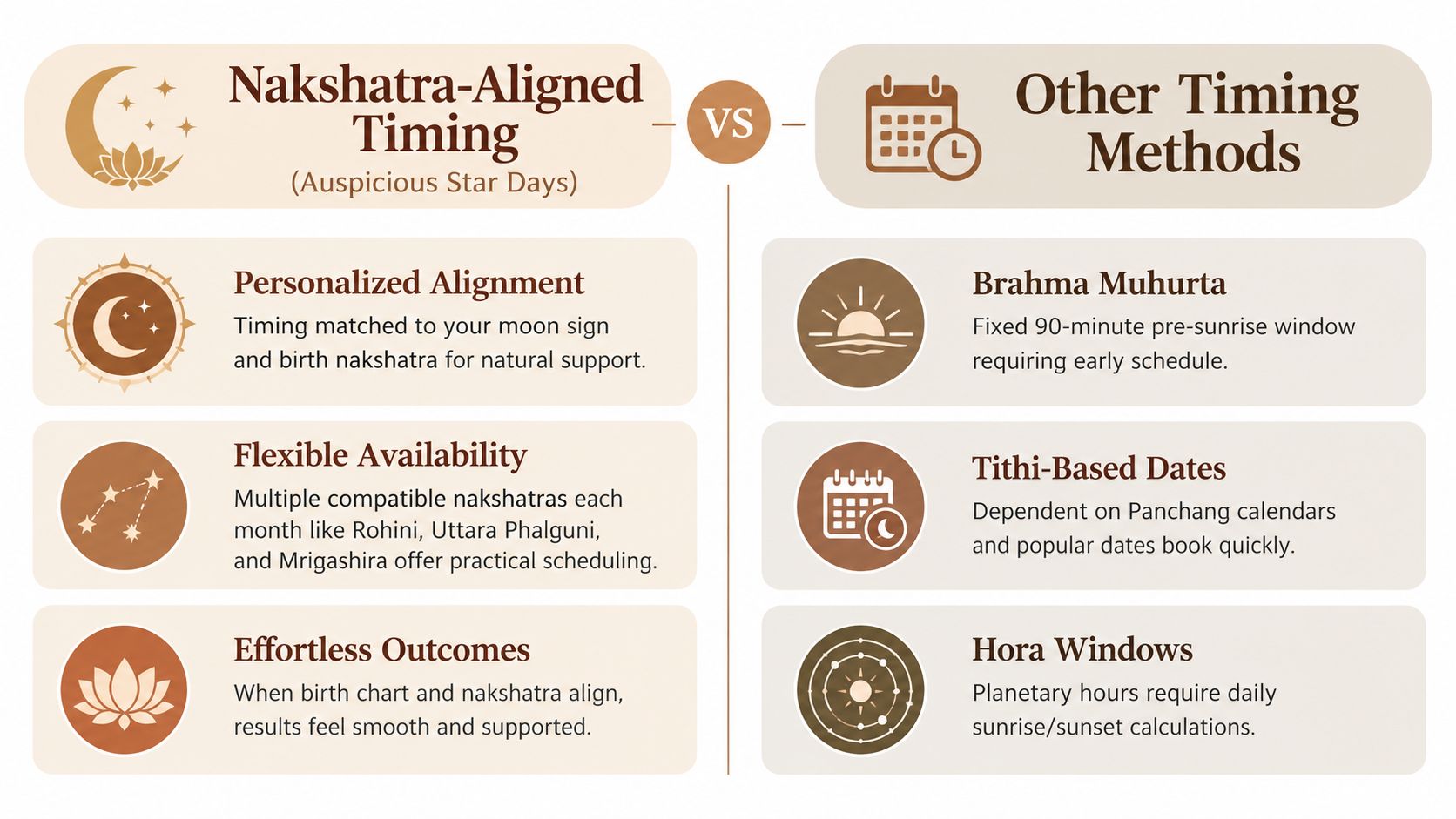
3. Nakshatra-Aligned Timing
A nakshatra is a lunar mansion used in Vedic astrology. A standard description presents the zodiacal sky as 27 equal divisions, while Britannica explains that nakshatras became significant elements in later astrological development (Britannica's history of astrology). In timing work, the Moon's nakshatra at the chosen moment becomes a filter for the quality and purpose of the activity.
This layer is more specific than choosing a favourable date. Traditional muhurta rules often treat the Moon's nakshatra as an important factor, with different nakshatras considered suitable or unsuitable for particular events, including marriage (Dehko Panchang's explanation of muhurta selection).
For example, a family considering a marriage date may compare the nakshatra with both partners' charts rather than choosing a day from a general calendar. A student beginning a course may ask whether the selected time supports concentration and continuity. A business owner may use the event's purpose, the founder's chart, and the day's lunar factors together.
Use the lunar mansion as a matching tool
The practical question isn't whether one nakshatra is universally perfect. It is whether the nakshatra suits the person, activity, and broader Panchang.
- Identify the natal Moon: A birth chart can show the person's Moon sign and birth nakshatra.
- Compare the purpose: A family ceremony, study plan, contract, and launch may call for different qualities.
- Review both partners: Marriage timing needs more than one person's preference.
- Avoid single-factor decisions: A favourable nakshatra can't cancel every other concern in the chart.
A nakshatra calendar can help locate candidate windows, but personalised interpretation matters when the event carries emotional, financial, or family consequences. The timing should make the decision more considered, not more anxious.
4. Dasha-Based Favourable Periods
A dasha is a planetary period shown in a Vedic birth chart. Instead of asking only whether today looks favourable, dasha analysis asks what long-term planetary period is active for the individual and whether the proposed action fits that period.
The best-known system, Vimshottari dasha, assigns 120 years across nine grahas, or planetary influences, in a fixed sequence. The Moon's birth nakshatra determines the starting dasha, which helps explain why an astrologer may request an accurate birth time and place before discussing career changes, marriage, or major commitments (Grimoire's Vedic astrology reference).
A person changing jobs may receive different guidance from a general daily Panchang and from a chart showing a period connected with career movement, learning, or responsibility. A couple may also compare each partner's active periods before selecting a wedding window. Such analysis can suggest whether the immediate task should be expansion, consolidation, preparation, or patience.
Make the birth data dependable
- Verify the birth time: Hospital records and family documents are more useful than an uncertain estimate.
- Map the current period: A qualified astrologer can distinguish the major period from its sub-period and interpret both.
- Match the scale: A dasha review is more relevant for a relocation, marriage, business launch, or career shift than for choosing a routine appointment.
- Use difficult periods constructively: Preparation, training, repair, and review may be wiser than forcing rapid expansion.
Readers seeking chart-based information can explore Kismo's kundli reading option for a fuller view of houses, dashas, and recurring life patterns. Dasha analysis can refine the calendar, but it still doesn't replace due diligence or guarantee an outcome.
5. Hora-Based Time Windows
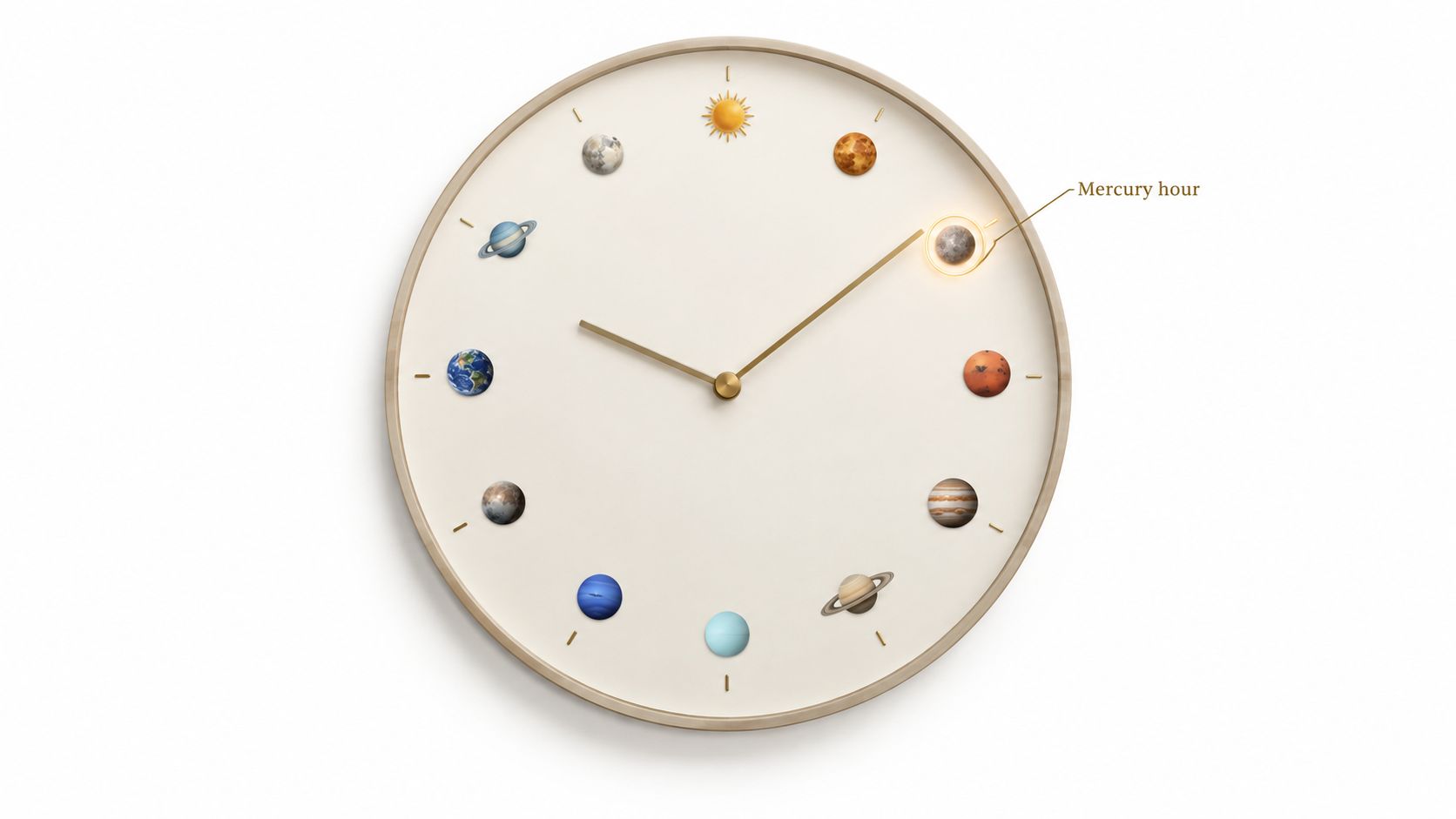
Which part of today is best suited to the task in front of you? Hora, or planetary hour, offers a practical way to narrow that choice after checking the date, tithi, and broader muhurta. Daylight and nighttime are divided into planetary periods, and each period's length changes with the local sunrise and sunset. Hora therefore works like a fine adjustment on a larger clock, rather than a complete timing method by itself.
Start with the task, then compare the available hours. A Mercury-associated hora is traditionally linked with communication, analysis, writing, and negotiation. Venus may be considered for a social gathering, relationship milestone, or design activity. Jupiter can be associated with teaching, mentoring, presentations, and discussions about growth. These links provide symbolic guidance, not a promise that an event will succeed.
A narrow use case makes hora easier to apply: someone preparing a communication-heavy document can compare the remaining Mercury periods, while a teacher might review Jupiter periods before a presentation. The practical caveat is just as important. A suitable planetary hour should not override a serious Panchang concern, a personal chart indication, a legal deadline, or another person's availability.
Apply the hour in four steps
- Define the task, such as writing, teaching, meeting, or gathering.
- Check the local planetary-hour sequence with a smartphone calculator.
- Compare the promising hora with the day's other timing factors.
- For major decisions, consider whether the person's birth chart changes the picture.
Kismo's free astrology tools can help readers explore related chart and timing information. Use hora as an additional selection aid, while keeping sound judgement, practical constraints, and the quality of the decision at the centre.
6. Transit-Based Timing
Which part of today's sky matters for your decision? Transits answer that question by comparing current planetary positions with a person's birth chart. They add a personal layer to a general calendar reading, showing how movements may interact with natal houses, planets, and sensitive points.
This method suits decisions such as a career move, relocation, investment, engagement, or business expansion. An astrologer might examine whether the current pattern supports visibility, responsibility, partnership, learning, or financial caution. The same transit can carry different meaning for two people because their charts differ.
A professional choosing between two joining dates could compare each date's practical conditions with current career indicators in the chart. For a ceremony, the couple's charts may be reviewed alongside the event window. A difficult period does not require fear or inaction. The person can verify documents, reduce exposure, prepare a backup plan, or complete a smaller step before the larger commitment.
A useful transit review answers three questions:
- What is moving? Identify the planets and areas of life involved.
- Whose chart is being assessed? A general forecast offers broad context, while a natal chart can show more personal relevance.
- What can be adjusted? Compare available dates, responsibilities, and practical risks before choosing.
Yearly transit calendars can flag periods that deserve closer attention, while dasha analysis may clarify whether a transit supports expansion, preparation, or restraint. Fixed dates still require practical compliance. An employer, court, school, bank, or travel provider may set a deadline that cannot be changed.
Kismo's planet transits tool can help explore this layer. Use the result to compare options and trade-offs, not to treat planetary movement as a guaranteed outcome.
7. Yogas and Combinations
Which planetary combinations may shape a proposed action? In Vedic astrology, a Yoga is a relationship among planets in a birth chart or a combination formed by current planetary movements. Names such as Gajakesari Yoga, Raja Yoga, and Dhana Yoga can offer a starting point, but a label alone cannot establish timing or outcome.
Interpretation depends on the chart's wider structure. An astrologer may review the houses involved, planetary strength, dasha activation, transits, and the purpose of the action. A combination linked with resources might suit a business decision, while another may relate more closely to learning, authority, partnership, or public recognition. The same yoga can carry different meaning for different people.
A founder selecting a launch date can apply the layers in order. A daily calendar window may identify a workable period, a nakshatra can refine it, and dasha or transit analysis can indicate whether the founder is better placed for expansion or groundwork. Yoga analysis adds context when a relevant combination is active during that proposed window. It does not replace checking contracts, budgets, staffing, or market conditions.
Use these questions to keep the reading practical:
- What does the yoga involve? Identify the planets, houses, and life area connected to it.
- Is it active now? A related dasha or transit may make the combination more relevant during one period than another.
- Does the timing fit the person? General timing offers broad guidance, while a complete birth chart can show personal relevance.
- Are other options stronger? Compare dates, responsibilities, and practical risks before choosing.
A selected date and its reasoning can be recorded for later reflection. Traditionally favourable combinations may support planning, but they cannot replace financial advice, compatibility discussions, medical care, legal review, or honest communication.
Todays Top 7 Auspicious Timing Methods
| Item | Implementation complexity | Resource requirements | Expected outcomes | Ideal use cases | Key advantages |
|---|---|---|---|---|---|
| Shubh Muhurta During Brahmana Hours (Brahma Muhurta) | Low, fixed daily window, easy to apply | Minimal, local sunrise time, alarm | Enhanced focus, calm starts, general auspiciousness | Rituals, study, signing documents, launches requiring clarity | Universal, simple, consistent daily opportunity |
| Tithi-Based Auspicious Dates (Shukla Paksha & specific tithis) | Moderate, monthly Panchang checks and scheduling | Panchang/calendar, scheduling lead time, optional astrologer | Socially harmonious, energy for growth and celebration | Weddings, housewarmings, business launches, group events | Widely accepted tradition; multiple monthly options |
| Nakshatra-Aligned Timing (Auspicious star days) | Moderate–High, requires moon sign and nakshatra matching | Birth chart (moon), nakshatra calendar, astrologer recommended | Personalized support; smoother outcomes when aligned | Marriage (kundli matching), personal milestones, education | Highly personalized timing; frequent monthly windows |
| Dasha-Based Favourable Periods (Planetary period alignment) | High, complex multi-year calculations | Accurate birth time, full chart analysis, expert astrologer/software | Major life-phase alignment; strong long-term support | Career shifts, marriage, investments, life-stage decisions | Most powerful predictor; aligns actions with life rhythm |
| Hora-Based Time Windows (Planetary hours) | Low–Moderate, daily hour calculations | Sunrise/sunset times or hora app | Short-term planetary boost; subtle, focused effects | Important calls, signings, negotiations, daily tasks | Precise hourly targeting; complements larger muhurtas |
| Transit-Based Timing (Current planetary positions) | High, ongoing monitoring and interpretation | Birth chart, transit ephemeris or astrologer, regular updates | Timely opportunity or caution windows; dynamic effects | Year planning, launches, investments, timing-sensitive events | Current, flexible insights; integrates with dasha and transits |
| Yogas and Combinations (Auspicious planetary alignments) | Very high, expert-level identification and timing | Accurate birth time, full chart, specialist astrologer | Concentrated auspiciousness when active; high-impact results | Major commitments: marriage, business founding, relocation | Highest precision and potency when active; synthesizes all timing layers |
Use Today's Window With Good Judgement
The simplest decision path starts with the local Panchang and sunrise. The reader first identifies the city, checks the day's tithi, nakshatra, Rahu Kaal, Abhijit Muhurta, Brahma Muhurta, and other listed periods, then notes which windows overlap with the actual schedule.
The next step is to match the window to the activity. A quiet early period may suit meditation, study, or preparation. A communication-focused hora may be considered for a call or document review. A wedding, property signing, business launch, or housewarming needs a more careful comparison because the event may involve several people, legal steps, travel, and lasting commitments.
Current India-focused Panchang pages often list several daily bands, but a list of times doesn't always explain which one best suits a specific action or city. That is the practical gap a reader should solve: not “Which time is universally lucky?” but “Which available window is suitable enough for this activity, in this location, under these conditions?”
A useful sequence looks like this:
- Locate the day correctly: Use the relevant city and local sunrise.
- Filter the calendar: Note the tithi, nakshatra, and major daily periods.
- Match the activity: Separate a routine beginning from a high-stakes commitment.
- Add personal factors: For important decisions, review the kundli, dasha, and transits.
- Check the practical world: Confirm availability, documents, deadlines, safety, budget, and consent.
- Choose without fear: If the perfect window isn't possible, select a reasonable option and proceed carefully.
Traditional timing has a broad cultural place in India. A Pew Research Center India survey found that Hindus were the major religious group most likely to say astrology can influence events, at 49%, compared with the national average of 44% (the survey summary). The figures point to variation in belief, not a requirement that every person follow the same method.
No muhurta guarantees a result. A personal birth chart can change the recommendation, and an astrologer may advise postponement, preparation, or a different type of action rather than just naming a clock time. Kismo is one option for readers who want one-to-one timing guidance through chat or call, including support with birth charts, marriage compatibility, career questions, and muhurta selection.
For a personalised timing discussion, Kismo connects users with verified astrologers by chat or call and supports guidance on kundli readings, marriage, career, and auspicious beginnings. Readers can visit Kismo to compare a personal chart with the day's available windows and choose a practical next step.