
How Can I Know My Birth Time from Records

A family member asks for a birth time for a kundli, the natal birth chart used in Vedic astrology, and the only paper at home shows a date with no hour. That's the moment when many people search "how can I know my birth time" and feel pressure to supply a neat minute. There's no need to invent one. A calm record search can separate an official time, a family-recalled time and an estimated time.
Table of Contents
- Where a Recorded Birth Time Usually Lives
- How to Request the Birth Record Step by Step
- When the Certificate Shows Only the Date
- How to Interview Family Without Inventing a Minute
- How Chart Rectification Narrows an Unknown Time
- What to Prepare Before You Book a Reading
Where a Recorded Birth Time Usually Lives
A family in Jaipur is preparing a wedding kundli and finds a birth certificate with the right date, place and parents' names, but no clock time. The answer isn't to choose the time an aunt half remembers. The minute worth trusting is the one written nearest the birth by a hospital or by the registrar at the place of birth, not a later memory and not a horoscope built on a guess. In Vedic astrology, a small clock change can move the lagna, the ascendant or rising sign at birth, so the source has to come before any chart.
Start With the Civil Record
In India, the first step is the original civil birth record or a certified birth certificate from the Registrar of Births and Deaths at the place where the birth occurred. The Registrar General and Census Commissioner, India notes that registration is governed by the Registration of Births and Deaths Act, 1969, registration is mandatory, and the normal reporting period is 21 days, with events reported in that period generally eligible for a certificate without a registration fee.
That official route is worth checking even for older births. The same office reports that the national proportion of registered births increased from 82.4% in 2011 to 92.7% in 2019, and the 2024 report states registration reached 99.1% in 2024, with registered births rising from 252.1 lakh in 2023 to 254.7 lakh in 2024. A missing older file is common, not a personal failure. Coverage improved over time, so an incomplete record from decades ago doesn't mean the family was careless.
Practical rule: Label every clue as official, family-recalled or estimated as soon as it appears. Don't let labels merge later.
Where a Birth Minute Is Usually Written
| Source | Typical time detail | Weight for the minute | Where to look |
|---|---|---|---|
| Birth register or birth certificate | Date, place, parents, and sometimes hour and minute | Highest when the register itself shows the clock time | Registrar of Births and Deaths at the place of birth |
| Labour-room or delivery register | Hour and minute entered around the birth | Highest clinical source | Hospital medical records or maternity archives |
| Discharge summary or case sheet | Time of birth if the ward recorded it | Strong if written at discharge, weaker if retyped later | Hospital or the family's own papers |
| Immunisation or child-health card | Often the date only, sometimes a copied time | Supporting, not primary | Clinic book or family file |
| School admission form | Date, and occasionally a time added years later | Low, because the time often came from memory | School records office |
| Passport or other identity application | Date of birth, rarely a verified minute | Low for the minute | The applicant's own copies |
| Family diary, letter or announcement | A noted or remembered clock time | Useful only if written within days of the birth | Relatives who were present |
| Printed horoscope or pandit note | Whatever time was supplied at the time | Not proof unless it cites a record | Family papers |
If papers disagree, keep the range, such as between 2:10 and 2:40 a.m., rather than picking a midpoint. Treat a round 6:00 a.m. as a clue, not a proven minute, because rounded hours are often how people summarise a night they didn't watch on a clock.
How to Request the Birth Record Step by Step
One documentary path works best, and astrology stays out of it until the papers have had a fair chance. The flow below shows the order, so no office gets approached with half the details missing.
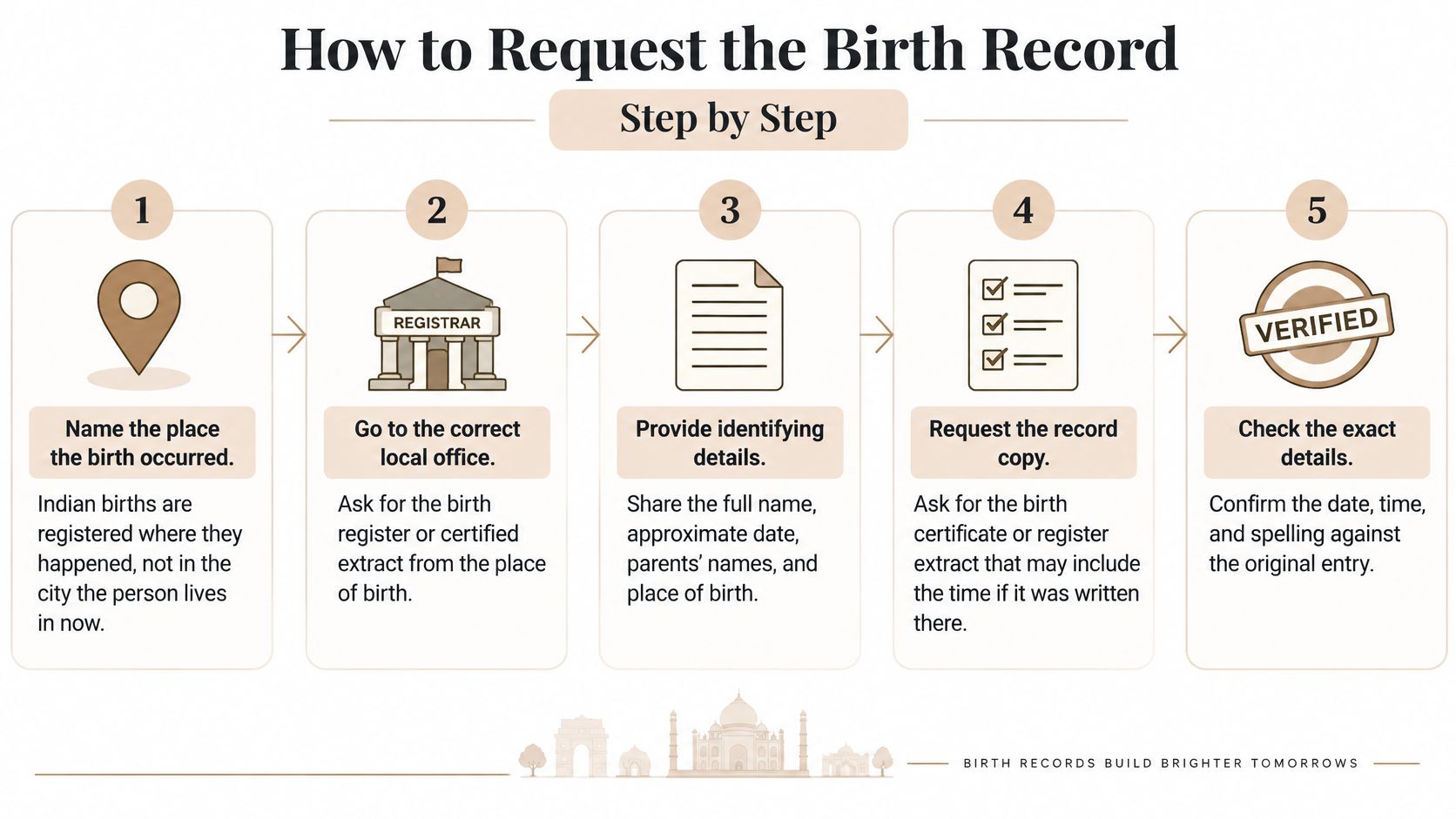
The Five Requests in Order
- Name the place the birth occurred: Indian birth events are registered at the place of occurrence, not in the city the person lives in now. A person born in Indore and living in Pune needs the Indore record first.
- Request the certificate from the right registrar: The Government of India Civil Registration System FAQ describes a system coordinated nationally by the Registrar General of India and implemented through state-appointed registrars. The request goes to the municipal corporation, municipality, gram panchayat, hospital-linked registrar, state portal or national Civil Registration System route serving the birthplace.
- Ask the hospital for clinical papers: Request certified copies of the labour-room register, discharge summary, birth notification and case sheet. Ask for copies, not a verbal summary over the counter, because a copied minute can be checked later against other documents.
- Lay every time side by side: Compare the certificate, hospital papers and family records on one page. Keep the earliest institutional source as the primary record and note any disagreement as a range.
- Get the search result in writing: If nothing is found, ask for written confirmation of the search and list every surviving clue before any chart work begins. That written result stops the same office being searched again from scratch months later.
The national public login route helps when an old paper certificate can't be found or the birth happened at home. A registered user can apply and track the file, but a digital request can't create a minute that was never reported. It can only surface what the registrar recorded.
Timing Rules and Common Slips
Hospitals are responsible for reporting births, normal reporting is within 21 days, and certificates for registered events should generally be issued within seven days after registration is completed, according to the same official FAQ. Because state registrars carry out the national system, forms, counters and archive practices differ by state. A polite, specific request works better than a general plea for "old records".
Four slips cause most failed searches. Families apply in the current city instead of the birth location. They mix the registration date with the birth date, so staff search the wrong week. They miss a file under the mother's maiden name or under a spelling used at admission. They also treat a rounded hour as exact, then build a whole chart on a tidy number that nobody measured.
Carry identification, proof of relationship where needed, the full name as first recorded, parents' names, the birth date and the hospital or locality. If the name was added or changed later, carry both versions. Staff can search a register far faster when the spelling, date and ward details arrive together.
A date-only certificate doesn't prove the clock time was never written. It proves only that the short certificate doesn't display it.
Keep certified copies together in one folder, with a note naming the office, the date of the request and the person who searched. That small habit turns a frustrating paper chase into evidence another relative, or an astrologer, can understand without starting again.
When the Certificate Shows Only the Date
India's civil register exists mainly to record that a birth happened, so a short certificate may show only the date even when a clock time was written in the hospital. The Civil Registration System portal sits within a system whose 2024 national report recorded 25.47 million registered births with 99.1% completeness, yet the system's core purpose is registration of the event, not preservation of a clinically verified minute-by-minute delivery time.
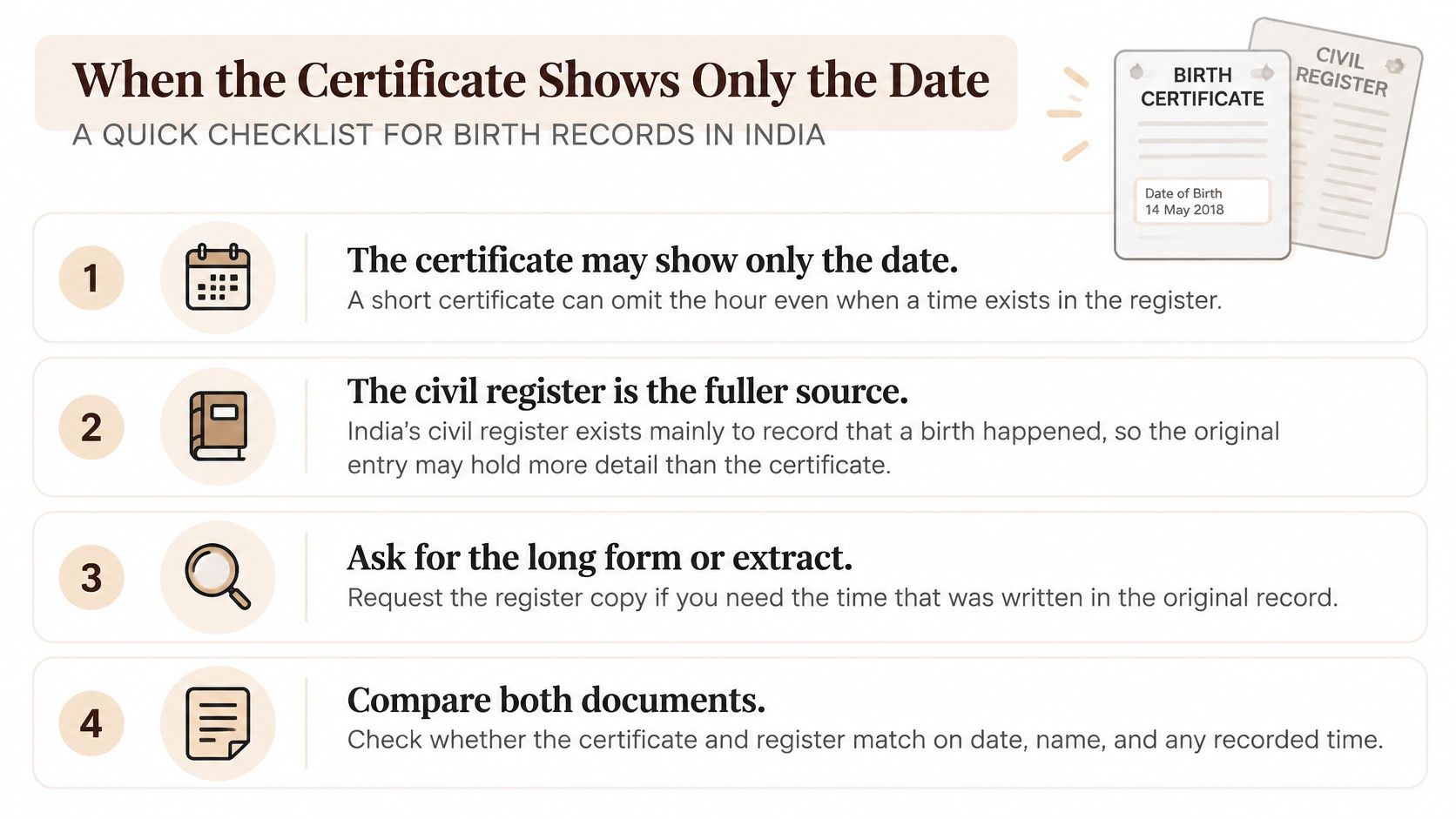
Ask the Next Desk, Not the Same One Again
Step 1: Ask the municipal registrar whether the original birth register contains a time field. The certificate in hand may be a short extract, while the register entry behind it may hold more detail. If no time field exists, request written confirmation.
Step 2: Contact the hospital's medical-record department, maternity ward or archives. Ask for the delivery register, newborn record, labour-room register, discharge summary or an authenticated duplicate. Access may need identity proof, proof of relationship or written consent from a parent, and hospitals can restrict records to authorised people. The birth-certificate desk may also be separate from the clinical records desk, so expect more than one visit.
Step 3: Check when the time was written. A time on a school form, passport or family note added years later is weaker than an entry made at the hospital or in a diary written within days of the birth. Later documents often copy an earlier guess so neatly that the guess starts to look official.
Who to Ask When the Certificate Has No Time
| Who to contact | Document to request | A useful result |
|---|---|---|
| Municipal registrar at the birthplace | Original birth register, not only the short certificate | A time field, or written confirmation that none was recorded |
| Hospital medical-record department | Delivery register, newborn record, labour-room register | An entry on the birth date with hour and minute |
| Maternity ward or archives | Case sheet and birth notification | A note made at the time that matches the register |
| Family file of hospital papers | Discharge summary | A time written when the mother left, kept apart from later guesses |
The Old-Clock Caution
For very old births, preserve the diary's original wording and place before converting anything. Modern Indian births use Indian Standard Time with no daylight-saving adjustment, but some older records were written in regional local time rather than the standard used today. Silent conversion can shift the time enough to change the ascendant, house cusps and sometimes the Moon's nakshatra, its lunar constellation division.
Before testing a recovered time in a chart, a reader can use the free astrology tools page to see whether a nearby time changes the lagna. That check doesn't prove the minute. It shows how much caution the remaining uncertainty deserves.
How to Interview Family Without Inventing a Minute
Offices hold registers, but people hold the texture of the day. A home-birth conversation shows how to collect that texture without forcing a precise answer. Say a grandmother in a small town remembers a baby arriving "in the deep night, after the rain stopped". That's useful. It becomes harmful only when somebody converts it, on the spot, into 2:17 a.m.

Ask Separately and Ask Concretely
The useful relatives are those who were in the room or arrived the same day. That may be the mother, father, grandmother, the neighbour who fetched the midwife, or the sibling who wrote a letter. Ask each person separately, before anyone hears the others' answers, so memories don't align unnoticed around the loudest voice.
Concrete questions work better than "What time was it?" Was it before or after the morning aarti, the daily lamp-and-prayer ritual? Was the sun up? Which meal had just finished? Was it raining, and how long after the pains started did the baby arrive? Write each answer in the person's own words, with whether a clock was seen.
- A memory of night: Treat it as a window, perhaps several hours wide.
- A memory of 2:17: Treat it as exact only if the person read a clock and wrote it down then.
- A same-week diary or announcement: Treat it as the strongest family source, still labelled family-recalled.
Preserve the Original Wording
Historical records need the place kept beside the words. The Indian Standard Time reference gives IST as UTC+05:30, formally adopted on January 1, 1906, while Bombay retained local time until 1955 and Calcutta until 1948. For most modern births, no daylight-saving adjustment applies, but an old note shouldn't be converted until the locality and year are clear.
Compare the family window with immunisation cards, school forms and diaries, giving more weight to anything created closest to the birth. If an aunt says just after 2 and a discharge slip says 2:40, record 2:10 to 2:40 rather than splitting the difference. Don't let the family vote for the time that makes a preferred chart.
Finish with a one-page clue sheet. List each source, the exact words, the date the note was made, and the label official, recalled or estimated. That sheet protects everyone's memory from being polished into false precision.
How Chart Rectification Narrows an Unknown Time
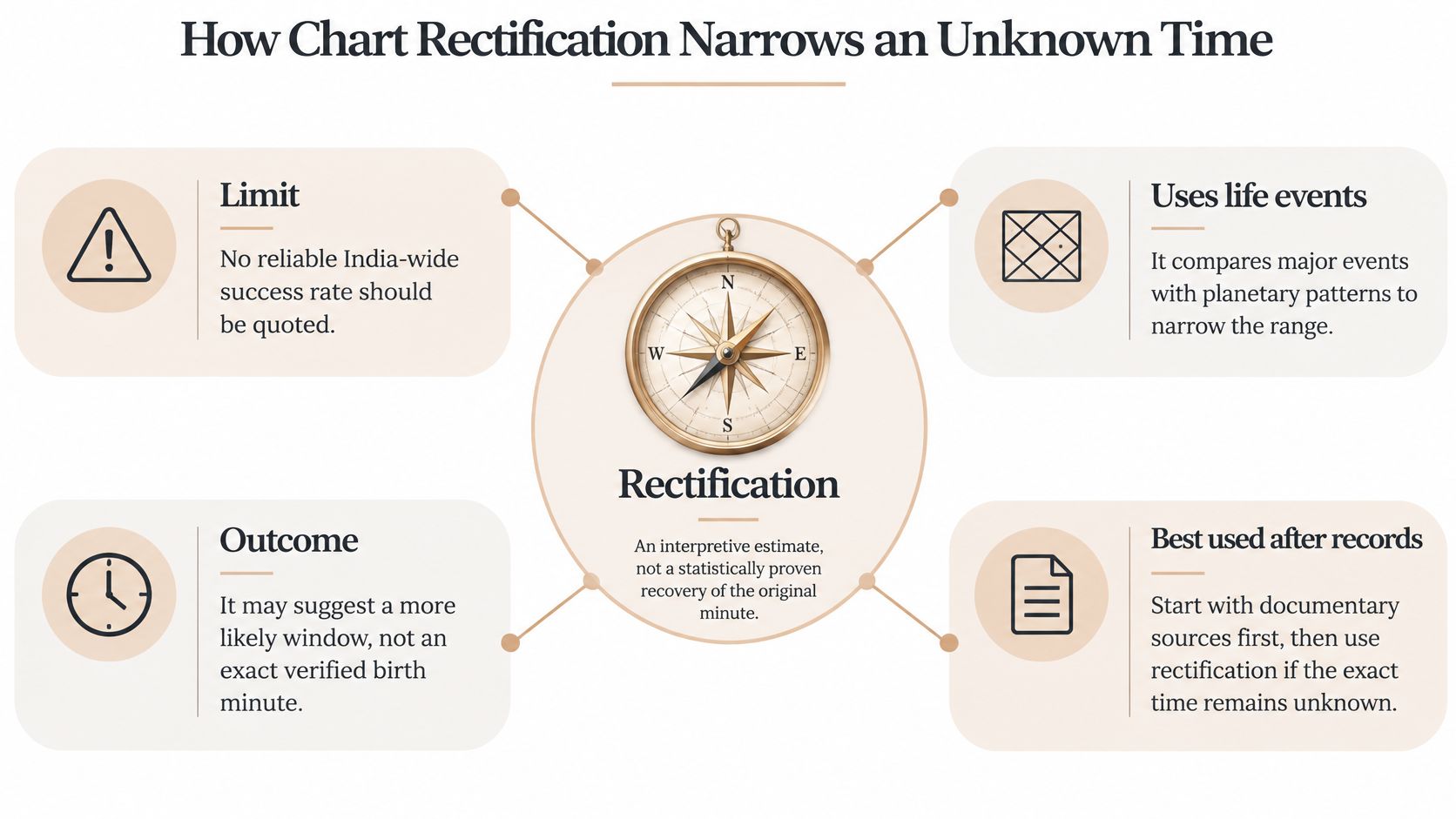
Rectification has a clear limit, and it comes before the method. It's an interpretive estimate, not a statistically proven recovery of the original minute, and no reliable India-wide success rate should be quoted. A chart exercise can't replace a hospital register, and a convincing story isn't the same as measured accuracy.
Check Late Registration First
If the birth was never registered, late registration comes before rectification. The Registration of Births and Deaths Act, 1969 provides that births reported after 30 days but within one year require prescribed permission and supporting documents, while events unregistered after one year require a magistrate's order after verification.
Registration Windows and What They Require
| Reporting stage | What applies |
|---|---|
| Within 21 days | Normal reporting window; a certificate is generally issued without a registration fee |
| After 21 days, within 30 days | Delayed registration procedures apply, so follow the local registrar's late-reporting route and supporting papers |
| After 30 days, within one year | Prescribed permission and supporting documents required |
| After one year | Magistrate's order required after verification |
Build the Event List
When papers can't supply a minute, build a dated list of specific life events. Useful entries include marriage, childbirth, major surgery, accident, graduation, first job, job loss, migration and bereavement. For each one, note the exact date, place and a documentary time if one exists. Vague entries such as "career trouble around 2019" can't test anything.
Give the astrologer the widest honest window, such as between 2 and 5 p.m., not a confident invented minute. A practitioner may test that window with Vimshottari dasha, the main planetary-period system in Vedic astrology, plus divisional charts, transits or KP sub-lords. KP sub-lords are the finer divisions of each nakshatra used in the Krishnamurti Paddhati (KP) method, a system some practitioners use alongside Vimshottari dasha.
Fair test: Comments on each candidate time should be written before the family's preferred time is revealed.
Score Only What Was Agreed in Advance
Ask for several candidate times, including one control time the family doesn't prefer. Score only events agreed before the work starts, such as whether a marriage fell in a stated window. Don't allow events that don't fit to be dropped, and don't change the birth time after seeing a pleasing reading. Those habits create confirmation bias, where the chart appears accurate because only matching details were kept.
A single minute shouldn't be reported unless several independent events point to the same narrow band. If two nearby times change the reading in a material way, the honest result is the uncertainty itself, not a frightening prediction built on one unproven option. A reader preparing a chart through the online kundli page should carry that range forward openly, so any later interpretation can state which parts depend on the unresolved minutes.
What to Prepare Before You Book a Reading
Book a reading after the document search, not as a substitute for it. Accurate guidance depends on the individual birth chart, and users must enter accurate birth date, time and place because these are the input for every chart the astrologer prepares. On Kismo, a client is asked what is on their mind, which languages the astrologer should speak, and their birth details. Birth details entered wrongly aren't grounds for a refund, so the date, time and place need checking before a reading starts.
A Short Brief With Four Items
- Birth date and place: Give the full date, plus the city and state of birth. Place matters because the chart is calculated for where the birth happened.
- Time with its label: Give a verified time, or a clear range marked official, family-recalled or estimated. A labelled range is more helpful than a polished guess.
- Four to six dated life events: Choose specific events such as a marriage, a job change, a move or a child's birth. Exact dates let the astrologer see whether the range needs testing.
- The actual question: State whether the concern is marriage timing, career, compatibility or a muhurta, an auspicious time chosen for a beginning such as a wedding or griha pravesh, the ceremony of entering a new home.
Also note whether nearby times have been checked for a change in ascendant. That one detail tells the astrologer how sensitive the chart is to the missing minutes. Readers browsing verified astrologers for a personal reading don't need to invent a minute to sound prepared.
Start the session by stating the range plainly. Then ask which parts of the chart stay the same across that range and which parts change. A calm reading names two or three practical priorities, explains the reasoning and avoids promising a result. It shouldn't frighten anyone with a conclusion that rests on a single unproven minute.
A paste-ready brief can be one sentence. For example: "Birth date is the stated day, born in the stated city and state, time between 2:10 and 2:40 a.m. (family-recalled), and the question is about marriage timing." That sentence gives the astrologer facts, uncertainty and purpose at once. It's the safest answer to How Can I Know My Birth Time when the documents support a window rather than a minute, because it keeps the reading honest from the first line.
Once the birth record search has produced a verified minute or an honest range, Kismo connects users with verified astrologers by chat or call for personalised chart readings, kundli matching, career guidance and muhurta selection. Bring the labelled time, dated life events and one clear question, and the conversation can focus on practical guidance rather than guessing the basics.