
How to Know if You Are Manglik: A Clear Practical Guide

A family may be discussing wedding dates when someone notices a line on a kundli, the traditional Vedic birth chart, saying that one partner is Manglik. Questions appear quickly. Does it affect marriage? Is the result final? What happens if one calculator says yes and another says no?
The answer depends on more than Mars in a single house. A careful check uses a Vedic sidereal chart, compares Mars from the Lagna, Moon, and Venus, verifies the birth time, and then considers cancellation or mitigation rules. The result is a chart factor to understand, not a prediction of marital failure.
Table of Contents
- What It Means to Be Manglik in Vedic Astrology
- The Three Reference Points to Check Mars From
- Why Two Astrologers Can Give Different Manglik Verdicts
- How Birth Time Accuracy Changes the Result
- Cancellation Rules and Common Exceptions to the Dosha
- Self-Check Versus a Full Kundli Reading
- Practical Next Steps and Where to Get Guidance
What It Means to Be Manglik in Vedic Astrology
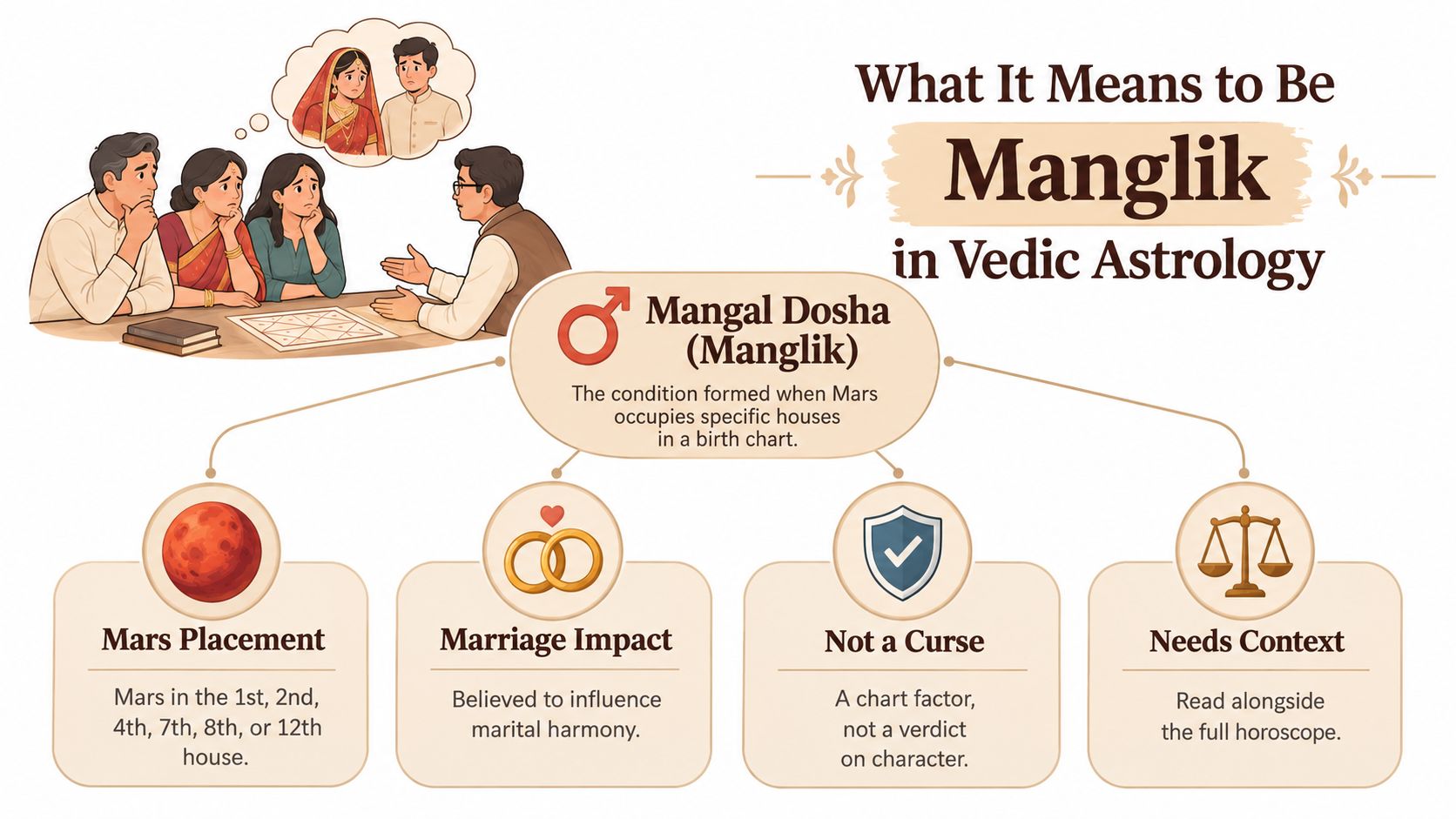
Mangal Dosha, also called Kuja Dosha, is a traditional condition in Vedic astrology linked with Mars. A person whose chart contains the relevant Mars placement is commonly called Manglik. In the classical house-based method, astrologers check whether Mars occupies the 1st, 2nd, 4th, 7th, 8th, or 12th house from a chosen reference point, most commonly the Lagna or ascendant, as described in this Manglik Dosha guide and calculator.
Mars represents courage, action, physical energy, assertion, and, when poorly balanced, impatience or conflict. The 7th house relates directly to marriage and the life partner, while the 1st house describes the individual's temperament and way of responding to life. Traditional interpretation therefore treats Mars in sensitive relationship or domestic houses as a sign that strong emotions and strong wills may need conscious management.
That interpretation shouldn't be confused with a curse. Manglik status doesn't decide a person's character, guarantee relationship problems, or prove that a marriage will fail. It indicates a tendency that astrologers read alongside the complete horoscope, including the strength of the 7th house, the condition of Mars, planetary aspects, and the partner's chart.
A casual quiz may produce a quick label, but a kundli-based assessment asks which chart system was used, where Mars is placed, and whether exceptions apply. The house rule is only the beginning of finding out how to know if you are Manglik.
The Three Reference Points to Check Mars From
A fuller Vedic astrology check uses a sidereal birth chart, not a Western tropical chart. Mars is examined from three anchors: the Lagna, the Moon, and Venus. Each anchor gives a different angle on the same Mars placement, and the usual dosha houses remain the 1st, 2nd, 4th, 7th, 8th, and 12th.
| Reference Point | Dosha Houses (1-12) | What It Reflects |
|---|---|---|
| Lagna, or Ascendant | 1st, 2nd, 4th, 7th, 8th, 12th | Overall life impact, temperament, and behaviour |
| Moon sign, or Rashi | 1st, 2nd, 4th, 7th, 8th, 12th | Emotional responses, mental peace, and family perception |
| Venus | 1st, 2nd, 4th, 7th, 8th, 12th | Romance, attraction, and marital harmony |
To count from the Lagna, the first house is the sign containing the ascendant. Count that sign as one, then move through the signs in order until reaching Mars. If Mars falls in a listed house, the Lagna-based check is positive.
The Moon check starts with the sign containing the Moon. This is often called the Rashi, meaning Moon sign. The Venus check starts with the sign containing Venus, because Venus is a karaka, or significator, of affection, partnership, and relationship enjoyment.
Whole-sign house counting keeps the process simple for beginners. If Mars is in the seventh sign from the Moon, for example, the Moon-based check identifies a sensitive placement even if Mars isn't in a dosha house from the Lagna. That doesn't automatically make the entire interpretation severe. It means the result needs to be labelled accurately, such as Lagna-based, Moon-based, or Venus-based Manglik.
Practical rule: A chart that is Manglik from only one reference point shouldn't be treated the same way as a chart that shows the condition from all three.
Why Two Astrologers Can Give Different Manglik Verdicts
A person can enter the same birth details into two calculators and receive different answers without either result being deliberately careless. The disagreement often comes from the rules each practitioner follows.
The first difference is definition drift. Some astrologers use all six houses, while others give priority to a narrower group or apply the 4th and 12th houses selectively. Regional teaching also matters. Some North Indian traditions use the 1st, 4th, 7th, 8th, and 12th houses, while some South Indian traditions replace the 1st with the 2nd, as described in this overview of Mars in the houses.
The second difference is the reference point. A basic calculator may inspect only the Lagna. A stricter reading may also check the Moon and Venus, which can turn a Lagna-only “no” into a Moon-based or Venus-based “yes”. Sources also differ on whether a strong conclusion requires Mars to fall in sensitive houses from one reference point or from at least two, a variation discussed in this explanation of Manglik Dosha interpretation.
The chart is the same, but the method may not be
North Indian diamond charts and South Indian square charts display the same planetary data in different visual layouts. A reader who transfers house notes incorrectly can count from the wrong sign, especially when comparing screenshots or handwritten kundli details.
Deeper readings may also consider nakshatra, a lunar constellation used for finer interpretation, or sub-lord and divisional factors. These don't replace the house check, but they can influence how strongly an astrologer interprets Mars.
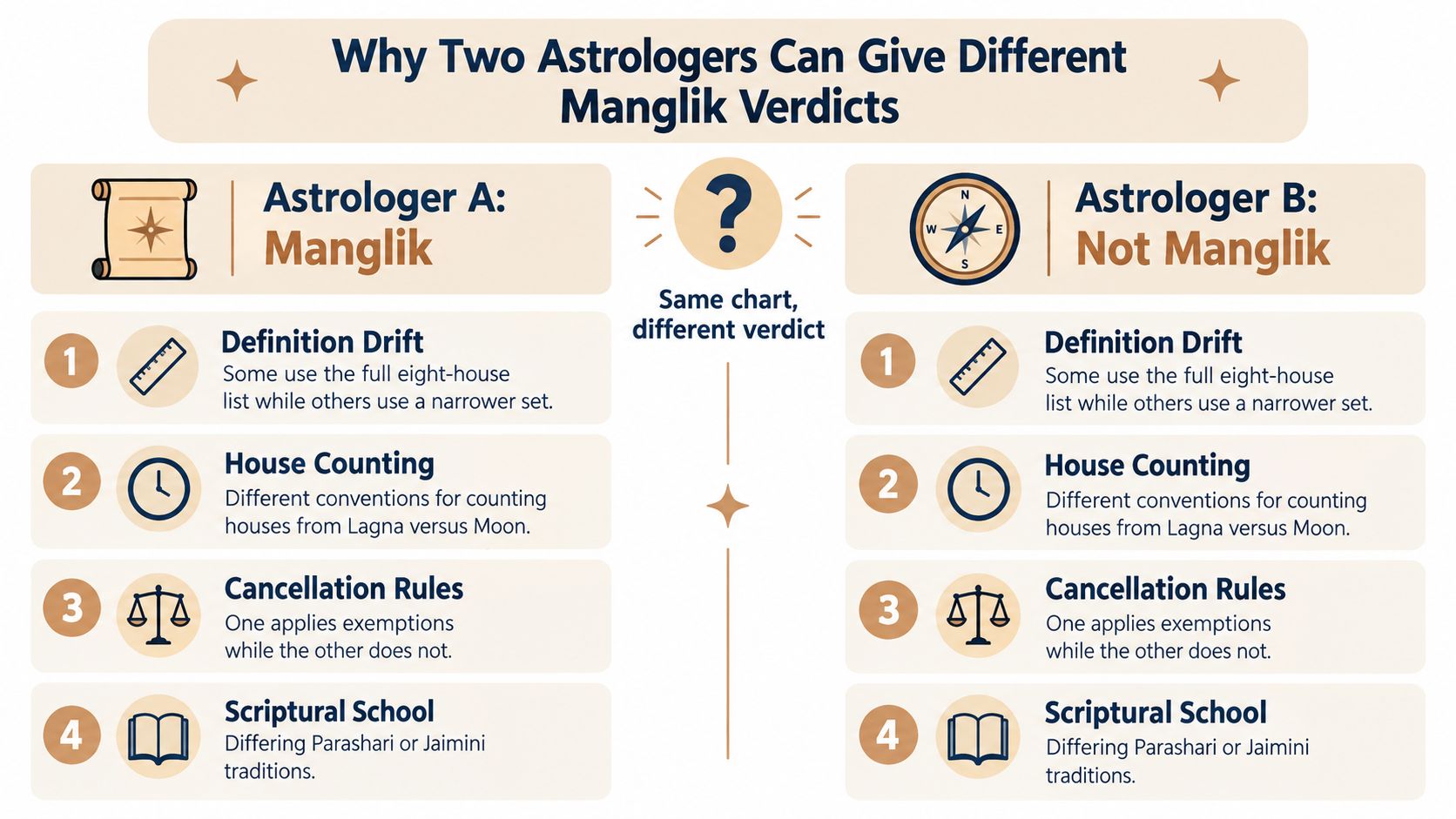
The practical response is to ask each reader which houses, reference points, chart type, and exceptions they used. A different verdict often reflects different methodology, not a personal contradiction.
How Birth Time Accuracy Changes the Result
Birth time matters because it determines the Lagna, and the Lagna sets the house map. The ascendant can move through a sign in roughly two hours, so a recorded time that is off by one or two hours may place Mars in a different house from the ascendant. A guide to Mangal Dosha calculation and birth-time accuracy highlights why exact time improves the reliability of the result.
A hospital record with a recorded delivery time is stronger than a family memory such as “early morning”. Home births can also have uncertainty if nobody noted the time immediately. This isn't unusual, and it isn't a failure by the family. Older records, approximate recollections, and rounded times are common.
Bracket the uncertain time
When the time is uncertain, check the chart at both ends of the likely window. If the family believes the birth occurred between 6:00 and 8:00, a practitioner can compare charts for both times and then inspect an intermediate time if needed. The key question is whether Mars remains in a sensitive house across the window or changes status as the Lagna shifts.
This method doesn't create false precision. It shows whether the Manglik conclusion is stable or time-sensitive. A date-only calculation cannot reliably settle a house-based question because the houses depend on time and place.
Rectification, the practice of testing possible birth times against important life events, can help in complex cases. It usually requires a longer conversation with a qualified astrologer and shouldn't be treated as a quick do-it-yourself correction.
Cancellation Rules and Common Exceptions to the Dosha
A Manglik result is not complete until the chart is checked for cancellation or mitigation. These rules vary between traditions, so they should be treated as interpretive factors rather than a universal checklist.
Mars in its own signs, Aries or Scorpio, is often considered more controlled because Mars has natural strength there. Mars exalted in Capricorn is also commonly treated as less troubling. The reasoning is that a well-placed Mars can express discipline, courage, and constructive effort instead of unmanaged heat. Some traditions also give weight to supportive benefic influence, particularly from Jupiter or Venus, which may soften Mars's expression. These examples are discussed in this guide to Manglik cancellation rules.
A widely used matching principle says that when both partners are Manglik, the dosha is traditionally considered balanced between the two charts. Both people bring comparable Mars energy to the relationship, so the comparison doesn't treat one partner as carrying an unmatched influence.
Other schools treat Mars in the 2nd house from the Moon or in the 12th house as milder in certain circumstances. Retrograde Mars is also debated. Some astrologers consider its inward or irregular expression important, while others don't treat retrogression as a cancellation by itself.
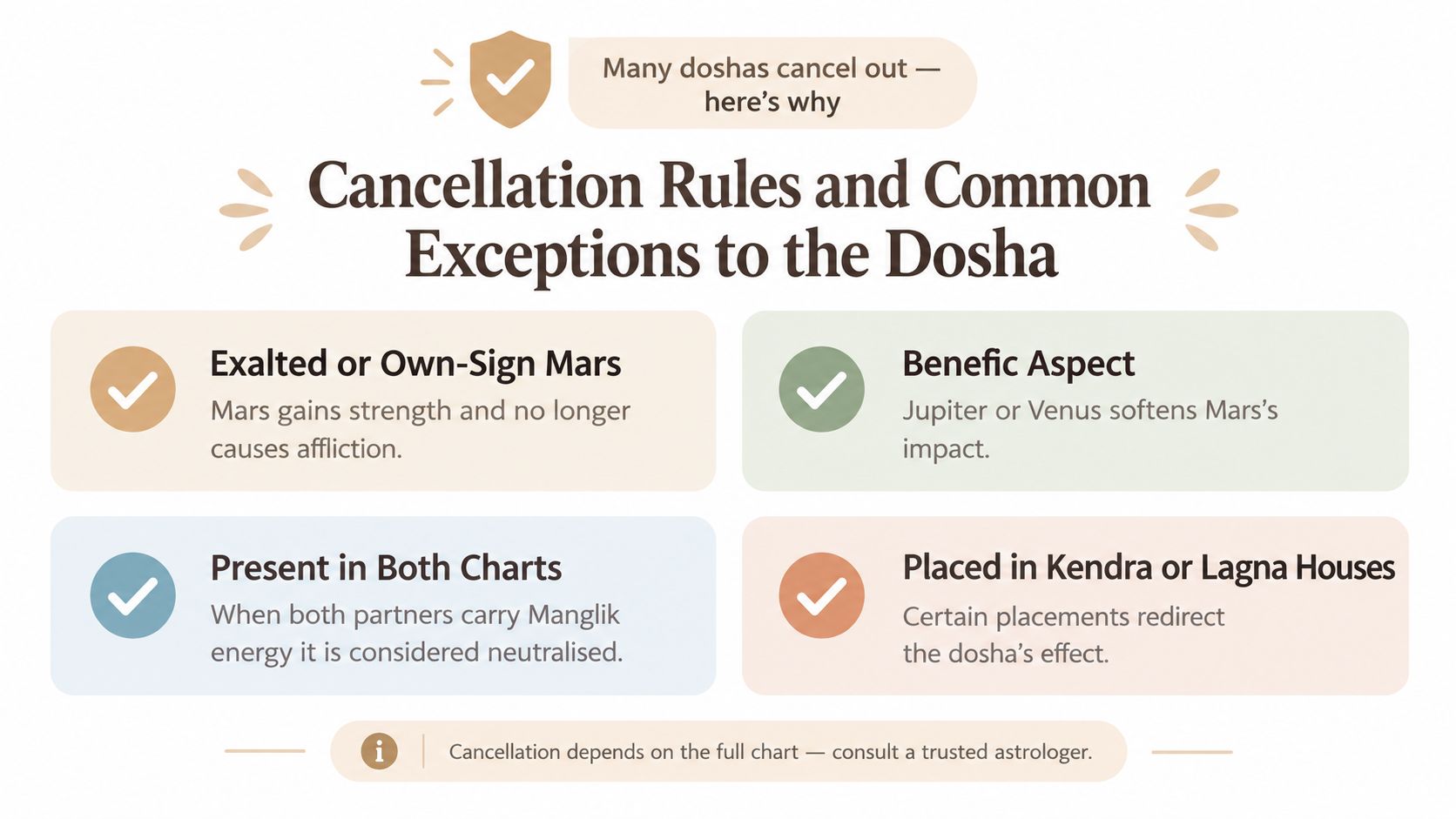
Read the strength, not just the label. A single reference-point result is generally weaker than a repeated result across Lagna, Moon, and Venus.
A couple considering marriage can compare both horoscopes through detailed kundli matching, while remembering that cancellation depends on the full chart, not on one isolated placement.
Self-Check Versus a Full Kundli Reading
A self-check can be reasonable when the birth details are reliable, the sidereal chart is clear, and Mars's position is easy to identify. A dependable Mangal Dosha calculator can show whether Mars falls in the listed houses from the Lagna, and a more complete tool can add the Moon and Venus checks.
That quick answer serves a limited purpose. It answers, “Does the chart meet a Manglik rule?” It doesn't fully answer, “How strongly does it operate?” or “What should the couple do about it?” Those questions require the condition of Mars, the 7th house, planetary aspects, timing periods, and both partners' charts.
When deeper review helps
A full reading is more appropriate when:
- The time is approximate: A changing Lagna can change the house result.
- The reference points disagree: Lagna, Moon, and Venus may not produce the same label.
- Several doshas appear: One factor shouldn't be interpreted without the others.
- Marriage discussions are active: Families may need a balanced compatibility reading rather than a frightening one-line verdict.
The trade-off is practical. A self-check is quicker and usually enough to understand the basic rule. A consultation takes more time but can separate a strong concern from a mild or cancelled indication.
A detailed kundli reading is useful when the reader needs interpretation rather than classification. The purpose isn't to replace personal judgement. It is to give the family a clearer basis for discussion.
Practical Next Steps and Where to Get Guidance
The question “how to know if you are Manglik” becomes manageable when the result is recorded carefully rather than treated as a sudden verdict. The reader can begin with the birth date, exact or approximate time, and birthplace, then confirm that the chart uses the Vedic sidereal zodiac.
A simple record can include:
- Mars from Lagna: Note the sign and house counted from the ascendant.
- Mars from the Moon: Record the Moon sign and Mars's distance from it.
- Mars from Venus: Repeat the same count from the Venus sign.
- Possible softening factors: Note own-sign Mars in Aries or Scorpio, exaltation in Capricorn, supportive aspects, mutual Manglik status, and any regional rule being applied.
- Timing context: Record the current dasha, a planetary period used in Vedic astrology, if a full reading is being considered.
This written comparison prevents a common mistake, which is remembering only the word “Manglik” and forgetting whether it came from Lagna, Moon, Venus, or a particular house convention. It also helps family members ask focused questions instead of reacting to a label.
The result should be discussed calmly. Marriage matching may include Guna Milan, the traditional compatibility scoring system, but Manglik analysis is a separate factor and shouldn't be reduced to a single score. A professional may also consider nakshatra, dashas, the 7th house, planetary strength, and muhurta, an auspicious time selected for an important event.
Kismo is one option for a personalised conversation, offering chat or call access to verified astrologers who can read the full kundli, discuss marriage compatibility, and explain how the Mars placement fits the wider chart. Readers can compare available practitioners through Kismo's astrologer service, while keeping the final decision grounded in clear communication and practical compatibility.
Kismo offers chat or call consultations with verified astrologers for personalised kundli readings and marriage compatibility questions, including Manglik interpretation. Readers who want a second opinion on conflicting charts or uncertain birth times can visit Kismo and choose a reading that fits their situation.