How to Read Houses in Kundli: Step-by-Step Vedic Guide

A new kundli can feel like a puzzle. The chart may show diamonds or squares, zodiac numbers, planet symbols, and Sanskrit terms such as kundli, a Vedic birth chart, and dasha, a planetary period used for timing. A reader who only wants to know about a job change, marriage, education, or relocation can quickly feel lost.
The chart becomes easier once houses are treated as a map of life areas rather than as mysterious boxes. Learning how to read houses in kundli means starting with the ascendant, identifying the sign and its lord, checking planets and aspects, and then using timing tools such as dasha and muhurta, an auspicious time selected for an important beginning. The method is structured, practical, and open to careful beginners.
Table of Contents
- Why Reading Houses Changes Everything in Your Kundli
- The Systematic Sequence for Reading Any House
- Key Houses for Education, Career, and Marriage Decisions
- Same House, Different Readings and What Placement Really Means
- Walking Through a Complete Kundli House Reading
- Common Mistakes When Reading Houses and How to Avoid Them
- Putting It All Together and Your Next Steps in Kundli Reading
Why Reading Houses Changes Everything in Your Kundli
A first chart reading often creates the wrong impression. A person sees planets spread across compartments and assumes each symbol has a fixed meaning everywhere. In Vedic astrology, the house tells where an experience operates, the sign describes its style, and the planet shows the influence involved. A career question therefore needs more than a general statement about one zodiac sign.
The classic 12-house framework was systematised in the Brihat Parashara Hora Shastra, widely treated as a core text of Vedic astrology in India. The text organises houses, planetary dignities, Vimshottari Dasha, divisional charts, and yogas and doshas, giving modern kundli reading its familiar structure. The first house relates to self, the second to wealth and speech, the seventh to marriage, and the tenth to career, as described in this foundation of kundli house meanings.
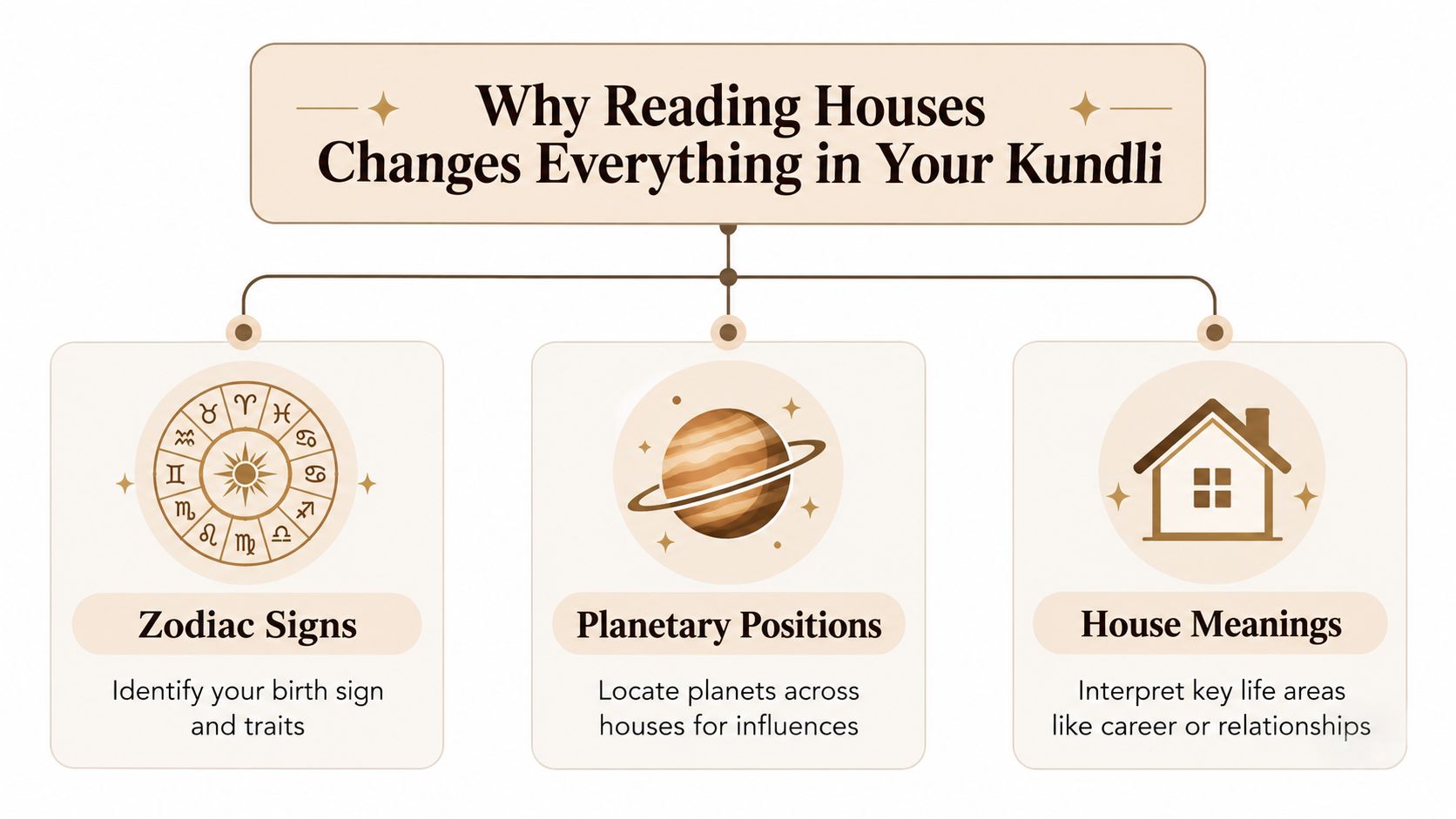
Houses turn broad concerns into useful questions
A house-based reading helps connect the chart to an actual decision. Someone considering a new role may focus on the 10th house and its lord, then examine gains, daily work, relocation, and the timing shown by dasha. Someone asking about marriage may examine the seventh house, Venus, supporting houses, and the relevant periods instead of treating one placement as a final verdict.
The same logic applies to family matters, property, education, health, and travel. The chart isn't a single prediction. It's a layered map that helps an astrologer organise evidence around the question being asked.
Practical rule: A house never speaks alone. Read its sign, lord, occupants, aspects, and timing together.
This approach also explains why a house can be important even when it contains no planet. Its sign lord remains active elsewhere in the chart, and that planet's condition helps describe how the life area functions. The result is more precise than a general Sun-sign horoscope because the ascendant creates a personal house structure.
The Systematic Sequence for Reading Any House
A reliable reading follows a repeatable order. Beginners often jump straight to the planet inside a house, but that can produce a distorted conclusion. The sequence below keeps the interpretation anchored.
Start with the sign and house lord
First, identify the sign occupying the house. Then find the planet that rules that sign. If Taurus occupies the seventh house, Venus becomes the seventh-house lord. The reader must then locate Venus elsewhere in the chart and assess its sign, house, strength, and connections.
This step matters because the lord carries the house's agenda. An empty seventh house doesn't remove marriage or partnership themes. The condition of its lord may provide more useful information than a quick glance at the house itself.
Add occupants and aspects
Next, note every planet placed in the house. A planet can bring its own themes into that life area, but its effect depends on dignity, lordship, conjunctions, and aspects. A strong planet may support the house, while a pressured planet may show work, delay, or a need for maturity. Such descriptions should remain conditional, not absolute.
Then check aspects from other planets. A house may look quiet but receive meaningful support or pressure from elsewhere. This is why a reader shouldn't label a placement favourable or difficult before checking the full chart.
Use karaka and timing
For a marriage question, the seventh house is read with its sign, lord, occupants, aspects, and Venus as the karaka, or natural significator, for relationships. The reading can also include bhava bala, Ashtakavarga, and transits when greater precision is needed, as outlined in this guide to the twelve bhavas.
Finally, examine the active dasha. Dasha shows which planetary themes are active during a period, while transits can act as triggers. A natal chart may show potential for a career change, but timing requires the planets and periods connected with the relevant houses.
Key Houses for Education, Career, and Marriage Decisions
Indian kundli practice gives special attention to a small group of houses for common life decisions. Education is usually read through the 4th, 5th, and 9th houses. The fourth house relates to foundational education, school environment, home, and emotional support. The fifth concerns intelligence, learning ability, creativity, and the way a student processes knowledge. The ninth points towards higher and advanced education.
A student choosing between academic streams shouldn't be judged from the fifth house alone. The reader can compare the three houses, their lords, planets placed there, relevant aspects, and the condition of Mercury and Jupiter where appropriate. The interpretation should describe tendencies and suitable support, not impose a fixed result. This three-house convention is outlined in education astrology guidance for Indian readers.
Marriage requires more than the seventh house
The 7th house is the main house for marriage, spouse, partnerships, and public dealings. Venus acts as an important karaka, but the seventh lord, planets in the house, aspects, and timing all matter. Family support, shared resources, and fulfilment can bring other houses into the discussion, especially when the reader is considering compatibility or a wedding decision.
A sound reading avoids statements such as “one placement guarantees marriage” or “one planet denies it”. Compatibility also requires both charts and the circumstances of the people involved.
Career is a connected pattern
The 10th house governs career, profession, status, authority, and public reputation. It should be read alongside the 10th lord, planets occupying the house, aspects, and the active dasha. A job-change question may also involve the sixth house for daily service and competition, the eleventh for gains, and the fourth or twelfth for relocation and living arrangements.
The house gives the domain. The lord and planets add detail. Dasha helps answer the question, “When might this theme become active?”
Same House, Different Readings and What Placement Really Means
A planet's house placement doesn't carry one universal result. The same 10th house can describe visibility, responsibility, pressure, or a gradual rise, depending on the sign, lord, dignity, aspects, conjunctions, and dasha. Reading a symbol in isolation is like judging a book from its cover and ignoring the surrounding story.
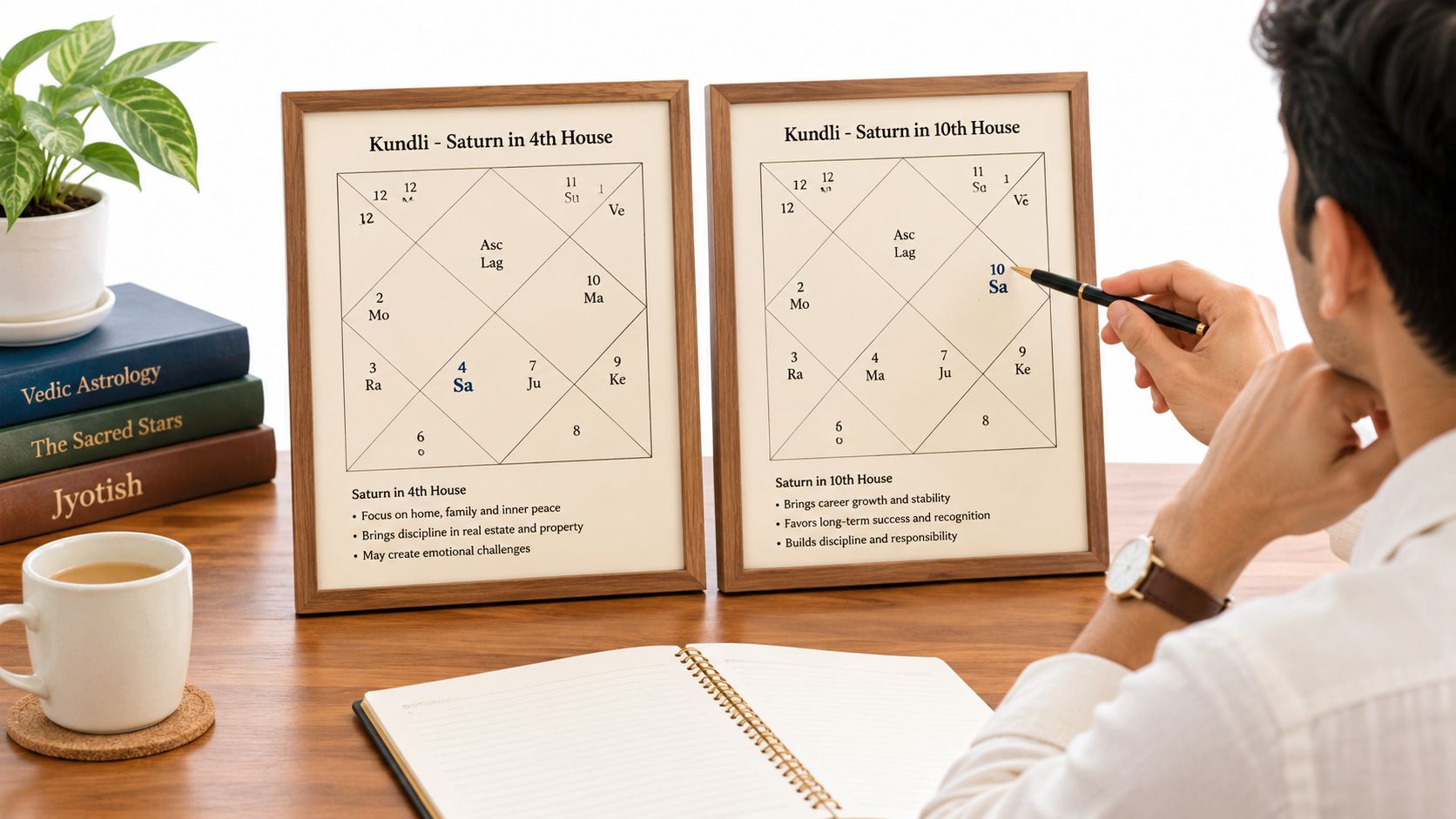
Consider two simplified career readings:
| Situation | What the reader examines | Responsible interpretation |
|---|---|---|
| A supported 10th house | The 10th lord's condition, helpful aspects, and active periods | Career responsibility may develop with clearer support |
| A pressured 10th house | Affliction, difficult conjunctions, lord weakness, and timing | Work may require patience, restructuring, or careful choices |
| An empty 10th house | The sign, 10th lord, aspects, and dasha | The career area remains active through its lord and timing |
Saturn offers a useful example because its meaning changes with context. In one chart, Saturn connected with the 10th house may emphasise discipline, long-term work, and responsibility. In another, difficult connections may coincide with delay or a heavier workload. Neither reading should become a doom prediction, because the full chart determines how the placement operates.
Planetary dignity also matters. A planet in its own sign may express its themes with greater steadiness, while a debilitated planet may require more careful management. This does not reduce the reading to “good” or “bad”. It asks where the person may have support and where deliberate effort may be needed. Current movement can then be studied through planetary transits.
The video below offers another visual way to compare house placements and interpretive context.
Walking Through a Complete Kundli House Reading
Suppose a reader asks, “Is a career change and relocation sensible?” A careful astrologer doesn't begin with a prediction. The first step is to confirm the ascendant and establish the house sequence using the birth details. In commonly used Indian practice, Whole-Sign houses place the ascendant sign across the entire first house, with the next signs following in order.
The reader then studies the 10th house and its lord for profession and status. The sixth house can show daily work and competition, while the eleventh can speak to gains and networks. If relocation is central, the fourth and twelfth houses become relevant, along with the planets occupying or ruling them.
Following the evidence
Assume the 10th lord is placed in a house connected with movement, but receives a mixed aspect. That doesn't mean “move” or “stay” automatically. The astrologer would compare the lord's strength, the condition of the relocation houses, and the dasha active at the time of the proposed decision.
The relationship question can be tested separately through the seventh house, its lord, Venus, and timing. Personal growth may involve the first and ninth houses, especially if the change requires new skills, travel, or a different worldview. The final interpretation should answer the original question, identify practical conditions, and acknowledge uncertainty.
A reader can practise this process with a Janam Kundli chart, then write down the house, lord, occupants, aspects, and active dasha before forming an opinion. The exercise teaches the key habit: connect evidence to the question instead of collecting isolated meanings.
Common Mistakes When Reading Houses and How to Avoid Them
Several errors appear repeatedly in beginner readings. Each has a simple check.
- Ignoring the ascendant: Without the Lagna, house lordships may be assigned incorrectly. Confirm the rising sign before reading any house.
- Confusing sign and house: A printed zodiac number identifies a sign, not automatically a house. Count from the ascendant.
- Declaring an empty house inactive: Find its lord and assess that planet's placement, strength, aspects, and dasha connections.
- Reading one planet alone: A planet in the seventh or tenth house must be judged with the sign, lord, karaka, aspects, and timing.
- Misreading chart format: North Indian charts keep the house positions fixed and rotate the signs, while South Indian charts keep signs fixed and mark the Lagna. The layouts look different but carry the same information.
Before interpreting: Write down the ascendant, house sign, house lord, occupants, aspects, and active dasha. If one item is missing, the reading is incomplete.
A difficult placement isn't a guaranteed negative outcome. The chart describes tendencies and timing possibilities, while choices, preparation, and circumstances still shape what happens.
Putting It All Together and Your Next Steps in Kundli Reading
A beginner can make useful progress by practising one question at a time. Start with the relevant house, then apply the sequence consistently. Career questions may begin with the 10th, marriage with the 7th, education with the 4th, 5th, and 9th, and relocation with the houses connected to home, travel, and foreign environments.
Timing needs additional care. Dasha activates planetary themes, while transits can add triggers. For ceremonies, launches, registrations, weddings, or housewarming, muhurta uses the Panchang, whose five parts are Tithi, Nakshatra, Yoga, Karana, and Vara. A Tithi is a lunar day, Nakshatra is the Moon's mansion, Yoga has its own calendar division, Karana is half a Tithi, and Vara is the weekday, as explained in this muhurta timing guide.
When personal guidance helps
Self-reading works well for learning the chart's structure and identifying the main houses. More complex decisions, such as marriage timing, compatibility, relocation, business launches, or a carefully selected muhurta, require the full birth chart and a consistent interpretation of its layers. Birth-time uncertainty can also affect house placement, so a reader should avoid confident conclusions when the underlying data is unclear.
A verified astrologer can compare the relevant houses, lords, dashas, transits, and practical circumstances in one conversation. Kismo offers chat or call sessions with verified astrologers for chart readings, kundli matching, career questions, and auspicious timing, while free astrology tools can support early exploration.
Kismo connects users with verified astrologers by chat or call for personalised kundli readings, marriage compatibility, career guidance, and muhurta selection. Readers can visit Kismo to discuss a specific chart question and receive guidance based on the complete birth chart rather than one isolated house.