Kalasarpa Dosha Types
A person may hear the words Kala Sarpa Dosha from a relative, see the label in an online kundli report, and immediately worry about marriage, career, or health. The name can sound severe, but a chart label isn't a life sentence. It describes a particular arrangement of planets that needs careful interpretation.
The useful question isn't just, “Which type is present?” It's, “How complete is the formation, which houses are involved, and what does the rest of the birth chart say?” The twelve Kalasarpa Dosha types provide a starting point, not a final verdict.
Table of Contents
- What Kala Sarpa Dosha Really Means
- The Building Blocks of This Yoga in Your Kundli
- Full Versus Partial and the Two Directions of the Dosha
- The 12 Kala Sarpa Dosha Types by House Axis
- Where the Effects Tend to Show Up in Daily Life
- Traditional and Practical Remedies Worth Considering
- Reading the Dosha in Context of the Full Chart
- Key Takeaways and When to Seek a Personal Reading
What Kala Sarpa Dosha Really Means
In Vedic astrology, Kala Sarpa Dosha is a planetary configuration involving Rahu and Ketu, the lunar nodes. They occupy opposite houses in the birth chart and create an axis. The formation is traditionally considered present when all seven classical planets, the Sun, Moon, Mars, Mercury, Jupiter, Venus, and Saturn, lie between that Rahu-Ketu axis. A standard description of this rule appears in this explanation of Kala Sarpa Yoga.
The phrase is often translated as “serpent of time” yoga. The serpent image reflects a cycle of desire, attachment, release, and repeated learning. In this symbolism, Rahu represents the head of the serpent and Ketu represents the tail. The idea is not that a person is cursed. It is that certain life themes may feel concentrated or cyclical, especially during relevant planetary periods.
A kundli, or birth chart, is interpreted as a complete system. Kala Sarpa Dosha is only one layer within it. House lordships, sign placements, planetary dignity, aspects, yogas, and the running dasha, a planetary time period, all affect the final reading.
Practical rule: The type name can identify the axis, but it can't describe the whole life.
This is why a person shouldn't judge marriage, money, or health from the dosha label alone. A strong ascendant lord, supportive Jupiter, favourable house placements, or a helpful dasha may change the way the pattern expresses itself. Accurate interpretation requires the full kundli and the exact birth details used to calculate it.
The Building Blocks of This Yoga in Your Kundli
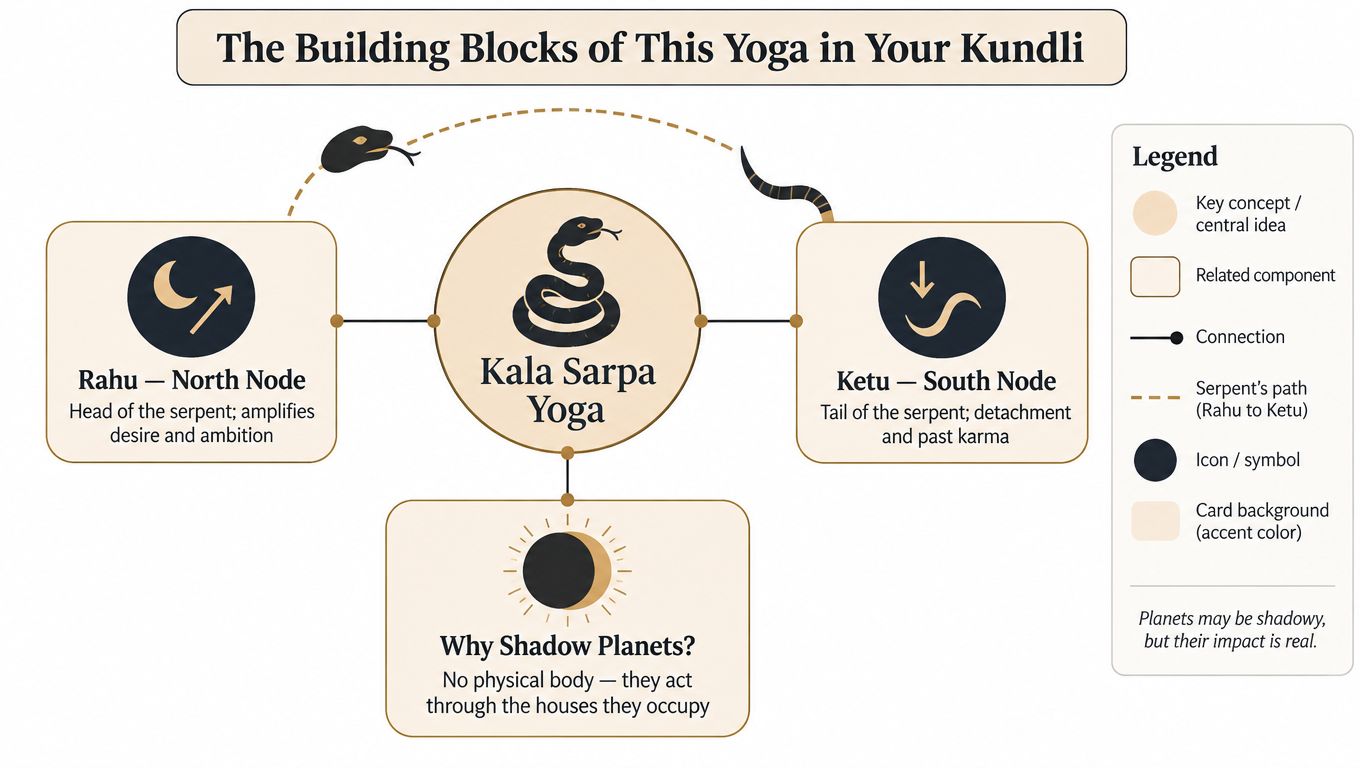
Rahu and Ketu are called shadow planets because they aren't physical planets. They are mathematical points connected with the Moon's orbit. In traditional interpretation, Rahu is associated with desire, ambition, appetite, and experiences that pull a person towards the unfamiliar. Ketu is linked with detachment, inward focus, separation, and patterns carried from the past.
A kundli is arranged as a twelve-house wheel. Each house points towards a life area, such as identity, family, communication, home, work, relationships, shared resources, fortune, career, gains, and solitude. Rahu and Ketu always sit opposite each other, so their axis links two opposing areas of experience.
The core rule is simple:
- Rahu and Ketu occupy opposite houses.
- The seven classical planets fall between them on one side of the zodiac.
- No classical planet breaks the enclosure by sitting outside the axis.
- The house occupied by Rahu determines the named type.
Some astrologers also examine whether a planet is placed in a sign associated with the opposite node. That detail can affect whether a formation is treated as strict, partial, or disputed. The calculation is therefore chart-specific, not a one-size-fits-all result. A person can review the basic house structure through a kundli chart guide, but interpretation still requires context.
A conjunction with Rahu or Ketu may create another type of Rahu-Ketu yoga. That isn't automatically the same as Kala Sarpa Dosha. Keeping these ideas separate prevents a reader from treating every difficult-looking node placement as one identical condition.
Full Versus Partial and the Two Directions of the Dosha
Kala Sarpa Dosha is better understood as a spectrum than as a simple yes-or-no label. A full formation means all seven classical planets sit strictly between Rahu and Ketu. A partial formation is used by some astrologers when one or more planets fall outside the axis or when the chart doesn't meet every condition required for a strict reading. Indian astrology references also distinguish between these formations rather than treating every node pattern as equally strong, as discussed in this historical overview of Kala Sarpa Dosham.
The second distinction concerns direction. Savya Kala Sarpa Dosham describes a pattern in which the planets are considered filled from Rahu towards Ketu. Apasavya Kala Sarpa Dosham describes the reverse sequence, from Ketu towards Rahu. In house terms counted from the lagna, Savya is commonly associated with Rahu in the 1st, 3rd, 5th, 7th, 9th, or 11th house. Apasavya is associated with Rahu in the 2nd, 4th, 6th, 8th, 10th, or 12th house.
| Pattern | Planets Between Rahu-Ketu | Rahu House Positions from Lagna | Common Interpretation |
|---|---|---|---|
| Full Kala Sarpa | All seven classical planets remain within the axis | Any of the twelve houses | A concentrated axis that deserves full-chart analysis |
| Partial Kala Sarpa | One or more planets fall outside the strict enclosure | Any of the twelve houses | A weaker, disputed, or modified formation |
| Savya | Planets are read from Rahu towards Ketu | 1st, 3rd, 5th, 7th, 9th, or 11th | An outward, desire-led interpretive emphasis |
| Apasavya | Planets are read from Ketu towards Rahu | 2nd, 4th, 6th, 8th, 10th, or 12th | An inward, release-led interpretive emphasis |
Traditional texts connect the two directions with different karmic leanings. Modern astrologers often use them as interpretive shades rather than fixed predictions. The practical sequence is to establish whether the pattern is full or partial, identify the direction, and then study the house axis. Only then does the type name become useful.
The 12 Kala Sarpa Dosha Types by House Axis
The twelve types are determined by Rahu's house placement, while Ketu occupies the opposite house. This house-axis logic is repeated across the full classification, as explained in this guide to the twelve Kala Sarpa Dosha types.
| Type Name | Rahu House | Ketu House | Core Life-Area Theme |
|---|---|---|---|
| Anant | 1st | 7th | Self, identity, marriage, and partnerships |
| Kulik | 2nd | 8th | Family, speech, savings, and shared resources |
| Vasuki | 3rd | 9th | Communication, courage, siblings, and beliefs |
| Shankhapal | 4th | 10th | Home, emotional security, property, and career |
| Padma | 5th | 11th | Creativity, education, children, friendships, and gains |
| Mahapadma | 6th | 12th | Service, health routines, obstacles, and spirituality |
| Takshak | 7th | 1st | Marriage, contracts, partnerships, and personal identity |
| Karkotak | 8th | 2nd | Transformation, joint finances, inheritance, and family assets |
| Shankhachur or Shankhanaad | 9th | 3rd | Fortune, teachers, higher learning, travel, and communication |
| Ghatak | 10th | 4th | Career, public role, home, and inner stability |
| Vishdhar | 11th | 5th | Income, networks, aspirations, creativity, and children |
| Sheshnag | 12th | 6th | Expenses, retreat, foreign links, health, and daily work |
How to identify the axis
A reader first locates Rahu in the kundli. If Rahu is in the 1st house and Ketu is in the 7th, the pattern is Anant. If Rahu is in the 2nd and Ketu is in the 8th, it is Kulik. If Rahu is in the 3rd and Ketu is in the 9th, it is Vasuki. The same opposite-house method continues through the remaining pairs.
The names are useful memory markers, but the houses carry the practical meaning. A 1st-7th axis naturally draws attention to the balance between personal identity and partnership. A 4th-10th axis points towards the relationship between private life and public responsibility. A 6th-12th axis connects routines, service, health, rest, and spiritual withdrawal.
The broad theme is not a guaranteed event. It shows where an astrologer may look for repeated tension, strong desire, detachment, or a need for better balance.
Where the Effects Tend to Show Up in Daily Life
A house axis becomes meaningful when it connects with a repeated experience. The same label can feel very different in two charts because the sign lords, planets, aspects, and dasha periods won't be identical.
Marriage and relationships
The 1st-7th axis, associated with Anant and Takshak, places attention on the balance between self-definition and partnership. A person may repeatedly question independence, commitment, expectations, or the kind of partner who feels suitable. This doesn't guarantee delay or separation. It suggests that relationship decisions deserve a careful reading of the 7th house, its lord, Venus, and the relevant dasha.
Career and professional growth
The 4th-10th axis, linked with Shankhapal and Ghatak, connects home, emotional grounding, status, and work. Career changes may feel disruptive when domestic needs and professional ambitions pull in different directions. The 3rd-9th axis, linked with Vasuki and Shankhachur or Shankhanaad, can shift attention towards communication, skills, mentors, travel, and personal beliefs.
Career timing should be read alongside transits and dashas. A person studying job changes or relocation can use a planet transit resource as background, but a transit alone doesn't replace a complete chart analysis.
Finances and stability
The 2nd-8th axis, represented by Kulik and Karkotak, links personal savings with shared money, family resources, taxation, inheritance, and financial obligations. The 11th-5th axis, represented by Vishdhar and Padma, connects income and networks with creativity, education, children, and personal fulfilment. These patterns can encourage better budgeting and clearer agreements, rather than fear.
Family health and inner balance
The 6th-12th axis, associated with Mahapadma and Sheshnag, brings attention to routines, service, rest, expenses, and spiritual life. The chart may show a need for disciplined sleep, sensible health care, and emotional support during demanding periods. Astrology shouldn't replace medical advice, especially when a person has persistent symptoms.
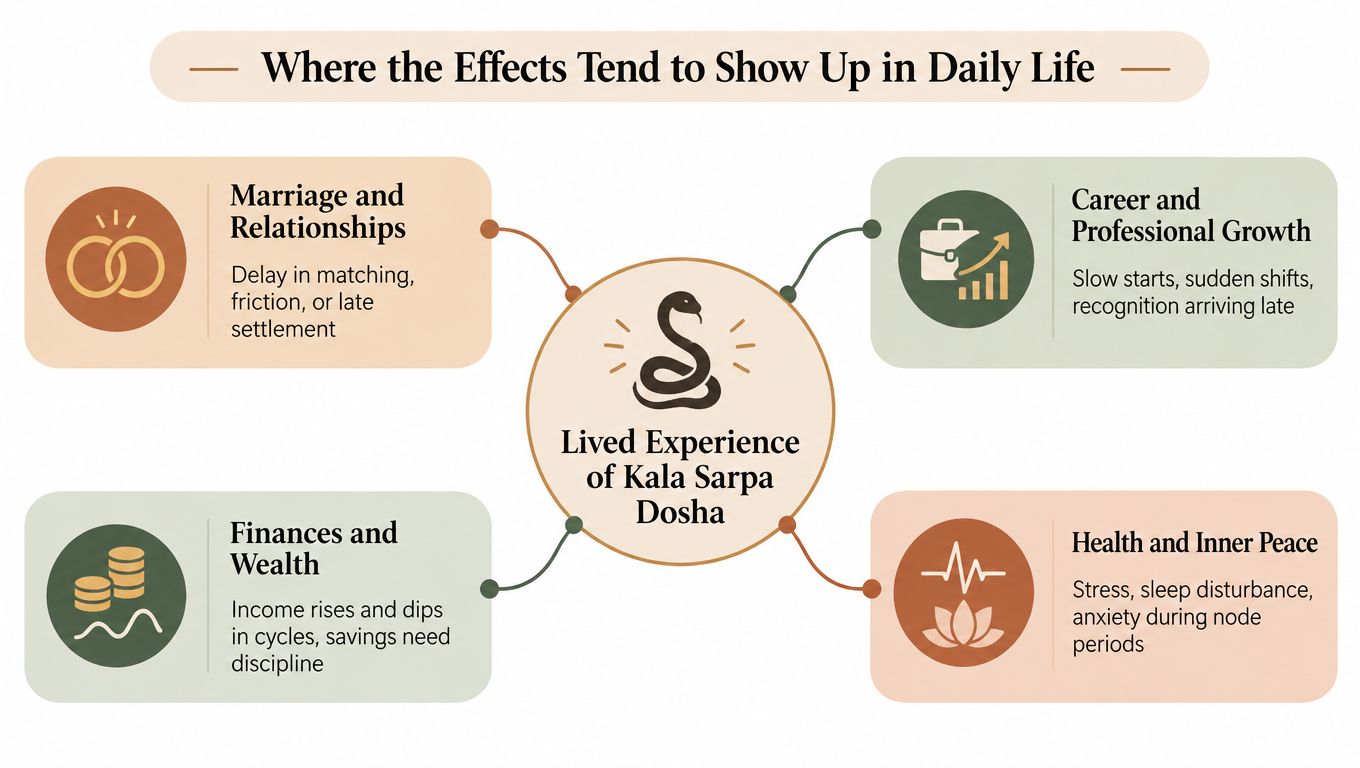
The most responsible interpretation looks for patterns, not promises. Delays, sudden shifts, or repeating concerns may appear as themes, but the full chart and timing periods determine whether those themes become active.
Traditional and Practical Remedies Worth Considering
Remedies work best when they help a person become more mindful, disciplined, and emotionally steady. They shouldn't be presented as guaranteed ways to erase a dosha or control another person's decisions.
Ritual practices
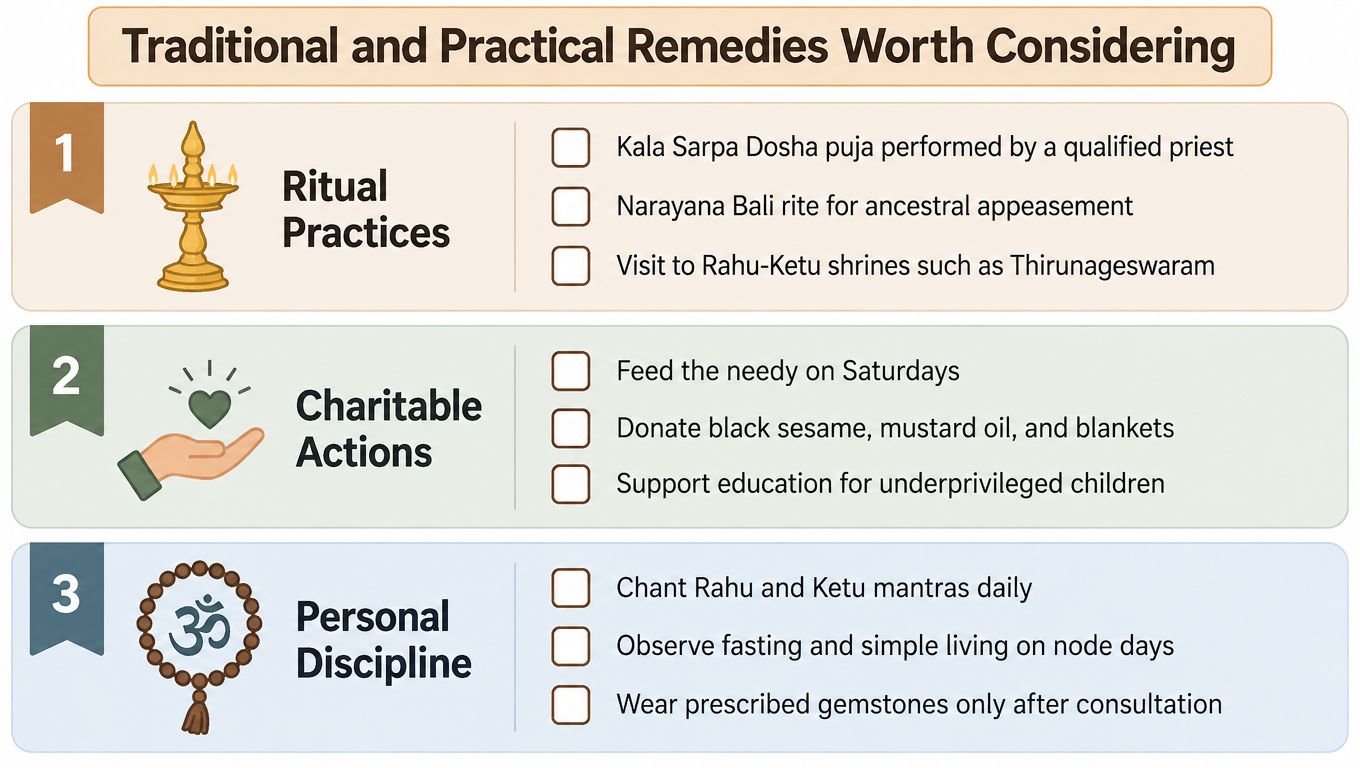
Traditional options include Kala Sarpa Dosha puja, Narayana Bali, and visits to temples associated with Rahu and Ketu. A qualified priest may recommend a ritual after examining the specific chart rather than applying the same ceremony to everyone.
Temple visits can also create a regular space for reflection. The spiritual value may come from prayer, intention, community, and a calmer routine, even when the final chart interpretation is complex.
Charitable actions
Charity gives the symbolic remedy a practical expression. Depending on family tradition and the astrologer's advice, a person may consider:
- Food support: Feeding people in need, particularly on a Saturday.
- Useful donations: Offering black sesame, mustard oil, or blankets where such customs are followed.
- Community support: Helping older people or supporting education for underprivileged children.
The purpose isn't to purchase a favourable outcome. It's to cultivate responsibility, generosity, and awareness of people who need support.
Personal discipline
Meditation, mantra recitation, fasting on relevant days, and a steady daily routine are often included in traditional guidance. Simple habits can be more sustainable than dramatic promises. A person may choose regular sleep, measured speech, careful financial planning, and time for quiet reflection.
Gemstones need particular caution. A stone associated with Rahu, Ketu, or another planet should be worn only after a qualified astrologer reviews the complete kundli. A remedy should match the specific type, the houses involved, and the running dasha period. Without that connection, a ritual may be meaningful spiritually but poorly targeted astrologically.
A short educational explanation of remedies can also be viewed here:
Reading the Dosha in Context of the Full Chart
The strongest correction to fear-based astrology is context. A chart may appear to contain Kala Sarpa Dosha, yet the formation may be partial, weakened, or balanced by other placements. Some astrologers examine whether planets sit in the 2nd or 12th house from the Rahu-Ketu axis as a possible cancellation or modification condition. Others give weight to a planet that falls outside the axis.
Benefic influence matters as well. Supportive aspects from Jupiter or Venus, a strong lagna lord, and planets placed in their own sign or exaltation can provide resilience. Other yogas may redirect the same pressure towards study, disciplined work, research, service, or spiritual practice.
Timing changes the emphasis
A natal pattern can remain quiet for long periods and become more noticeable during a relevant Mahadasha or Antardasha, the major and sub-periods used in Vedic timing. Rahu or Ketu periods may bring the axis into sharper focus, but the actual result still depends on the houses, signs, lords, and supporting planets.
A personal reading adds value when the question is specific. Marriage timing, a job decision, relocation, financial uncertainty, or recurring family concerns all require more than a type name. General knowledge is enough for identifying the house axis, but it isn't enough for making major decisions.
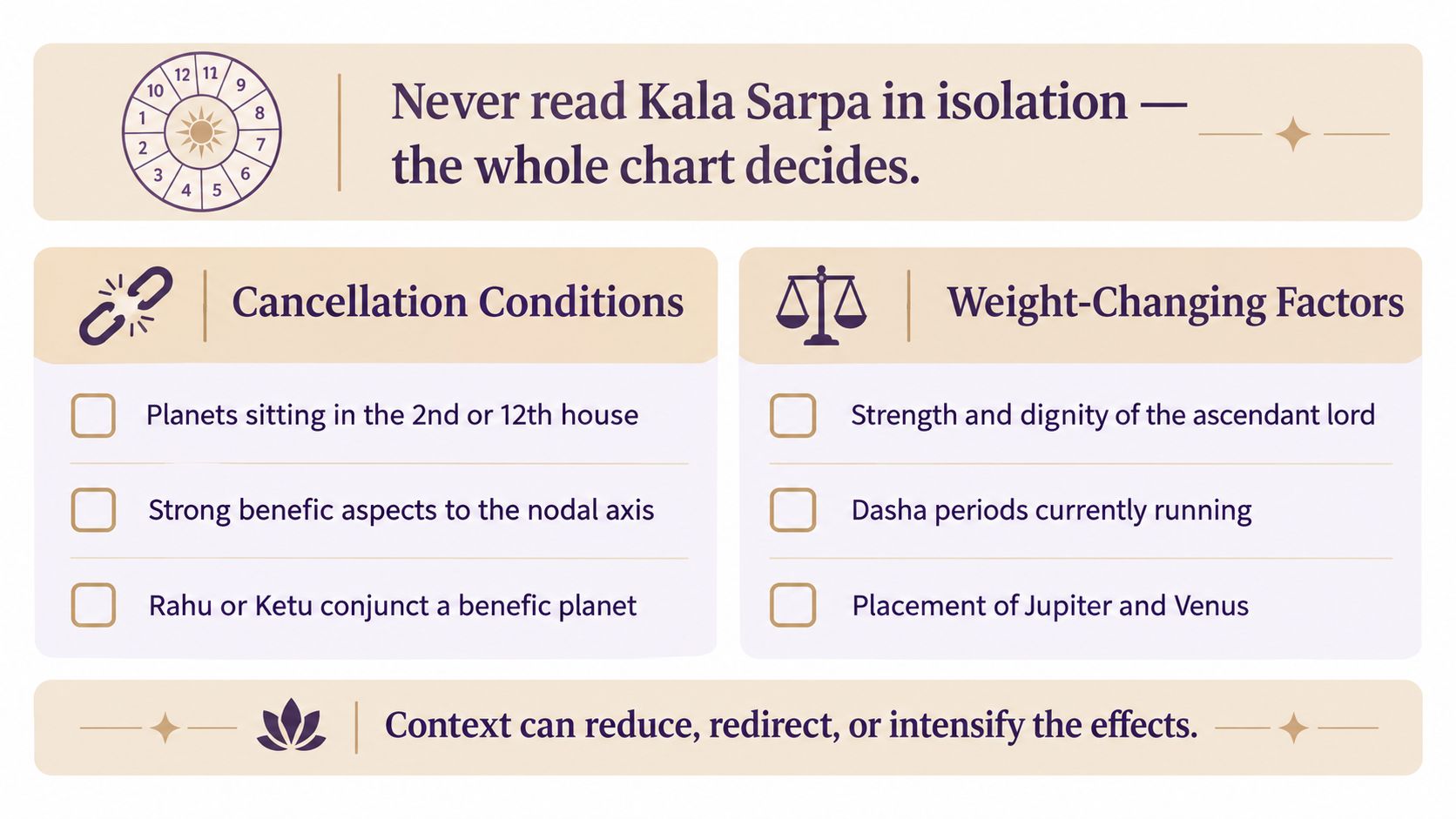
A grounded interpretation: Context can reduce, redirect, or intensify the effect of a planetary pattern.
This approach also explains why two people with the same type may report different experiences. Their ascendants, sign placements, house lords, dashas, and planetary strengths aren't the same. The label identifies a structure. The full kundli gives it meaning.
Key Takeaways and When to Seek a Personal Reading
Kala Sarpa Dosha describes a specific Rahu-Ketu alignment in which the seven classical planets are enclosed between the nodes. The twelve types correspond to twelve opposite-house axes, from Anant on the 1st-7th axis to Sheshnag on the 12th-6th axis.
Full and partial formations shouldn't be treated as identical. Savya and Apasavya describe different directions, while cancellation conditions and supportive placements can soften or redirect the interpretation. The type name is a starting point, not a verdict.
A complete reading considers:
- House lordship: The condition of the houses involved and their ruling planets.
- Planetary dignity: Whether important planets are strong, weakened, or supported.
- Dasha timing: Whether Rahu, Ketu, or connected planets are currently active.
- Chart balance: Whether benefic aspects, supportive yogas, or planets outside the axis change the result.
- Practical question: Whether the concern involves marriage, career, money, family, health, or timing.
General understanding may be enough when a reader wants to identify the axis and learn the terminology. A personal reading becomes more useful during a Rahu or Ketu dasha, before a major decision, or when the same life-area concern keeps returning. A verified Vedic astrologer can help place the dosha within the full kundli without turning it into a fearful prediction. Readers seeking that kind of conversation can explore verified astrologers.
Kismo connects users with verified astrologers by chat or call for full birth chart readings, marriage compatibility, career questions, and muhurta timing. Readers can visit Kismo to discuss a Kala Sarpa Dosha type in the context of the complete kundli and receive practical, personalised guidance.