Ketu in Astrology: Meaning, Effects, and Meaning
Someone studying a birth chart may understand the Sun, Moon, and zodiac signs, then stop at a small symbol labelled Ketu. It can look worrying, especially when a quick search connects it with loss, separation, or confusion. The more useful question is not whether Ketu is “good” or “bad”, but which area of life it is activating, how long that influence lasts, and what the complete chart says about it.
Ketu in astrology is best approached as a symbolic timing signal. It can describe where conventional ambition weakens, where old patterns feel familiar, and where a person is pushed towards reflection or a different direction. Its meaning becomes practical only when its house, sign, planetary connections, and current dasha are read together.
Table of Contents
- What Ketu in Astrology Really Means
- The Mythological Story Behind Ketu
- How Ketu Works in Vedic Chart Mechanics
- Ketu Through the Houses and Signs
- Ketu Mahadasha and Transits in Daily Timing
- Ketu and Rahu as Complementary Forces
- Reading Ketu Practically and Common Remedies
- Bringing It All Together for Your Chart
What Ketu in Astrology Really Means
Ketu is the descending, or south, lunar node in Vedic astrology. It isn't a physical planet. It's a mathematically defined point connected with the Moon's orbit, which is why traditional astrologers call it a shadow graha, or shadow planetary influence. Ketu is paired with Rahu, the north node, and remains opposite Rahu in a birth chart, at a distance of 180 degrees as described in this overview of Ketu's mythology and astronomical meaning).
The simplest image is a compass with two pressures. Rahu points towards appetite, experience, and worldly growth. Ketu points away from over-attachment. It can show skills that feel instinctive, interests that seem carried from the past, and a strange lack of satisfaction in areas that appear successful from the outside.
Detachment is not always loss
Astrologers commonly associate Ketu with detachment, past-life impressions, spiritual searching, moksha, or liberation, and sudden breaks that create new understanding. These symbols can appear as a career change, a cooling relationship, a move away from familiar surroundings, or a breakthrough after a period of uncertainty. None of those possibilities is guaranteed by Ketu alone.
Ketu may also weaken the desire to prove something. A person with strong Ketu influence might question a prestigious job, lose interest in social approval, or prefer specialist work that gives independence. That can be uncomfortable, but it can also help someone stop pursuing a goal that no longer fits.
Practical rule: Ketu describes a field of release and insight. It doesn't, by itself, write a fixed event into someone's life.
Why chart mechanics matter
A generic statement such as “Ketu causes separation” is too broad to guide a marriage decision or a job change. The house indicates where detachment appears. The sign describes how it feels. The house lord, conjunctions, aspects, and dasha show whether the pattern is temporary, constructive, difficult, or mixed.
The sections ahead examine Ketu's myth, astronomical structure, house and sign expression, timing through mahadasha and transit, its relationship with Rahu, and traditional remedies. The purpose is to replace fear with a more careful question: what is Ketu asking the chart holder to stop forcing, and what deserves deeper attention instead?
The Mythological Story Behind Ketu
The traditional story of Ketu begins with Samudra Manthan, the churning of the cosmic ocean. Gods and demons worked together to obtain amrita, the nectar of immortality. When the nectar appeared, an asura named Svarbhanu disguised himself and sat among the gods so he could drink it.
Mohini, the female avatar of Vishnu, recognised the deception. Vishnu used the Sudarshana Chakra to sever Svarbhanu's head from his body. The nectar had already touched his throat, so the being did not die. His head became Rahu, while the headless body became Ketu.

The story gives astrologers a memorable way to distinguish the two nodes. Rahu has a head, so it symbolises wanting, consuming, comparing, and chasing the next experience. Ketu has no head, so its symbolism is less about forming new worldly appetite and more about what remains after experience has already been absorbed.
The body without a head
Ketu can be understood as the aroma of past karma without a clear desire for repetition. A person may be naturally skilled at a subject yet feel oddly detached from recognition in that field. Someone may understand spiritual practice intuitively but struggle to explain why it matters. Another person may leave a familiar path without being able to name the destination.
That doesn't mean every Ketu placement indicates a previous life in a literal, provable sense. Past-life karma is a traditional interpretive framework, not a medical or historical diagnosis. In chart reading, it often works as a language for inherited patterns, instinctive abilities, and areas where ordinary ambition no longer feels complete.
A short visual explanation of the myth and its symbolism can help readers connect the serpent image with the themes of separation, release, and inner searching.
The myth also explains why Ketu is linked with moksha. The headless body cannot keep reaching for the next reward in the same way as Rahu. Its lesson is not that worldly life has no value, but that identity and desire can become lighter when a person stops treating them as the whole self.
How Ketu Works in Vedic Chart Mechanics
A career can look successful on paper while feeling strangely disconnected inside. In a Vedic chart, Ketu helps describe that gap, then chart mechanics show when and how it may become noticeable. Its symbolism becomes more useful when paired with the house, sign, ruling planet, and timing factors.
Astronomically, Ketu is the point where the Moon's orbit crosses the ecliptic while moving southward. Rahu marks the northern crossing, so the nodes form one axis rather than two independent physical planets. Their cycle takes about 18.6 years, and Ketu is traditionally described as moving retrograde through the zodiac in this explanation of Ketu's astronomical definition and cycle. Traditional Indian astrology also commonly places Ketu in a sign for about one and a half years, giving its transits a gradual quality.
The Navagraha place of Ketu
Ketu belongs to the Navagraha, the traditional group of nine astrological bodies. This group includes visible planetary influences as well as Rahu and Ketu, even though the nodes have no physical form. Ketu does not own a complete zodiac sign. Some Vedic references describe it as exalted in Scorpio and fallen in Taurus in this sign-based discussion of planetary Ketu.
Ketu is linked with three nakshatras, or lunar divisions: Ashwini, Magha, and Mula. Each covers 13 degrees 20 minutes, giving Ketu a defined place within the system of 27 nakshatras as outlined in this Ketu reference.
Use these mechanics as a sequence for reading a chart:
- Locate Ketu's house and sign. The house shows the life area being reviewed.
- Check the sign lord. Its condition describes the setting through which Ketu operates.
- Study conjunctions and aspects. Other planets may intensify, redirect, or moderate the expression.
- Review the nakshatra and dasha. These add timing and psychological detail.
A complete birth chart, or kundli, gives more reliable context than a single Ketu label. Readers can calculate and review chart elements with a Vedic kundli resource, then relate the placement to practical choices about work, marriage, and life direction.
Ketu Through the Houses and Signs
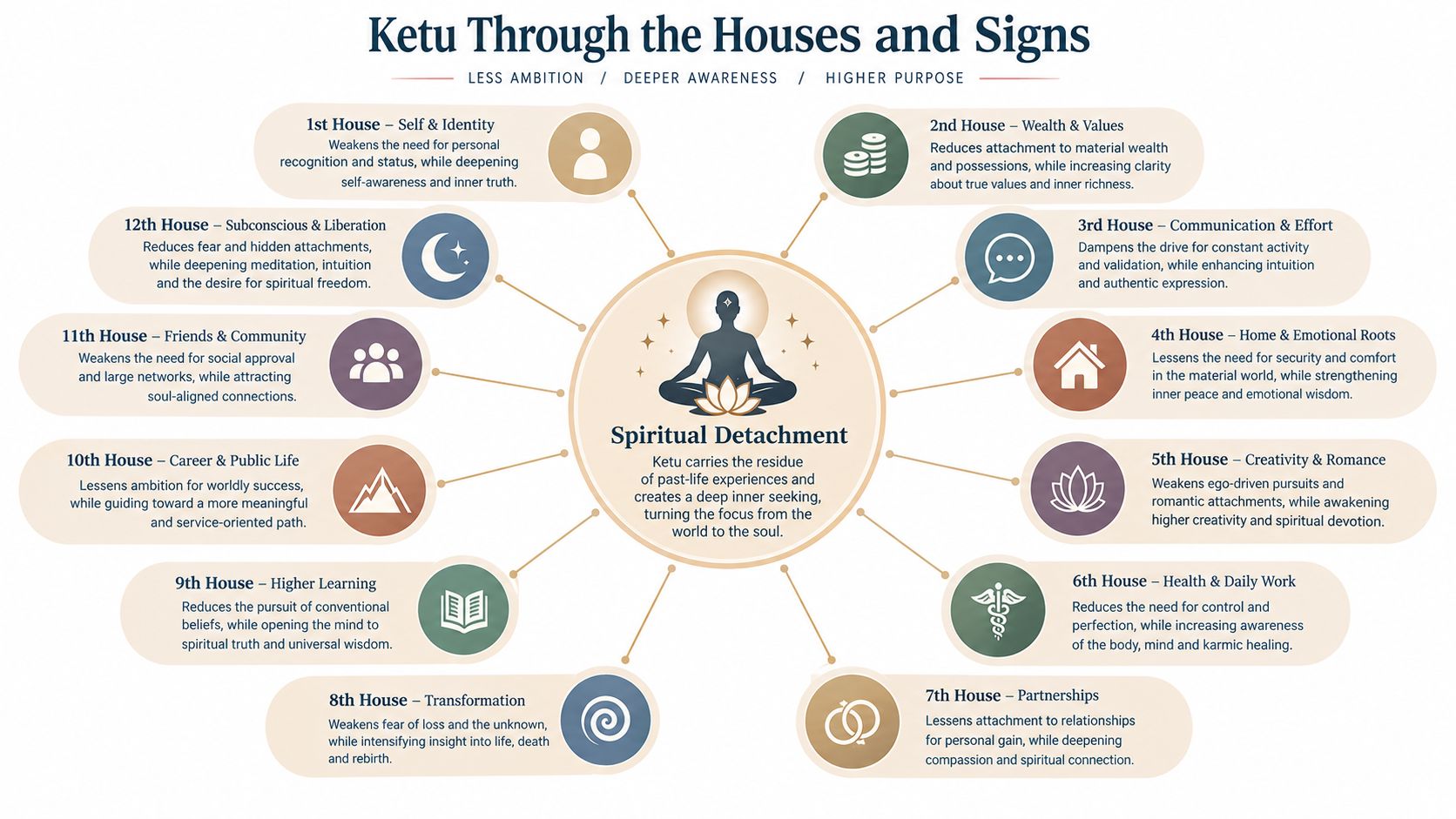
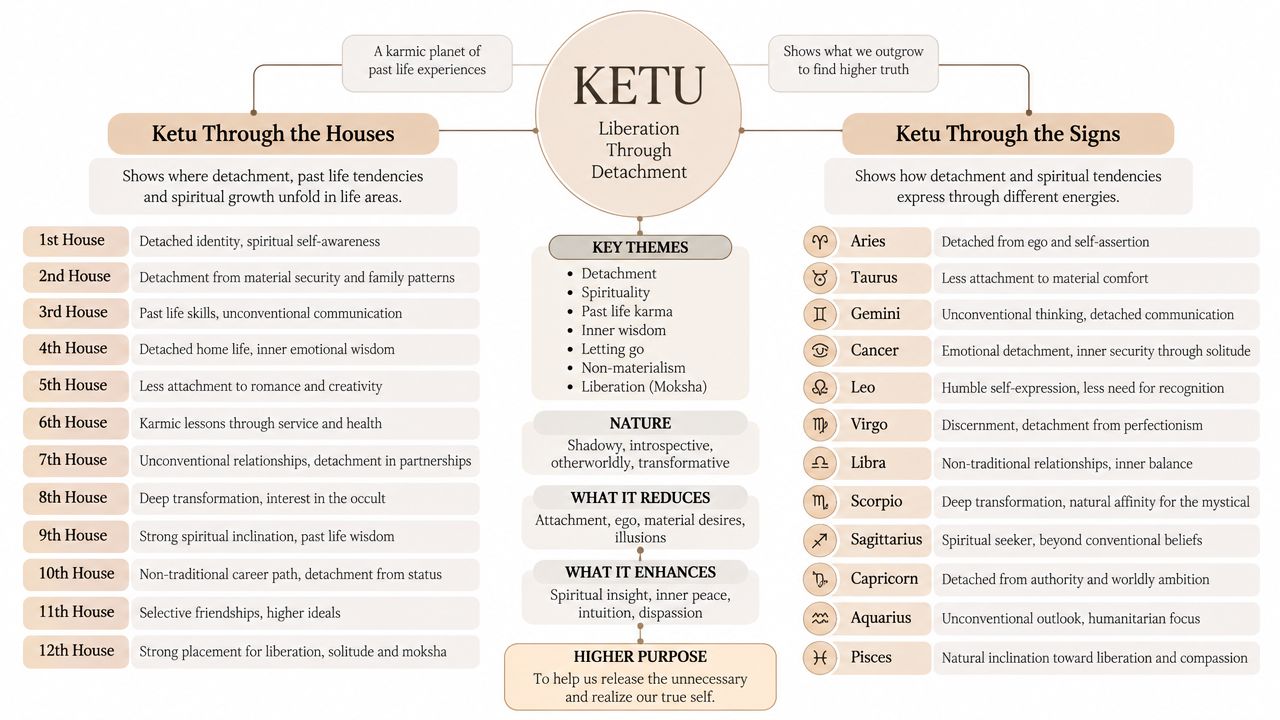
Ketu's house placement shows where a person may feel familiar with an experience yet less interested in proving success through it. It can act like a dimmer switch on conventional ambition while turning up subtle perception, research ability, or spiritual curiosity.
Ketu in the tenth house may resemble an employee who secretly wants to resign even after receiving recognition. Career status can feel hollow, or professional life may move through unusual turns. That doesn't automatically mean unemployment. It may indicate a need for specialised work, independence, or a career that serves a deeper interest.
Ketu in the fourth house can feel like homesickness for somewhere the person has never visited. Domestic life, property, family identity, or the search for emotional security may carry a sense of distance. The person may need to define “home” internally rather than relying only on a place, family role, or possession.
Other house themes
- First house: Identity may feel difficult to pin down, while introspection and unusual personal presence become stronger.
- Second house: Speech, family values, food, savings, and self-worth may become areas of simplification or uncertainty.
- Third house: Communication and everyday courage may take an unconventional route, with interest in solitary learning or specialised skills.
- Fifth house: Romance, creativity, children, and speculation may bring both intuitive gifts and reduced attachment to applause.
- Sixth house: Work routines, service, health habits, and conflict may require practical discipline instead of avoidance.
- Seventh house: Partnerships can teach self-reliance, boundaries, and the difference between emotional distance and healthy space.
- Eighth house: Research, shared resources, hidden subjects, and transformation may become unusually compelling.
- Ninth house: Religious or philosophical beliefs may be questioned until a more personal form of meaning develops.
- Eleventh house: Social circles, gains, and group approval may lose their grip, even when networks remain useful.
- Twelfth house: Solitude, foreign places, dreams, meditation, and withdrawal may gain importance, but balance still matters.
Signs refine the experience
Ketu behaves like a guest in a sign. It borrows that sign's style rather than owning the sign outright. In fiery signs, detachment may show through independence or abrupt action. In earthy signs, it may question material security or routine. Air and water signs can turn the focus towards ideas, emotion, intuition, or inner life.
The traditional descriptions of Scorpio exaltation and Taurus debilitation are interpretive cues, not automatic verdicts. The sign lord, dignity of that lord, house condition, conjunctions, and dasha can change the outcome significantly. Readers can use a Vedic horoscope guide to begin with the placement, but decisions about marriage, work, or relocation require the full chart.
Ketu Mahadasha and Transits in Daily Timing
A dasha is a planetary period used to organise the timing of a Vedic chart. Ketu's Mahadasha lasts seven years within the 120-year Vimshottari system, so it can feel more like a change of direction than a passing mood as discussed in this chart-timing guide to Ketu.
The early part may bring disinterest in goals that once seemed obvious. A person may question a job, relationship pattern, location, or public identity. The middle phase often involves reorientation, where practical choices are tested against a quieter sense of purpose. Later, an unconventional routine may feel normal, even if it would have seemed impossible before the period began.
That pattern isn't universal. Ketu's results depend on its house, sign, lord, conjunctions, and the planet running in the antardasha, or sub-period. A strong supporting planet can make the period productive and specialised, while difficult connections can make uncertainty harder to manage.
Three timing layers
| Timing Layer | Duration | Scope of Effect | Typical Life Triggers |
|---|---|---|---|
| Mahadasha | 7 years | Broad direction and priorities | Career identity, relationships, spiritual practice, relocation |
| Antardasha | Varies within the dasha sequence | Focus within the larger period | Decisions, conversations, offers, family developments |
| Transit | About 1.5 years per sign | Current pressure around a chart area | Job pivots, relationship distance, changes in home or routine |
Ketu transits colour a period gradually. Ketu moving through the tenth house may prompt a review of professional identity, while a transit through the seventh may make a person examine closeness, expectations, and partnership roles. Those signals don't rewrite personal destiny, and they shouldn't be used alone to declare that a marriage will end or a job must be abandoned.
Timing principle: A transit describes the weather. The dasha shows the longer season. The birth chart provides the terrain.
For a practical decision, the astrologer can compare the running Mahadasha, active antardasha, transiting Ketu, and relevant house lords. A person considering a job change might wait for clearer support in career houses rather than reacting to one restless week. Someone planning marriage may assess compatibility, the seventh house, Venus, Jupiter, and the dasha sequence instead of treating Ketu as a standalone warning. A planet transit reference can help identify movement, but personalised timing still depends on the individual kundli.
Ketu and Rahu as Complementary Forces
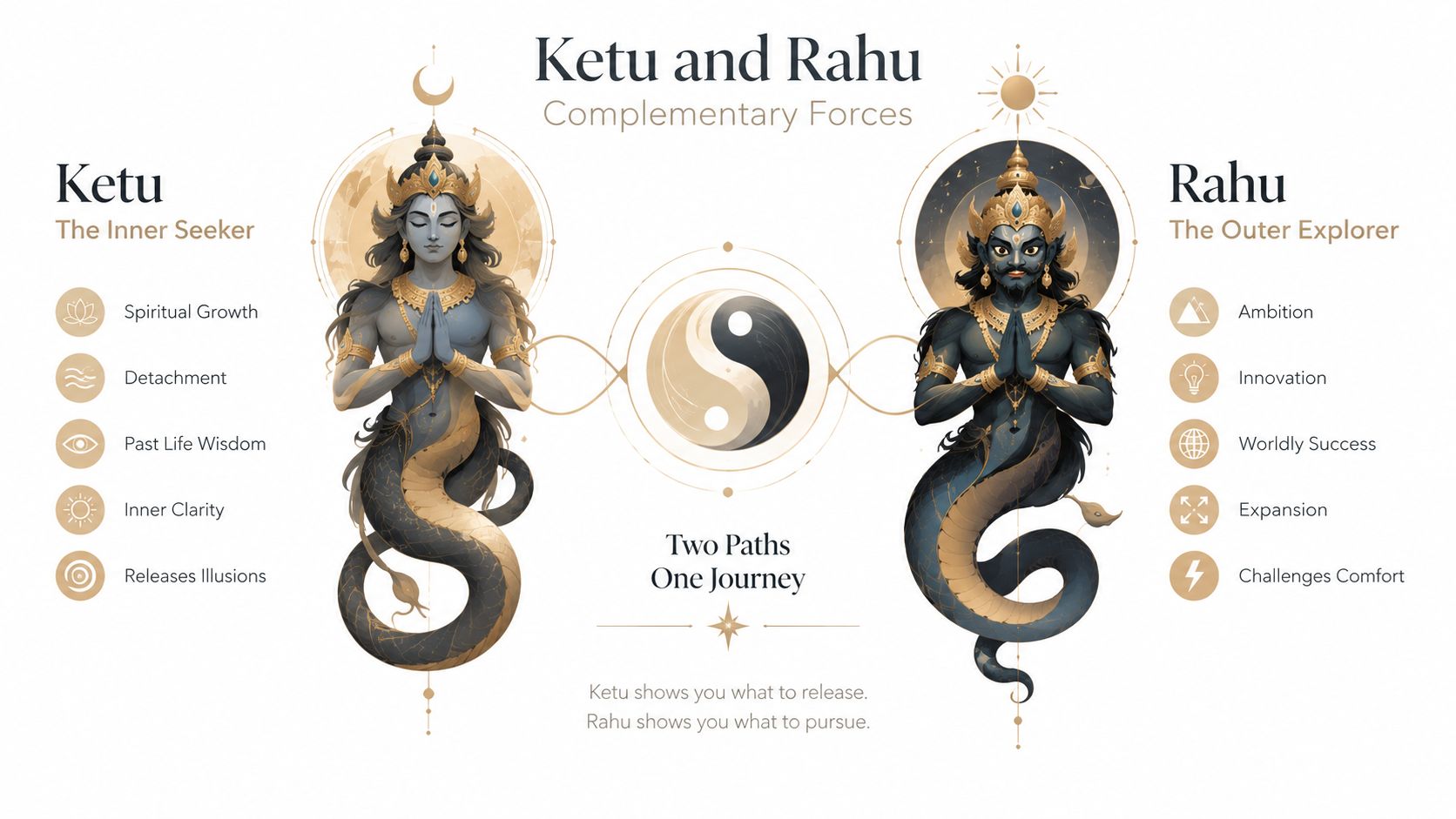
Rahu and Ketu are opposite ends of one nodal axis. The myth presents them as the head and body of one being, while chart mechanics place them 180 degrees apart. This makes their interpretation relational. Ketu shouldn't be read without noticing what Rahu is simultaneously intensifying.
A useful analogy is a magnetic compass. Rahu points towards a glittering destination, where desire, ambition, and unfamiliar experiences pull attention. Ketu points towards the exit, where attachment weakens and a person becomes less willing to repeat what already feels complete.
| Rahu | Ketu |
|---|---|
| Increases appetite for experience | Reduces attachment to familiar rewards |
| Seeks recognition, expansion, or novelty | Questions status, identity, or repetition |
| Can amplify unconventional ambition | Can encourage withdrawal, research, or release |
| Looks towards what feels unfinished | Draws on what feels already known |
This contrast becomes practical across the life axis. If Rahu occupies a career-focused area while Ketu occupies a domestic one, professional experimentation may grow while old ideas of home lose their hold. If Rahu activates partnership themes and Ketu sits opposite in the self-oriented area, the person may seek a powerful connection while learning not to disappear inside it.
When the axis becomes intense
Conjunctions, oppositions, and parivartana, a sign exchange between planets, can add complexity when nodes connect with key chart factors. The result may feel like a tug of war between wanting more and wanting out. In a relationship, one person may crave certainty while another needs space. In a career, a new opportunity may look exciting while the current role no longer feels meaningful.
The right interpretation doesn't ask which node is winning. It asks whether the chart holder can pursue Rahu's growth without ignoring Ketu's need for clarity. A balanced reading turns the axis into a decision tool: explore what expands capability, and release only what has become misaligned.
Reading Ketu Practically and Common Remedies
A responsible Ketu reading starts with context. The placement may suggest detachment, but the house lord can show whether that detachment becomes healthy independence, confusion, research talent, or avoidance. A benefic aspect may support insight, while a difficult conjunction can make the same house feel unsettled.
A reader can use this short checklist before drawing conclusions:
- House placement: Identify the life area where attachment or ambition may change.
- Sign and sign lord: Note the style Ketu adopts and the strength of the planet ruling that sign.
- Conjunctions and aspects: Check whether other planets support, restrict, energise, or distort the expression.
- Nakshatra: See whether Ashwini, Magha, or Mula adds a particular symbolic tone.
- Dasha sequence: Compare the Mahadasha and antardasha with current transits.
- Real-life context: Separate spiritual reflection from symptoms that require practical, medical, or professional support.
Traditional practices
Traditional practitioners suggest remedies as supportive habits, not as magical guarantees. Ketu mantra chanting can create a regular contemplative practice. Meditation, silence, and spiritual study also match Ketu's inward symbolism because they help a person observe attachment rather than react to every change.
Some practitioners recommend donating blankets or sesame on Saturdays, and feeding dogs as acts of charity and care. The value of these practices lies partly in disciplined service and generosity, not in a promise that a ritual will force a particular outcome.
Grounded approach: A remedy should strengthen steadiness and ethical action, not replace a clear decision or professional help.
Gemstones require greater caution. Cat's Eye is traditionally associated with Ketu, but it shouldn't be treated as a default solution. A qualified astrologer should examine the ascendant, house lordship, conjunctions, dasha, and the wider chart before recommending it. A stone that suits one chart may be unsuitable for another.
Kismo offers one route for one-to-one guidance by chat or call, including birth chart interpretation, marriage compatibility, career questions, and muhurta, the selection of an auspicious time. Any platform or practitioner should be used for reflection and planning rather than for fear-based guarantees.
Bringing It All Together for Your Chart
A Ketu period may feel like a career door closing, a relationship changing shape, or a familiar goal losing its appeal. Its nodal cycle takes about 18.6 years, so similar themes can return at different stages as priorities and circumstances change. This timing signal does not predict one fixed event. It highlights where reflection and a deliberate choice may matter.
Ketu can point to past skills, instinctive familiarity, and a strong inward pull. A person may perform well in one area yet feel little lasting satisfaction from its ordinary rewards. That discomfort can support wiser choices when examined carefully. Left unexplored, it may instead appear as avoidance or repeated withdrawal.
A useful reading combines the ascendant, Moon, Ketu's house and sign, the sign lord, aspects, conjunctions, and dasha lord. The horoscope then becomes a map for questions rather than a substitute for judgment. A career change still calls for financial planning. Marriage decisions still require communication and consent. Health concerns still call for appropriate medical attention.
During a major dasha or transit, ask: Which goal has lost meaning? Which natural skill is underused? Is withdrawal creating clarity, or postponing a necessary conversation? These answers connect symbolic interpretation with practical decisions about work, marriage, and life direction.
An individual horoscope gives the needed context, and Kismo can provide personalised guidance by chat or call, including Ketu timing, marriage compatibility, career changes, relocation, and muhurta. Visit Kismo to discuss the relevant house, sign, dasha, and transit pattern.