Rahu Moon Conjunction in Your Birth Chart: What It Means
Two people born on the same day, with the Moon and Rahu sitting in the same zodiac sign, walk into two different astrologers. One comes out with a description of a curious, intense, unconventional mind. The other comes out convinced that something in the chart is broken.
Why the gap? Because "same sign" is the coarsest possible reading of a Rahu Moon conjunction, and it hides the four things that decide how the placement behaves: the exact degrees between the two points, the house that holds them, the strength of the Moon, and the planetary period running at the time.
None of that requires fear. It requires arithmetic and a little patience, which is exactly what this walkthrough supplies.
Table of Contents
- What Rahu and the Moon Mean Together
- How Orb Distance Changes the Strength
- How to Read the Conjunction Step by Step
- How the House Shapes the Life Theme
- How Dasha Timing Brings the Pair to Life
- Why Two Astrologers May Read It Differently
- Decide How to Use This Reading With Care
What Rahu and the Moon Mean Together
The Moon is the mind's daily weather. It colours how a comment lands, how quickly a mood shifts, and where attention drifts when nobody is watching. Rahu works like a volume knob on whatever it touches. Place the two in the same part of a chart and ordinary emotional life gets louder, more curious, and harder to switch off.

That much is simple. The confusion starts one step earlier, with what Rahu is.
Rahu isn't a planet
Popular imagination pictures nine planets lined up in the sky. Rahu doesn't belong in that line. The historian Rajesh Kochhar traces Rahu and Ketu to early Vedic literature, where they appear as eclipse-associated mythological figures, and shows the technical astronomical meaning arriving much later, with the sixth century CE marking the shift in his account of Indian astronomical history. After Aryabhata's mathematical explanation of eclipses, Rahu was identified with the ascending node of the Moon's orbit and Ketu with the descending node.
An ascending node is a crossing point, not a solid body. The Moon's orbit is tilted by about 5.1 degrees from the ecliptic, the apparent yearly path of the Sun, as the standard astronomical description of Rahu sets out. Because of that tilt, most new and full Moons pass slightly above or below the Sun and no eclipse happens. Only when the Moon sits near one of the two crossing points can the three bodies line up.
So a Rahu Moon conjunction in a kundli, the birth chart cast from your date, time and place of birth, means the Moon and that calculated point share a zodiac sign. Nothing is touching. Nothing is being swallowed.
Why the name frightens people
Traditional Indian astrology calls this pairing Chandra Grahan Yoga and, more alarmingly, Grahan Dosha. Both are inherited names for a pattern, the way "square" is a name for a shape. The themes attached to it run towards emotional intensity, quick curiosity, fixation on a subject, sensitivity to social feedback, and a pull towards the unconventional.
Worth saying plainly: these are traditional interpretive claims about symbolism. No study shows that a node sharing a sign with the Moon rewires a personality.
Kochhar's history supports one thing clearly, that Rahu travelled from mythological eclipse agent to mathematical node, and the marriage of that node to emotional meaning came afterwards. It's a rich interpretive tradition. It isn't a diagnosis, and it isn't a verdict.
Before reading another word about severity, note four numbers from your own chart: Moon sign, Moon degree, Rahu sign, Rahu degree. Everything that follows depends on them.
How Orb Distance Changes the Strength
The orb is the number of degrees between the two points, measured inside the same sign. Subtract the smaller figure from the larger and you have your band.
| Orb between Moon and Rahu | Weight usually given | What to check next |
|---|---|---|
| 1 to 2 degrees | Especially intense | Moon strength, dispositor and Jupiter aspect |
| 3 to 7 degrees | Moderate; still a real conjunction | House placement and running dasha |
| 8 to 12 degrees | Operationally significant | Nakshatra, house and transit overlay |
| 13 to 30 degrees (same sign) | Software flag only; weak alone | Confirm exact degrees before any interpretation |
Charting software will happily mark any pair sharing a sign, and a sign stretches up to 30 degrees wide. Practitioners read that flag with caution. One technical reference describes roughly 8 to 12 degrees as operationally significant and 1 to 2 degrees as especially intense, as Dekho Panchang's guide to Grahan Yoga explains, and it lists the checks an astrologer should complete before assigning any outcome.
Why a sign flag isn't evidence
Take a Moon at 3 degrees Aries and Rahu at 25 degrees Aries. Same sign, so the software lights up. But that's a 22-degree gap, wide enough that the rest of the chart has plenty of room to speak. Compare a Moon at 12 degrees Leo and Rahu at 15 degrees Leo: three degrees, close, and far more likely to dominate the reading.
Closeness carries weight because the two significations overlap more completely when the points sit near each other. The Moon's emotional and perceptual work and Rahu's amplifying quality act on the same material rather than on different parts of life.
One more correction: a shared sign doesn't mean you were born during a lunar eclipse. A true eclipse needs Full Moon geometry, with the Sun opposite the Moon and both near the nodal axis.
Solar eclipses follow the same rule, becoming possible only when a new Moon falls within roughly 15 to 18 degrees of a lunar node, as an explainer on Rahu, Ketu and eclipses describes, with eclipse seasons arriving about 173 days apart. A birth-chart conjunction is a position, not an event.
Orb is one factor among several. House, Moon strength and timing carry equal weight, and a reader who stops at the degree count will misjudge the chart.
How to Read the Conjunction Step by Step
A sign-level label tells you almost nothing by itself. A short, repeatable routine gets you to something usable, and to a set of questions worth putting to any astrologer.
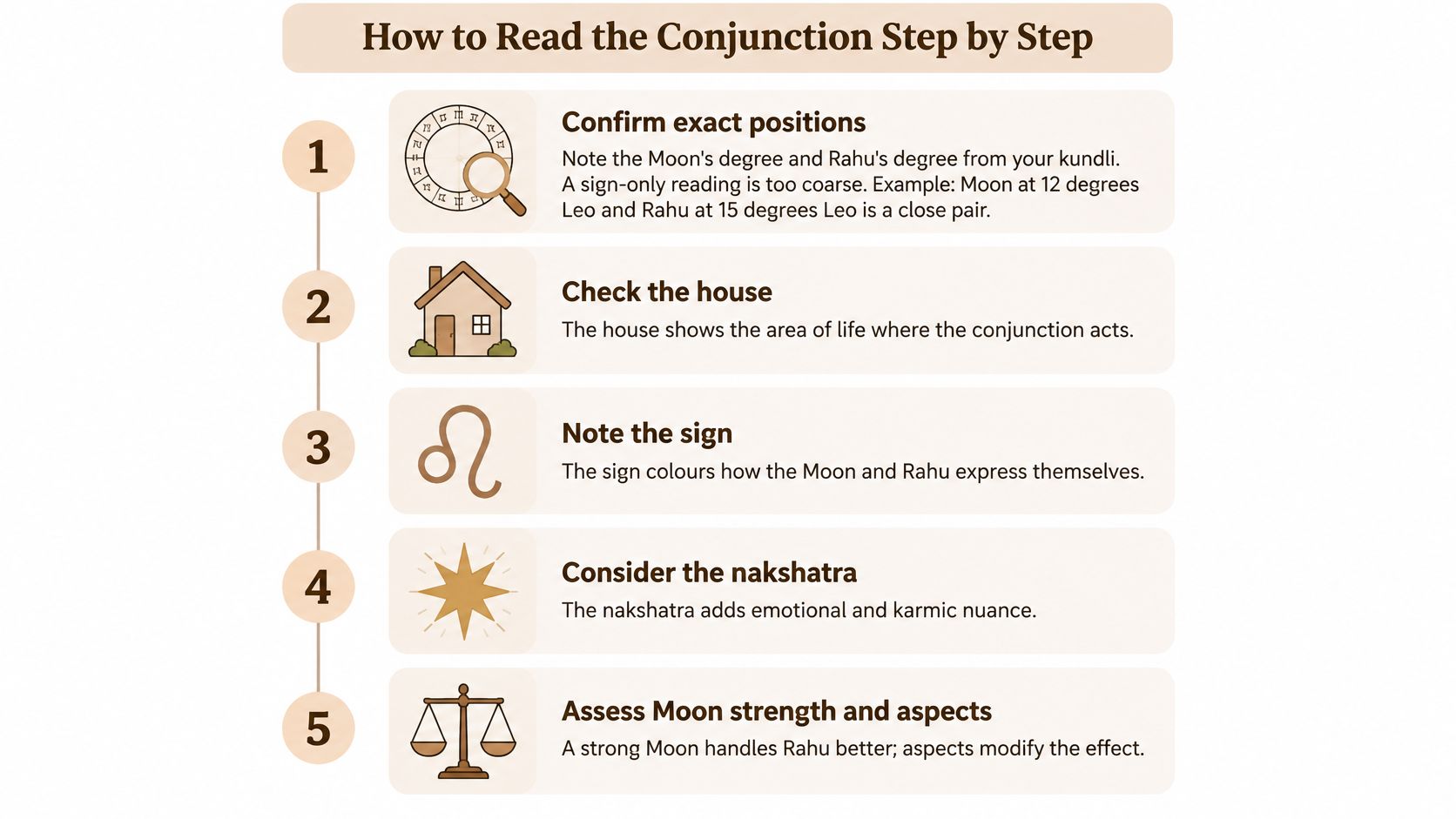
Work through the sequence below with a printed chart in front of you. Twenty minutes is usually enough.
Confirm exact positions. Write down the Moon's degree and Rahu's degree. A sign-only reading is too coarse to grade. A free janam kundli calculator will list both to the minute of arc. The reason is simple: Moon at 12 degrees Leo and Rahu at 15 degrees Leo behaves like a close pair, while the same two in a sign but 25 degrees apart behaves like a wide one.
Measure the orb. Subtract the smaller degree from the larger and match it to the bands set out earlier in this guide. Under 2 degrees is intense, 8 to 12 is significant, and anything past 13 is a flag that still needs checking. Precision matters because a wide pair lets other chart factors lead.
Note the nakshatra. Nakshatras are the 27 lunar mansions, each exactly 13 degrees and 20 minutes wide, as a guide to the 27 nakshatras explains. Record the Moon's nakshatra, its pada (the quarter within the mansion), and the planet ruling it. Two Moons at the same degree of the same sign can read differently if one sits at a mansion boundary.
Find the house. The house, or bhava, is the life area the pair occupies, from money and family in the second to career in the tenth. The reason this step comes before any interpretation is that the house names the subject receiving the amplified attention.
Assess the Moon's strength. Three checks in order: sign dignity, phase, and dispositor. The Moon is exalted in Taurus, at home in Cancer, and debilitated in Scorpio. A waxing Moon holds more steadiness than a waning one, and the planet ruling the Moon's sign carries the Moon's agenda, so its condition matters.
Look for support. Check whether Jupiter aspects the pair or the Moon. A benefic aspect supplies structure, and structure is what turns amplified perception into research, media work or problem solving instead of rumination.
Overlay timing. Check the running dasha and the current transits to the natal Moon and Rahu. A natal promise sits until a period activates it.
For a visual walkthrough of the same checks applied to a live chart, this short video covers the sequence from the beginning.
Finish by writing two short lists side by side on one page. Left column, supporting factors: a strong Moon, Jupiter's aspect, a favourable house, a helpful period. Right column, pressure points: an exact orb, a debilitated Moon, a difficult house, an activating dasha. A reading that shows only one column isn't a reading. It's a warning dressed up as one.
How the House Shapes the Life Theme
Houses, or bhavas, divide a kundli into twelve life areas. The house holding the Moon and Rahu points to the subject that gets the most emotional and mental attention across a life.
| House | Life area | Traditional reading to check |
|---|---|---|
| 1st | Self, body and personality | Strong focus on identity; mood and self-image can swing |
| 2nd | Family, speech and money | Strong feelings about money and family; sensitive speech |
| 3rd | Courage, siblings and short travel | Restless communication; review quick decisions |
| 4th | Home, mother and inner peace | Need for emotional security; home changes |
| 5th | Children, creativity and learning | Vivid imagination and intuition; focused study needed |
| 6th | Health, routine and rivals | Worry about routine and health; needs structure |
| 7th | Partnership and marriage | Intense attachments; check expectations early |
| 8th | Transformation and shared resources | Sudden shifts; research before big commitments |
| 9th | Fortune, faith and higher learning | Interest in foreign or unconventional teachers |
| 10th | Career and public standing | Strong visibility; career changes need planning |
| 11th | Gains, networks and elder siblings | Unconventional friends; check money expectations |
| 12th | Rest, foreign lands and solitude | Foreign connections; needs quiet time |
Read your own row, then hold it loosely. Two people with the pair in the seventh house don't share a marriage outcome. They share a tendency to pour attention into partnership, and the rest of the chart decides how that tendency plays out.
When the chart supplies structure
The working model in Indian astrology is psychological and symbolic rather than medical. Rahu magnifies the Moon's attention and desire, and the same configuration turns productive when something in the chart holds it steady, whether that's a strong sign placement, a capable dispositor, benefic aspects, or disciplined planetary periods. Amplified perception then shows up in research, technology, media, foreign environments, public-facing work, or problem solving outside conventional norms, as this reading of the Moon and Rahu together describes.
When the chart withholds it
Weak lunar dignity, affliction from additional malefics, a difficult house placement, or a destabilising dasha is read very differently. The traditional language is confusion, rumination, compulsive interpretation, and decisions that don't hold. That isn't a curse. It's a description of a mind running at high volume without a structure around it.
Take a pair in the tenth house of career and public standing, with the Moon in a strong sign and Jupiter casting an aspect. That chart has traditionally been read as suited to public-facing work, where a person is seen and heard and the intensity has somewhere to go.
The house tells you where to look, not what will happen. It names the life area receiving the attention. It doesn't name the result.
This is why one-variable predictions about marriage, career or mental health don't survive contact with a real chart. The house narrows the subject. Everything else determines the outcome.
How Dasha Timing Brings the Pair to Life
A dasha is a planetary period, a stretch of years given to one graha and then the next. Vimshottari dasha is the version most Jyotish readers use: a 120-year cycle shared among nine grahas. It starts from the Moon's birth nakshatra and from the balance of that opening period left at birth. Kismo's free janam kundli lists that Vimshottari dasha sequence from your birth details.
| Graha | Major period (years) |
|---|---|
| Ketu | 7 |
| Venus | 20 |
| Sun | 6 |
| Moon | 10 |
| Mars | 7 |
| Rahu | 18 |
| Jupiter | 16 |
| Saturn | 19 |
| Mercury | 17 |
| Full cycle | 120 |
Those lengths belong to the traditional scheme, as this dasha reference lists them. The order never changes. The starting point does, so two people with the same conjunction can be living in different chapters of the cycle.
The chart and the timetable
Moon conjunct Rahu is a position in the birth chart. The running period is a timetable. They meet when a period of Rahu or the Moon, or of a graha that rules their sign or nakshatra, is in force.
Inside a mahadasha, the long period, shorter antardashas take turns. Rahu's mahadasha lasts 18 years and the Moon's lasts 10, so a life can pass nearly three decades through periods that keep handing the same theme back to this pair.
Say the Moon and Rahu sit in the fourth house, and a Rahu mahadasha opens a Moon antardasha. Both ends of the pair are active together, so home, family, and the need to feel settled move forward. If Saturn's period is running instead, the same pair can stay quiet for years while Saturn's topics take the room.
A common mix-up: the conjunction describes what is available in the chart. The dasha describes when it becomes active.
The pair grows louder when the operating period touches Rahu, the Moon, the ruler of their nakshatra, or the houses they occupy. An astrologer then lays current transits, the planets' present positions, over the natal Moon and Rahu to narrow the timing.
The conjunction by itself does not date an event. Dignities, house placements, and aspects in the full chart have to be read before any period is treated as a forecast.
Why Two Astrologers May Read It Differently
Plenty of popular explanations present the conjunction as a fixed personality result, as though one placement signed off on a whole life. That isn't how a serious reading works. A meaningful Vedic interpretation depends on sign, house, exact degree distance, lunar strength, dispositor, nakshatra, aspects, divisional charts, dasha sequence and current transits, and the Indian medical-astrology literature illustrates the same complexity by reading health through several chart frameworks at once.
Change one variable and the reading shifts. Change four and two astrologers can look at the same kundli and sound like they're describing different people.
| Chart factor | Reading that feels more severe | Reading that feels more manageable | Why it matters |
|---|---|---|---|
| House | Dusthana (6th, 8th or 12th) | Kendra (1st, 4th, 7th or 10th) | Difficult houses add friction; angular houses give a steadier base |
| Degree distance | Close pair, 1 to 2 degrees | Wide pair, 13 to 30 degrees in same sign | Close pairs carry more weight |
| Moon condition | Weak Moon, no Jupiter aspect | Strong Moon, Jupiter aspect | Support and structure change the outcome |
| Timing | Pair activated by running dasha | Pair not activated | Timing shows when the pair becomes active |
Two charts, one sign
Put the comparison into practice. Chart A has Moon and Rahu 2 degrees apart in the tenth house, with the Moon in its own sign, Jupiter's aspect falling on it, and a dasha that activates the pair. That reading leans towards visibility, focus and public work, and an astrologer would probably call it manageable.
Chart B has the same two points in the same sign but 25 degrees apart in the sixth house, with a weak Moon and no Jupiter support. That reading names worry about routine and health, and asks for structure. Both are interpretations. Neither is an outcome.
A fair question to put to any astrologer: which chart factors made this placement severe in my case, and which ones soften it?
Readers seeking guidance on relationships, career, relocation or family matters deserve that reasoning spelled out. Ask for it. A one-line label, whether reassuring or alarming, isn't a reading. If you'd rather hear the working, Kismo's verified astrologers will walk through the chart factor by factor.
Decide How to Use This Reading With Care
Two people can share a Rahu-Moon conjunction and hear the same short warning. One treats it as a weather note for the week. The other treats it as a life sentence. The chart did not change. The use of it did.
A reading works like a map of symbolic weather. It can show where mood, attention and timing tend to gather. It has no clinical authority over your health, your marriage or your future.
That limit is practical. Persistent sleep trouble, panic, thoughts of self-harm, or days when ordinary functioning is breaking down need a qualified doctor or mental-health professional, whatever any graha says. Researchers associated with NIMHANS examined 101 papers and found associations between astrology use, thinking style, self-concept and stress, with distress and reduced help-seeking when use became excessive, as the published review reports. That review did not establish that a planetary conjunction causes a psychiatric condition.
The placement is also widely shared. Very many people are born with the Moon and Rahu together in some form, so the pair cannot be a private sentence on one life. Traditions differ on how close the two must sit, and on whether a stronger Moon or a quiet dasha softens the picture. Those differences are a reason to ask how the factors were weighed.
Three habits keep the reading in proportion. Write the choice, the reasons, and what would change your mind. Notes slow the moment enough for judgement to catch up, the way a cook tastes the pot before serving it. Give a marriage, a move or a job change a few days or weeks before you commit. Urgency makes a symbol feel more final than it is. Watch sleep, meals and the people around you. If checking predictions starts crowding those out, pause. Checking harder will not fix that.
Kismo's astrologers work from your birth details and your actual situation, so a session is one input among several, beside the people who already know your life. A reading worth keeping names what supports you as clearly as what does not, and it grades the pair by orb, house, Moon strength and dasha before it concludes anything.
If a Rahu-Moon conjunction has reached you as one frightening line, ask for the rest of the picture. Chat or call a verified astrologer and have those four factors explained first. Visit Kismo to start a session and hear the reasoning, not only the label.