Lord Sri Rama Nakshatra: What It Means and Why It Matters
On Ram Navami, a temple bell rings at midday while devotees remember Rama's birth in Ayodhya. Behind that familiar celebration lies a precise astrological idea: Lord Sri Rama is traditionally associated with Punarvasu Nakshatra.
Table of Contents
- The Story Behind Lord Sri Rama Nakshatra
- What a Nakshatra Actually Is in Vedic Astrology
- Punarvasu Nakshatra and Its Place in the Sky
- The Traditional Birth Chart of Lord Sri Rama
- Two Ways Scholars Reconcile the Birth Time
- Qualities of Punarvasu Reflected in Rama's Life
- How Ram Navami Keeps the Nakshatra Alive
- What This Means for You and Your Own Chart
The Story Behind Lord Sri Rama Nakshatra
Ram Navami begins with a scene familiar across Hindu households. Devotees remember the birth of Lord Sri Rama in Ayodhya, offer prayers, recite sacred verses, and welcome the moment associated with his appearance. Traditional accounts place this birth on Chaitra Shukla Navami, the ninth lunar day of the bright fortnight in the month of Chaitra.
Astrology adds another layer to this devotional memory. According to widely cited Indian astrological traditions, Rama was born under Punarvasu Nakshatra, with Cancer Lagna, or Cancer ascendant, and a Cancer-based lunar placement. The nakshatra identifies the Moon's position within a particular lunar mansion at the time assigned to the birth narrative.
This distinction matters because a nakshatra isn't another name for a zodiac sign. A sign gives a broad location along the zodiac, while a nakshatra marks a more precise section of the Moon's path. For Rama's traditional chart, Punarvasu becomes the celestial signature attached to the birth story.
Devotion and calculation
The devotional account and the astrological chart serve related but different purposes. The festival expresses Rama's sacred identity and his place in Hindu religious memory. The chart gives astrologers a symbolic and technical framework for discussing the planetary positions connected with that identity.
Some reconstructions place the birth at approximately 12:30 p.m. on 10 January 5114 BCE, while another traditional framing connects it with the daytime midpoint of the Navami tithi. These are reconstructions, not modern civil birth records, and Indian sources differ in how they convert the traditional chronology into a historical date. A traditional discussion of Rama's birth sky map reflects this broader debate.
The central point remains consistent in the traditional framework: Chaitra Shukla Navami, Cancer Lagna, and Punarvasu Nakshatra form the core of Lord Sri Rama's birth identity in Vedic astrology.
What a Nakshatra Actually Is in Vedic Astrology
A nakshatra is a lunar mansion, a defined portion of the sidereal zodiac used in Hindu astrology. Britannica explains that the term refers to lunar mansions listed in the Atharva Veda, while later astrological practice uses a person's birth date, time, and place to determine the relevant mansion. Britannica's explanation of nakshatra also distinguishes older Vedic reckoning from later astrological practice.
Classical Indian astrology divides the sidereal ecliptic into 27 equal parts, with every nakshatra measuring 13°20'. Astro.com's technical description of nakshatra divisions presents this as a mechanical division, not a loose symbolic category.
A simple analogy helps. Think of the zodiac as a long circular track divided into 27 equal markers. If the 12 zodiac signs are broad neighbourhoods, the nakshatras are smaller streets within those neighbourhoods. The Moon's exact position tells the astrologer which street it occupies at a given birth time.
How the calculation works
The calculation follows a clear sequence:
- Record the birth place and time. Location affects the ascendant, while time affects the Moon and rising degree.
- Locate the Moon in the sidereal zodiac. The Moon's longitude determines the nakshatra.
- Identify the mansion. Each 13°20' segment corresponds to one nakshatra.
- Find the pada. Every nakshatra contains four padas, or quarters, each measuring 3°20'.
This level of detail helps explain why astrologers use nakshatras for birth-chart interpretation, timing, and muhurta, the selection of an auspicious time for an activity. Readers exploring planetary movement can also review Kismo's planet transit resource, while remembering that a transit isn't the same as a natal nakshatra placement.
The Sanskrit word is often discussed through the roots naksha, associated with approaching, and tra, associated with protection. Whether considered linguistically or technically, the nakshatra system gives astrologers a focused way to describe the Moon's position. That precision is why Punarvasu, rather than only Cancer or Gemini, carries special importance in discussions of Rama's chart.
Punarvasu Nakshatra and Its Place in the Sky
Punarvasu is the seventh nakshatra in the standard sequence of 27. It has a distinctive position because it crosses the boundary between Gemini and Cancer. Its traditional span runs from approximately 3°20' to 16°40' Gemini, followed by 0° to 3°20' Cancer. The final quarter, or fourth pada, therefore connects Punarvasu with the Cancer portion of the zodiac.
This crossing gives Punarvasu a useful teaching example. A person can have the Moon in Punarvasu while the Moon's sign depends on the exact degree. The first three padas fall in Gemini, while the fourth pada falls in Cancer. That is why one source can describe Punarvasu as Gemini-to-Cancer while also linking Rama's lunar placement with Karka Rashi, the Sanskrit name for Cancer.
The symbolic language
Punarvasu is traditionally associated with Aditi, the mother of the Adityas. Its planetary ruler is Jupiter, known in Sanskrit as Guru. In Jyotisha, or Vedic astrology, the ruling planet supplies an interpretive lens, while the deity adds a sacred and philosophical dimension.
The nakshatra's symbols are often given as a bow with a quiver or a house. The bow suggests movement, purpose, and the ability to direct energy. The house suggests shelter, restoration, and return. Together, these symbols support the familiar meanings connected with Punarvasu, including renewal, return, and safe homecoming.
| Attribute | Detail |
|---|---|
| Position | Seventh of the 27 nakshatras |
| Zodiac span | Gemini to the Cancer portion of the sidereal zodiac |
| Planetary ruler | Jupiter, or Guru |
| Deity | Aditi |
| Symbols | Bow with quiver, or a house |
| Subdivisions | Four padas |
| Traditional themes | Return, renewal, shelter, and restoration |
Some traditional descriptions also associate Punarvasu with Vaishya-adjacent qualities, especially nourishment, exchange, and practical support. Brahma is named as its presiding god in several astrological frameworks. These associations are interpretive, not scientific measurements, but they help explain why Rama's connection with Punarvasu carries such rich symbolic meaning.
The Traditional Birth Chart of Lord Sri Rama
Traditional references generally describe Rama's horoscope through a combination of Cancer Lagna, Punarvasu Nakshatra, and Chaitra Shukla Navami. Cancer Lagna means that Cancer rises on the eastern horizon in the chart, while the Moon's placement in Punarvasu supplies the nakshatra identity.
A commonly cited astrological description places the Moon in the fourth pada of Punarvasu while it transits Cancer. Another traditional presentation places Rama's birth at midday in Ayodhya. The traditional horoscope discussion from Indastro makes clear that this is a revered horoscope framework, not a modern empirical birth certificate.
Readers may also encounter references to the Sun in Ashwini, or to an opposing constellation in alternative treatments. The difference arises because traditional narratives, regional calculations, ayanamsa choices, and later reconstructions don't always produce the same planetary details.
Why the chart is celebrated
The chart is often treated as a coherent sacred pattern in which the Navagrahas, or nine planetary forces, participate in a meaningful birth narrative. This reading is theological and symbolic. It expresses the belief that Rama's birth reflects a complete cosmic order rather than merely recording an ordinary horoscope.
Astronomical reconstruction asks a different question. Instead of beginning with the sacred date and interpreting its meaning, it tries to calculate a date and time that could produce the stated planetary placements. A journal-published analysis places the Moon in the fourth pada of Punarvasu, transiting Cancer, and links the result with Cancer Lagna and the Moon in its own sign. The technical journal reconstruction narrows the estimated birth window to approximately 11:51:50 a.m. to 12:12:50 p.m.
| Chart Element | Faith-Based Tradition | Journal Reconstruction |
|---|---|---|
| Birth tithi | Chaitra Shukla Navami | Chaitra Shukla Navami used as the anchor |
| Lagna | Cancer Lagna | Cancer Lagna |
| Moon | Punarvasu, traditionally linked with Rama | Fourth pada of Punarvasu in Cancer |
| Timing | Daytime or midday framing | Approximately 11:51:50 a.m. to 12:12:50 p.m. |
| Purpose | Sacred horoscope and theological template | Technical attempt to match planetary positions |
A personal kundli, or birth chart, requires the same care with birth time, place, and chart settings. Readers seeking to understand that calculation can explore Kismo's kundli resource, but Rama's traditional chart shouldn't be treated as a direct template for every person born during Ram Navami.
Two Ways Scholars Reconcile the Birth Time
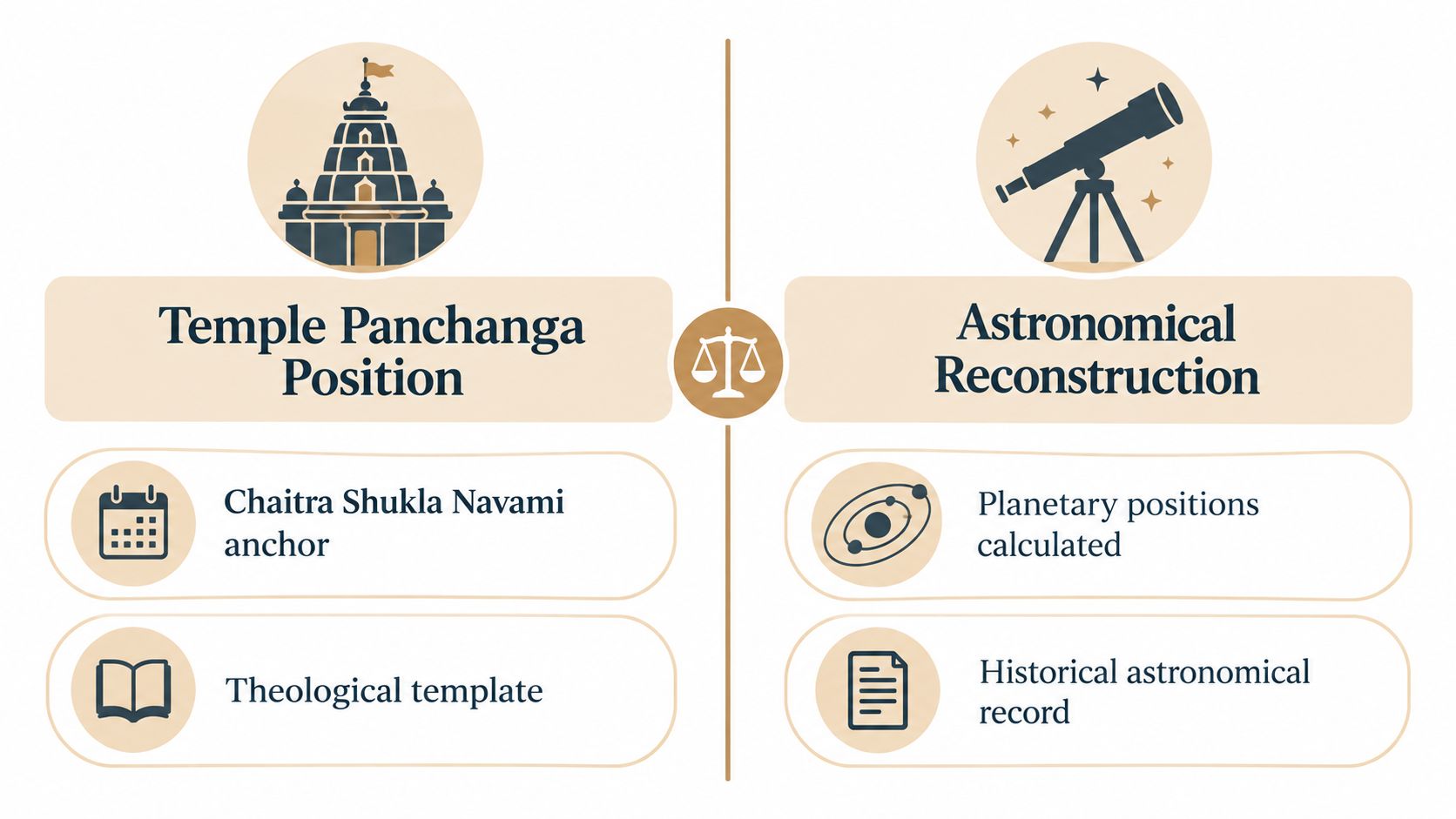
The debate over Rama's birth time becomes easier to understand when the two methods are placed side by side. The temple panchanga approach accepts Chaitra Shukla Navami as the sacred anchor. A panchanga is a traditional Hindu almanac that tracks lunar days, nakshatras, and other calendrical factors.
Under this approach, Rama's chart functions as a theological template. Its value lies in how it expresses his sacred qualities and his place in the Ramayana tradition. The date is not necessarily being offered as a modern historical record created through instruments and archived civil documentation.
The journal approach starts with the traditional descriptions and tries to reproduce them through astronomical calculation. It back-converts a Tretayuga chronology into a modern calendar framework, then searches for planetary positions that place the Moon in Punarvasu and Cancer rising.
Areas of agreement
Both approaches commonly retain several central elements:
- The lunar identity: The Moon is associated with Punarvasu.
- The ascendant: Cancer rising remains a major feature.
- The lunar month: Chaitra provides the calendrical setting.
- The time of day: Traditional and technical discussions point towards a daytime or noon-like window.
The differences appear in the details. Reconstructions can vary over the exact degree of Cancer Lagna, the Sun's constellation, and the specific Tretayuga year mapped onto the modern calendar. Those differences don't automatically invalidate the devotional account. They show that the two methods use different standards of evidence.
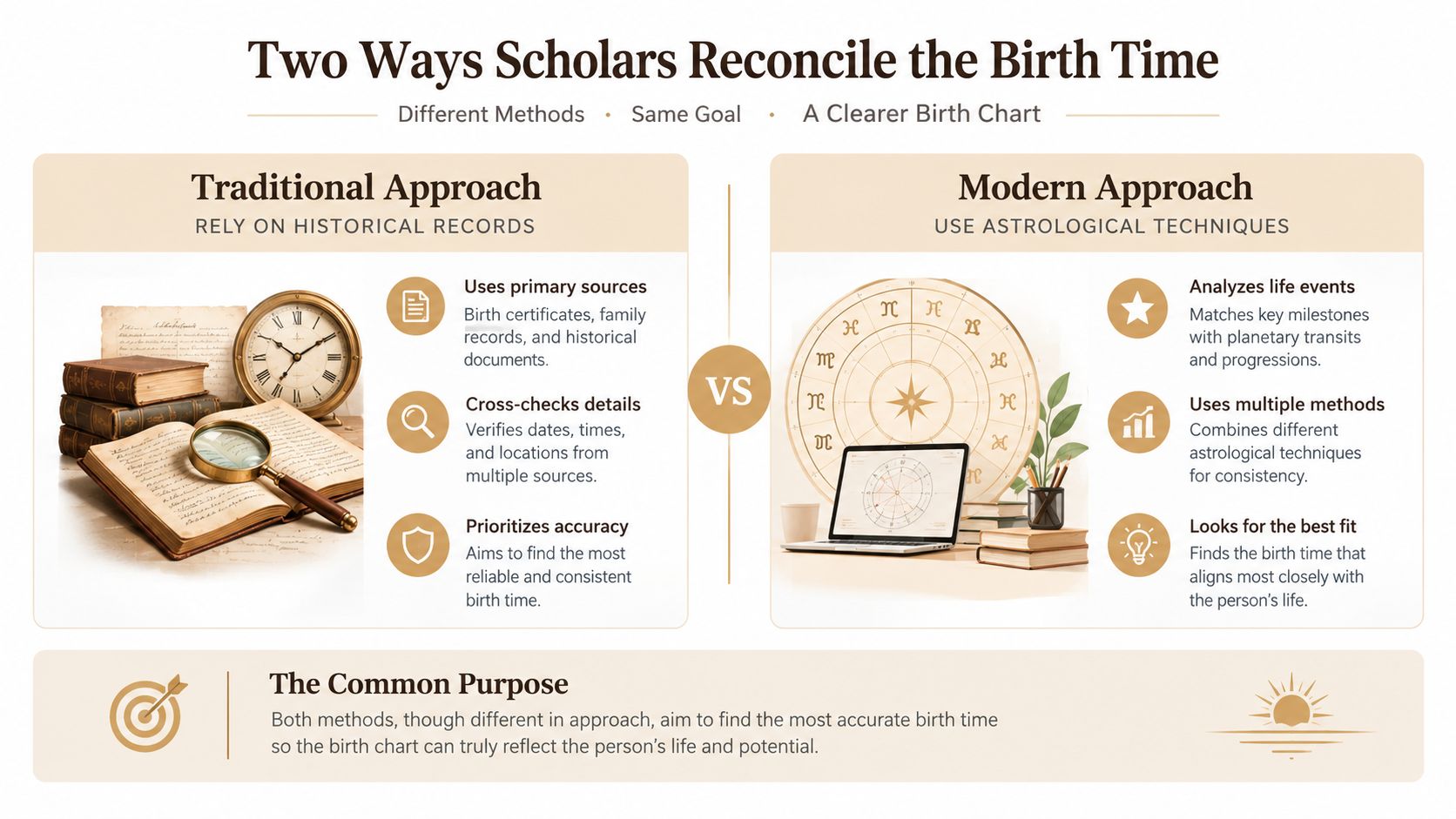
A useful distinction: Faith-based chronology asks what the tradition preserves as sacred. Astronomical reconstruction asks which calculated positions can fit the traditional description.
Indian astrology has always included layered traditions, regional calendars, and interpretive lineages. A reader can respect the temple panchanga position while also examining a journal's computational method. The two perspectives coexist because they answer different questions about the same revered birth narrative.
Qualities of Punarvasu Reflected in Rama's Life
The Ramayana gives Punarvasu's symbolism a human shape through specific choices, especially the episode involving Bharata. When Bharata asks Rama to return from exile and reclaim Ayodhya, Rama refuses to abandon the promise made by their father. Bharata then carries Rama's sandals back and places them on the throne, governing as their representative. The episode shows restoration through dharma: Ayodhya's order is preserved even while Rama remains away.
The house symbol becomes clearer here. Home is not only a building or a place of return. It also means rightful responsibility, trust, and a community protected from disorder. Rama's eventual restoration of Ayodhya therefore carries personal, political, and moral meaning.
Jupiter, Aditi, and dharma
Jupiter's rulership connects Punarvasu in traditional astrology with wisdom, guidance, teaching, and ethical judgement. Its deity, Aditi, is associated with expansiveness and boundlessness. Devotional readings can relate these ideas to Rama's generosity, restraint, and steady commitment to dharma, or righteous duty.
These connections remain interpretive. A nakshatra does not mechanically force a person to act in a particular way. Instead, astrologers and devotees use celestial symbolism to organise qualities already honoured in the epic.
The Gemini portion of Punarvasu is associated with Mercury in the traditional planetary rulership sequence. That association supports a reading centred on communication, discernment, and strategic conversation. Rama's exchanges with Hanuman, Sugriva, and Ravana show how speech can carry diplomacy, persuasion, warning, and moral clarity. The point is not that Rama speaks well. His words help establish alliances, test intentions, and keep action connected to duty.
The meaning of delayed fulfilment
Punarvasu is also described as cautious, with good fortune unfolding after experience. Rama's exile gives that idea a concrete narrative form. He accepts loss, uncertainty, and delay before the story reaches restoration and victory.
This interpretation should remain reflective rather than predictive. A person with Punarvasu in a birth chart will not automatically repeat Rama's life, because no nakshatra alone determines destiny. Its value lies in the questions it raises: how can difficulty test discipline, how can duty guide a delayed result, and how can restoration include responsibility toward others?
How Ram Navami Keeps the Nakshatra Alive
Ram Navami keeps Rama's connection with Punarvasu in a living calendar, rather than leaving it only in astrological texts. Devotees mark the festival through worship, fasting, scripture recitation, processions, and temple ceremonies centred on the birth narrative. Each practice gives the celestial association a public, repeatable form.
The date changes because Hindu festivals follow lunar tithis, not a fixed solar date. A tithi is a lunar day calculated from the relationship between the Sun and Moon. The civil date may therefore shift each year, while the appropriate puja time depends on the tithi window at a particular location.
The 2026 timing example
For Ram Navami 2026, the Shri Ram Janmabhoomi site listed the festival date as Friday, 27 March 2026. According to The official Ayodhya festival ecosystem, the planned public observance included a target of 28 lakh diyas across Ram Ki Paidi and 51 Sarayu ghats, compared with the previous record of 26,17,215 diyas. These figures describe Ayodhya's planned scale, not every local celebration.
A separate timing source states that the relevant tithi ran from 11:48 a.m. on 26 March to 10:06 a.m. on 27 March, placing the midday puja on 26 March. The Ram Navami 2026 tithi timing shows why priests consult a local panchanga instead of relying only on a general calendar. Readers checking the tithi window for their location can also use Kismo's free tools alongside their local panchanga.
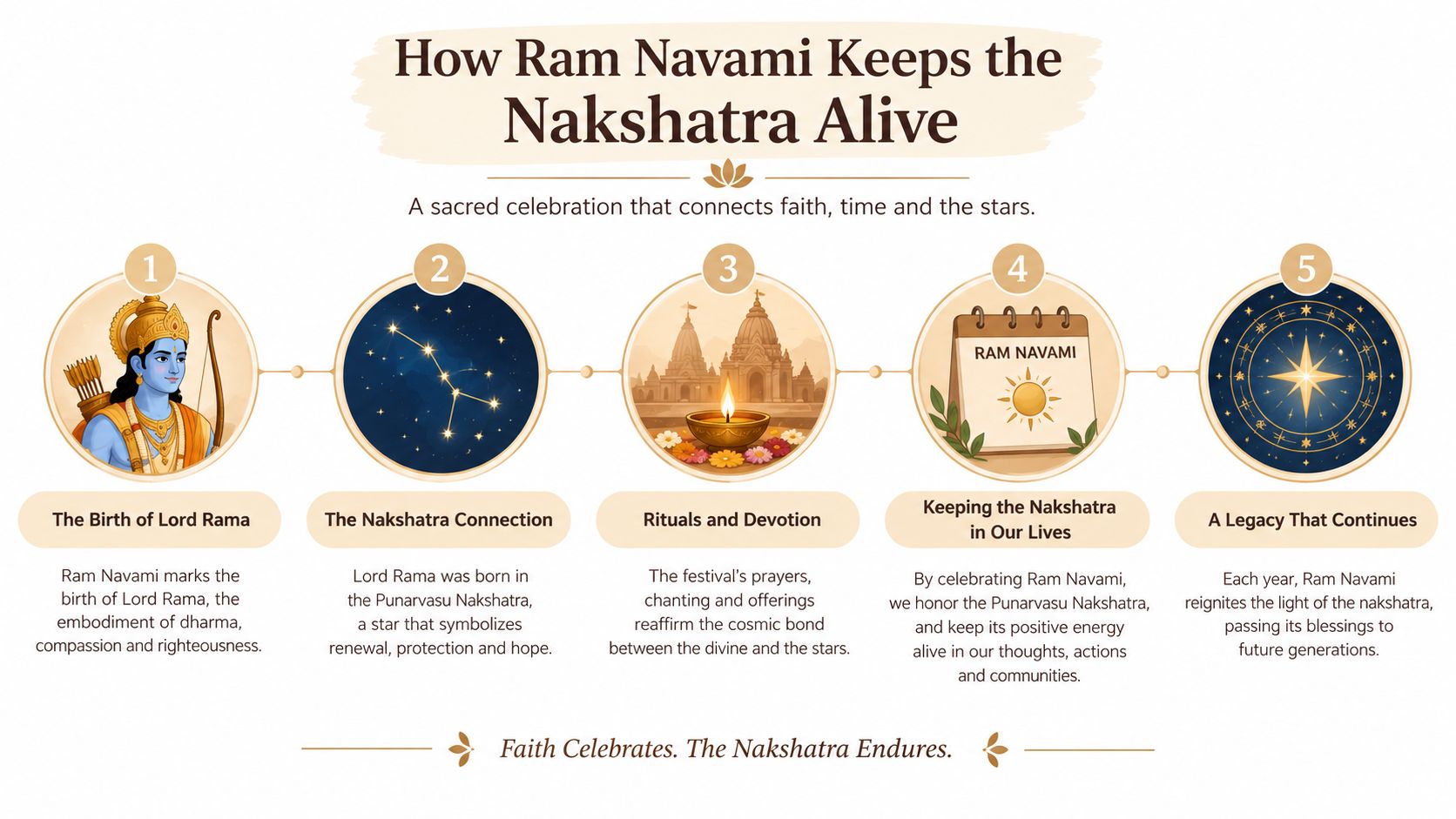
The ritual calendar carries the nakshatra idea through abhisheka, devotional singing, readings, and carefully chosen muhurta periods. A devotee need not calculate the Moon's exact degree to participate. Shared observance keeps Rama's celestial identity present in public memory, turning Punarvasu from a scholarly term into part of religious culture.
What This Means for You and Your Own Chart
The main lesson is simple. Punarvasu Nakshatra is the traditional lunar mansion associated with Lord Sri Rama, and its themes of return, renewal, shelter, wisdom, and righteous action help explain why the association remains meaningful.
That connection doesn't mean every child born on Ram Navami has Rama's complete chart. A full kundli includes the ascendant, Moon sign, planetary positions, houses, house lords, and dasha, the planetary-period system used in Vedic astrology. Even a small difference in birth time can alter the ascendant degree and change the way astrologers read the chart.
Questions readers often ask
Does every Ram Navami birth indicate Punarvasu?
No. Ram Navami is determined by the lunar tithi. Punarvasu is determined by the Moon's exact position within the sidereal zodiac. The two factors can coincide in a traditional birth narrative without matching every modern birth on the festival.
Does Punarvasu alone describe personality?
No. Nakshatra interpretation is one part of a chart. The pada, Moon's condition, ascendant, houses, planetary periods, and other placements add context.
Should a generic Punarvasu description guide an important decision?
It shouldn't. A personal reading requires accurate birth details and a careful examination of the full chart. Marriage compatibility, career choices, and muhurta selection need individual context rather than a single nakshatra label.
Readers can treat this guide as an introduction to mythology, lunar astronomy, and traditional chart interpretation. It isn't a prediction about personal destiny. A respectful reading uses Rama's story for insight while recognising that each person's birth chart is distinct.
Kismo connects users with verified astrologers through chat or call for personalised guidance on birth charts, kundli matching, career questions, and muhurta timing. Readers who want to understand their own nakshatra in the context of a complete chart can visit Kismo and choose a session suited to their question.