Love Marriage vs Arrange Marriage Success Rate in India
A couple may be preparing to tell their families about a relationship, while the families are already wondering whether an arranged match will bring a safer and more stable future. Both sides may search for the same answer: what is the love marriage vs arranged marriage success rate in India? The honest answer is less dramatic than viral percentages, but it is more useful. No reliable India-wide dataset proves that one path is categorically more successful than the other.
Marriage success also means different things to different people. One couple may value long-term stability, another may prioritise emotional closeness, personal safety, independence, family harmony, or the freedom to grow together. A thoughtful decision therefore looks beyond the label and examines consent, compatibility, communication, family expectations, financial understanding, and the couple's ability to handle difficult periods.
This guide separates stability, satisfaction, safety, and legal divorce instead of treating them as one measure. It also explains how Vedic astrology, including kundli matching and muhurta, can offer reflective decision support without promising a guaranteed outcome. Readers looking for broader personal guidance can also explore Kismo's free astrology tools, while keeping practical conversation and informed consent at the centre.
Table of Contents
- Why the Question Deserves a Careful Answer
- What Indian Data Shows About Love and Arranged Marriages
- Why Divorce Percentages Are a Poor Measure of Success
- What Indian Couples Actually Report About Satisfaction
- How Vedic Astrology Reads Compatibility and Timing
- A Side-by-Side View of the Two Paths
- Choosing Thoughtfully and Using Guidance Well
Why the Question Deserves a Careful Answer
The phrase “success rate” sounds precise, but marriage researchers and families may use it to mean very different things. Some people mean whether a couple remains legally married. Others mean whether both partners feel respected, emotionally connected, financially secure, and free to make important choices. A marriage can remain legally intact while one partner feels lonely or unsafe, just as a couple can face serious family opposition and still build a caring relationship.
Four measures matter
A useful first step is to separate the question into four parts:
- Stability: Does the relationship continue over time, including how the couple handles separation or major stress?
- Satisfaction: Do both partners feel valued, understood, and reasonably content with the relationship?
- Safety: Can each person express disagreement, set boundaries, and leave an unsafe situation without coercion?
- Shared life: Can the couple manage money, household duties, children, careers, relatives, and personal goals?
Divorce is only one possible outcome. In India, some couples may live separately without filing for divorce, while others may remain together because of financial dependence, social pressure, family expectations, or limited access to legal support. A low divorce figure can't automatically demonstrate happiness or healthy partnership.
Practical rule: A marriage should be judged by the quality of the relationship, not only by whether the legal bond continues.
The important question is therefore not “Which category wins?” It is “Which conditions are present in this particular relationship?” A love marriage may begin with strong emotional familiarity but face resistance from relatives. An arranged marriage may benefit from family involvement but require time for trust and affection to develop. Neither pattern guarantees kindness, compatibility, or commitment.
Astrology can sit alongside these practical questions as a cultural and reflective tool. A birth chart may help a couple discuss temperament, timing, emotional needs, and recurring patterns, but it shouldn't replace direct conversation, independent choice, or attention to safety. The most responsible approach gives both partners room to speak openly before families, traditions, or expectations make the decision feel irreversible.
What Indian Data Shows About Love and Arranged Marriages
A couple may meet through family introductions, choose each other after years of friendship, or combine both paths. National Indian data can describe how marriages begin, but it cannot by itself decide which path succeeds. A 2018 survey of more than 160,000 Indian households reported by the BBC found that 93% of married respondents described their marriage as arranged, 3% as a love marriage, and 2% as love-cum-arranged. The arranged share remained above 90% among respondents in their twenties, showing that arranged marriage was still the dominant route across generations.
This finding measures prevalence, not quality. Arranged marriages were more common in the survey, so their larger number cannot be treated as evidence of a higher success rate. Comparing raw divorce totals would be like comparing outcomes from two groups that began with very different sizes.
Reading the wider numbers carefully
A India Human Development Survey summary reported that 1.4% of women aged 15 to 49 and 0.9% of men aged 15 to 54 were divorced, separated, or deserted in 2019 to 2021. A separate demographic analysis in the same evidence base found that roughly 2% of Indian marriages ended in divorce or separation within twenty years.
These figures describe recorded marital dissolution across the population. They do not show whether love or arranged marriages produce greater satisfaction, autonomy, or safety. A couple may remain legally married while feeling unhappy, and another couple may separate without completing a formal divorce.
| Indicator | Source | What it shows | What it does not show |
|---|---|---|---|
| Marriage type among married respondents | BBC / 2018 India survey | Arranged marriage remains the most common pathway | A higher success rate for arranged marriage |
| Divorce, separation, or desertion among adults | IHDS 2019-21 | Overall recorded marital dissolution is limited | Satisfaction or safety by marriage type |
| Reported arranged-marriage share among surveyed couples | WeddingWire India 2023 | Preferences differ across surveyed urban couples | A national trend or better outcomes for love marriage |
Urban preference data needs the same caution. A 2023 WeddingWire India survey found that 44% of participating couples said their marriage was arranged, compared with 68% in the company's 2020 survey, a 24-percentage-point decline, mainly among respondents in Tier 1 cities, as reported by Media India. The result describes that surveyed group. It cannot establish that either marriage type lasts longer or creates greater happiness.
The practical conclusion is measured: available Indian evidence shows different patterns of formation and reporting, not one universal winner. Stability, satisfaction, and safety are separate questions, and each needs more than a single percentage.
Why Divorce Percentages Are a Poor Measure of Success
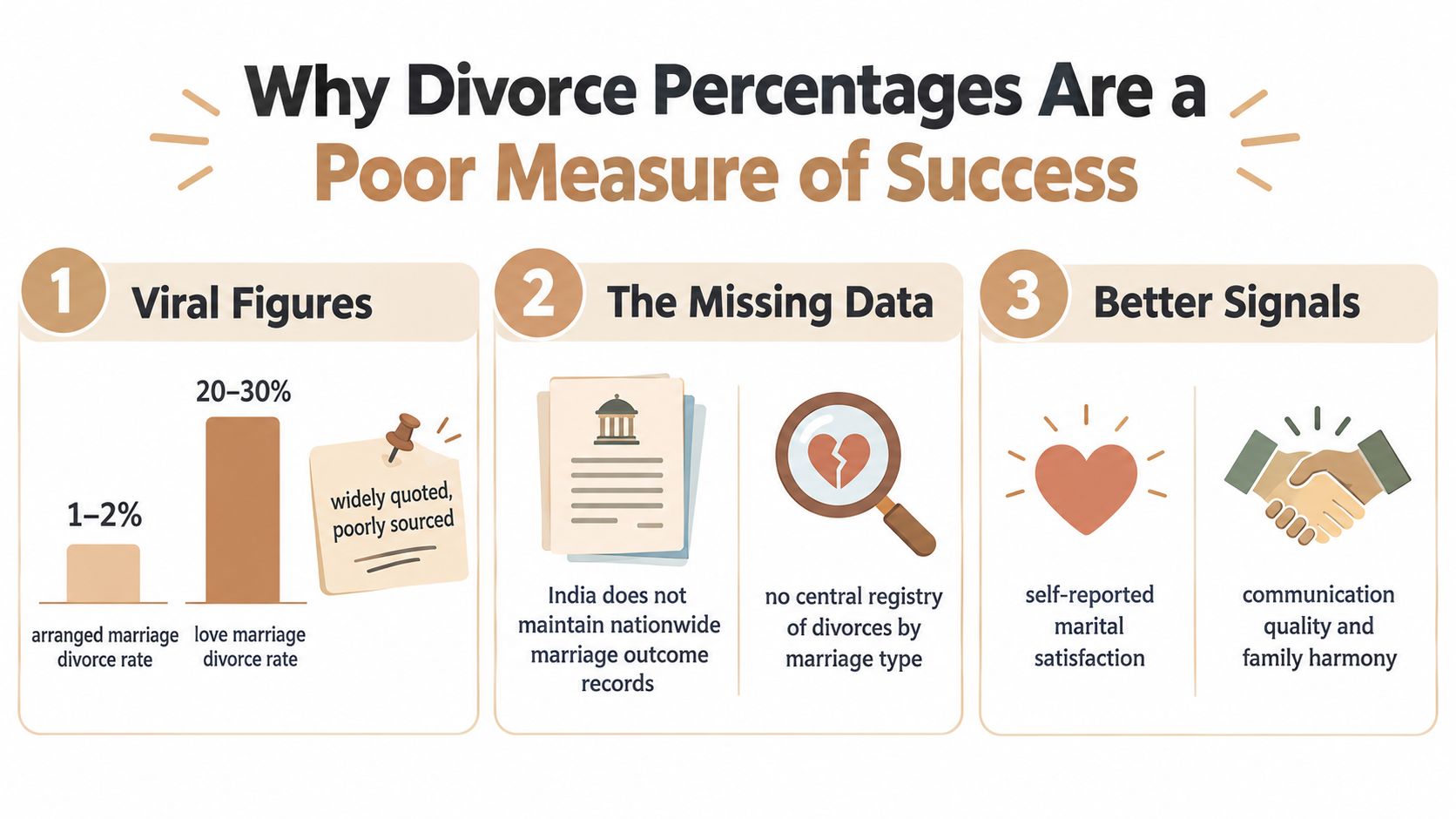
Online articles often repeat a striking comparison: 1% to 2% divorce for arranged marriages versus 20% to 30% for love marriages. Those figures shouldn't be treated as authoritative. As explained by 1to1help's review of arranged and love marriage claims, India doesn't maintain a nationally representative government dataset that records divorce by marriage type, and these figures generally come from regional samples, secondary websites, or unsupported estimates.
What small studies can and can't tell readers
A Gujarat study examined 200 married individuals, divided equally between love and arranged marriages, across Ahmedabad, Surat, Rajkot, and Vadodara. Its preliminary account associated love marriages with stronger initial emotional intimacy but greater exposure to family and social pressure. Arranged marriages showed broader family support and acceptance in that account.
That result may help researchers identify questions, but it can't produce an India-wide success rate. The participants came from four cities, the sample was limited, and the study couldn't represent every region, caste, class, religion, age group, or family structure.
An Andhra University study, reported by the Times of India, examined 530 people, including 80 in love marriages and 450 in arranged marriages. Love-marriage participants reported higher satisfaction, well-being, expectation-achievement fit, coping confidence, and fewer disagreements, while arranged-marriage participants reported stronger family and social support.
A small study can reveal useful patterns, but it can't carry the weight of a national verdict.
Divorce also depends on whether a person can realistically use the legal system. Social stigma, economic dependence, family pressure, abandonment, informal separation, and limited support can all affect whether a marriage reaches court. A better assessment asks about communication, consent, conflict, financial expectations, family boundaries, and personal safety rather than relying on a dramatic percentage.
What Indian Couples Actually Report About Satisfaction
Satisfaction offers a closer view of married life, but the evidence still doesn't produce a simple winner. A comparative review of Indian and cross-cultural research found no systematic relationship between marriage type and marital satisfaction. Among Indians living in India, greater involvement in choosing one's spouse was significantly associated with higher marital-satisfaction scores.
That distinction is important. The useful factor may not be whether parents or the couple initiated the match. It may be whether both partners had meaningful influence, understood the decision, and entered the marriage willingly.
Love can develop, change, and deepen
A small India-focused study on love in arranged marriages reported that self-rated love rose from a mean of 3.9 to 8.5 on a 10-point scale, with commitment identified as a major contributor, as described in the research synthesis by Robert Epstein and colleagues. This is a process finding, not proof that arranged marriages have a higher overall success rate.
The same synthesis cites Indian couple research suggesting that affection in love marriages may decline somewhat over time, while affection in arranged marriages can increase. Such findings remind readers that early chemistry and later durability are related but not identical. A couple's habits, commitment, conflict repair, and shared responsibilities may change the relationship after the wedding.
Different strengths can carry different pressures
Love marriages may offer greater premarital familiarity and emotional closeness. They may also face opposition when families disagree with the match, especially around community, religion, caste, location, or economic expectations.
Arranged marriages may offer wider family support and a clearer social network. They can also become difficult if either partner feels unable to refuse, ask questions, delay the decision, or set boundaries with relatives.
A useful assessment therefore tracks several stages:
- Initial familiarity: How well do the partners know one another's values and habits?
- Decision autonomy: Did both people freely agree, with enough time to consider the match?
- Family environment: Do relatives support the couple without controlling every decision?
- Daily communication: Can the partners discuss anger, money, work, intimacy, and future plans?
- Long-term commitment: Do they repair conflict and adjust as life changes?
The evidence points towards partner involvement and relationship quality, not a label, as the more practical focus.
How Vedic Astrology Reads Compatibility and Timing
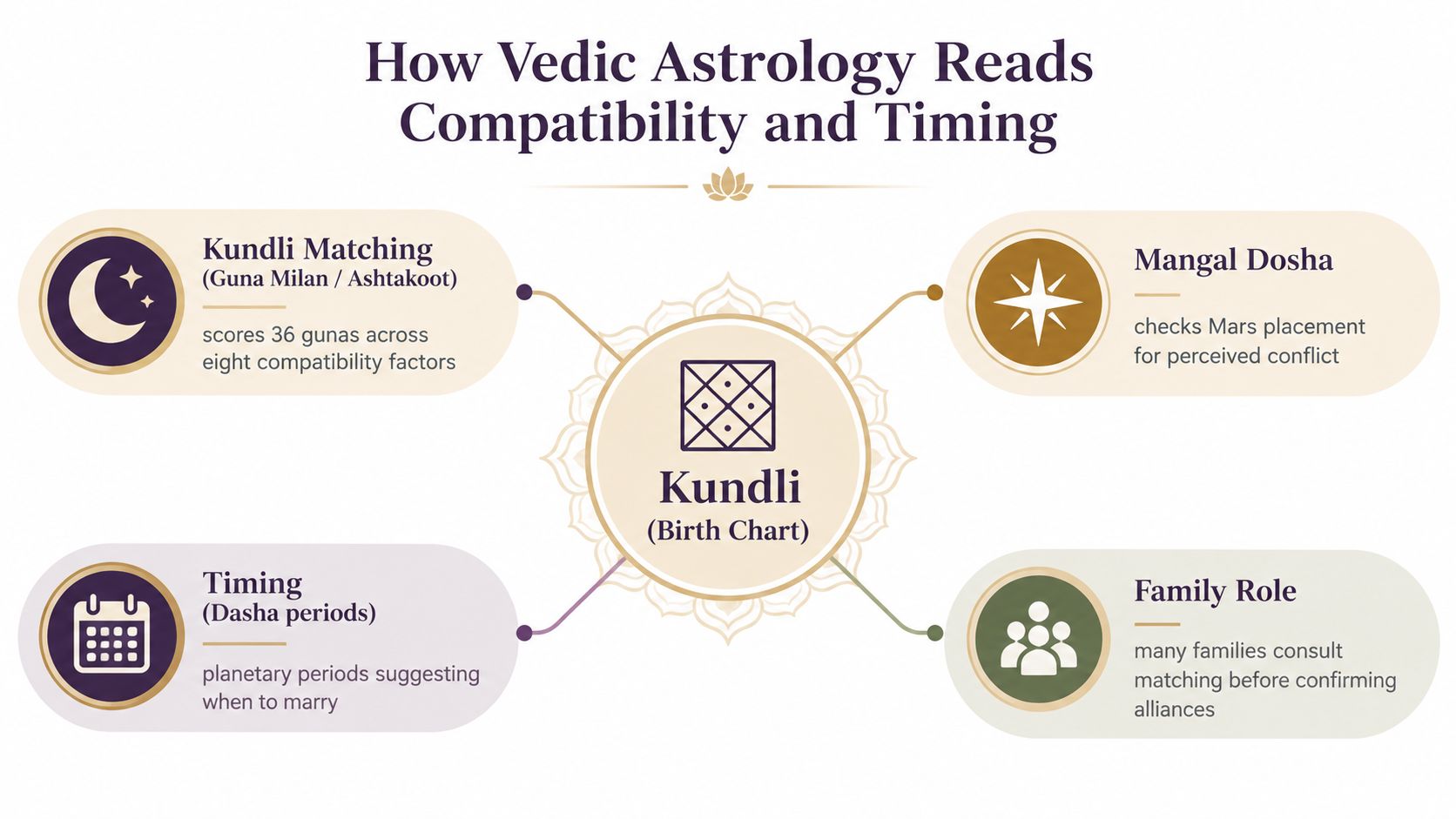
In Vedic astrology, a kundli is a birth chart created from a person's date, time, and place of birth. Kundli matching, also called guna milan or ashtakoot matching, compares two charts through traditional compatibility factors. A nakshatra is a lunar birth constellation used in chart interpretation, while dasha refers to planetary periods that astrologers use to examine changing life themes. Muhurta means selecting an auspicious date and time for an important beginning, such as a wedding.
Matching is a conversation starter
Many families use guna milan as an initial filter, whether the match comes through relatives or through the couple themselves. Traditional matching may examine areas linked with temperament, health, family life, emotional rhythm, and shared direction. Some readings also consider Mangal Dosha, a traditional interpretation of Mars placement that certain astrologers associate with potential friction.
A responsible reading shouldn't reduce two human beings to one score. It should explain the chart factors, identify areas that deserve conversation, and leave room for the couple's lived reality. Birth details must also be accurate, because an uncertain birth time can affect chart interpretation.
Astrologers may examine dashas to discuss periods associated with relationship decisions, responsibility, or change. Muhurta then focuses on the wedding date and time itself. These are different questions. Compatibility reading concerns the people and their patterns, while muhurta concerns the timing of the ceremony.
Kismo's kundli matching service presents this type of guidance as a detailed chart-based reading rather than a statistical comparison between love and arranged marriages. The useful outcome is a clearer discussion about strengths, concerns, expectations, and timing.
Astrology can add perspective, but it shouldn't overrule consent, safety, honest communication, or the right to say no.
Accurate guidance depends on each person's individual birth chart and the quality of the birth details provided. Vedic concepts can support reflection and family dialogue, but they don't guarantee a particular marital outcome.
A Side-by-Side View of the Two Paths
The two paths often overlap more than everyday language suggests. A family-introduced match may become a love relationship before marriage, while a couple who chose each other may later depend heavily on family support. The following comparison focuses on common patterns, not fixed rules.
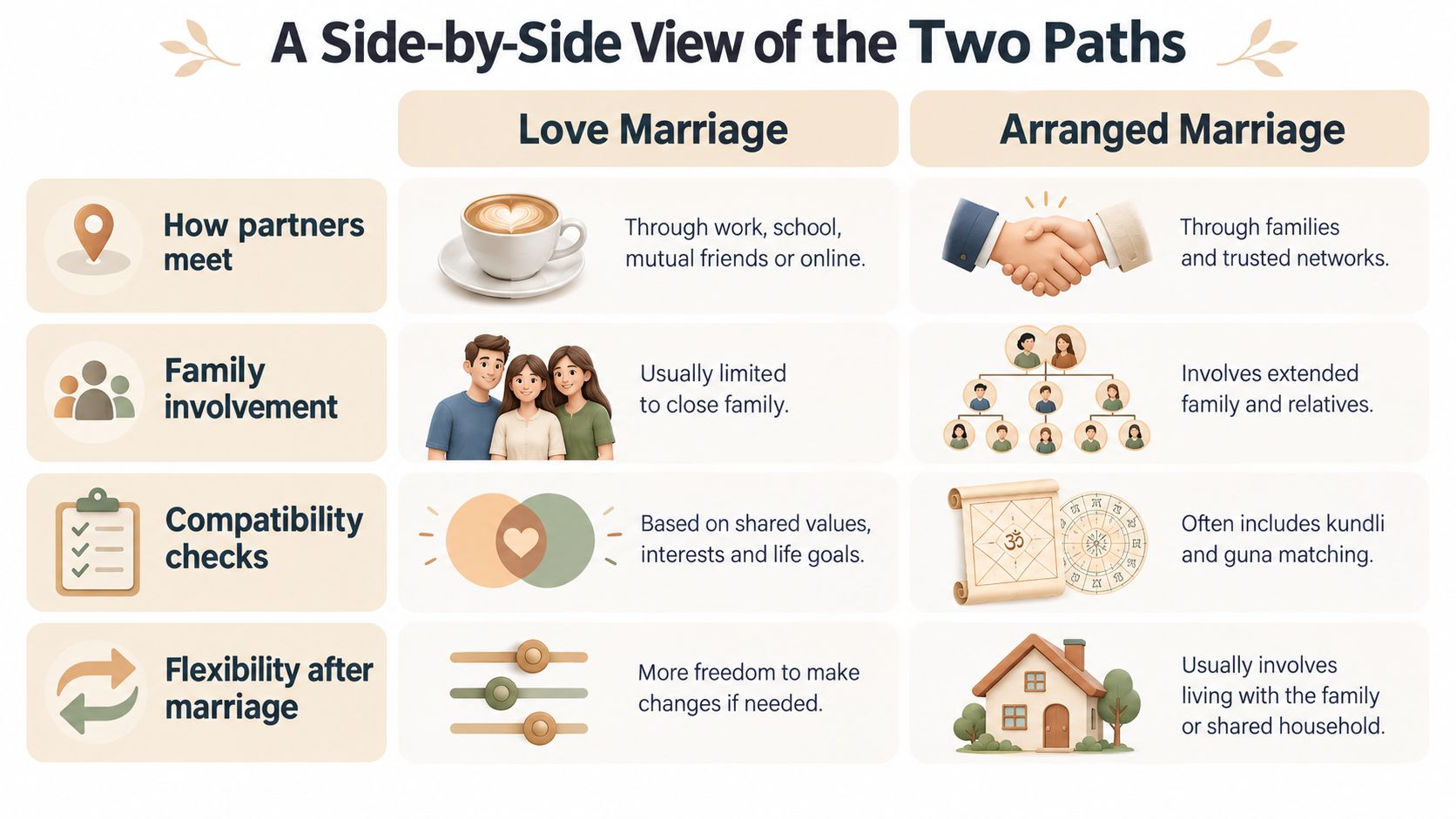
| Criterion | Love marriage | Arranged marriage |
|---|---|---|
| How the relationship begins | Partners usually meet through education, work, friends, or social life and choose to continue together | Families, relatives, or trusted networks introduce the partners |
| Family role | Relatives may become supportive later, or they may need time to accept the relationship | Families often participate from the beginning and may help assess background |
| Premarital familiarity | Partners may have more time to observe communication, habits, and affection before marriage | Familiarity may develop through conversations and meetings before commitment |
| Initial emotional intimacy | Emotional closeness may already be strong before the wedding | Affection may grow gradually through trust, shared experiences, and commitment |
| Family acceptance | Acceptance can vary and may become a major source of pressure | Wider acceptance may provide practical and emotional support |
| Autonomy | The couple may feel greater ownership of the choice | Autonomy depends on whether both people can ask questions and freely agree |
| Common pressure | Family disagreement, social judgement, distance, and financial independence | Expectations, limited choice, quick decisions, and family involvement in private matters |
| Durability supports | Shared values, emotional familiarity, communication, and willingness to build family bridges | Family support, patient affection-building, shared expectations, and respectful boundaries |
| Role of Vedic checks | Kundli matching may offer reflection after the couple has chosen each other | Kundli matching may be used before families confirm an alliance |
| Main question | Can the couple sustain trust while managing external resistance? | Can the couple build intimacy while preserving independent choice? |
A survey of surveyed urban couples also suggests that preferences are changing in some parts of India. The WeddingWire figures cited earlier describe a shift within its Tier 1 city sample, but they don't establish that love marriage is more satisfying or stable.
The same criterion can be helpful or harmful depending on how it operates. Family involvement can provide care during illness or childbirth, but it can also become intrusive. Premarital familiarity can reveal compatibility, but it doesn't guarantee mature conflict management. The label is less informative than the conditions inside the relationship.
The strongest foundation is not the way the match began. It is mutual consent, honest communication, respect, and daily care.
Choosing Thoughtfully and Using Guidance Well
A couple may begin with love or through family introduction, then face the same practical questions. Define success as stability, satisfaction, safety, and room for growth, rather than treating either category as a guaranteed answer.
A grounded decision checklist
Start with free consent. Each partner should be able to say yes, request more time, or say no without threats or humiliation. Agreement shaped by family pressure is not informed consent.
Discuss ordinary life before the ceremony. Talk about work, residence, money, household responsibilities, children, religion, care for parents, friendships, privacy, and relatives' boundaries. Identical opinions are unnecessary. Knowing where differences exist makes future decisions clearer.
Observe conflict habits. Disagreements will occur. Look for listening, apologies, repair, and changed behaviour. Anger, prolonged silence, threats, or financial restriction can turn disagreement into control.
Assess the support network. Family support can help during difficult periods when relatives respect the couple's decisions. It becomes harmful when parents or other family members treat the marriage as their property or ignore the partners' privacy.
Use astrology after practical questions are visible. Kundli matching can help couples reflect on temperament and recurring relationship patterns. Dasha analysis offers a traditional way to discuss periods of transition, while muhurta can guide the choice of a wedding date and time. These practices add decision support. They are most useful as prompts for conversation, not as replacements for consent, communication, or careful observation.
For readers who want a chart-based conversation, Kismo connects users with verified astrologers for marriage compatibility readings by chat or call. Sessions have upfront pricing, and guidance is available in Hindi, Tamil, Bengali, Marathi, and English. An astrologer still needs accurate birth details, and a reading should not promise a guaranteed result. Families may use the conversation to raise concerns respectfully, while couples can bring those concerns back to the practical questions they must answer together.
If you are weighing a match now, write down three questions from the checklist, discuss them with the person involved, and consider a chart reading only after those answers are on the table. A reading can support reflection, while the couple's choices and conduct shape the marriage day by day.
Kismo offers one-on-one kundli matching, marriage compatibility, and muhurta guidance through chat or call with verified astrologers. Couples and families can use a Kismo reading as one thoughtful input while discussing compatibility, consent, family expectations, and wedding timing.