Manglik and Non Manglik Marriage: Can It Work?
Yes, in most Vedic traditions, a Manglik and a non-Manglik can marry because Mangal dosha is one factor within the full birth chart, not a marriage verdict. The classical cancellation check is the first step towards settling whether that dosha should influence the traditional assessment.
If the same person can receive different Manglik labels from different astrologers, should a label alone decide a marriage? That question matters whenever a couple feels comfortable together but their families receive a worrying calculator result.
A Manglik and non-Manglik marriage calls for a careful comparison, not an automatic rejection. A useful reading explains the calculation, examines the complete charts and leaves room for the couple's wishes and everyday compatibility.
Table of Contents
- Can a Manglik Marry a Non-Manglik? The Short Answer
- What Manglik Dosha Means and Which Houses Count
- Why the Manglik Label Changes From One Chart to Another
- How Kundli Matching Reads the Whole Match
- Real-Case Considerations for Indian Couples
- Remedies, Evidence and Balanced Decisions
- Get a Full Chart Comparison Before You Decide
Can a Manglik Marry a Non-Manglik? The Short Answer
Yes. Within most Vedic approaches, a mixed Manglik match can be considered after a full assessment. The important distinction is between identifying a Mars placement and deciding how much importance that placement deserves.
A kundli, or birth chart, is the astrological map used for this assessment. An astrologer shouldn't stop after finding Mars in a particular house. The reading should explain whether the tradition recognises a cancellation, whether other chart factors modify the interpretation and what remains uncertain.
Manglik pairings and what astrologers check first
| Pairing | What astrologers check first | Usual next step |
|---|---|---|
| Both partners non-Manglik | Full chart compatibility and the Ashtakoota score | Proceed with standard kundli matching |
| One Manglik, one non-Manglik | Whether a classical cancellation applies, Mars strength and the seventh house | Detailed chart review, with a remedy only if the families choose one |
| Both partners Manglik | Whether the doshas are treated as balanced in their tradition, plus the full chart | Confirm both birth charts and review the rest of the match |
Neither matching label provides a guarantee. A non-Manglik pairing still needs a compatibility discussion, while a shared Manglik label doesn't remove the need to examine the relationship.
Checks before concern becomes a decision
- Classical cancellation: The astrologer should identify the specific exception being applied, rather than declaring the dosha absent without explanation.
- Birth-time accuracy: The recorded time helps establish the ascendant, also called lagna, the sign rising at birth. This determines the arrangement of houses used in an ascendant-based reading.
- The wider chart: Partnership indicators deserve attention alongside Mars. A single placement shouldn't stand in for the complete assessment.
Say a family has only an approximate birth time, remembered as sometime before sunrise. Treating a calculator's answer as final would hide that uncertainty. A more responsible approach is to disclose the uncertain time and ask whether the interpretation changes across the plausible birth-time window.
Practical rule: An uncertain birth detail should remain visible in the reading, not become a confident marriage verdict.
The immediate task is straightforward: record both people's birth dates, times and places, along with the source of each birth time. Keep a note of the Manglik method already used, including whether the result came from an astrologer or a calculator. That gives a full-chart review a clear starting point without promising a particular outcome.
What Manglik Dosha Means and Which Houses Count
A birth chart can be understood as a home with different rooms. Each house represents an area of life, and Vedic astrology treats Mars, or Mangal, as energetic, forceful and sometimes impatient. In this analogy, Mars brings heat into whichever room it occupies.
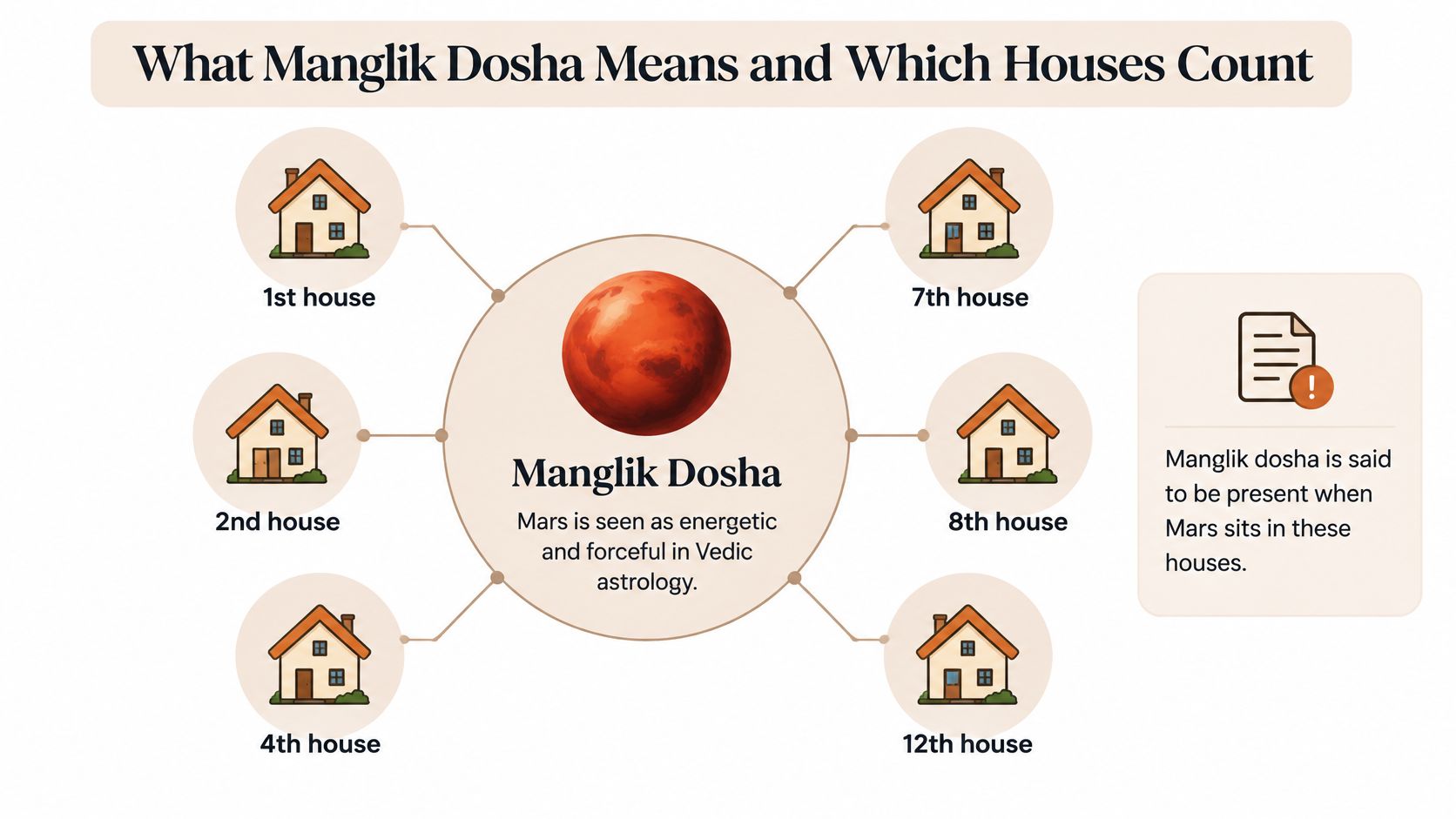
Mangal dosha is a traditional interpretation of certain Mars placements, not a medical condition or a description of someone's character. The Mangal dosha explanation by Aditya Ar Sharma describes the commonly used ascendant-based rule as Mars occupying the 1st, 4th, 7th, 8th or 12th house.
The illustration shows the house-based idea; the table identifies the common rule used here.
Houses where Mars creates Manglik dosha
| House | Life area it relates to | Why it matters for marriage |
|---|---|---|
| 1st house | Self, personality and temperament | Shapes how a person brings energy into a partnership |
| 4th house | Home, mother and domestic peace | Linked to comfort and emotional life at home |
| 7th house | Spouse, partnership and marriage | The house read most directly for a marriage |
| 8th house | Shared resources, longevity and sudden change | Linked to shared finances and intimacy in traditional readings |
| 12th house | Expenses, losses and private life | Linked to spending and private matters in traditional readings |
A placement needs an interpretation
The additional house shown in the infographic reflects a wider convention, rather than the narrower rule in the table. This distinction is important: diagrams and calculators don't always use identical house rules.
Some traditions also count houses from the Moon or Venus, rather than only from the ascendant. A reading should name its reference point so that the family understands what was assessed.
Manglik dosha is an indicator that needs context, not a prediction that a marriage will fail.
The next questions concern Mars's sign, strength, aspects, meaning planetary influences, and conjunctions, meaning planets placed together. The astrologer may also consider the Moon, Venus, partnership indicators and timing.
An initial Manglik calculation can help organise the question, but its result still needs interpretation. A useful explanation describes the actual placement and its modifying factors without turning traditional symbolism about loss, longevity or conflict into a frightening prediction.
Why the Manglik Label Changes From One Chart to Another
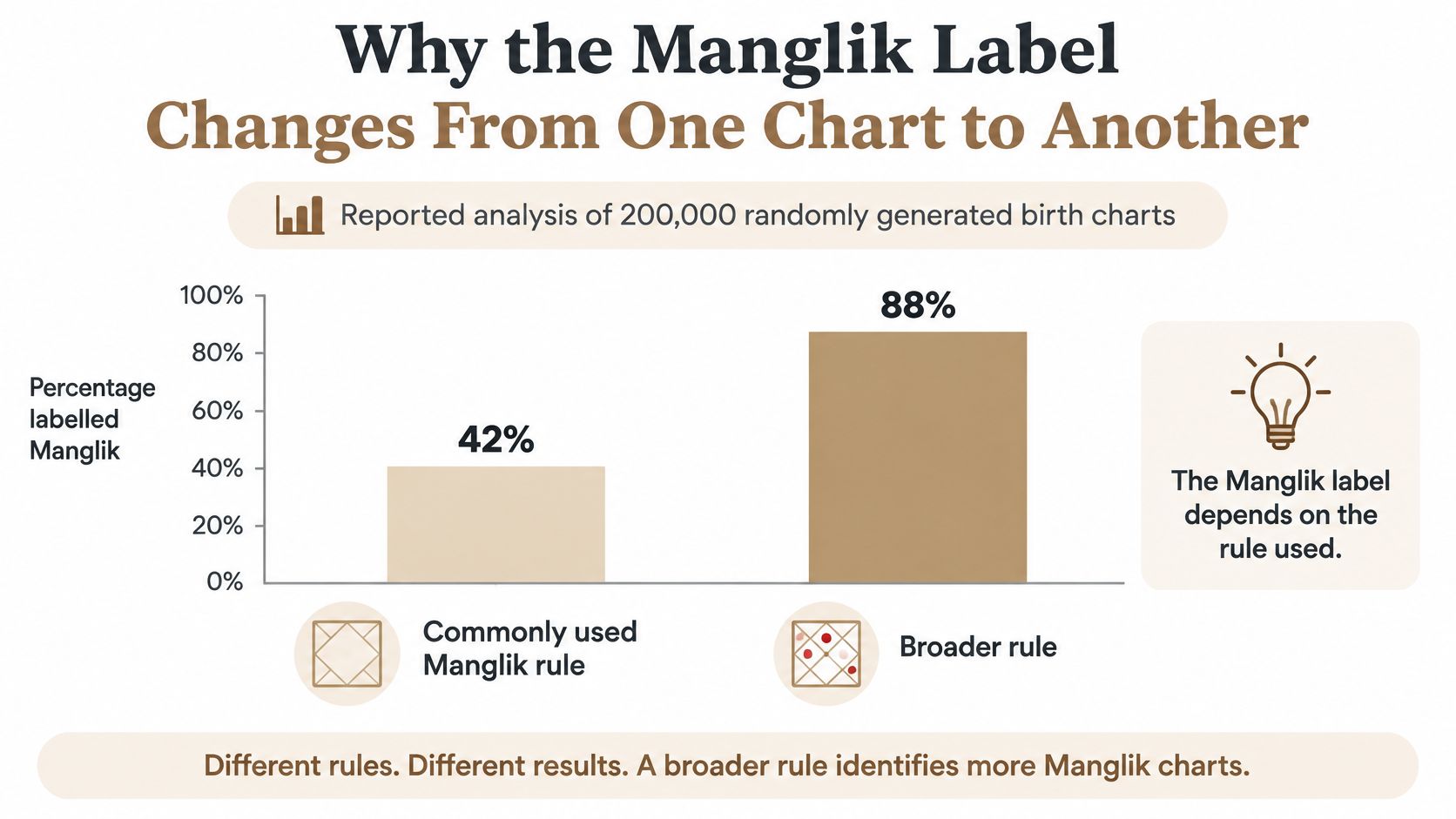
42% of charts met a commonly used Manglik rule in an India-focused analysis of 200,000 randomly generated birth charts, while 88% met a broader rule with extra reference points before traditional exceptions, according to the GetKundly Manglik analysis. Its simulated sample of 100,000 randomly paired couples also produced the pairing shares shown below.
These are model-based estimates, not a survey of actual Indian marriages. The results reflect the selected birth years, chart assumptions and definitions. They don't establish how many Indian couples face relationship difficulties.
The visual comparison highlights how strongly the chosen rule affects classification.
Reported shares under different Manglik rules
| Measure | Reported share | What it means |
|---|---|---|
| Commonly used Manglik rule, 200,000 random charts | 42% | Share of charts that met the narrower rule |
| Broader rule with extra reference points, before exceptions, 200,000 random charts | 88% | Share that met the wider rule before traditional exceptions |
| Paired sample with exactly one Manglik partner, 100,000 random couples | About 49% | The pairing most often discussed in consultations |
| Paired sample with both partners Manglik, 100,000 random couples | About 18% | Two-partner Manglik pairings in the simulation |
Different starting points can produce different labels
Say an astrologer counts Mars's house from the ascendant, while another also counts from the Moon. Both may describe their approach as a Manglik check, yet they haven't performed the same test.
It resembles reading a measuring tape from different starting marks. The underlying chart hasn't changed, but the reference used to classify it has.
A broader method can also flag a placement before examining exceptions. A short calculator result may therefore show a preliminary label that a detailed reading would qualify as reduced or cancelled.
Families comparing opinions should seek clarification rather than collect more unexplained verdicts:
- Which house rule and reference points were used? The answer should specify the method.
- Were cancellation conditions examined? A preliminary flag and a final interpretation aren't interchangeable.
- How reliable is the birth time? Any uncertainty should be recorded alongside the result.
The aim is a transparent explanation. Manglik and non-Manglik are categories within a traditional framework, not fixed scientific risk groups.
How Kundli Matching Reads the Whole Match
Ashtakoota, also called Gun Milan, is an eight-part compatibility system with a total of 36 points; 18 points or more is a common screening threshold, according to Ishvaram's marriage-matching guide. The guide describes the following maximum points for each koota, or matching category.
Ashtakoota kootas, points and what each reads
| Koota | Points | What it reads |
|---|---|---|
| Varna | 1 | Temperament, work nature and approach to life |
| Vashya | 2 | Mutual attraction and influence |
| Tara | 3 | Health and well-being of the partners |
| Yoni | 4 | Physical and intimate compatibility |
| Graha Maitri | 5 | Mental compatibility and friendship of ruling planets |
| Gana | 6 | Temperament, grouped as deva, manushya or rakshasa |
| Bhakoot | 7 | Love, family welfare and finances |
| Nadi | 8 | Health, progeny and nature of the combined charts |
These descriptions express traditional astrological associations. They aren't clinical assessments of health, fertility or psychological compatibility. Likewise, the Gana categories are symbolic classifications, not judgements that a person is good or bad.
Matching commonly uses the Moon's nakshatra, or lunar mansion, meaning a division of the zodiac used in Vedic astrology. This is why a matching report can contain unfamiliar category names even when a family only asks about Mars.
Why the total isn't enough
A total can conceal uneven results. Stronger scores in some categories may sit beside weak friendship or family-related indicators, so an astrologer should explain the individual entries rather than announce only a pass or fail.
A small survey of Vedic matchmaking and post-marriage compatibility involving 19 Indian couples described incompatible or divorced couples with weak Graha Maitri and/or Bhakut despite reaching the commonly used 18-point threshold. Its sample was very small and associative, so it cannot establish that horoscope factors caused those outcomes.
Traditional readers often pay particular attention to Bhakoot and Nadi, including any recognised cancellation conditions. A concerning entry deserves a clear explanation, not a prediction about illness, children or inevitable separation.
What sits outside the score
A full comparison also considers each person's Mars placement, the seventh house and its lord, meaning the planet ruling that house's sign, and Venus and Jupiter. It may examine dasha, a planetary period used for timing, and Navamsha, a divisional chart traditionally used in marriage analysis.
A kundli-matching assessment becomes more useful when the couple keeps a short interpretation record:
- Request every koota score, not just the total.
- Mark the lower entries and record the astrologer's explanation of their significance.
- Keep the Mars assessment separate, including the calculation method and any cancellation.
This separates different parts of the reading and makes disagreements easier to discuss.
Real-Case Considerations for Indian Couples
Indian families don't make marriage decisions in a vacuum. Education, employment, location, family participation and the couple's readiness can all affect when a proposal moves forward.
An analysis using National Family Health Survey marriage histories reports that mean age at first marriage rose across the compared birth cohorts from approximately 22.7 to 27.3 years for men and 18.3 to 25.5 years for women; the share unmarried at age 20 rose from 45.6% to 86.6% for men and 8.0% to 67.8% for women. These are cohort comparisons, not predictions for a particular couple.
Astrology can still influence family discussions: a small sociological study of 25 families reported that 86% had consulted astrology for marriage and 89% believed in guna milan, while marriage delay attributed to Manglik dosha was reported by 83% of older respondents against 48% of younger respondents. The study's limited scope means these figures shouldn't be treated as national estimates.
A practical path when only one partner is Manglik
- Ask for a visible chart explanation. The astrologer should identify Mars's placement and explain whether a cancellation applies.
- Compare the complete partnership picture, including the seventh house and its ruling planet, rather than requesting another binary result.
- Agree on a review date with both families. A clear timetable prevents repeated consultations from becoming an open-ended reason to postpone.
- Return the decision to the couple. Their willingness, comfort and consent deserve direct discussion, not assumptions made on their behalf.
A focused partner-compatibility consultation can be organised around the family's exact disagreement. For example, a couple may agree to obtain an explanation of a disputed cancellation before discussing wedding arrangements.
Family boundary: A chart discussion shouldn't become permission to shame either partner or pressure either person into marriage.
Age, education and family views belong in the conversation alongside tradition. Consent remains essential regardless of what a chart says.
Remedies, Evidence and Balanced Decisions
The most troubling myth is that a Manglik person will cause a failed marriage. Available evidence doesn't support Manglik status as a scientifically validated predictor of marital compatibility, divorce or relationship quality.
A consultation should distinguish traditional interpretation from claims about what will happen.

The Samaj Saathi discussion of horoscope matching and arranged marriage summarises a commonly cited double-blind test published in Nature, in which astrologers performed at approximately chance levels when matching natal charts with personality profiles. That test concerned personality matching, not Manglik marriage specifically, so its scope should remain clear.
Small matchmaking surveys also cannot prove that planetary placements cause marital outcomes. Respect for astrology as a cultural or spiritual practice doesn't require presenting it as established predictive science.
What traditional remedies mean
Families may choose remedies for religious reassurance or continuity with custom. These should be explained as faith-based practices, not treatments with guaranteed effects.
- Matching with another Manglik: Some traditions regard the placements as balancing each other, but this isn't a universal marriage requirement.
- Kumbh vivah: A symbolic ceremony, often involving a pot or a tree, performed before marriage in some families.
- Mangal shanti puja: A priest-led ritual intended within the tradition to calm Mars.
- Devotional practices: Hanuman worship, reciting the Hanuman Chalisa, or donating red lentils or red cloth on Tuesdays may be suggested.
Some schools recognise cancellation or mitigation involving Mars in Aries or Scorpio, exalted Mars in Capricorn, or a strong aspect from Jupiter. These aren't universal switches that erase every concern; the astrologer should explain the school and chart conditions being applied.
A sensible sequence is to confirm the interpretation, examine cancellation conditions and only then discuss an optional remedy. The couple's agreement matters alongside family agreement, and nobody should be pressured to pay.
The accompanying video can serve as a starting point for discussion, rather than a substitute for an individual assessment.
Other assumptions worth questioning
A Manglik must marry a Manglik confuses a traditional balancing preference with a compulsory rule. A remedy guarantees happiness promises more than a ritual can establish. A total score settles the match overlooks both the individual chart interpretation and the people involved.
Labels can also encourage confirmation bias. If a family expects conflict, an ordinary disagreement may be blamed on Mars instead of discussed fairly. Stigma and avoidable rejection can follow before anyone has assessed communication, money, family boundaries, health or conflict management.
Astrology should remain one input, never the sole basis for accepting, delaying or rejecting a marriage.
Get a Full Chart Comparison Before You Decide
A useful consultation should leave a couple with a written explanation of the match, not merely a reassuring or alarming label. Preparing specific questions makes it easier to distinguish an individual reading from a generic answer.
A checklist for a considered decision
Gather accurate birth details for both people. Record the birth date, time and place, and whether the time comes from a document or family memory. Any uncertainty should be disclosed before the reading begins.
Name the method. Request the house rule, reference points and cancellation approach used. If earlier opinions conflict, bring those reports so the astrologer can explain the difference rather than add another unexplained conclusion.
Request a complete comparison. The report should include the individual Ashtakoota entries, Mars placement and any cancellation, partnership-house interpretation and relevant planetary periods. Separate chart observations from the astrologer's judgement about their importance.
Discuss life beyond the chart. The couple should talk privately about spending, savings, work, living arrangements, family expectations and ways of handling disagreement. Health concerns need appropriate professional care, not astrological diagnosis.
Make the decision without pressure. Both families can participate where the couple welcomes that involvement. Neither partner should be expected to accept a proposal, perform a ritual or abandon a relationship just to end an uncomfortable discussion.
What an individual reading should clarify
Kismo's Marriage & compatibility reading covers kundli matching for two people or a proposal brought by a family. It provides an Ashtakoota score out of 36 with all eight kootas and checks Mangal dosha on both charts; its astrologers work from the user's birth details and actual situation.
Individual birth details are necessary for an individual astrological interpretation, but they don't turn that interpretation into certainty. A couple can ask for clarification, take time to consider the explanation and decide which traditional practices feel meaningful to them.
For a Manglik and non-Manglik marriage, the most helpful outcome is an informed, unpressured decision. A label should begin a careful conversation, not end one.
For couples seeking a personalised explanation of a Manglik and non-Manglik match, Kismo offers chat or call consultations with verified astrologers. Both partners' birth details and the family's specific questions can guide a kundli comparison, with time to discuss the interpretation before making a decision.