Marriage Compatibility Astrology Explained Simply
The most repeated advice on marriage compatibility astrology is simple. Clear 18 points out of 36, and the match is fine. Fall short, and the proposal should stop. That advice treats a family discussion aid as a veto.
A guna total is not a tested forecast of happiness, how long a marriage lasts, or whether people separate. Many chance pairings clear the usual line. A careful reading separates the eight factors, any traditional cancellation, and timing from consent, money, and how two people get on.
The pages below set out the score, the birth details that keep it steady, the wider chart, and a way for families to talk without fear or a false promise.
Table of Contents
- The Eight Kootas in a Match Score
- Birth Details That Keep the Chart Honest
- Houses Yogas Doshas and Timing
- Calculator Scores and a Full Reading
- What a Difficult Score Can Still Mean
- How Couples and Families Can Talk
- Common Questions and When to Consult
- Use the Score as a Conversation
The Eight Kootas in a Match Score
In India, marriage compatibility astrology is organised as kundli matching, also called kundali milan or guna milan. A kundli is a birth chart. The common North Indian method, Ashtakoota, compares eight factors, called kootas, and totals them to 36 points. As the Evaara matrimony guide to kundli matching sets out, those points come mainly from each person's Moon sign and birth star, the nakshatra, not from Sun signs alone. A nakshatra is the lunar mansion the Moon occupied at birth. The janma nakshatra is that birth star for the person whose chart is being read.
What each koota is commonly read for
The traditional order and maximum points look like this.
| Koota | Max points | Commonly read for |
|---|---|---|
| Varna | 1 | Broad social or spiritual outlook |
| Vashya | 2 | Mutual influence or attraction |
| Tara (Dina) | 3 | Birth-star count linked to wellbeing |
| Yoni | 4 | Instinctive or physical rapport |
| Graha Maitri | 5 | Mental friendship between charts |
| Gana | 6 | Temperament: Deva, Manushya or Rakshasa |
| Bhakoot | 7 | Moon-sign emotional and prosperity fit |
| Nadi | 8 | Constitution and family-line themes |
Varna sketches a broad outlook. Vashya looks at mutual pull. Tara, also called Dina, is a count between birth stars linked with wellbeing. Yoni uses symbolic animal types for instinctive rapport. Graha Maitri is mental friendship between the charts. Gana groups temperament as Deva, Manushya, or Rakshasa, which are traditional labels for style, not moral grades. Bhakoot reads the relationship between Moon signs for emotional ease. Nadi is the heaviest line, tied to constitution and family-line themes.
Why 18 is a custom, not a law
18 out of 36 is a widely cited custom, not a law and not a universal pass-or-fail rule. A proper reading looks at the separate kootas, at doshas and any cancellation, and at both complete charts. A low total is not a prediction of an unhappy marriage. A high total is not a guarantee of compatibility. In parts of South India, families use related nakshatra matching under different names for a similar conversation.
A calculator result moves when one heavy koota changes. Read which lines built the total before anyone treats the sum as the whole story.
Nadi sits at 8 points, so it can shift a printout on its own. The next step is not to fear that line. It is to see which kootas contributed, then read them with the full charts.
Birth Details That Keep the Chart Honest
The chart is only as steady as its inputs. Both people need date, time, and place of birth, because the Moon's position fixes the sign and the nakshatra used for Tara, Yoni, Gana, and Nadi. Those same details also set the ascendant, the sign rising on the eastern horizon, which fixes the houses.
A time that is off by even a modest amount can move the Moon near a nakshatra boundary and change several kootas at once. It can also move the ascendant, so house topics shift even when the guna lines look familiar. If the time is unknown, or only remembered as morning or evening, say that plainly. A responsible reading labels the limit, may test a time range, and does not pretend a sunrise chart is a timed one.
Accurate birth date, time, and place are the input for every chart prepared from those details, including a full birth chart. Accurate guidance depends on these two individual charts, not on a generic couple type.
What else to bring
Context: Say whether this is a love match, a family proposal, or a wedding already planned.
The question: Fit, timing, or a specific worry such as Mangal dosha. A vague request produces a vague answer.
Earlier printouts: Bring them so differences can be explained, rather than treated as a contest with a screenshot.
A short readiness check
Two birth records, one clear question, and agreement that the result is material for a conversation. If one time is uncertain, write "uncertain" on the paper before anyone opens a calculator.
Houses Yogas Doshas and Timing
Treat the guna total as a doorway. Say two families in Pune already have a score of 22 and still disagree about a wedding next winter. A fuller reading uses both complete charts, not the sum alone.
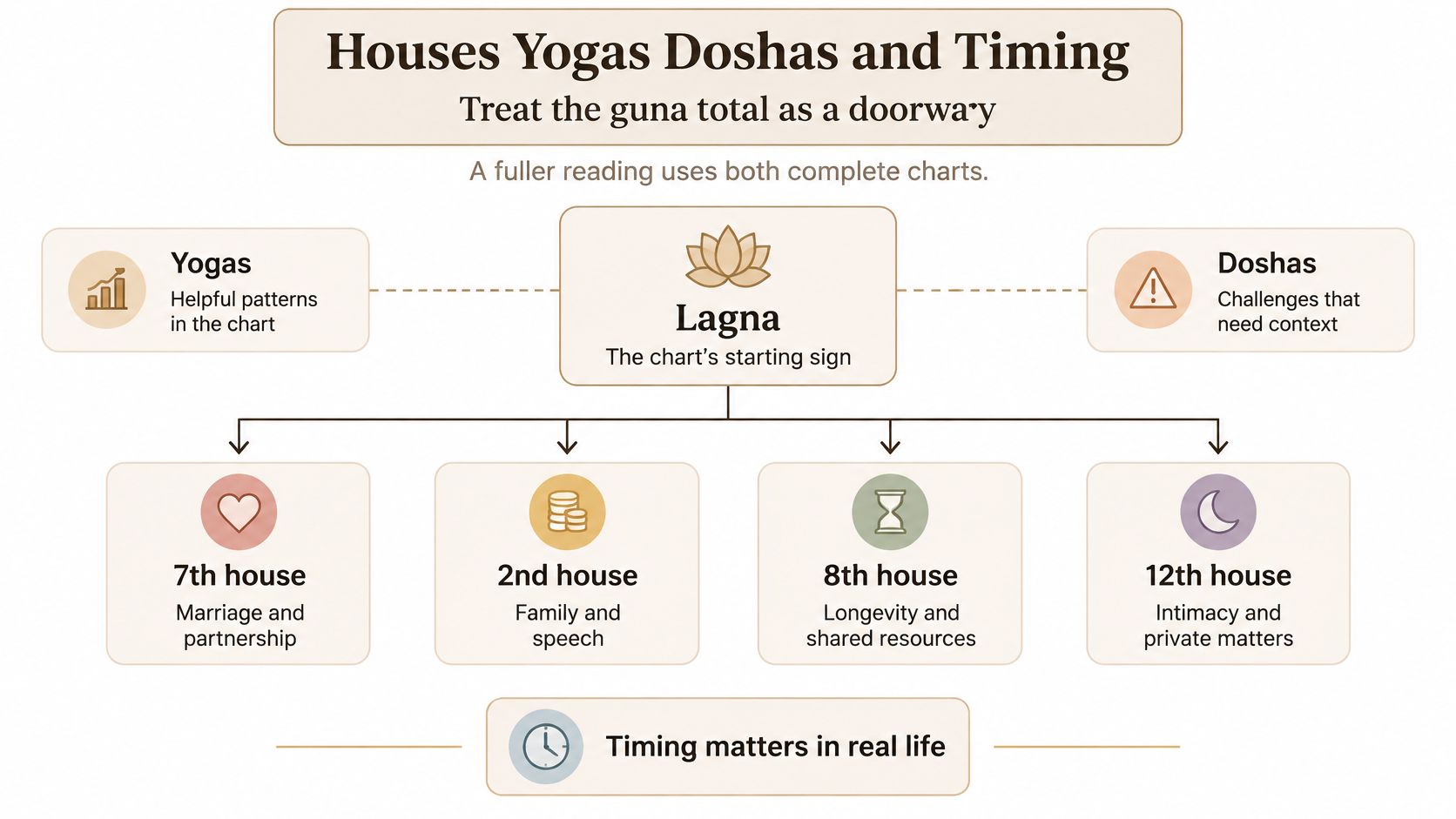
Lagna, the ascendant, is the chart's starting sign. Houses are counted from it. These are discussion areas, not stamps of fate.
Houses people ask about in a marriage talk
The 7th house is partnership, and its lord shows how that theme is carried.
The 2nd house is family and speech, including how a household talks about money and belonging.
The 5th house is romance and children.
The 8th house is shared resources and long bonds.
Yogas are named planetary combinations that colour how easily a theme shows up. An astrologer may note them as patterns. They are not prizes, and they are not curses. Navamsa, the D9 divisional chart, is traditionally consulted for a closer look at marriage quality. A comfortable main chart with a strained navamsa is a reason to slow down and ask more, not a verdict.
Dosha, then timing
Doshas are flagged conditions. Mangal dosha, often called Manglik, comes from Mars placements and has traditional cancellation rules. A label without those checks is incomplete. The same Mars placement in both charts is read differently from a placement in only one.
Vimshottari dasha is a timing system. As the Muhurat Choghadiya note on Vimshottari explains, the 27 nakshatras are organised into three groups of nine, each sequence governed by one of nine planetary rulers. The Moon's nakshatra sets the starting mahadasha, the long planetary period, and the leftover portion depends on how far the Moon had travelled through that star. A dasha question asks when a relationship theme may be active, including the sub-period. It does not promise that a wedding will or will not happen.
Transits are the current weather around that longer period. Saturn and Jupiter are the slow movers families usually ask about. A planet transits view is a weather-app summary. The two birth charts plus the operating periods are the fuller forecast. None of these layers guarantees a marriage or predicts a breakup.
Calculator Scores and a Full Reading
A calculator and a full reading answer different jobs. Set them side by side before anyone gives advice.
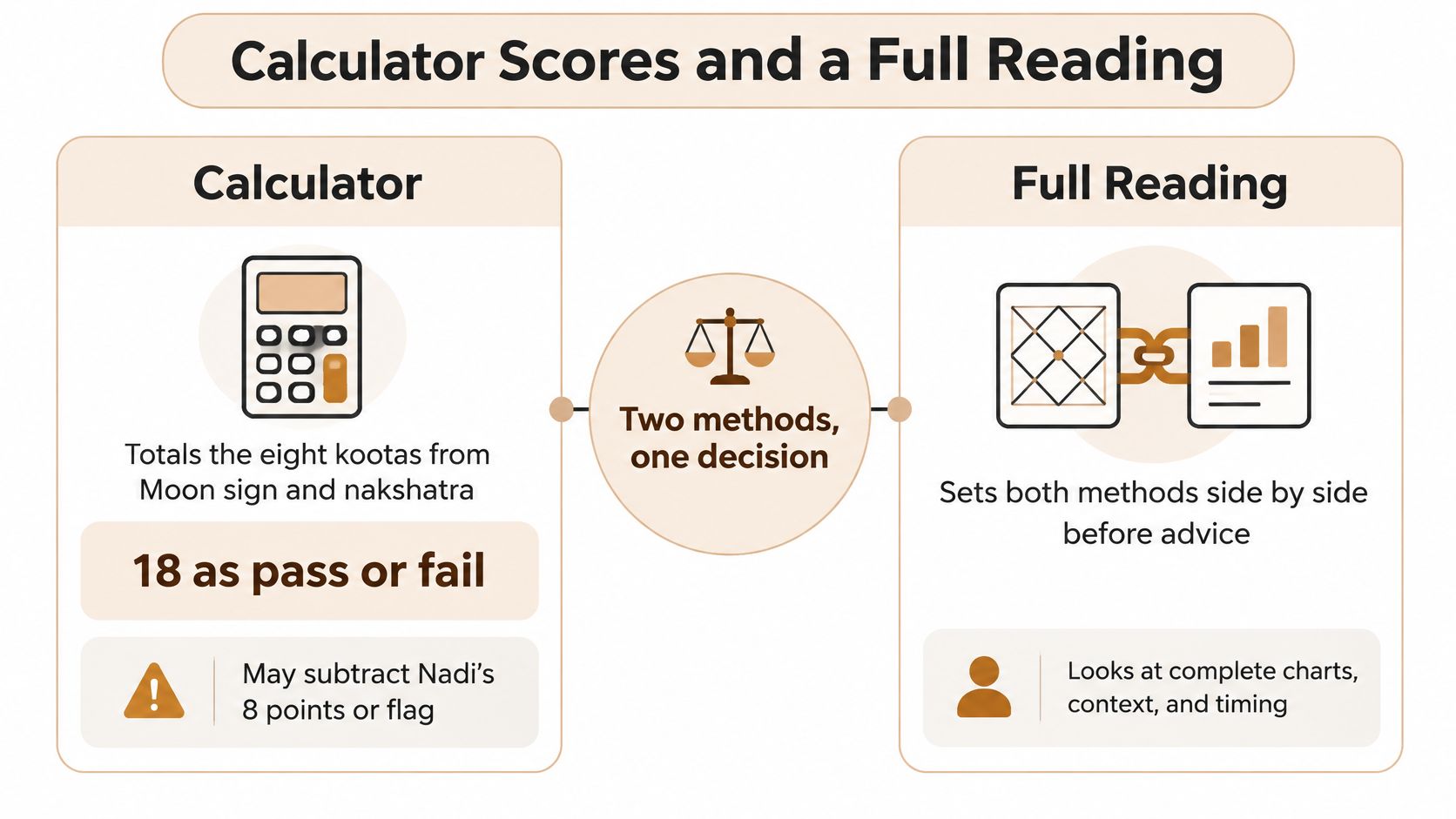
A calculator totals the eight kootas from Moon sign and nakshatra. It often prints the usual cutoff as pass or fail. It may subtract Nadi's full points or flag Mangal dosha as a simple yes or no. It does not apply cancellation conditions, judge the Moon's strength, or notice whether a weak Bhakoot is eased elsewhere in the charts.
| Check | Calculator score | Detailed reading |
|---|---|---|
| Eight kootas | Adds points from Moon and nakshatra | Lists them, then discusses each one |
| 18 out of 36 | Often printed as pass or fail | Treated as a custom, not a rule |
| Nadi dosha | May deduct 8 or mark unsuitable | Checks cancellation and both charts |
| Mangal dosha | Binary Mars flag | Checks both charts and exceptions |
| Timing | Usually absent | Dashas and transits for when themes are live |
| Daily life | Not included | Prompts on communication, money and consent |
What the cutoff cannot prove
Clearing that custom line is common among chance pairs. An analysis of kundli matching score distribution of 200,000 randomly generated birth-time pairs found that 71.51% would score at least 18, with a median score of 21.5. That check did not track marriages or relationship outcomes. No large independent study in the available sources validates guna totals as predictors of satisfaction, longevity, or divorce. The number is a prompt for questions, not a probability.
A double-blind evaluation of Indian astrology, described in Skeptic reporting on the Narlikar-led Maharashtra experiment, found astrologers' classifications of anonymised charts at roughly chance level, around 50%. Tests across planets, ascendant, houses, and house lords did not produce statistically significant separation. It did not directly test divorce prediction. It does mean no single chart factor should be presented as proven.
Record birth-time doubt, list the same kootas for both people, and check doshas for cancellation on both charts. Keep symbolic notes separate from how the couple argues, money goals, consent, and what each family expects.
What a Difficult Score Can Still Mean
A low total is not a verdict, and a high one is not a promise. The 36-point score works best as a family discussion aid: it can show which matching factors deserve a closer look, while leaving room for the couple's consent and everyday experience.
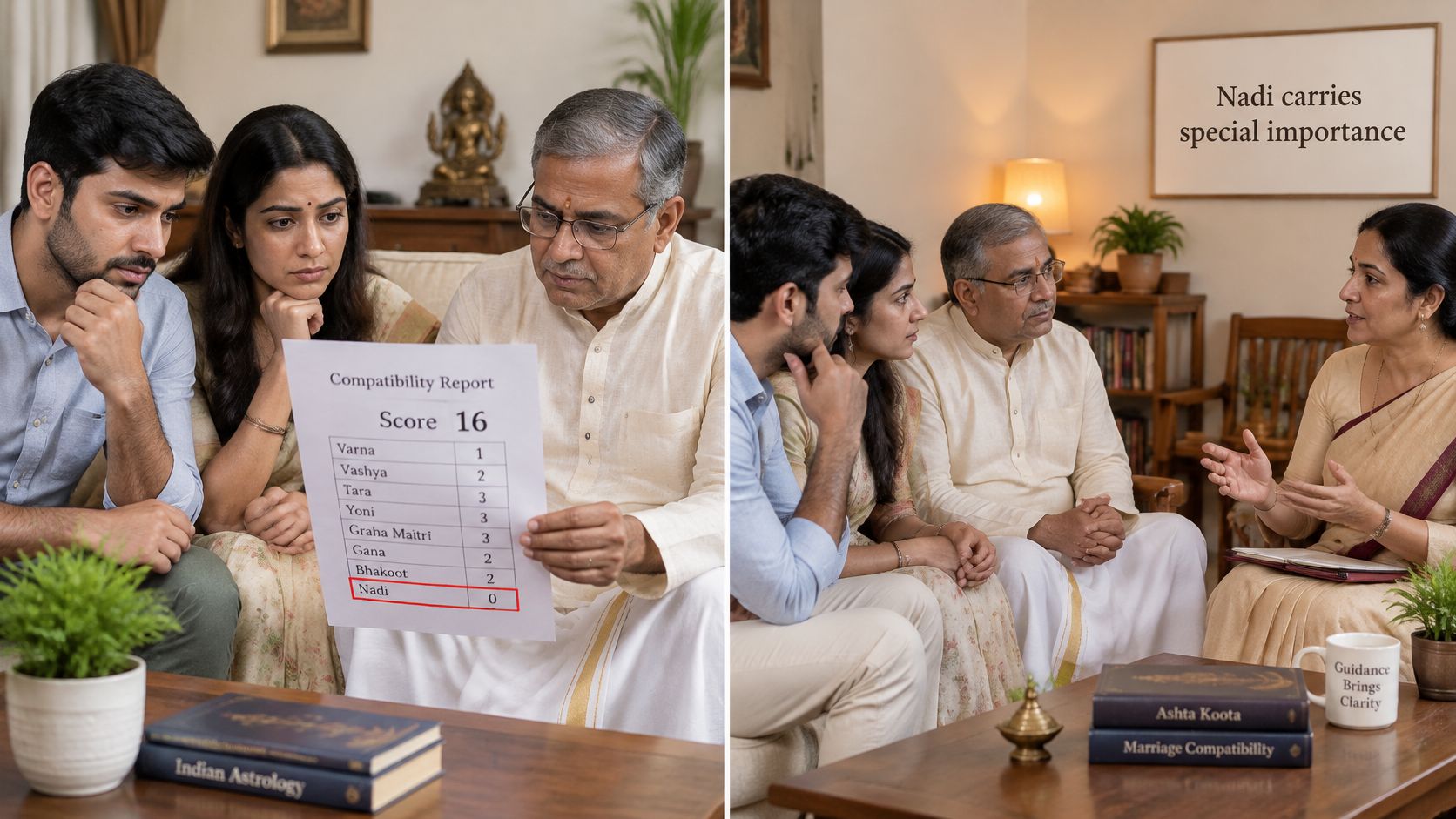
Three situations, none of them a verdict
Situation A. A proposed match totals 16 because Nadi scores 0, and the family hears “stop.” Nadi can contribute up to 8 of 36 points. The other seven kootas carry 1 to 7 points each. A perceived Nadi conflict is often called Nadi dosha. Traditional practice also includes exceptions, known as parihara. A calculator may subtract the points without explaining whether an exception applies. Ask which rule is being used and how it applies to both charts. Nadi is a traditional matching factor, not a medical forecast or a reason by itself to reject a person.
Situation B. A match scores 28, and everyone relaxes. Yet one chart is in a heavy Saturn mahadasha, while the 7th-house lord is under strain. These factors can prompt questions about support and timing. They do not guarantee happiness, just as a difficult period does not decide the future of a willing couple.
Situation C. Two people share a Sun sign but have different janma nakshatras. A nakshatra is a lunar star, so it is not interchangeable with a zodiac sign. Tara, Yoni, and Gana can therefore differ even when the Sun signs match. The Panchang Time account of kundli matching explains that these matching lines use the Moon's star, not the Sun sign alone.
A short film walk-through can help families hear the same idea in speech. These situations illustrate how to read a score, not what will happen in any real marriage. The outcome remains open.
Three questions worth asking
Which single koota moved the total? If one line accounts for much of the difference, the sum alone gives an incomplete picture.
Is a cancellation being claimed, and why? Ask which rule is meant and how it applies to each chart.
What would we decide if the number were set aside? Use that question to bring the discussion back to the couple's consent and daily life.
How Couples and Families Can Talk
Many Indian matches are still family-supported, even as stated preferences change. Reporting on the matchmaking platform Jeevansathi, carried by ThePrint, found that the share of users selecting caste as a strict preference fell from 91% in 2016 to 54% in 2025, and to 49% in metropolitan areas. That drop has not automatically produced more intercaste marriages. Family influence can remain while the checklist changes. A guna score then sits in a room that is already negotiating autonomy, religion, city, and money.
Symbolic notes and practical notes
Keep two lists, and do not let one swallow the other.
Symbolic side: Temperament as Gana describes it, timing from the dasha, a dosha, and any stated cancellation. These are traditional prompts. They are not orders.
Practical side: Money goals, how conflict is handled, willingness to relocate, and clear consent from both people. These can be observed this month. A chart cannot replace them.
Astrology here is one framework among others. A difficult factor is a subject for discussion. It is not a reason to frighten a partner, and it is not a reason to declare the marriage doomed or blessed.
Five questions for the meeting
What decision is in front of us this month? A wedding date, a continued courtship, or only more information.
Which factor worries the family, and can someone explain it without a threat? If the explanation needs fear to work, it is not ready.
What would we need to see in daily life to feel comfortable? Name behaviour, not a point total.
Who gets a say, and who must agree? Parents may advise. The two people still have to consent.
If we waited for a different dasha, what would we be waiting for? Name the theme, the support needed, and what would count as enough.
Reduced preference on a form does not, by itself, shrink family influence. The talk still needs a place for disagreement that is not a verdict on either person.
Common Questions and When to Consult
Short answers readers look up first
Is a low guna total a reason to end a proposal? No. It is one input to a wider talk. A good reading checks cancellations and both full charts before anyone treats the sum as a decision.
Can a free calculator be trusted? It is useful for a quick look at the eight lines. It does not apply parihara, and it does not judge the Moon's strength. Use it to prepare questions, not to close a proposal.
What if the birth time is unknown? Say so plainly, and ask whether the reading can work with a time range. A guessed minute should not be entered as a fact.
Is an astrologer needed if the family already agrees? Consult when a dosha label, a dasha window, or conflicting printouts still worry someone, or when a serious proposal is on the table. Agreement in the room does not erase a question that keeps returning. People comparing notes can speak with an astrologer once the question is specific.
Does the method change abroad? The birth details and the questions stay the same wherever someone lives. Place of birth still matters because it fixes the chart. The family conversation may happen on a call, but the method does not become a different system.
When a consultation is worth booking
A family proposal is becoming serious, and people want both charts read rather than a single printout.
Two printouts disagree, and nobody can say whether the gap is birth time, software, or a missed cancellation.
A timing question affects a decision this year, such as whether to set a wedding window or to wait and see how a period feels in ordinary life.
Use the Score as a Conversation
Write down the total, the one or two kootas that moved it, and the non-chart points the couple still needs to discuss. If that page is enough to start a calm family talk, stop there. A number has done its job when it produces clearer questions.
If someone wants both charts read, doshas framed with any cancellation, and a dasha window set against the situation, a one-to-one session is the right next step. Kismo's marriage and compatibility reading covers kundli matching for two people or for a proposal a family has brought. Astrologers work from the birth details and the situation the user describes.
What a useful session should leave in hand
A plain explanation of the score, including which lines built it.
Any dosha framed with exceptions, not with fear.
A timing window described as a planning aid, not as a promise.
Two or three practical priorities, such as a money talk, a relocation question, or how conflict is handled.
It should not promise a wedding, predict divorce, or push a remedy as the price of a happy marriage. The same steps apply in India or abroad. The chart belongs to these two people, not to a generic match. Keep what helps the conversation, and do not let a single number outrank consent and how they live.
Kismo connects people with astrologers by chat or call for marriage compatibility astrology, including kundli matching when a couple or a family wants both charts read with care. Sessions work from the birth details and the situation described, and they are meant as guidance for a conversation, not as a guaranteed outcome. Visit Kismo when a proposal, a timing question, or a confusing printout needs a calm, personal reading.