Marriage Timing Astrology: A Practical Guide
A couple may have already booked a venue, sent digital save-the-dates, and begun discussing guest travel when one practical question changes the conversation: which date is auspicious? A family astrologer may not give one fixed answer. Instead, the chart may show a favourable period, and the final ceremony time may depend on the Moon, the ascendant, family customs, and venue availability.
That is the heart of marriage timing astrology. It isn't a promise stamped on one calendar square. It is a careful comparison of personal readiness in the chart, planetary activity around the proposed period, and the exact muhurta, meaning an auspicious time chosen for an event. In India, this approach matters even more when auspicious wedding dates gather inside narrow seasonal windows.
Table of Contents
- Why Marriage Timing in Astrology Is More Than a Date
- Reading the Dasha Layer First
- Key Transits That Signal a Marriage Window
- Kundli Matching and Couple Timing
- Your Muhurta Selection Checklist
- A Sample Calculation for a 2026 Wedding
- Putting It All Together for Your Own Decision
Why Marriage Timing in Astrology Is More Than a Date
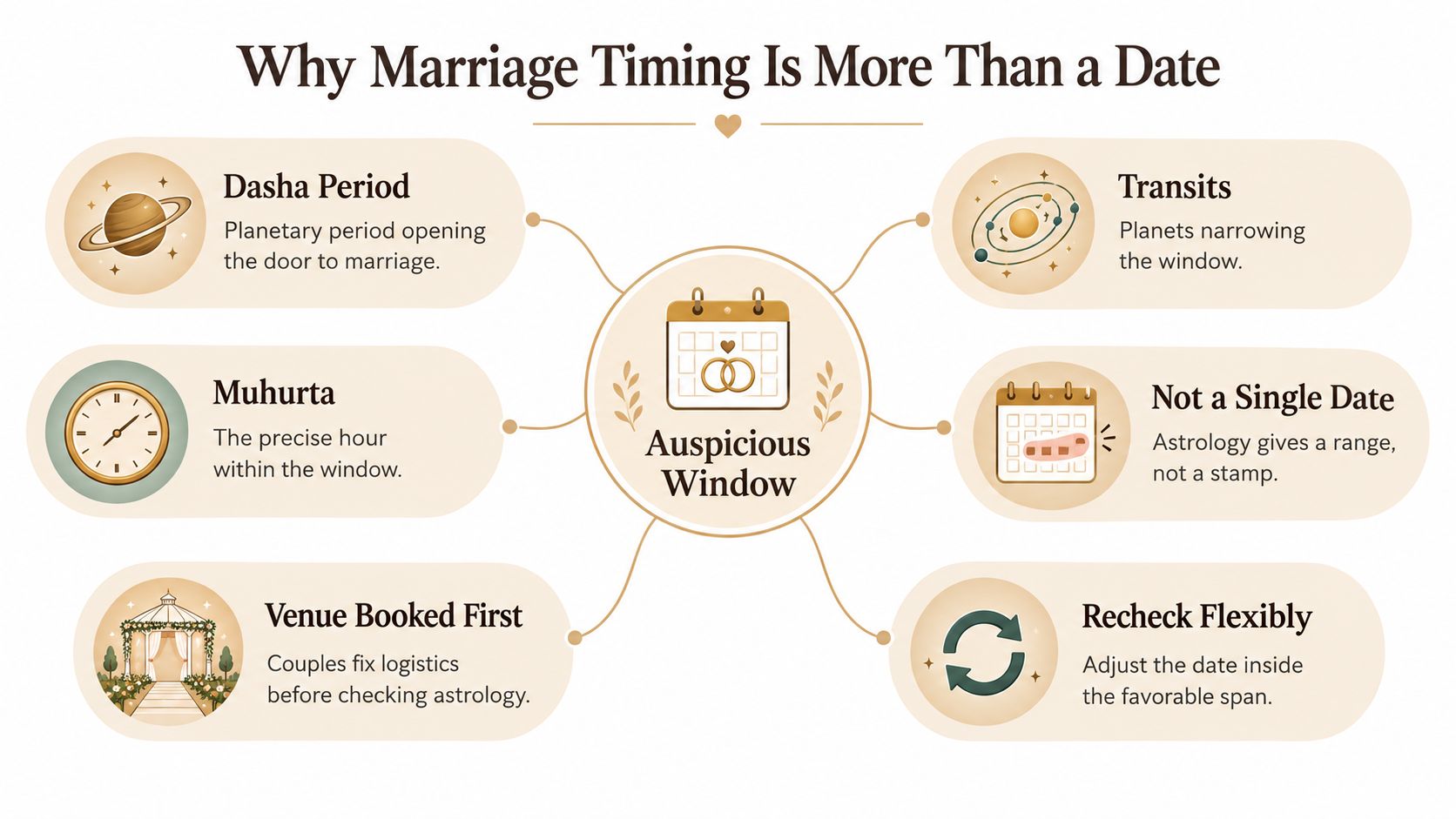
A reliable consultation begins by separating four questions that families often combine. First, does a person's chart show a period in which marriage themes are supported? Second, do current planetary transits strengthen that possibility? Third, which ceremony time is suitable? Fourth, do both partners' charts support the same period?
The first layer is dasha, a planetary period system used to describe longer life phases. The second is the study of transits, or the way planets are moving in relation to the birth chart. The third is muhurta, the selection of an auspicious time for the wedding itself. For a couple, kundli, the birth chart, adds a compatibility and timing comparison between two people.
Practical rule: A transit may open a possibility, but it doesn't replace the dasha analysis or the muhurta selection.
The Indian wedding calendar makes this layered method especially practical. Many Hindu communities avoid marriages during Chaturmas, traditionally described as running from mid-July to mid-November. A 2026 panchang compilation says the season reopens after Dev Uthani Ekadashi on 20 November 2026, with the first Vivah Muhurat on 21 November 2026. The same compilation counts only 4 muhurat dates in November 2026 and 7 in December 2026 before another pause, so families may need to compare astrology with venues, flights, school calendars, work leave, and religious customs (2026 and 2027 wedding muhurat dates).
Another India-focused guide places the total number of auspicious dates at about 52–59 in 2026, compared with roughly 96 in 2027 (India-focused marriage date guidance). The figures illustrate an important planning problem. A couple might have a supportive chart period, but a narrow calendar can still make the ceremony date difficult.
Marriage timing astrology therefore works best as decision support, not as a demand to wait for a perfect alignment. A practical astrologer identifies the strongest available window, explains its limits, and helps the couple make an informed decision.
Reading the Dasha Layer First
Dasha is the first timing filter because it describes the life season in which a subject becomes more active. One cited Vedic structure uses a 120-year cycle, with each planet ruling a set period before another planetary period begins. Astrologers read the main period, called the mahadasha, together with a sub-period, called the antardasha, and then examine the planet's sign, house, aspects, and connection with marriage factors (planetary dasha periods in Vedic astrology).
A beginner can follow the process in four stages:
- Identify the current mahadasha. The astrologer notes which planet governs the broad life phase.
- Find the antardasha. This narrower period shows which planetary themes are becoming more immediate.
- Assess marriage connections. Venus, Jupiter, the 7th house, the 7th lord, and relevant chart factors are considered together.
- Treat the result as a window. A supportive dasha means that marriage may be easier to arrange or accept. It doesn't force a wedding to happen.
Venus and Jupiter are often discussed in marriage consultations, but no combination works identically in every chart. A Venus-Jupiter period may support partnership when those planets are well connected to the 7th house or its lord. Jupiter-Ketu or Moon-Venus may support marriage in some charts, while Venus-Mars can bring a faster or more urgent relationship development when the wider chart agrees. These are starting points, not automatic rules.
A worked teaching example
Consider a hypothetical Sagittarius ascendant whose Venus mahadasha runs from 2024 to 2044, with Venus-Jupiter beginning in March 2026. If the chart also links Venus and Jupiter with the 7th house, the consultation might describe an 18-month marriage window, rather than naming one guaranteed day. The dates and periods in this illustration are teaching assumptions, not a prediction about a real person.
The reason for using a broad window is simple. Dasha answers, “When is marriage supported?” It doesn't answer, “Which Saturday will the venue host the ceremony?” Transits and muhurta must narrow the period further.
| Mahadasha and antardasha | Duration window | Typical marriage signal |
|---|---|---|
| Venus with Jupiter | A chart-dependent supportive period | Partnership, family approval, or formal commitment may gain strength |
| Jupiter with Ketu | A chart-dependent period | A significant relationship decision may arise, sometimes after uncertainty |
| Moon with Venus | A chart-dependent period | Emotional readiness and relationship focus may become more visible |
| Venus with Mars | A chart-dependent period | Faster developments, strong attraction, or urgent decisions may appear |
The calculation shouldn't be performed from a generic age chart. Birth time accuracy matters, and a small error can change the ascendant, houses, and dasha balance. Readers comparing basic chart information can begin with Kismo's free astrology tools, while a personal reading remains necessary for interpretation.
Key Transits That Signal a Marriage Window
Transits act like the moving layer over a natal chart. They don't replace the dasha, but they can show when a supportive period becomes more visible, active, or practical. The astrologer normally checks the transit in relation to the Moon sign, ascendant, 7th house, 7th lord, Venus, and Jupiter.
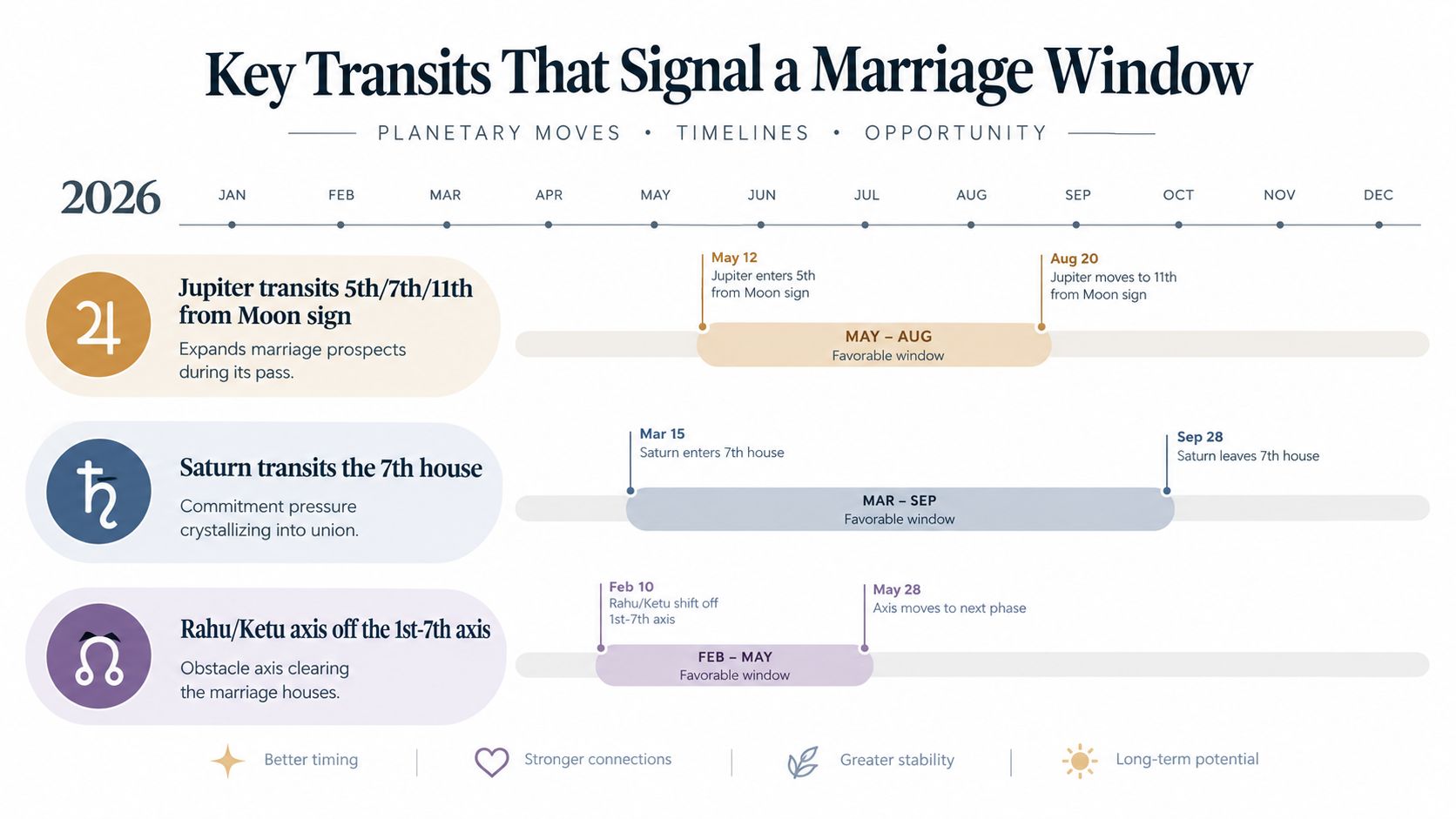
Jupiter is often examined when it transits or aspects the 5th, 7th, or 11th house from the Moon sign. The 5th house relates to romance, the 7th to committed partnership, and the 11th to fulfilment and social opportunity. Jupiter passing over the 7th house alone may indicate an opening, but it doesn't prove that a wedding will occur.
Saturn brings a different quality. A Saturn transit through the 7th house, or an aspect to Venus or the 7th lord, can bring seriousness, responsibility, and decisions about commitment. It may coincide with delay in one chart, but in another it may help a relationship become formal and durable.
Rahu and Ketu can alter the pattern. Their axis may bring an unusual meeting, a cross-cultural connection, sudden developments, or a decision that doesn't follow the family's expected route. Such transits need careful interpretation because they can create movement without guaranteeing stability.
Reading combinations instead of isolated signals
An astrologer might read Jupiter over the 7th as an opportunity. If Jupiter also aspects the 7th lord while Saturn activates a career-related house, the period may combine marriage planning with a job move, promotion, or relocation. That combination can explain why a couple has a favourable marriage window but still needs to coordinate work and housing.
A mid-2026 Jupiter-in-Gemini scenario can be used as a teaching example, but its house effect depends on each individual chart. Gemini may activate the 7th house for one ascendant, the 5th for another, and a completely different area for a third. The sign alone isn't enough.
A useful transit review asks three questions:
- Which marriage factor is being activated? The transit should connect with the 7th house, its lord, Venus, Jupiter, or another relevant indicator.
- Does the dasha agree? A strong transit during an unrelated period may describe a proposal, meeting, or conversation rather than a completed marriage.
- Can the couple act during the window? Work notice, travel documents, family agreement, and venue space remain part of the decision.
A visual explanation of planetary movement can help beginners understand why the same transit affects two people differently:
Readers exploring transit meanings can use Kismo's planetary transit resource, then ask an astrologer to relate the transit to the full chart.
Kundli Matching and Couple Timing
Kundli matching, also called kundli milan, compares two birth charts before marriage. A widely used North Indian method is Ashtakoot Milan, which scores eight compatibility areas for a maximum of 36 points. One common classification places scores below 18 in the not-recommended range, 18 to 24 as acceptable, 24 to 32 as very good, and 32 to 36 as excellent (Ashtakoot matchmaking guidance).
The eight gunas are Varna, social and spiritual orientation; Vashya, mutual influence; Tara, supportive birth-star connection; Yoni, instinctive and physical compatibility; Graha Maitri, mental rapport between planetary rulers; Gana, temperament; Bhakoot, emotional and family-life patterns; and Nadi, health, constitution, and lineage considerations in the traditional method.
| Guna | Max points | What it measures |
|---|---|---|
| Varna | Part of the 36-point system | Broad values and orientation |
| Vashya | Part of the 36-point system | Mutual influence and attraction |
| Tara | Part of the 36-point system | Birth-star support |
| Yoni | Part of the 36-point system | Instinctive compatibility |
| Graha Maitri | Part of the 36-point system | Mental and planetary friendship |
| Gana | Part of the 36-point system | Temperament and behaviour |
| Bhakoot | Part of the 36-point system | Emotional and family-life patterns |
| Nadi | Part of the 36-point system | Traditional health and lineage considerations |
The score is only one layer. A couple with 27 out of 36 in a hypothetical match may still need a careful timing review if one person has a difficult Venus-Mars period during the proposed year. In that illustration, a consultation might move the workable wedding period into early 2027, not because the match is automatically unsuitable, but because the two personal timelines don't overlap comfortably in 2026.
Low Nadi or Bhakoot concerns should not be treated as an instant rejection. Traditional astrologers examine cancellation factors, the full charts, Navamsa support, communication, shared values, and the actual relationship. A good match is not created by a number alone.
If Person A enters Jupiter-Jupiter while Person B is in a Venus period, the overlap may be promising. If only one chart supports marriage and the other shows career relocation or emotional withdrawal, the astrologer may recommend a later window. Detailed kundli matching through Kismo can be one way to organise that comparison, provided the result is discussed rather than accepted as an automatic verdict.
Your Muhurta Selection Checklist
Muhurta is the ceremony-level decision. It doesn't decide whether two people should marry. It selects a suitable time for an event after the broader chart and couple timing have produced a workable period.
Traditional marriage-date guidance gives special importance to nakshatras, the 27 lunar constellations used in Vedic astrology. Commonly favourable nakshatras include Rohini, Mrigashira, Magha, Uttara Phalguni, Hasta, Swati, Anuradha, Mula, Uttara Ashadha, Uttara Bhadrapada, and Revati. Another guide highlights Rohini, Mrigashira, Uttara Phalguni, Hasta, Swati, Anuradha, Uttarashadha, Uttara Bhadrapada, and Revati, along with Monday, Wednesday, Thursday, and Friday as preferred weekdays (marriage muhurat rules).
Favourable tithis, or lunar days, commonly considered in the requested checklist include Dwitiya, Tritiya, Panchami, Saptami, Dwadashi, and Trayodashi. Families may also consider weekdays ruled by Jupiter, Mercury, Venus, or the Moon. Local panchang rules can vary, so a date suitable in one location may need adjustment in another.
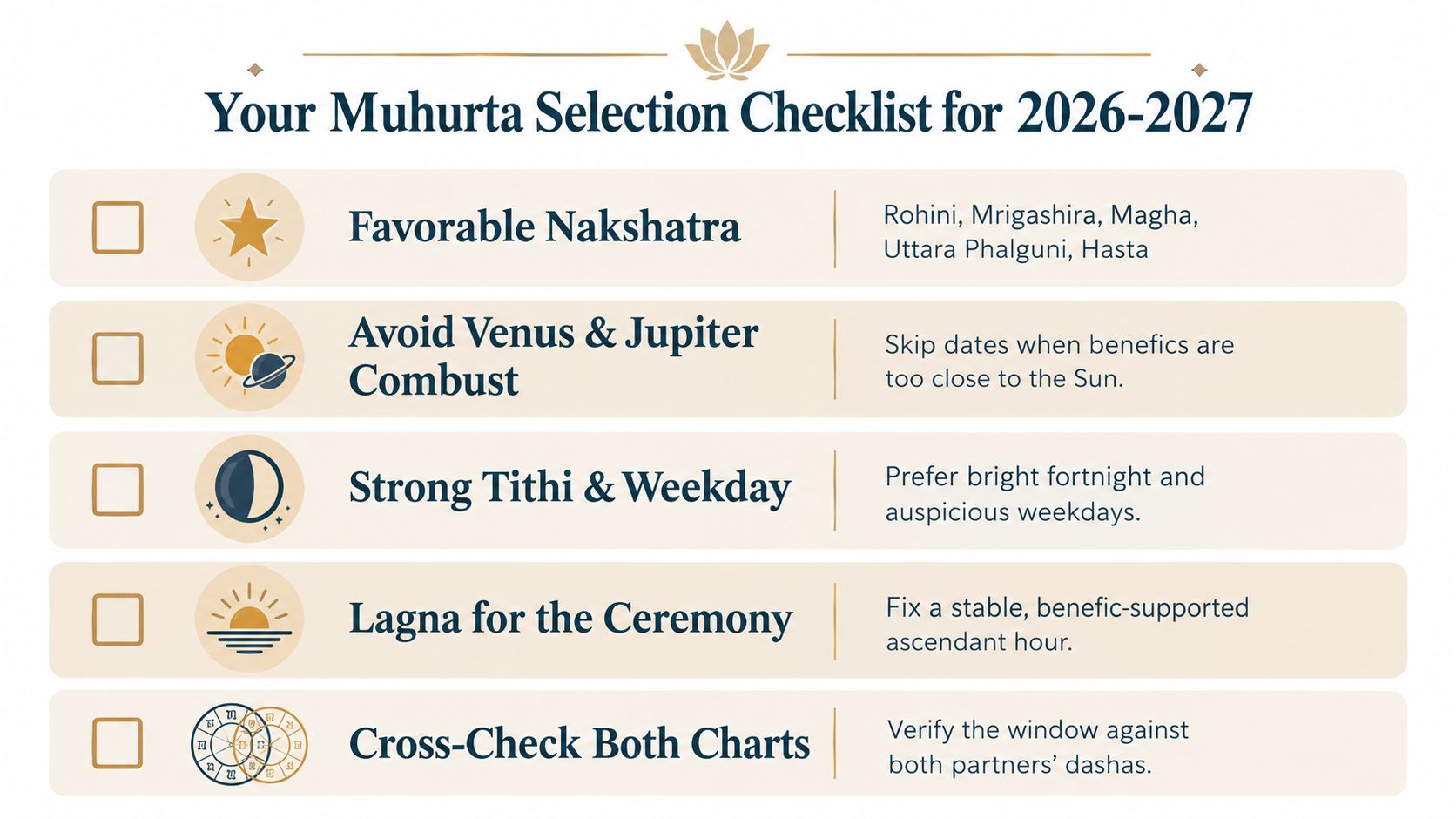
A practical filtering order
- Remove eclipsed dates. The consultation first excludes dates affected by an eclipse or a relevant eclipse-related restriction.
- Check the lagna. The rising sign at the ceremony should be stable and supported, because it describes the beginning of the married household.
- Confirm the Moon's nakshatra. The Moon should occupy a benefic and culturally acceptable nakshatra for the ceremony.
- Review Venus and Jupiter. Traditional guidance advises checking periods when Guru or Shukra are combust, meaning too close to the Sun to function freely.
- Cross-check both ascendants. The selected hour should not support one person while sharply conflicting with the other person's chart.
The avoidance list may include Rahu Kalam, Yama Ghantaka, Chaturdashi, Amavasya, eclipse periods, and Chaturmas. Traditional notes also include family-specific rules, such as avoiding certain first-born cases in Jyestha month or placing space between a girl's marriage and a brother's wedding or a child's mundana ceremony within the family's three generations (traditional muhurta class notes).
The 2026 calendar squeeze makes flexibility important. Limited auspicious Saturdays and Sundays may conflict with guest availability, while the strongest ritual dates may fall on working days. A family can shortlist several dates, rank them astrologically, and then compare venue, travel, work notice, and ceremony requirements rather than rejecting every date that isn't perfect.
A Sample Calculation for a 2026 Wedding
The following is a hypothetical teaching example, not a real case study or a prediction. Priya is described as born on 5 March 1994 in Delhi, and Arjun as born on 12 August 1991 in Mumbai. The exercise shows how a consultation might organise information, but only a complete chart calculation could establish whether the assumed dashas and transits are correct.
The example assigns Priya a Moon mahadasha until mid-2026, followed by Mars. Arjun is assigned Jupiter-Venus until late 2025, followed by Jupiter-Sun. The astrologer then compares the two sequences instead of reading either chart in isolation.
The first pass
The hypothetical transit layer places Jupiter in Taurus through 2026, activating both 7th houses in the teaching model. Saturn in Pisces is treated as aspecting Priya's 7th lord, while a Venus-Jupiter conjunction in Aries around April 2026 supplies an additional relationship indicator in the illustration.
The astrologer doesn't stop there. January and February 2026 are considered for stable Venus conditions, while May 2026 is treated as a period with a Jupiter-Moon Ashtakoot overlap. July through November 2026 is largely removed from consideration because it falls within the Chaturmas retreat described in the traditional calendar framework.
The resulting shortlist contains:
- 14 May 2026, treated in the example as a Thursday with Hasta nakshatra and Panchami tithi.
- 22 November 2026, treated in the example as a Sunday with Anuradha nakshatra and Saptami tithi.
These are not presented as universally auspicious dates. They are hypothetical outputs from assumed chart conditions and must be checked against the local panchang, ceremony location, lagna, family custom, and the actual birth data.
The practical decision
Suppose the venue is available on 14 May, but Priya cannot obtain enough work leave for the family events around the ceremony. Suppose 22 November has a stronger logistical fit, but relatives need to travel internationally and visa timing is uncertain. The astrologer would compare the strengths of both dates rather than frighten the couple into choosing one.
A chart can rank options, but the couple still has to live with the practical result.
The sample calculation also shows why a personal consultation adds value. An astrologer can verify the birth time, examine divisional charts such as the Navamsa, assess the actual Moon and lagna at each hour, and explain whether a difficult indication is temporary, manageable, or irrelevant in the complete chart.
Putting It All Together for Your Own Decision
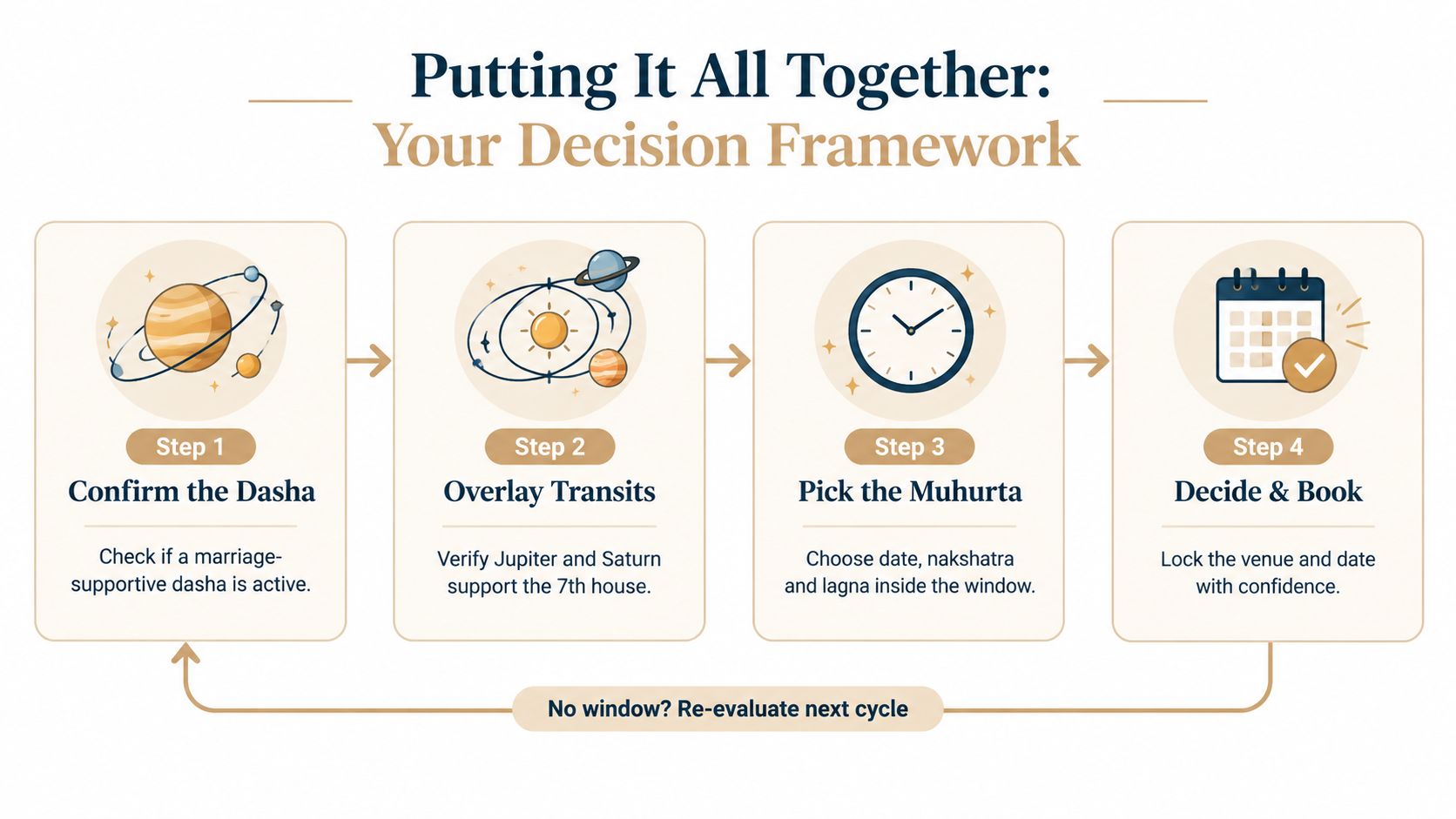
A reusable marriage timing astrology framework has three main layers. Dasha identifies the broad period in which marriage is supported. Transits show when planetary movement strengthens or activates that possibility. Muhurta selects the date and hour within the available period.
The order matters. If a consultation starts with a list of auspicious dates and never checks the personal dashas, it may produce a polished calendar with little personal meaning. If it examines one Jupiter transit and ignores the partner's chart, it may mistake an opportunity for a complete marriage indication.
The four-part decision framework
Step 1, confirm the dasha. The astrologer checks the mahadasha and antardasha, then studies their relationship with Venus, Jupiter, the 7th house, and the 7th lord.
Step 2, overlay the transits. Jupiter, Saturn, Rahu, Ketu, and relevant planetary movements are assessed against both charts. The question is whether the transit confirms the dasha period, not whether one planet looks favourable by itself.
Step 3, pick the muhurta. The couple filters dates through nakshatra, tithi, weekday, combustion, eclipse rules, Chaturmas, and the ceremony lagna. The strongest date is still subject to local timing and family tradition.
Step 4, decide and book. The couple compares the shortlisted times with venue availability, family travel, career obligations, relocation, and visa constraints. If no overlap exists, the next supportive cycle can be reviewed without treating the delay as a permanent denial.
The most common mistakes are chasing an exact date, relying on a generic list, rejecting a partner because of one dosha, and ignoring emotional compatibility. Traditional matching can offer structure, but trust, communication, shared values, readiness, and mutual respect remain essential to the decision.
A personal consultation becomes useful when signals conflict. The astrologer can check Navamsa confirmation, clarify whether Saturn indicates delay or mature commitment, compare both partners' overlapping periods, and balance the chart with real constraints. That approach replaces fear with a ranked set of practical choices.
Kismo offers one-to-one guidance by chat or call for birth chart readings, kundli matching, dasha-based marriage timing, and muhurta selection. Readers planning a wedding can bring the proposed dates, birth details, location, and practical constraints to a session through Kismo.