Mars in Leo Meaning and How It Shapes Your Life

A person may feel ready to lead a new project, speak up in a difficult meeting, or take a relationship more seriously, yet wonder whether that drive is confidence or pride. In Vedic astrology, Mars in Leo offers one way to reflect on courage, visibility, and action. It isn't a fixed verdict about someone's character or future; the full birth chart matters.
One important distinction helps prevent confusion. Natal Mars in Leo describes Mars's position in the chart at birth, while a Mars transit through Leo is a temporary movement that astrologers interpret in relation to a person's chart. The two aren't interchangeable.
Table of Contents
- What Mars in Leo Means in Vedic Astrology
- Core Traits of Mars in Leo Personality
- Career, Ambition, and Taking Action
- Relationships, Romance, and Conflict Style
- The 2026-2027 Mars Transit Timeline
- How Houses, Nakshatras, and the Sun Modify the Reading
- Practical Guidance and When to Seek a Personal Reading
What Mars in Leo Means in Vedic Astrology
Someone who steps forward when a group needs direction, works hard for a goal, and feels stung when their contribution goes unnoticed may recognise parts of Mars-in-Leo symbolism. That isn't proof of a particular placement, and it doesn't mean every person with this placement behaves the same way. It's a starting point for understanding how Vedic astrology combines a planet and a sign.
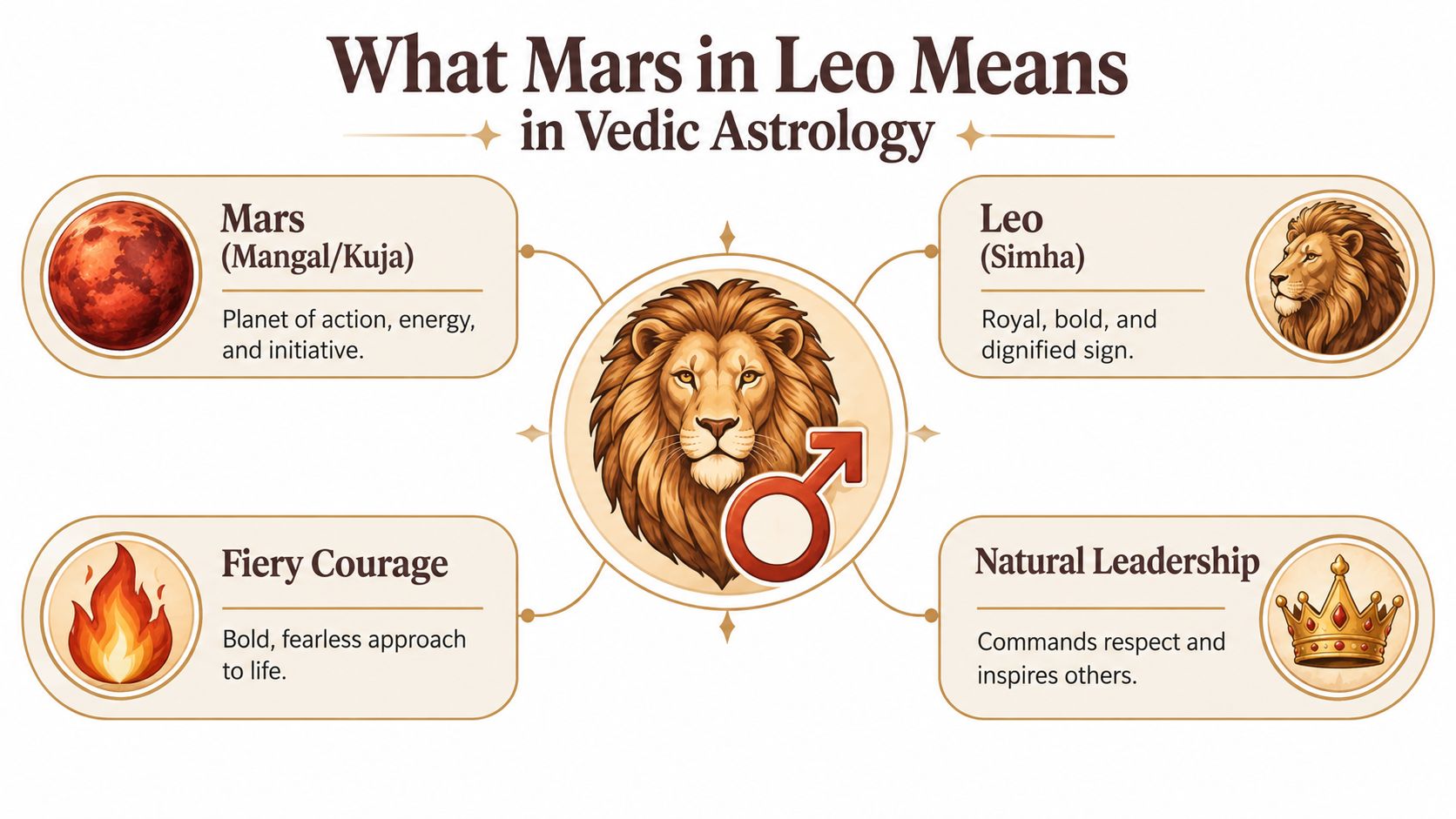
In Indian astrology, Mars is Mangal or Kuja, associated with action, energy, initiative, stamina, and drive. Leo, or Simha, is a fiery sign ruled by the Sun, traditionally connected with visibility, dignity, authority, and self-expression. Put together, Mars in Leo is often interpreted as action that wants to make an impression: taking charge, defending a principle, or pursuing a goal with confidence.
That symbolism can be constructive. A person might volunteer to organise a community event, speak up for a colleague, or put sustained effort into a creative project. The same energy may become difficult if the person treats disagreement as disrespect or insists on recognition before listening to others.
Vedic astrology reads these themes through a person's kundli, or birth chart, rather than treating a sign placement as a complete reading. The house occupied by Mars, its relationships with other planets, the Sun's condition, and the chart's timing all add context.
Natal placement and transit are different
Natal Mars in Leo is a birth-chart placement. Astrologers may interpret it as a lasting pattern in how someone approaches effort, competition, or leadership, while still weighing the rest of the chart. Transit Mars in Leo, by contrast, describes a temporary period when Mars moves through Leo and activates different areas of individual charts.
So a general description can offer useful language for reflection, but it can't settle a personal question by itself. A careful interpretation depends on the full chart and the exact placement, not just the words “Mars in Leo”.
Core Traits of Mars in Leo Personality
The clearest way to understand this combination is to look at its ingredients. Mars represents how someone acts and pursues goals; Leo brings a style associated with confidence, dignity, and visibility. Together, they're often read as a bold, warm, and determined approach, though the exact expression varies from chart to chart.

Think of a lion that naturally takes the lead in a group. It can protect others and hold its ground, but it may also roar when it feels challenged. In everyday life, this symbolism might show up as someone who speaks directly, volunteers to take responsibility, and stays committed to a goal even when progress is slow.
A desire for recognition can be part of the picture. Appreciation may encourage this person to contribute generously, while being overlooked can bring frustration. The practical question isn't whether they should want recognition, but whether they can value their own effort without turning every disagreement into a contest.
Strength and sensitivity can sit together
Mars in Leo is traditionally associated with courage and warmth as well as pride and impatience. A person may be loyal to friends and family, generous with encouragement, and able to inspire a team. Yet the same strong will can make it harder to admit a mistake or share control.
For example, a group leader might be excellent at motivating people and keeping a project moving. If a teammate suggests another approach, the leader's first reaction could be defensive. Pausing to ask what the suggestion improves can turn a possible clash into useful collaboration.
A short visual reflection can help clarify these themes before applying them to a chart:
These are possibilities within an astrological interpretation, not guarantees. The house Mars occupies and its wider chart context shape where confidence, loyalty, or pride may be most noticeable.
Career, Ambition, and Taking Action
In career questions, Mars in Leo is commonly associated with initiative and a wish to take responsibility. Someone with this symbolism may prefer to shape a project rather than wait for instructions, and may feel especially motivated when their contribution is visible. That doesn't identify a single suitable career. Management, entrepreneurship, performance, sport, and other public-facing work can all draw on leadership or confidence, but skills, circumstances, and preferences matter too.

A useful distinction is long-term pattern versus timing window. Natal Mars in Leo is interpreted as part of someone's enduring approach to effort and ambition. A transit through Leo is temporary, and its relevance depends on where Leo falls in the natal chart and how Mars connects with the person's planets and chart factors.
Why exact timing matters
Mars doesn't move through every sign at one uniform pace. Its sidereal mean daily motion is approximately 0°31′27″, with listed speeds ranging from about −0°26′ per day during retrograde motion to +0°48′ per day in direct motion (sidereal planetary ephemeris). The speed can change the time Mars spends in a sign, while its exact contacts with a person's chart are concentrated around conjunctions, oppositions, squares, and other aspects.
For a career decision, that means a general transit date shouldn't be treated as a personal green light. An astrologer would consider the sidereal position, the chosen ayanamsha (the adjustment used to calculate the sidereal zodiac), the relevant house, and the chart's timing systems. Two people can experience the same transit dates and receive different interpretations because the activated houses and chart relationships differ.
Practical use: someone considering a job change could use the symbolism as a prompt to review their plan, workload, and response to competition. They shouldn't rely on a transit alone to make a consequential career or financial decision. Ambition can be an asset, but rest, preparation, and thoughtful timing help keep effort sustainable.
Relationships, Romance, and Conflict Style
Mars in Leo is often interpreted as bringing warmth, loyalty, and protectiveness to close relationships. Someone may express affection through generous gestures, direct support, or a willingness to stand up for a partner. They may also want their care to be noticed and valued.

The same need for appreciation can create tension if it becomes a demand for agreement. A disagreement about plans, money, or family responsibilities may feel personal when one partner believes the other has dismissed their effort. Anger can rise quickly, especially when pride is involved, but awareness creates room to pause before a sharp response becomes the focus of the conversation.
Turn strong feelings into clearer communication
A helpful approach is to separate the issue from the need for respect. Instead of trying to win an argument, a person can name the specific concern, listen to their partner's view, and agree on what action would address the problem. Giving the other person time to finish speaking isn't surrendering; it helps both partners understand what's at stake.
A partner with this symbolism may naturally take the lead, but a healthy relationship leaves space for both people to make decisions. Appreciation matters, yet it works best as part of mutual care rather than a test that one person must keep passing.
For marriage questions, one placement can't establish whether two people are compatible. Kundli matching, the comparison of partners' birth charts, looks at the charts as a whole; Mars in Leo should be considered alongside other relevant factors. A thoughtful reading can help couples discuss patterns and expectations, but it shouldn't promise a particular marriage outcome.
Seeing the possible strengths and pressure points can support better conversations. It doesn't label someone as a difficult partner, and it doesn't excuse hurtful behaviour. It offers a framework for noticing when loyalty and confidence help a relationship, and when pride may be getting in the way.
The 2026-2027 Mars Transit Timeline
A natal Mars in Leo describes tendencies a person carries throughout life, while a transit describes a season everyone shares for a limited stretch of time. One India-focused transit calendar projects an unusually long sidereal Mars transit through Leo, beginning 12 November 2026 at approximately 20:11 Indian Standard Time and lasting until 10 March 2027 at approximately 00:29 IST, a stay of about 117 days (India-specific Mars-in-Leo transit dates). For scale, the same reference gives a median Leo passage of 49 days across 22 transits between 2006 and 2046, with recorded stays of 48 days in 2006, 49 days in 2008, and 55 days in 2010.
This passage works like a long visit rather than a brief stopover. All dates here are sidereal and calculated for Indian time conventions.
Read the extended transit in phases
During the first entry, Mars initially moves into Leo. In traditional interpretation, this is when the themes of the house Leo occupies in a chart begin to grow more active. It can be a useful time to prepare or begin a considered plan, though a favourable entry alone never guarantees a favourable outcome for every launch or major choice.
The cited projection places Mars turning retrograde on 10 January 2027. Astrologers often treat a retrograde phase as a prompt to review, repair, and revisit, rather than to rush a decision because energy feels high. A plan begun earlier may need adjustments. That slower stretch can be used well: check assumptions, correct avoidable problems, and strengthen the foundation before the pace picks up again.
The final exit is projected for 10 March 2027. An astrologer may read this as a natural point to assess what changed across the transit and what still needs follow-through. The meaning always depends on the individual chart, not just the calendar.
For a wedding, job move, business launch, housewarming, or other important decision, timing should be checked against the full chart and the relevant muhurta, an astrologically selected time for an undertaking. A person exploring the general movement can review the Mars transit calendar, and a personal reading can then test whether a projected window suits their chart. Medical, legal, and financial decisions also require the relevant professional advice.
How Houses, Nakshatras, and the Sun Modify the Reading
The sign describes one layer of the interpretation, not the whole story. In a kundli, the ascendant, or rising sign, helps establish the houses, and the house containing Leo points to the life area astrologers examine when interpreting Mars there. A career-related house may shift attention towards professional effort and competition; a relationship-related house may make partnership dynamics more central. The precise reading depends on the chart, rather than on a universal rule about what each person will experience.
Degree, nakshatra, and pada add detail
A nakshatra is a lunar mansion used in Vedic astrology, and a pada is one of its quarters. Traditional Indian astronomy divides the ecliptic into 27 nakshatras, each spanning 13°20′, with each nakshatra divided into four padas of 3°20′. That creates 108 smaller divisions (overview of the nakshatra system).
This is why the exact degree matters. Two people may both have natal Mars in Leo, yet Mars may fall in different nakshatras or padas in their charts. Astrologers use those details to add nuance, rather than treating the sign name as a full personality description.
The Sun also matters because it rules Leo. Its placement and condition form part of the interpretation of how Leo's themes of visibility and authority operate in the chart. A reading should examine that context along with Mars's house, aspects, conjunctions, and the timing of the relevant dasha, or planetary-period sequence.
A chart reading brings these elements together instead of judging Mars in Leo by one feature. A Vedic kundli chart reading can show why two people with the same sign placement may have different areas of emphasis. It can't turn symbolism into a guaranteed prediction, but it gives the interpretation a more personal foundation.
Practical Guidance and When to Seek a Personal Reading
Mars in Leo isn't good or bad. The same drive that helps someone take responsibility can become impatience if they feel forced to prove themselves. A useful response is to work with the constructive side of the symbolism while checking where pride, pressure, or the need for immediate recognition might affect a choice.
A person can set a clear goal, break it into manageable actions, and schedule time to rest rather than relying on bursts of effort. In a conflict, they can pause before replying and make sure they've understood the other person's point. During a retrograde period, traditional astrological practice may favour reviewing or refining a plan over launching impulsively, but the full chart and real-world circumstances still matter.
A steady question to ask: “What needs a bold step, and what needs a second look?”
For personalised guidance about marriage, career, or auspicious timing, an astrologer needs the birth details and the chart context, not just a sign placement. A full reading should explain the factors behind its interpretation and leave room for practical judgement. People seeking a chart-based conversation can explore one-to-one astrology guidance.
A birth chart is best used as a tool for self-awareness and thoughtful decisions, not as a reason to fear what might happen. Understanding the symbolism can help someone act with more confidence while staying open to other people and to changing circumstances.
Kismo connects users with verified astrologers for personalised birth-chart readings, kundli matching, career questions, and muhurta guidance by chat or call. To explore how Mars in Leo fits an individual chart, visit Kismo.