
Meaning of Rohit: Sanskrit Origin, Culture and Astrology
Rohit is a masculine given name from the Sanskrit word rohita, meaning red or reddish, and in Indian usage it is also linked with the first light of dawn. But does a name connected with sunrise mean the sun, or does that explanation belong to its cultural story?
That distinction matters when a family is choosing a baby's name. A dictionary meaning, a family association and an astrological interpretation can all be meaningful, but they don't answer the same question.
Table of Contents
- What the Name Rohit Means at a Glance
- Sanskrit Roots Behind the Name Rohit
- Sunrise Symbolism in Indian Naming Traditions
- Popularity of Rohit Today and Notable People Named Rohit
- Astrology and Numerology Notes on the Name Rohit
- Choosing a Name With Meaning and Birth Details
- Conclusion and Your Next Step With Rohit
What the Name Rohit Means at a Glance
A parent considering Rohit might hear different explanations from relatives. Someone may describe it as red, another as the rising sun, and another as a name suggesting a fresh beginning. These explanations become easier to understand when the literal meaning and the symbolic associations are kept separate.
Rohita, the Sanskrit word behind the name, means red, reddish or ruddy. In India, Rohit is primarily understood as a masculine given name, with an association with the reddish glow of early morning, as outlined in the overview of Rohit's origin and meaning).
Different questions need different answers
A reader searching for the meaning of Rohit may be naming a newborn, learning about a friend or trying to understand a family tradition. Each purpose calls for a slightly different emphasis.
| A reader's question | The useful distinction |
|---|---|
| What does the original word mean? | Start with the Sanskrit colour meaning. |
| Why do people connect it with dawn? | Consider the image and symbolism of reddish morning light. |
| Why might a family choose it? | Look at personal preference, heritage and the story behind the name. |
| Does it determine personality or fortune? | Keep linguistic meaning separate from astrological or numerological interpretation. |
For example, a family may favour Rohit because it reminds them of a hopeful morning. That is a personal reason for choosing it, not evidence that the child will have a particular temperament.
A useful distinction: A name can express a family's hopes without predicting the child's future.
The reassuring starting point is that these layers needn't compete. A family can value the Sanskrit root, enjoy the sunrise image and consider traditional naming guidance without treating any interpretation as a guarantee.
Sanskrit Roots Behind the Name Rohit
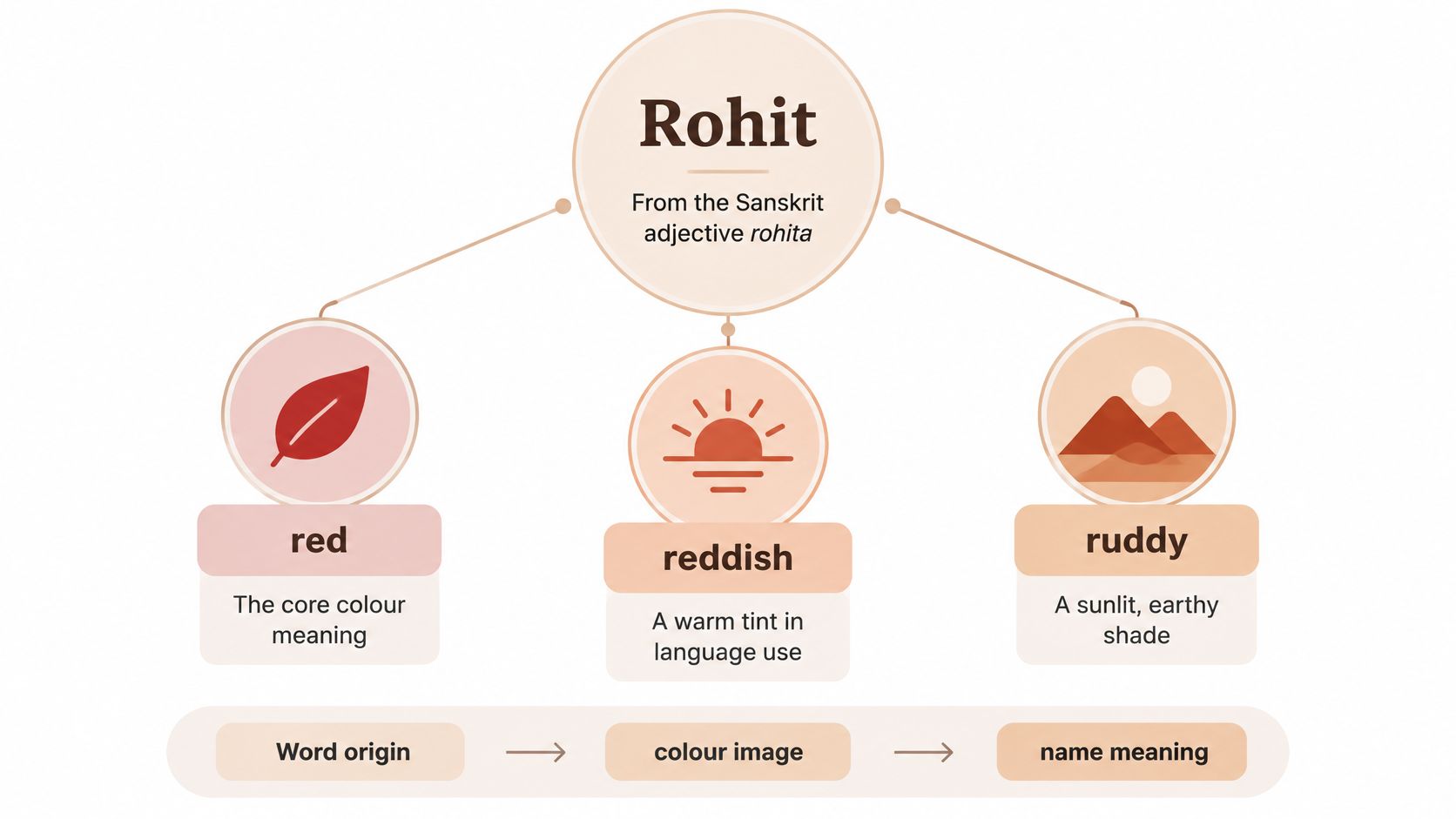
The clearest way to understand Rohit is to begin with rohita as a descriptive word, rather than with a list of personality traits. An adjective describes a quality. In this case, the quality is colour.
The Sanskrit entry for rohita gives the meaning red or reddish and connects it with lohita, another Sanskrit word for red. It also records a Vedic use involving a red horse associated with the Sun.
Understanding a colour word through everyday language
An English speaker might describe a sunset as red even though the sky contains orange, pink and golden shades. The speaker isn't naming a precise paint colour. The word gives a broad visual impression.
Rohita can be understood in a similar way. Red, reddish and ruddy are closely related translations, not separate predictions attached to the name. “Ruddy” may be less familiar to some readers, but it describes a reddish appearance.
This helps explain why an old word can appear in descriptions of different things. The colour quality provides the connection. A word's use for an animal or natural object doesn't mean that every person with the related name carries the meaning of that object.
- Red gives the most direct starting point.
- Reddish allows for a tint or appearance rather than an exact shade.
- Ruddy is another English way of expressing a red-toned quality.
Why the related word lohita matters
The relationship with lohita places Rohit within an established Sanskrit colour vocabulary. The explanation doesn't depend on a modern interpretation invented to make the name sound attractive.
It also encourages careful reading. A dictionary may record several uses of a word across different contexts, while a baby-name page may select only the most poetic one. Neither format should lead a reader to assume that every recorded sense is equally central to the personal name.
A useful comparison is a word with several branches. The colour meaning is the root from which the other images can be understood. For a naming decision, red or reddish is the safest first explanation, while contextual and symbolic meanings add detail.
Sunrise Symbolism in Indian Naming Traditions
A colour can suggest much more than its dictionary definition. A painter's first warm brush stroke on a blank canvas may suggest a morning scene before any trees or houses appear. In a similar way, a reddish colour can bring the early sky to mind.
This is the key to understanding Rohit's dawn association. The connection is meaningful, but the image of the first light of dawn shouldn't replace the underlying colour meaning.

The difference between the sun and sunrise
There is a useful nuance. Classical Sanskrit dictionary entries collected under Rohit record the sun as a masculine meaning, alongside the colour-related vocabulary. Related forms also appear in descriptions of a red mare, deer or fish.
That gives readers a more precise answer than a simple choice between “red” and “sun”. The colour meaning is foundational, and a dictionary-based sun meaning also exists. However, the fuller phrase the first rays of the rising sun is best understood as a cultural or poetic explanation rather than a word-for-word translation.
| Layer | How to understand it |
|---|---|
| Literal colour | The underlying red or reddish quality |
| Recorded dictionary sense | The sun |
| Cultural image | Reddish dawn light and the beginning of a day |
| Family interpretation | A personally chosen association with hope or renewal |
How families can explain the symbolism
A family might explain Rohit to a child by describing the warm colour of the early morning sky. That keeps the explanation simple without turning it into a claim about what the child must become.
The symbolism can carry ideas of renewal, vitality and a new beginning. Those associations offer a reason to appreciate the name, particularly when a family wants a connection with nature or an auspicious start.
Sunrise symbolism expresses a hopeful story. It doesn't place a duty on a child to be cheerful, energetic or successful.
A thoughtful naming explanation leaves room for the person who will carry the name. A child named Rohit may be quiet or outgoing, artistic or practical. The family's chosen symbolism can remain affectionate without becoming a fixed description of character.
Popularity of Rohit Today and Notable People Named Rohit
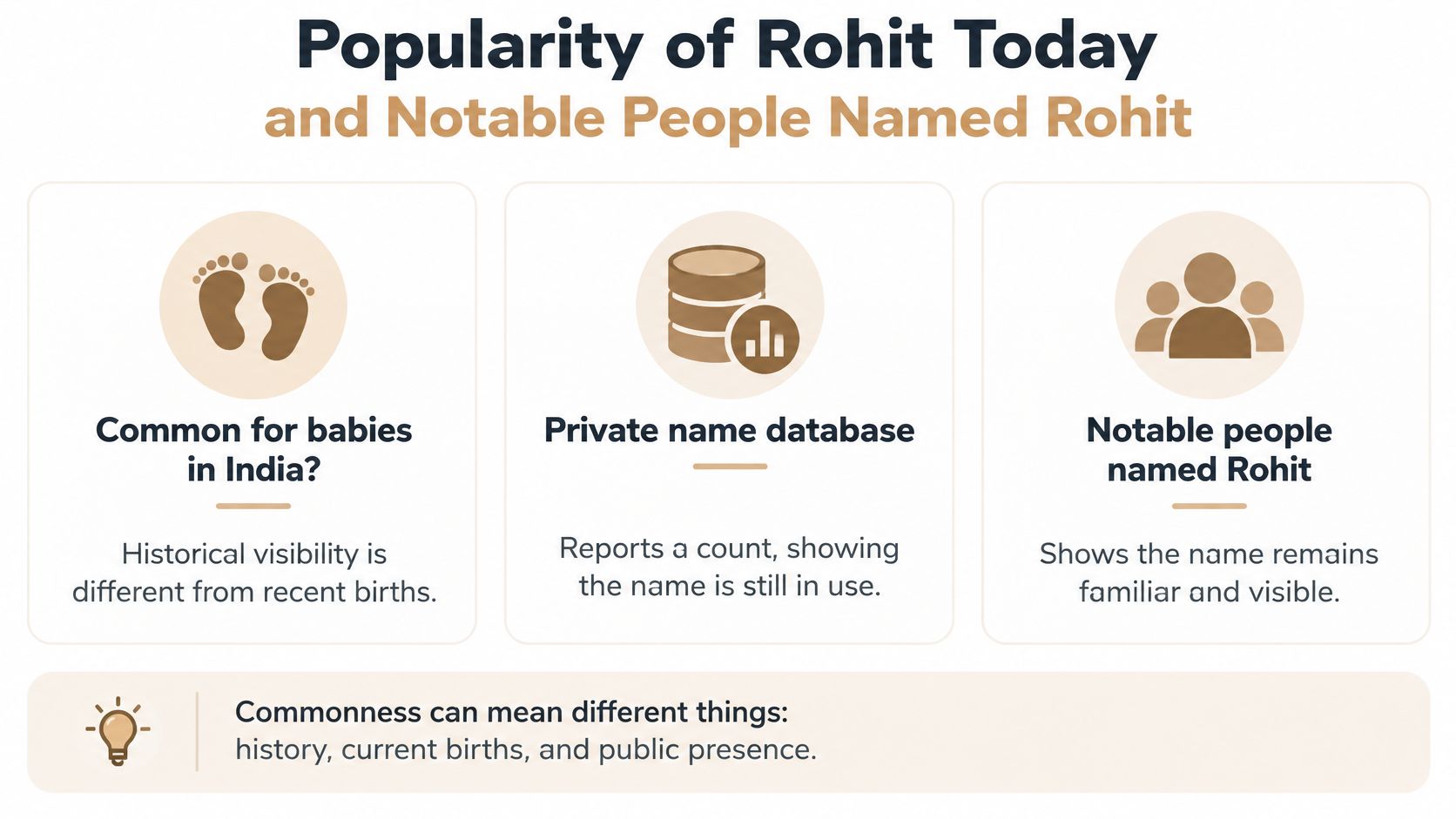
“Is Rohit common?” can mean several different things. A family may be asking whether people recognise it, whether many adults have it, or whether parents are choosing it for newborns today. These questions require different kinds of evidence.
The iMeUsWe record for Rohit reports 16,43,116 people with the name in its own records and gives it a rank of 71st. Those figures describe a private database, not an official Indian population estimate or a measure of recent births.
Recognition isn't the same as newborn popularity
A database can include people from different generations. Without a clear breakdown by birth year, region and coverage, its total cannot establish how often the name is being given to babies now.
The evidence also doesn't support a confident claim that Rohit is experiencing a recent revival or decline. An adult's experience of hearing the name frequently may be genuine, but that experience isn't a national naming survey.
- Historical use concerns people who already carry the name.
- Current baby-name use requires information about recent births.
- Public visibility concerns the names encountered in media, professional life and public discussion.
These distinctions are especially useful for families living outside India. A name may feel familiar within a family's community while being less familiar in the child's school or local neighbourhood. Checking that practical setting is more useful than assuming a database rank describes every location.
Public examples and their limits
Publicly visible people can also make a name easier to recognise. The author credit “By Rohit Bhargava” provides an example from published commentary. A separate professional profile identifies Rohit Ganguly as an “AI Product Manager”.
These are examples of the name appearing in different professional settings, not evidence about baby-name trends. Their visibility can help a reader encounter the name, but it cannot establish national popularity.
For a parent, the more useful question may be whether the name feels comfortable and meaningful in daily life. A family can test how relatives pronounce it, how it sounds with the surname and whether its familiarity is an advantage. A name doesn't need to be fashionable to be a good personal choice.
Astrology and Numerology Notes on the Name Rohit
Does a name connected with the sun automatically establish a person's astrological identity? No name meaning, by itself, supplies an individual birth chart. The linguistic explanation and the chart interpretation answer different questions.
In Vedic, or Indian, astrology, a kundli is a birth chart. Some naming traditions consider a starting sound connected with the child's nakshatra, a lunar mansion, and rashi, a zodiac sign. A practitioner needs the relevant birth details to explain how that tradition applies to a particular child.
A name is not a complete chart
A helpful analogy is a map. The name is like a title written at the top, while the birth chart contains the detail used for the interpretation. Reading the title alone cannot reveal the whole route.
This is why a general name page shouldn't assign a certain future to every Rohit. Even within an astrological framework, the individual chart matters. A dasha, an interpreted planetary period in Vedic astrology, is another chart-related concept, not something established by the name's colour meaning.
A reassuring boundary: An unfamiliar naming rule isn't a reason for a family to fear that an existing name has harmed a child.
For families exploring astrology tools, a useful approach is to record the birth information carefully and note any uncertainty about the birth time. A personalised interpretation should acknowledge that uncertainty rather than present an unsupported level of precision.
Numerology is a separate interpretive practice
Numerology assigns numbers to letters and interprets the resulting combinations. It isn't the same as Sanskrit etymology, and a numerological reading shouldn't be presented as the dictionary meaning of Rohit.
A family considering numerology can ask practical questions before accepting a recommendation:
- Method used: Which letter-to-number system is being applied?
- Spelling considered: Does the interpretation use the official name, an everyday spelling or the full name?
- Reason for a change: What is the explanation, and does the proposed spelling remain comfortable to use?
Such readings are interpretive, not guarantees of luck, marriage, career success or personality. A spelling change shouldn't be presented as a condition for a safe or successful life. The family can consider a tradition respectfully while retaining the freedom to decline advice that causes pressure or confusion.
Choosing a Name With Meaning and Birth Details
A family doesn't have to choose between a dictionary and a tradition. Different people can help with different parts of the decision, provided their roles remain clear.
A dictionary helps establish language and meaning. Family elders may explain why a name matters within the household. A pandit may advise on a muhurta, an auspicious time chosen for a beginning, while an astrologer may consider the individual birth chart when discussing naming sounds or timing.
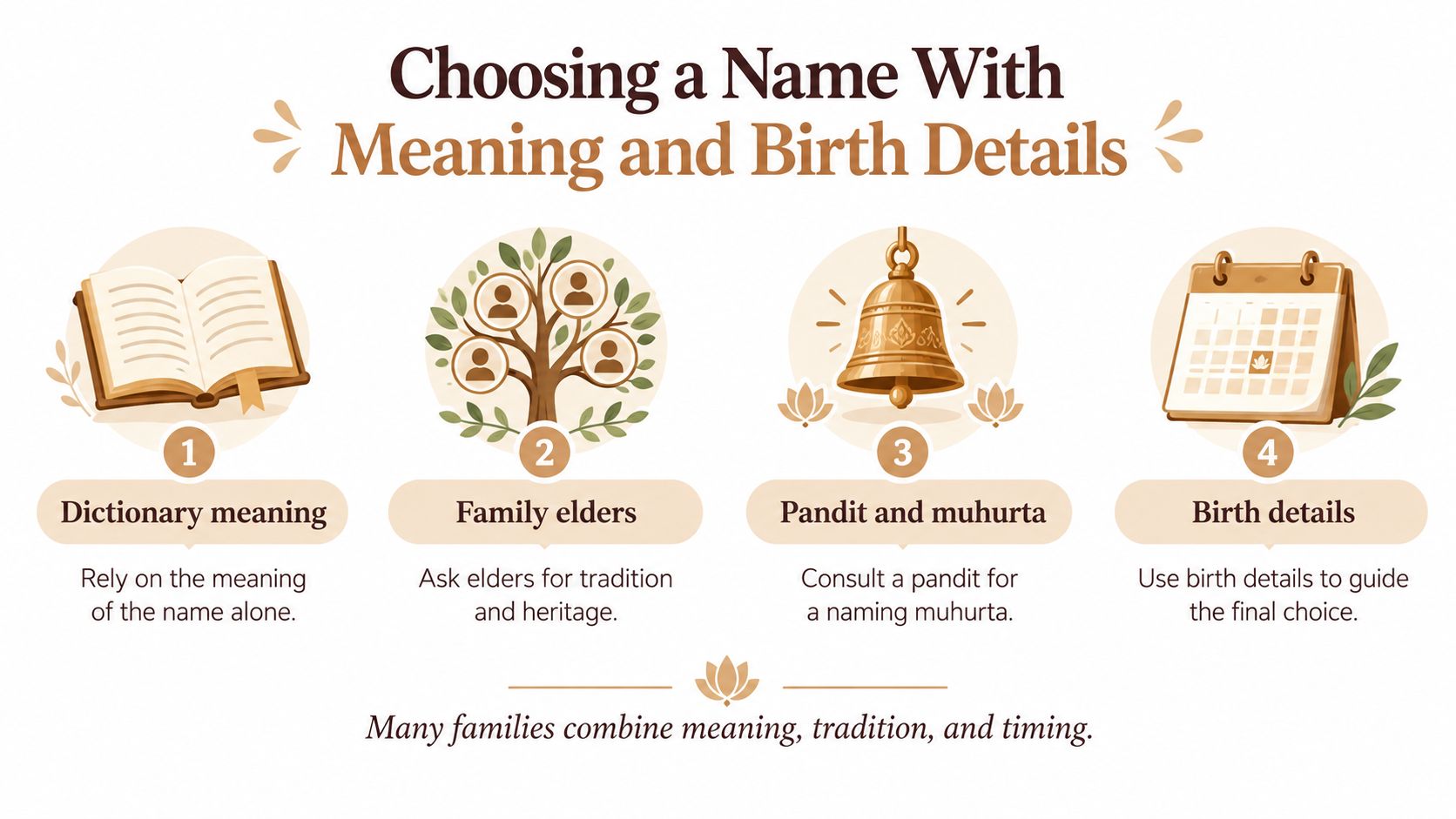
Match the source of advice to the question
| Approach | What it can help clarify | What it shouldn't replace |
|---|---|---|
| Dictionary meaning | The word's origin and recorded senses | The family's personal preference |
| Family discussion | Heritage, memories and established customs | A check of the actual word meaning |
| Pandit's guidance | Ceremony customs and naming muhurta | The parents' consent |
| Individual chart reading | Traditional interpretation using birth details | Practical considerations about the child's name |
For a family seeking a personalised kundli reading, the useful preparation is straightforward: collect the birth date, recorded time and birthplace, and write down the naming question. If the time is uncertain, that uncertainty should be stated openly.
The chart may shape timing guidance within the chosen astrological tradition. It doesn't remove the need to consider how the name will be spoken, written and used.
A practical naming checklist
- Confirm the meaning. Keep a short explanation of the Sanskrit root and distinguish it from the family's preferred symbolism.
- Check pronunciation. Ask relatives who speak different household languages to say the name naturally, without coaching.
- Choose the written form. Agree on the Roman-letter spelling and the form used in the family's preferred script.
- Read the full name aloud. Include the surname and consider ordinary situations such as a school introduction or a formal document.
- Keep birth details ready. If traditional guidance matters to the family, provide the information used for an individual interpretation.
The final conversation should include the people who will use the name every day. If relatives disagree, identifying the actual concern helps: meaning, sound, tradition and timing are different issues. A calm discussion can address each concern without treating one preference as an unquestionable rule.
Conclusion and Your Next Step With Rohit
The meaning of Rohit becomes clearer when its layers remain distinct. The Sanskrit colour root provides the firm starting point, while the sun and dawn associations explain why many families find the name evocative.
That understanding is more useful than an attractive but unexplained list of traits. A family can appreciate the name's story without expecting the child to fit a description taken from a naming page.
Turn understanding into a practical decision
For a family considering Rohit, a useful next step this week is to make a small shortlist of preferred names. Beside each name, record its meaning, agreed spelling and the reason it appeals to the family.
Then test the choices in ordinary situations. A name may look attractive on a list but feel different when spoken with the surname or written in the household's preferred script. These small checks help turn an abstract preference into a considered choice.
- Meaning: Is the explanation clear enough to share with a child?
- Daily use: Does the pronunciation feel comfortable across the family's languages?
- Personal connection: Does the choice reflect affection and preference rather than pressure?
- Traditional guidance: Is there a specific question that a chart reading could help the family discuss?
If birth-chart guidance would be useful, a family can review the available astrologers for a personal consultation and prepare that question before booking. The most constructive conversation focuses on the individual birth details and the family's decision, rather than seeking a promise about the child's future.
Rohit carries a meaningful linguistic and cultural story. Whether it becomes the final choice depends on the family's own priorities, and that choice can be made thoughtfully, without fear or urgency.
Kismo offers one-on-one chat or call sessions with verified astrologers for personalised birth-chart guidance, with the flat session fee shown before booking. Families considering Rohit can visit Kismo to discuss naming questions and auspicious timing while keeping the final decision in their own hands.