Moon in Sagittarius: Emotions, Relationships and Life
A marriage conversation is becoming serious, but the possibility of studying or working elsewhere still feels exciting. Family members want a clear answer, while the person making the decision wants both closeness and room to grow. Someone reading about Moon in Sagittarius may recognise that tension, but a horoscope label shouldn't decide what happens next.
Table of Contents
- Moon in Sagittarius as an Emotional Compass
- How Vedic Astrology Reads the Placement
- Emotional Needs and Everyday Responses
- Relationships Family and Cultural Commitments
- Education Career and Direction
- Reading Emotional Timing with Dasha and Transits
- Practical Guidance for Clearer Decisions
Moon in Sagittarius as an Emotional Compass
In Indian Jyotisha, the traditional Indian astrological system, Moon in Sagittarius generally means that the Moon occupied Dhanu rāśi, the sidereal zodiac sign Sagittarius, at birth. This is a Moon placement, not another name for someone's Sun sign, as explained in this guide to Dhanu rashi.
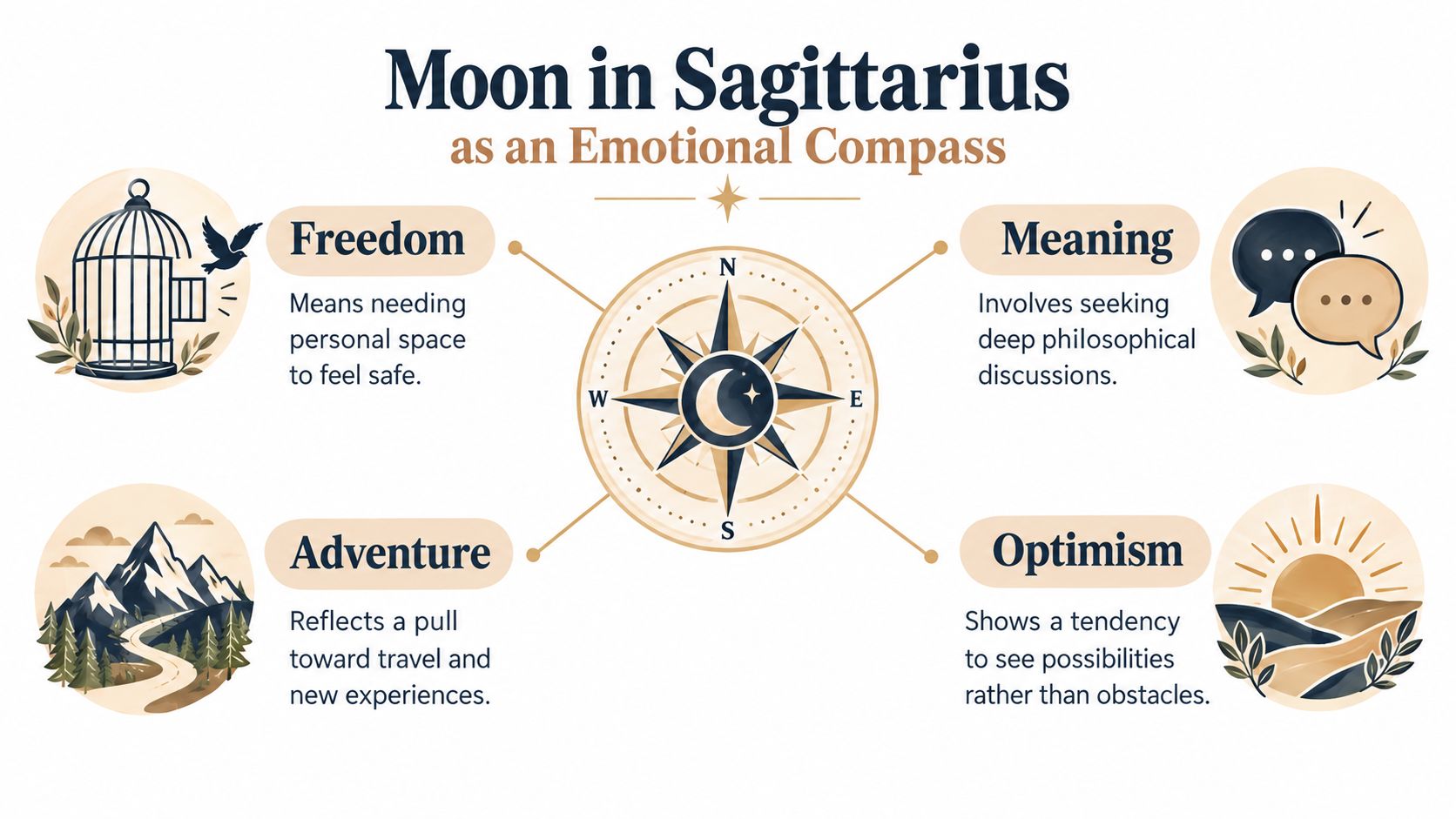
In this tradition, the Moon represents the mind, emotions, memory, nurturing and subjective security. Sagittarius symbolism connects these needs with discovery, freedom, meaningful conversation and hope. These are traditional interpretations, not scientifically established descriptions of everyone born with this placement.
The compass illustration presents those themes as possible directions for reflection.
Direction Without a Fixed Destination
Consider someone who welcomes a committed relationship but feels uneasy when discussions assume that personal interests must disappear after marriage. The useful question isn't whether Sagittarius Moons dislike commitment. It's whether the proposed arrangement allows both partners to remain curious, connected and responsible.
A kundli, meaning birth chart, provides the wider astrological context. A nakshatra, or lunar mansion, adds a more specific lunar placement within that chart. Neither should replace attention to what the person feels, says and does.
What the Placement Can and Cannot Tell You
| Useful starting question | What needs fuller examination |
|---|---|
| Does personal space help this person feel settled? | How space is negotiated without neglecting others |
| Does learning provide a sense of direction? | Interests, resources and willingness to follow through |
| Does honesty support emotional closeness? | Tone, listening and the effect of words |
| Does change feel necessary? | Whether the need concerns growth, discomfort or practical circumstances |
The central principle is simple: a compass suggests direction; it doesn't choose the destination. A reader can use this symbolism to name a need without turning that need into an excuse or a permanent identity. Someone can value adventure and still prefer a stable home, or love family life while needing independent interests.
How Vedic Astrology Reads the Placement
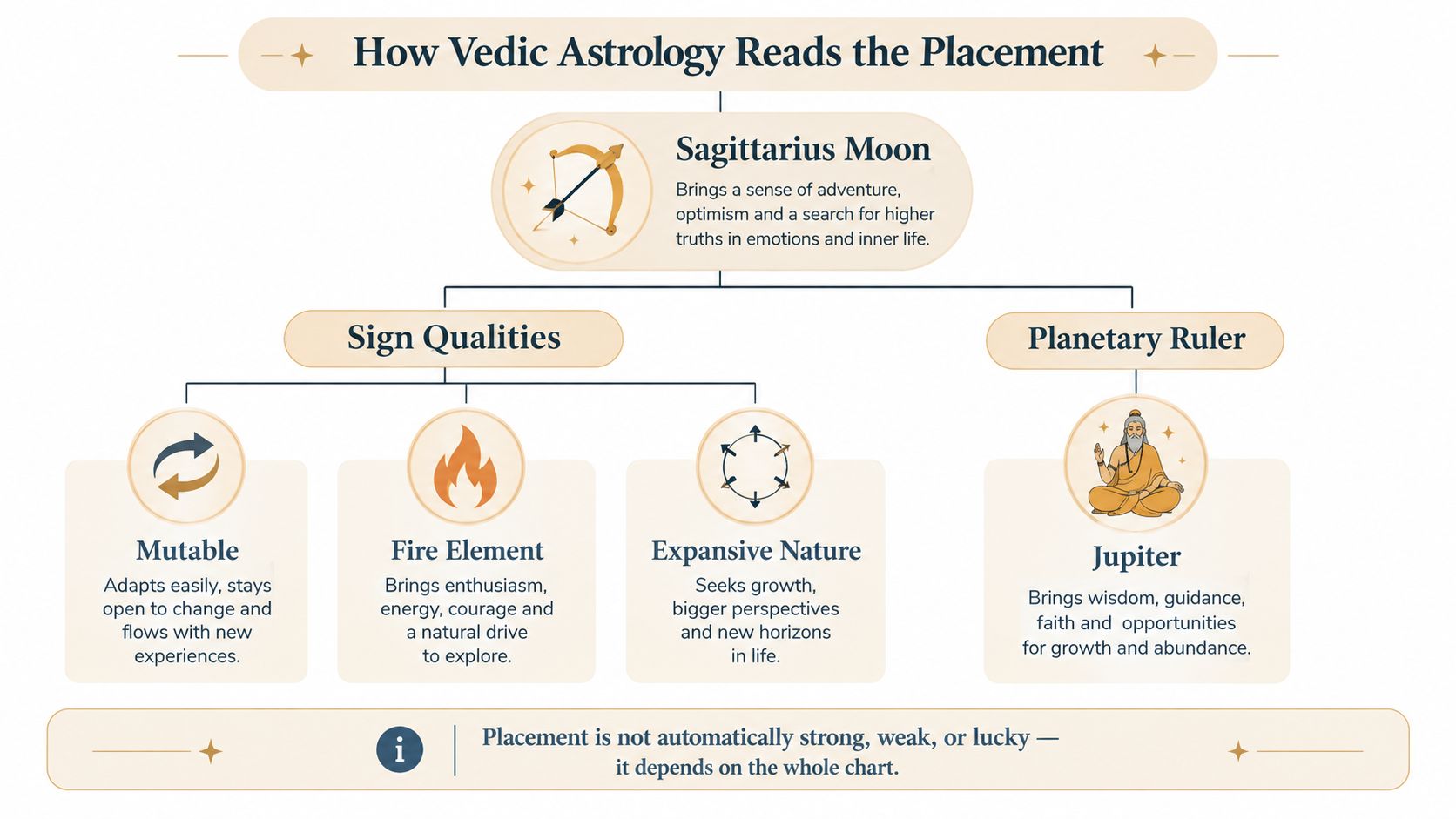
A Vedic reading begins with the placement, then examines what modifies it. Sagittarius is traditionally described as a mutable fire sign ruled by Jupiter. Mutable refers to adaptability; fire is a symbolic category associated with energy and initiative, not a physical explanation of behaviour.
The diagram separates those sign qualities from the role of the planetary ruler.
Why Jupiter and the Surrounding Chart Matter
The technical term dispositor means the planet ruling the sign occupied by another planet. Jupiter is therefore the Moon's dispositor in Sagittarius. Within Jyotisha, an astrologer examines Jupiter's condition rather than assuming that this Moon placement is automatically lucky, strong or weak.
Several chart details help distinguish otherwise similar readings:
- House placement: A house represents an area of life. The Moon's house is assessed from the ascendant, the sign rising at birth.
- Planetary relationships: Aspects are traditionally interpreted influences between planets; conjunctions concern planets placed together.
- Lunar phase: Shukla paksha means the waxing half of the lunar cycle, while Krishna paksha means the waning half.
- Jupiter's condition: Its sign dignity, meaning its traditional standing in a sign, and its chart role affect the interpretation.
A personal birth chart provides a more relevant starting point than a general personality description. Missing or uncertain birth details should be disclosed rather than treated as precise.
The accompanying video offers another format for exploring the placement.
Why the Exact Lunar Position Matters
The lunar path is traditionally divided into 27 nakshatras, each measuring 13°20′. Sagittarius includes Mula, Purva Ashadha and the first quarter of Uttara Ashadha; each nakshatra has four padas, or quarters, so the broad Moon-sign label leaves important detail unresolved, as outlined in this explanation of nakshatras and traditional timing.
For example, a birth recorded near a sign boundary deserves careful checking if the recorded time is uncertain. A difference of a few hours may change the calculated sign, rather than merely refine an interpretation.
Practical rule: Uncertain birth information calls for a qualified reading with clear limitations, not confident predictions built on an assumed time.
Accurate calculation establishes the astronomical placement. It doesn't establish that the resulting personality or life predictions are scientifically valid.
Emotional Needs and Everyday Responses
After a disappointing day, someone might prefer a conversation about future possibilities to repeated discussion of what went wrong. Another person might reach for a book, plan an outing or seek a different perspective. In a Sagittarius Moon reading, these can be explored as ways of finding emotional direction, rather than assumed behaviours.
The distinction between a refreshing change and an escape deserves attention.

Optimism With Room for Difficult Feelings
Within Jyotisha, a well-supported Jupiter is associated with constructive optimism, learning and recovery through meaning-making. A difficult Jupiter may instead be interpreted through overconfidence, dogmatism, bluntness or unrealistic expectations. These are conditional astrological associations, not proven psychological effects, as described in this Vedic interpretation of Moon in Sagittarius.
The difference can be explored through an ordinary setback. After an unsuccessful interview, constructive optimism might involve recognising disappointment, requesting feedback and preparing differently. Unrealistic certainty might involve dismissing all criticism and assuming the next opportunity requires no preparation.
Hope is most useful when it leaves room for evidence. Equally, honesty becomes more constructive when the speaker considers whether the listener needs advice, sympathy or time.
| Observable response | A useful reflection |
|---|---|
| Restlessness during a repetitive week | Whether the person needs variety, rest or a clearer purpose |
| Humour during an upsetting conversation | Whether the humour creates connection or avoids acknowledging hurt |
| Immediate advice after someone shares a problem | Whether understanding has come before solutions |
| Withdrawal after feeling restricted | Whether the need for space was communicated clearly |
Freedom That Supports Emotional Presence
Personal space doesn't have to mean distance from everyone. It might mean an independent interest, uninterrupted study time or permission to disagree respectfully. The practical test is whether the person returns more able to participate in everyday life.
For reflection, a reader might notice whether plans for travel appear mainly after conflict, whether every routine starts to feel like confinement, or whether philosophical discussion replaces naming a specific feeling. These observations are more informative than trying to match every action to an astrological description.
A Sagittarius horoscope can serve as a reflective prompt, but a general forecast can't establish the reason for a particular mood. Sleep, workload, relationships and current pressures also deserve direct attention.
A need for possibility can be respected without dismissing sadness, uncertainty or another person's concerns.
Someone who doesn't recognise these themes doesn't need to force a fit. A responsible interpretation allows room for difference.
Relationships Family and Cultural Commitments
A partner may hear a wish to study abroad as reluctance to marry. Parents may interpret a request for privacy as rejection of family involvement. Yet those meanings aren't necessarily the same as the intention behind the request.
Moon in Sagittarius doesn't automatically indicate disinterest in marriage. The more useful distinction is between independence that remains accountable and distance that leaves others uncertain. The following contrast turns that distinction into observable behaviour.
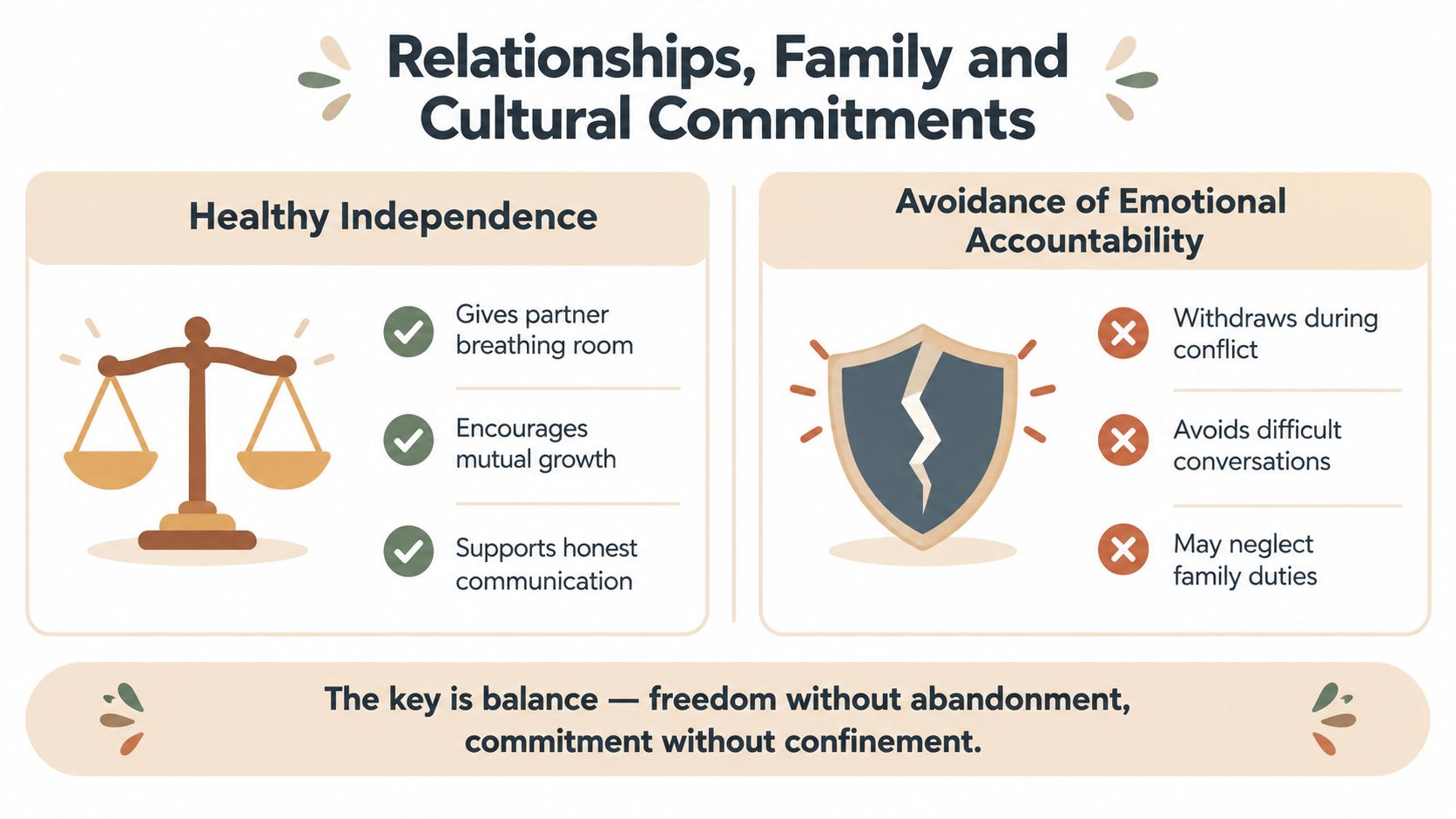
Independence and Accountability Can Coexist
Consider a hypothetical couple discussing an overseas course. Healthy independence would involve discussing the course's purpose, affordability, living arrangements and the partner's plans. Avoidance would involve announcing the move while refusing to discuss its consequences.
A similar distinction applies within a shared household. An adult can respectfully ask for private time while still contributing to caregiving and domestic work. Family closeness needn't require agreement on every choice, but an appeal to freedom doesn't remove agreed responsibilities.
- Shared beliefs: Partners can explore which religious, cultural or ethical practices matter to each person without assuming complete agreement.
- Family involvement: A couple can define which decisions welcome family advice and which require their own consent.
- Relocation: Discussions should include employment, caregiving, finances and whether both partners want the arrangement.
- Direct communication: Honesty should make expectations clearer, not justify hurtful delivery.
What Kundli Matching Adds
Kundli matching is the traditional comparison of birth charts for marriage. In Ashtakoota matching, astrologers compare eight compatibility categories for a maximum of 36 guna, or points; the Moon's nakshatra is central, but the individual charts and other marriage indicators remain relevant, according to this explanation of compatibility assessment.
A high score isn't a guarantee of marital success, and a lower score isn't automatically grounds for rejection. Traditional assessment also considers the seventh house, associated with partnership, its ruling planet, Venus, Jupiter and relevant timing factors.
Those qualifications matter particularly when an automated result becomes the centre of a family discussion. A score cannot answer whether both people feel respected, whether consent is freely given or whether their daily expectations are compatible.
A practical conversation can cover spending and saving, household work, support for parents, career breaks and acceptable boundaries with relatives. For an intercultural match, it can also address ceremonies, language, food and future children's upbringing without treating difference itself as a problem.
Commitment becomes clearer through specific agreements. A couple can decide how to preserve independent interests while remaining emotionally available, rather than asking a Moon-sign label to settle the question.
Education Career and Direction
A student may enjoy several subjects but feel pressured to choose a stream quickly. A professional may have a secure role yet feel drawn towards teaching, further study or work elsewhere. Sagittarius Moon symbolism offers a way to explore the desire for a broader perspective, not a list of destined occupations.
Within the traditional framework already described, learning, advising, philosophical interests and travel can be relevant themes. Their practical value depends on the person's abilities, circumstances and willingness to do the less exciting parts of the work. Curiosity alone doesn't establish suitability.
Different Decisions Need Different Evidence
For a student, interest should be tested through actual tasks. Someone attracted to a subject can examine its syllabus, try sample work and speak with a teacher about the demands involved. Enjoying a subject's big questions isn't always the same as enjoying its daily methods.
For a parent, the useful role is to distinguish the child's expressed interests from adult hopes. A chart discussion shouldn't become a fixed claim that a child must enter a particular profession. Schoolwork, feedback, access requirements and the child's own developing preferences deserve attention.
For a professional, dissatisfaction needs a more precise description before a job change. The difficulty might concern repetitive tasks, limited autonomy, poor management or an unwanted location. A move that changes only the scenery may leave the original problem unresolved.
| Decision check | Evidence worth gathering |
|---|---|
| What genuinely energises the person? | Tasks that sustain interest after the novelty fades |
| What does the option require? | Qualifications, daily duties, resources and family responsibilities |
| What supports the choice? | Course information, written job terms and realistic alternatives |
Exploration With Follow-Through
A hypothetical professional considering work abroad may enjoy the prospect of discovery while overlooking practical constraints. A grounded comparison would include the actual role, legal requirements, housing, support networks and the effect on dependants. Astrological reassurance can't replace those checks.
Likewise, someone who starts many courses can examine what happens when progress becomes repetitive. The answer needn't be another new subject; it may be a more manageable study plan or clearer expectations.
Feedback deserves care, too. A person who values directness can explain concerns specifically without labelling colleagues or dismissing their methods. A meaningful direction still includes practice, patience and ordinary responsibilities.
The placement is most useful here as permission to ask better questions about purpose. It shouldn't narrow education or career choices before the person has had a fair chance to explore them.
Reading Emotional Timing with Dasha and Transits
A person may recognise a recurring concern yet still wonder when to act. Vedic astrologers address timing through several methods, including dasha, meaning a planetary period, and transits, the planets' current movements considered in relation to a birth chart. These are traditional interpretive methods, not established guarantees about future events.
Vimshottari dasha uses a 120-year sequence across nine grahas, or planetary influences. The Moon's exact nakshatra determines the starting ruler and how much of the first mahadasha, or major period, had elapsed at birth, as described in this account of the Vimshottari system.
Why a Shared Moon Sign Doesn't Mean Shared Timing
A Moon in Mula begins under Ketu's rulership, one in Purva Ashadha under Venus, and one in Uttara Ashadha under the Sun. The starting point therefore differs even within Sagittarius. The amount remaining in the opening period also depends on the Moon's precise position.
Astrologers then examine antardashas, the shorter sub-periods within a major period. They interpret these alongside the houses involved, planetary strength and other chart relationships. A planetary period isn't read responsibly as an isolated promise of marriage, promotion or relocation.
| Timing method | Traditional purpose | Important limitation |
|---|---|---|
| Dasha | Organising broader life periods and sub-periods | The period's ruler must be assessed within the individual chart |
| Transits | Comparing current planetary movements with natal placements | A general movement doesn't describe everyone's circumstances |
| Muhurta | Selecting a suitable moment for an action | The Moon sign alone cannot establish suitability |
A planetary transit overview can provide context for a timing discussion. For a specific decision, the useful questions concern which chart factors are being considered, what uncertainty remains and what practical action is reasonable.
Muhurta and Real-World Readiness
Muhurta means selecting an auspicious time for an important action, such as a wedding, housewarming or business registration. Traditional assessment considers the panchanga, a five-part calendar framework involving tithi, or lunar day; nakshatra; yoga; karana; and the day's calendrical context, alongside the ascendant at the proposed moment. Exact time and location matter, as explained in this muhurta selection methodology.
A family planning a wedding can ask why a particular window was selected and whether workable alternatives exist. Venue availability, travel, health, legal requirements and the couple's consent should remain part of that conversation. An auspicious label shouldn't make an impractical arrangement compulsory.
Timing boundary: A supportive astrological interpretation isn't evidence that a risky choice has become safe.
For education, employment or relationships, readiness needs its own assessment. A student still needs the required admission information; an employee still needs written terms; a couple still needs agreement about the commitment. Timing can be considered without surrendering responsibility for the choice.
Practical Guidance for Clearer Decisions
Repeated horoscope checking deserves attention when it stops producing a useful question and becomes a search for certainty. Someone might consult another forecast whenever an answer feels uncomfortable, even though no new information has emerged. That pattern can be examined without dismissing the person's spiritual beliefs.
A report covering more than 10,000 Indian respondents aged 18–35 said 58% used astrology to manage anxiety, while 36% of millennials experienced unnecessary anxiety from over-reliance on horoscopes. These findings aren't specific to Sagittarius Moon and don't establish that the placement causes anxiety, as the report on young Indians' astrology use makes relevant to the wider discussion.
A Calm Decision Record
A short written record can keep reflection connected to action:
- Observable pattern: Describe the actual difficulty, such as postponing a family conversation, rather than assuming a planetary cause.
- Relevant context: Note the chart question and any uncertainty in the birth details.
- Balanced choice: Identify an action that respects both independence and existing responsibilities.
- Missing information: Separate what an astrologer can interpret from what requires documents, conversation or professional advice.
Parents can use this approach before choosing an education stream. Couples can use it before making relocation plans, while professionals can apply it to an offer that feels exciting but remains unclear.
Reflection should leave a person better able to act, not dependent on another prediction before every ordinary decision.
A planned pause from repeated checking may help establish whether a consultation produced a usable next step. Persistent distress deserves support from a qualified mental-health professional; medical, financial and legal concerns likewise require appropriately qualified advisers.
Moon in Sagittarius is best understood as a language for exploring emotional needs, not a verdict. Its most constructive use leaves room for curiosity, honest relationships and decisions supported by present-day evidence.
For readers seeking an individual interpretation, Kismo offers chat or call consultations with verified astrologers for birth chart readings, marriage compatibility, career questions and muhurta guidance. Readers can visit with their birth details and a specific question about freedom, commitment or direction, and ask how the complete chart informs the interpretation.