Online Astrologer Chat: How to Find and Use It
A person may be staring at a phone with one question that keeps returning: Is this relationship moving towards marriage, or is it time to step back? Someone else may be comparing a job offer in another city with the security of a current role. In both situations, an online astrologer chat can feel easier than arranging an in-person appointment, especially when the question is private or time-sensitive.
A useful session isn't a guaranteed prediction. It is a structured conversation based on the person's birth chart, the question being asked, and the practical choices available. The quality of the experience depends greatly on preparation, the astrologer's method, and the platform's approach to privacy, language, and clear communication.
Table of Contents
- Why Online Astrologer Chat Changes the Experience
- Preparing Your Birth Details and Questions
- Choosing the Right Astrologer for Your Needs
- What Happens During a Live Chat Session
- Navigating Privacy, Pricing, and Language Options
Why Online Astrologer Chat Changes the Experience
A relationship question can be difficult to ask aloud. A person may want to understand a partner's intentions, a family objection, or the timing of a proposed marriage, yet feel uncomfortable discussing those details in a crowded office. A career decision can create the same tension. Someone considering a move abroad may need a calm conversation before accepting an offer, not a general horoscope that says change is coming.
Online astrologer chat creates a private, conversational setting for that first step. The user can explain the concern in their own words, answer follow-up questions, and return to written guidance after the session. That format can make the discussion feel less formal and more manageable than a single report or a brief face-to-face appointment.
India has the digital reach to support specialised, chat-based advisory services. The IAMAI and Kantar Internet in India Report 2024 recorded 886 million active internet users in India during 2024, with 488 million rural users, approximately 55% of the total, and about 397 million urban users. The report also recorded average internet use of about 90 minutes per day. These figures suggest that mobile services can reach beyond major cities, including users who prefer local language and culturally familiar explanations.
From a broad concern to a useful conversation
A good chat changes the question from “What will happen?” to something more specific:
- Relationship: What factors should be discussed before a marriage decision?
- Career: What should be considered before accepting a role abroad?
- Family: Which part of a recurring household tension needs attention?
- Timing: Which practical dates are worth reviewing for a planned beginning?
The user can ask for clarification immediately instead of waiting for a written report. That matters when an astrologer mentions a house, transit, or planetary period that isn't familiar. A careful practitioner should explain the term, connect it to the individual chart, and separate traditional interpretation from practical advice.
A platform comparison such as astrology apps available in India can help a first-time user examine availability, communication format, language support, and astrologer information before starting. The important choice isn't only the fastest reply. It is whether the session gives enough room for the actual concern to be understood.
Preparing Your Birth Details and Questions
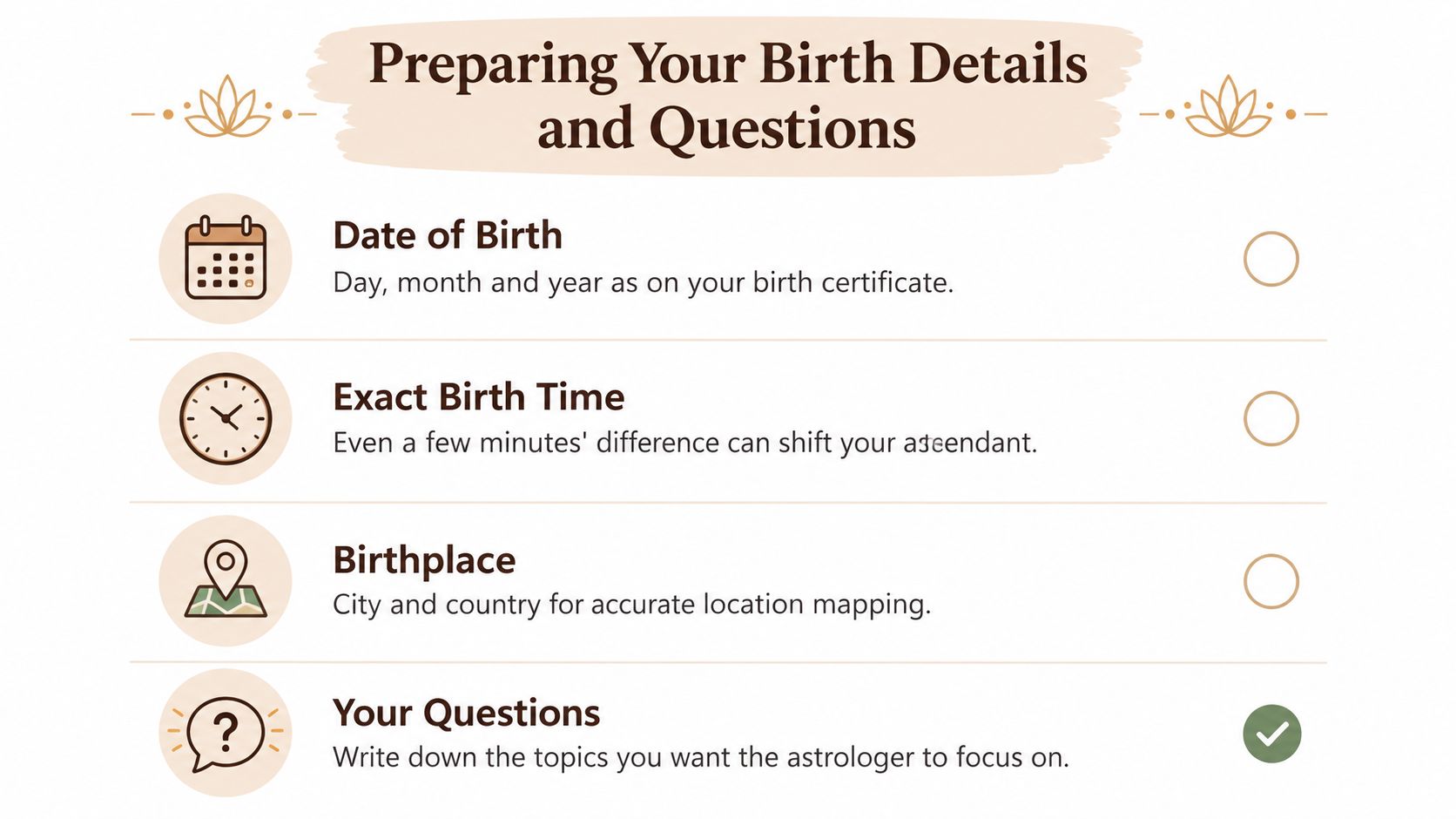
A productive consultation starts before the chat opens. The astrologer needs three core birth inputs: date of birth, exact birth time, and birthplace. These details help create the individual chart used for interpretation, rather than relying only on a general zodiac sign.
Check the birth information
The date should include the correct day, month, and year. The time should include whether it was morning or evening, and the birthplace should identify the city and country. If the time is uncertain, the user should check a birth certificate, hospital record, or family document rather than guessing.
A small difference in recorded birth time can affect the ascendant, also called the rising sign. That may change the chart framework used to discuss houses and life themes. An honest astrologer should acknowledge uncertainty when the time isn't reliable, rather than presenting a precise conclusion as though the input were confirmed.
The kundli preparation guide can help users understand why these details matter before sharing them in a consultation. A kundli is a birth chart used in traditional Indian astrology. It isn't the same as a short daily horoscope, because it is built from the person's birth information.
Turn the concern into a focused question
The question should describe a decision, topic, or time period. “What will happen in life?” is too wide for a useful live session. “Is this a supportive period to change jobs?” gives the astrologer a clear subject and allows the user to discuss timing, risks, and practical conditions.
The user should also write down:
- The decision deadline: Note when an offer expires, a family discussion is planned, or a date must be selected.
- The relevant context: Explain whether a relationship is new, ongoing, paused, or being considered for marriage.
- The desired output: Ask for themes, possible windows, and practical safeguards rather than a simple yes or no.
- The follow-up points: Keep a short list of unfamiliar terms or chart factors to clarify during the session.
The following video can help a new user understand how an online consultation may work before booking.
A prepared question doesn't force a particular answer. It gives the astrologer enough context to explain the reading clearly and helps the user notice whether the response directly addresses the concern.
Choosing the Right Astrologer for Your Needs
The right astrologer depends on the question, not only on general popularity. A practitioner who focuses on detailed Vedic chart interpretation may suit a career or marriage question, while another practitioner may specialise in Tarot, Numerology, Vastu, Palmistry, or life coaching. Those approaches can serve different purposes and shouldn't be treated as interchangeable.
A user browsing verified astrologers should read each profile for qualifications, methods, language ability, and the topics the practitioner regularly handles. A clear profile helps the user compare expertise before sharing sensitive information.
Match the method to the decision
| Question | Relevant focus | What a useful session should clarify |
|---|---|---|
| Marriage or a family-proposed match | Kundli matching and relationship interpretation | Compatibility factors, areas needing discussion, and practical considerations |
| Job change or relocation | Birth chart, dasha, and transits | Themes around timing, preparation, and alternative scenarios |
| Wedding or housewarming date | Muhurta and local panchanga factors | Why a proposed time is being considered and what limitations apply |
| Broad recurring patterns | Full chart reading | Relevant houses, planetary periods, and realistic actions |
Kundli matching means comparing two birth charts for marriage compatibility. In traditional Vedic astrology, the comparison is often organised through Ashtakoota, eight compatibility categories with a maximum of 36 guna points. A score of 18 or more is often used as a basic compatibility threshold, but this explanation of kundli matching makes clear that the score shouldn't replace detailed chart interpretation. The seventh house, Venus, Jupiter, and possible Nadi or Bhakoot concerns may also be considered.
The same source notes that there is no scientific evidence that kundli scores predict marital success. A responsible consultation should therefore treat the result as one cultural or reflective input alongside consent, communication, values, and practical compatibility. No score can replace a couple's conversations about finances, family expectations, living arrangements, or personal boundaries.
Ask how the astrologer reaches a conclusion
For career and timing questions, the astrologer may discuss dasha, a planetary period in Vedic astrology. The Vimshottari Dasha system divides life into major periods called Mahadashas and shorter Antardashas. The description of Laghu Parashari and Vimshottari Dasha describes this framework as a way to examine how planetary themes unfold across different life phases.
The user should ask which chart factors support the recommendation. A strong explanation connects advice to a house, dasha, transit, or compatibility factor and labels uncertainty clearly. A warning sign is an unsupported, frightening statement that pressures the user to buy a remedy, continue a session, or make a major decision immediately.
What Happens During a Live Chat Session
A live session works best as a conversation with a clear sequence. The astrologer should first confirm the birth date, time, and place, then restate the user's question in neutral language. This simple step prevents a sensitive concern from being misunderstood or turned into a more dramatic claim than the user made.
The user can then describe the context briefly. For example, someone asking about marriage might explain that both families are considering a match and that the concern is compatibility, not a prediction about a stranger. Someone asking about a job may mention the role, location, deadline, and reason for considering a change.
Watch how the chart is explained
The astrologer may refer to technical terms, but those terms should be connected to the user's question.
- Dasha: A planetary period used for timing themes and phases of life. It can be discussed as an indication of opportunities or pressures, not proof that an event must occur.
- Nakshatra: One of the 27 lunar mansions used in Jyotisha. The Moon's position at birth falls within one of these sections, giving the reading a more specific reference than a broad Moon-sign description. The overview of nakshatra interpretation links each nakshatra's planetary ruler with dasha-based analysis.
- Muhurta: An astrologically selected time for beginning an activity, such as a wedding, housewarming, registration, or business launch. Traditional muhurta considers panchanga elements including tithi, weekday, nakshatra, yoga, karana, and the ascendant.
A user shouldn't hesitate to ask, “Which part of the chart supports that?” or “What would change if the birth time is uncertain?” Plain explanations matter more than a long list of Sanskrit terms.
Expect options, not a fixed verdict
A responsible session should finish with two or three actionable scenarios. A career reading might compare staying in the current role, accepting the offer after additional preparation, or delaying a move until practical conditions improve. A marriage discussion might identify compatibility strengths, topics requiring open conversation, and questions that both families should answer before proceeding.
Practical rule: A chart-based recommendation should be traceable to a clearly discussed factor, while uncertainty and real-world safeguards remain visible.
The user can save the session summary and check whether it includes the original question, verified inputs, method used, evidence interpreted, time window, limitations, and practical safeguards. Astrology shouldn't substitute for medical, legal, or financial professionals. It can offer a traditional framework for reflection, but consequential decisions still require appropriate expert advice and informed consent.
Navigating Privacy, Pricing, and Language Options
A platform becomes more useful when three conditions work together: the user feels safe sharing information, understands the cost before starting, and can communicate naturally. A technically polished chat isn't enough if the user can't explain family expectations, marriage customs, or emotional concerns in comfortable language.
Privacy starts with data minimisation. A consultation generally needs birth details and the context of the question, not account passwords, financial credentials, medical records, or access to private devices. Users should look for explicit consent before birth details are stored and should avoid off-platform payments or transfers requested by an individual astrologer.
The small India-focused research available on astrology apps shows why trust deserves attention. In a 57-person study, 24 participants didn't believe app content was real, 24 were unsure, and 9 considered it real; the study also identified substantial privacy uncertainty. Because the sample was purposive and non-probability based, it can't support a national accuracy rate. The study of astrology-app users is more useful as a reminder to examine consent, privacy, evidence, and communication before relying on a reading.
Use a simple platform checklist
| Question | What to look for |
|---|---|
| Can users see the price first? | A clearly displayed session fee and no surprise upselling |
| Is the payment process centralised? | Secure payment and support handled by the platform |
| Does the service protect personal details? | Limited data collection, storage information, and no requests for passwords |
| Can users speak naturally? | Native-language fluency, not just translated scripts |
| Is the session reviewable? | A written summary containing the method, time window, caveats, and recommendations |
Language support means more than translating English words. In the India Digital Summit material on Indic-language adoption, the IAMAI and Kantar report is cited as finding that 98% of users accessed Indic-language content, while 57% of urban users preferred regional-language content. The same source records 886 million active internet users in 2024 and a rural share of approximately 55%.
A user may switch between English and an Indian language during the same conversation, use family-specific terms, or need a respectful explanation of hierarchy and custom. A good platform should make that possible and provide a recap that remains understandable if another family member reads it later. This is also relevant to overseas Indians who want guidance in an Indian language while living abroad.
A safe consultation never uses fear to sell a remedy, force a payment, or make the user surrender control of a personal decision.
Kismo offers private chat or call sessions with verified astrologers for birth chart readings, kundli matching, career questions, and muhurta guidance. The platform also presents language and session information so users can compare an astrologer's focus with the question they need to discuss.
A first-time user can prepare the birth date, exact time, birthplace, decision context, and two or three focused questions before opening a session. Visit Kismo to explore chat or call-based astrology guidance and choose a consultation that matches the topic, language, and level of explanation required.