Online Kundali Matching Explained Simply and Accurately
A family receives a marriage proposal. The details look promising, but one question comes quickly: should the two kundalis be matched before the families move forward? An online report can provide an answer in minutes, yet a trustworthy decision needs more than a green result or a high number.
Online kundali matching compares the birth charts of two people through Vedic astrology. It can help families review emotional patterns, compatibility factors, doshas, and timing before engagement or marriage discussions become formal. The process is now common across India and among overseas Indians because birth details and reports can be shared easily across cities and countries.
The Indian astrology app market already has strong commercial scale. One market estimate values the Indian astrology app market at USD 0.27 billion in 2025, with a projection of USD 2.32 billion by 2032, while another estimate places the market at about USD 163 million in 2024 and projects USD 1,797 million by 2030, at a projected CAGR of 49.19%. These figures come from separate market estimates in the India astrology app market report, so they should be read as different estimates rather than combined totals.
This guide keeps the subject simple. It explains what a kundli shows, how the 36-guna system works, why birth-time accuracy matters, and what families should ask after receiving a report. Vedic astrology can offer a traditional framework for reflection, but it shouldn't create panic or replace honest conversations between the two people.
Table of Contents
- Introduction to Online Kundali Matching Today
- What Kundali Matching Means in Vedic Astrology
- Automated Calculators Versus Detailed Chart Matching
- Inside a Detailed Match Guna Milan Doshas and Strengths
- Getting Accurate Results With Correct Birth Details
- How to Read Your Online Matching Report With Confidence
- Choosing Trusted Online Kundali Matching and Next Steps
Introduction to Online Kundali Matching Today
A family may begin with a photograph, a short biography, and a phone call between relatives. Soon, someone asks for the birth date, birth time, and birthplace of both people. The details are entered into an online kundali matching tool, and a report appears with a guna score, dosha notes, and a short compatibility summary.
That speed is useful. Families can perform an initial check before arranging more conversations, and couples living in different cities or countries can share the same report. Online matching has become part of a wider digital astrology habit in India. A 2024 academic analysis recorded large install bases for apps such as AstroTalk, AstroGuru, AstroYogi, Guruji, Astrolive, and dedicated kundli tools, including a Kundli app with 10 lakh-plus downloads. The analysis is available in this academic study of Indian astrology apps.
Why families use a digital first check
Marriage in India often involves two people and two families. Relatives may want a traditional compatibility check, while the couple may want a private and practical discussion about values, work, location, finances, and communication. Online kundali matching gives both sides a common document to discuss.
Industry reporting has also described strong mobile preference. One 2025 report stated that astrology app usage in India grew 35% from 2024 to 2025, and that 70% of users preferred apps for quick daily horoscopes and personalised guidance. Those figures appear in the reported astrology app usage overview, alongside the broader academic discussion of app adoption.
Practical rule: Treat an online score as a starting point for questions, not as a final command about marriage.
What this guide helps readers do
A useful report should help a family:
- Confirm the inputs: Check that both birth records are complete and entered correctly.
- Understand the score: Read the eight kootas instead of looking only at the total.
- Notice important flags: Ask how Nadi, Bhakoot, or Manglik indications affect the individual charts.
- Review timing: Discuss dasha periods and the muhurta, meaning an auspicious time chosen for an important event.
- Plan the next conversation: Compare astrological guidance with the couple's real relationship, expectations, and family circumstances.
A high score can still need interpretation. A modest score isn't automatically a rejection. The quality of the birth data and the depth of the chart reading matter just as much as the calculator's result.
What Kundali Matching Means in Vedic Astrology
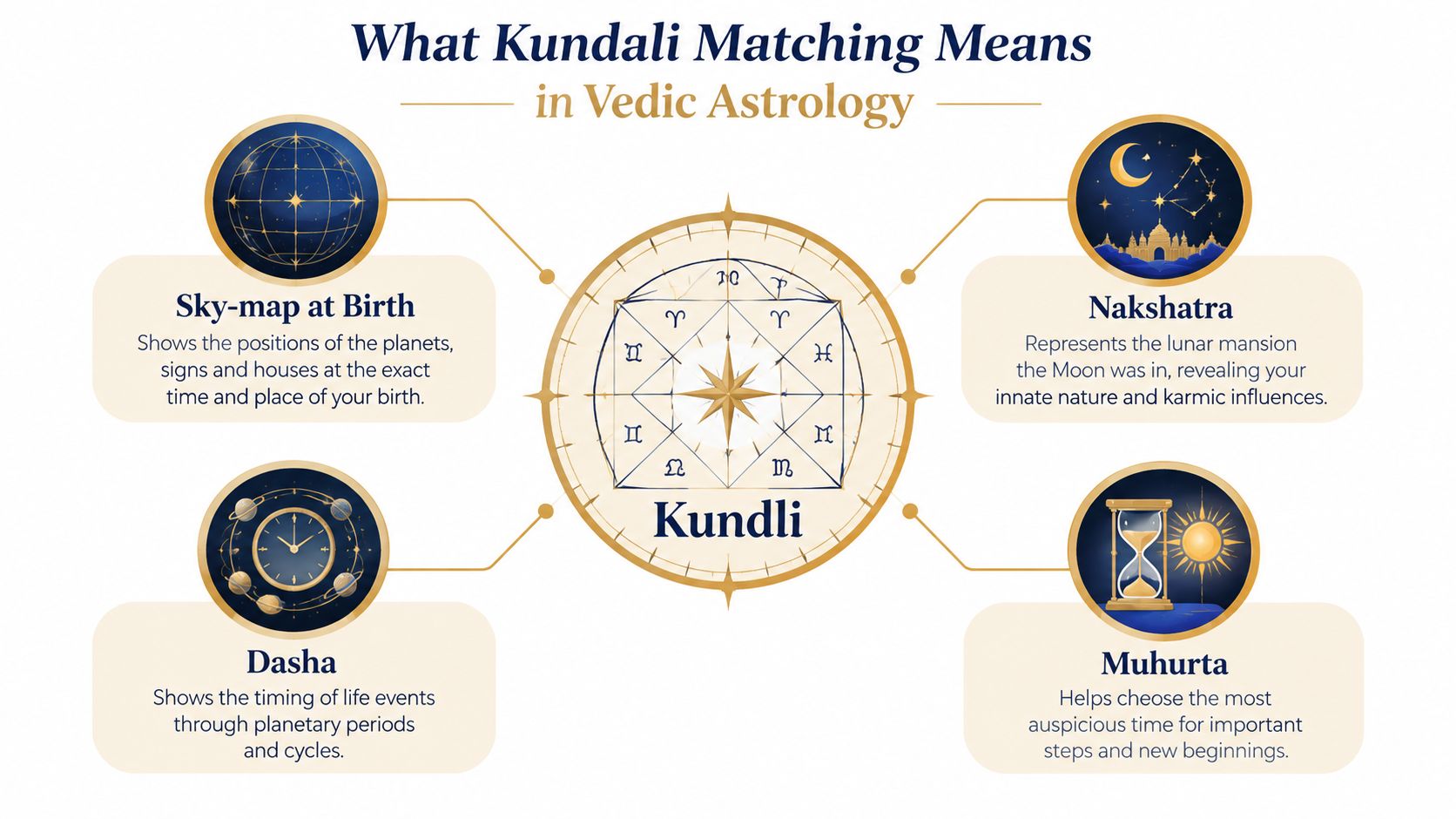
A kundli, also called a kundali, is a birth chart. In simple terms, it is a map of planetary positions for the date, time, and place of birth. A Vedic astrologer reads that map to study areas such as personality, emotional responses, relationships, work, family life, and major life periods.
For marriage matching, two charts are compared. The purpose is not to find two identical personalities. It is closer to checking whether two musical instruments can play together. One instrument may be soft and reflective, while the other may be direct and energetic. Harmony depends on how their tones work together, where tension appears, and whether the musicians can adjust.
Four terms that make reports easier to understand
- Nakshatra: A nakshatra is a lunar mansion used in Vedic astrology. The Moon's position in a nakshatra helps determine several matching factors, including Tara, Yoni, Gana, and Nadi.
- Dasha: A dasha is a planetary period, or a life phase ruled by a planet. The commonly used Vimshottari Dasha system places planetary periods in sequence across a 120-year cycle, with each of the nine grahas assigned a fixed duration, as explained in this Vimshottari Dasha glossary.
- Muhurta: Muhurta means an auspicious time selected for an important action, such as a wedding, housewarming, or registration.
- Graha: Graha is commonly translated as a planet in the language of Vedic astrology. The term may include the traditional nine planetary influences used in a chart.
Why Moon factors receive attention
Many online reports focus on the Moon sign and nakshatra because they relate to emotional habits, mental comfort, and instinctive responses. The chart also contains houses, which represent different life areas, and planetary relationships that add context.
Sun-sign matching alone gives a very small picture. Vedic matching usually looks at the Moon sign, nakshatra, houses, planetary strength, and timing patterns together. This wider view helps an astrologer ask more useful questions. For example, two people may have a comfortable emotional connection but face different pressures during the same period, or they may have a reasonable guna score with a chart pattern that needs closer discussion.
The system isn't meant to prove that a marriage will succeed or fail. It offers a traditional way to identify areas of ease and areas where patience, communication, or additional guidance may be valuable.
Automated Calculators Versus Detailed Chart Matching
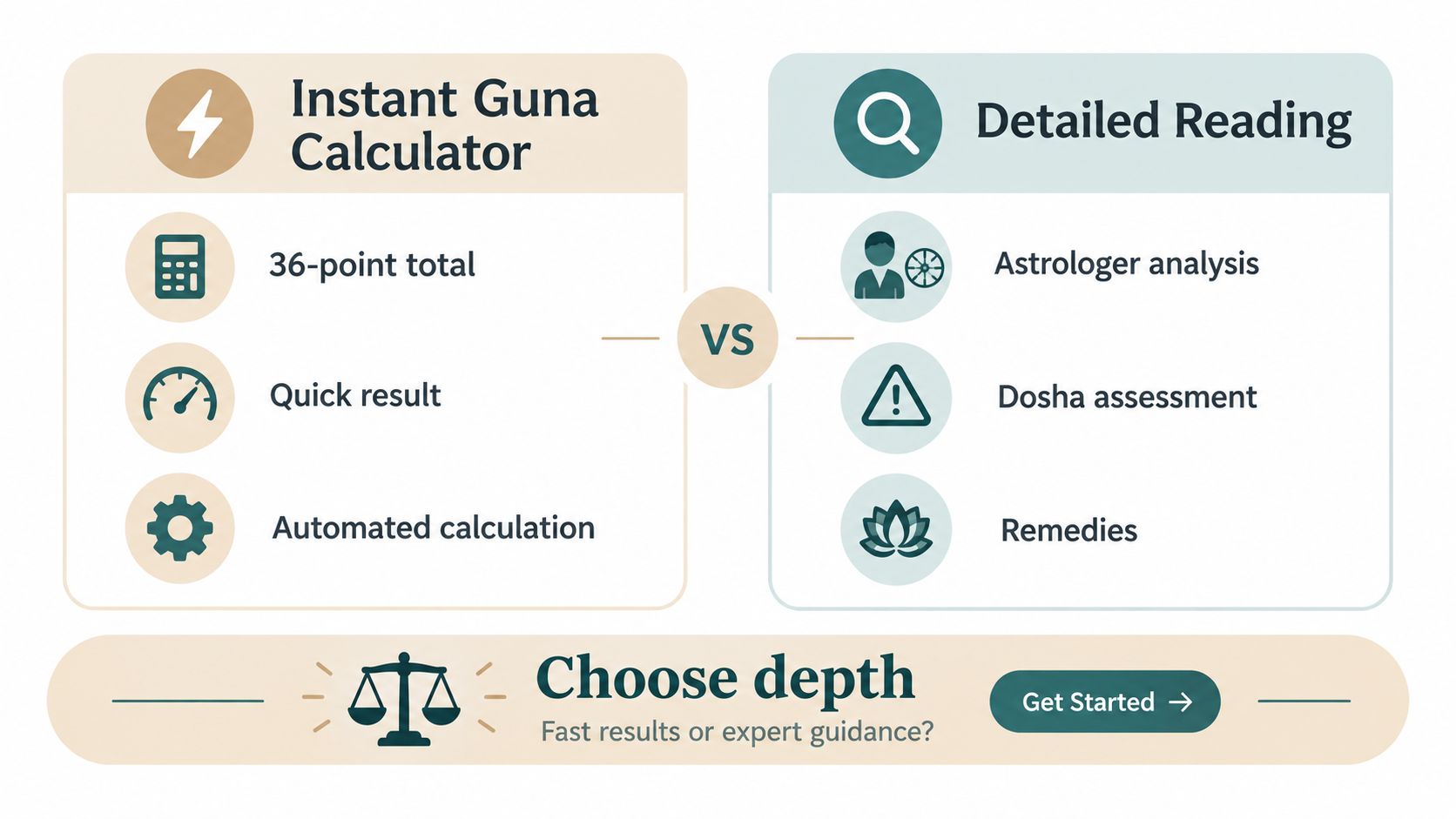
An instant guna calculator and a detailed chart reading serve different purposes. A calculator is designed for speed. A detailed reading is designed for interpretation.
An instant tool generally takes the birth details of both people and produces an Ashtakoota or Guna Milan total out of 36 points. It may also display individual koota scores and basic dosha indicators. This makes it useful when a family is reviewing several proposals or wants to check whether a report is complete.
A detailed chart comparison goes further. It considers both full charts, houses, planetary relationships, strengths, and relevant timing periods. An astrologer can also examine whether an apparent dosha is reduced, cancelled, or supported by other chart factors. Those details often cannot be expressed properly through one number.
A practical comparison
| Need | Instant calculator | Detailed chart matching |
|---|---|---|
| First screening | Useful for a quick overview | Provides a fuller review |
| Guna total | Produces the 36-point score | Explains what each score means |
| Doshas | May flag a concern | Examines severity and wider chart context |
| Timing | Usually limited | Can review dasha patterns and wedding timing |
| Personal questions | Cannot respond to family context | Allows questions about the couple's situation |
| Unclear birth data | May calculate from an assumption | Can discuss uncertainty and possible methods |
A calculator can also help users prepare for a conversation. Families can note the total, the lowest kootas, and any dosha alerts before speaking with an astrologer. The free astrology tools page is one example of a place where users can begin with online tools.
A detailed reading becomes more important when birth times are uncertain, when the score appears moderate but the family is worried, or when the couple wants advice about timing and next steps. It also helps when the report uses technical terms without explaining their practical meaning.
The following video provides another introduction to the subject:
The sensible choice isn't always “free” versus “paid”. It is screening versus interpretation. A quick tool can organise information. A qualified astrologer can help a family understand what deserves attention and what doesn't.
Inside a Detailed Match Guna Milan Doshas and Strengths
Guna Milan, also called Ashtakoota Milan, is the traditional eight-factor matching method. The eight kootas together carry 36 points. The commonly used practical threshold is 18 out of 36, while 25 to 32 is often read as strong compatibility and 33 to 36 as excellent compatibility, according to this Ashtakoota compatibility reference.
The total matters, but the distribution matters too. A report with a good total may still contain a significant Nadi or Bhakoot concern. A lower total may need context rather than an immediate conclusion.
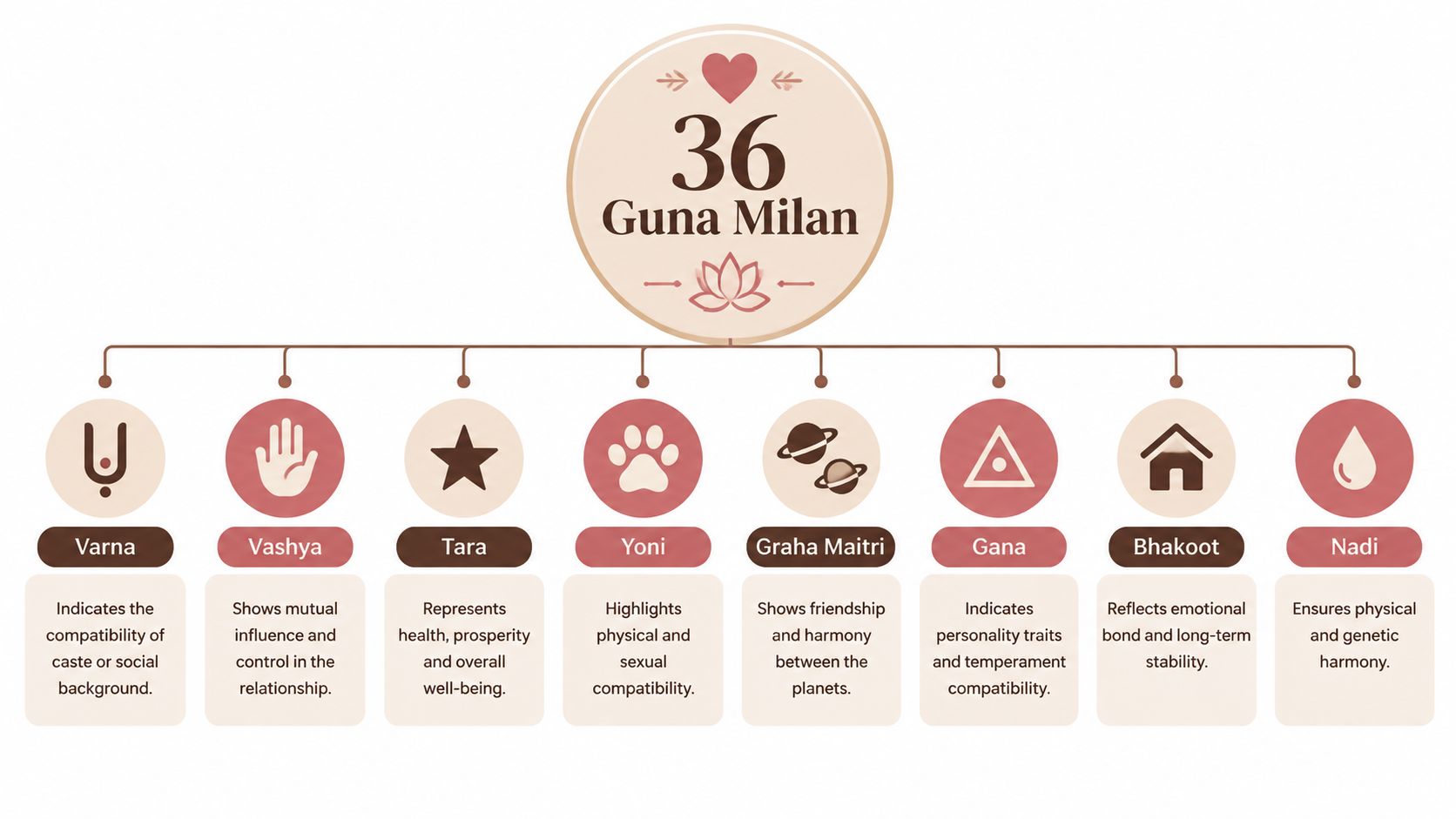
The eight kootas at a glance
| Koota | Points | What It Shows |
|---|---|---|
| Varna | 1 | Broad values, outlook, and spiritual orientation |
| Vashya | 2 | Mutual influence and relationship dynamics |
| Tara | 3 | Support, wellbeing, and birth-star relationship |
| Yoni | 4 | Physical nature and intimate compatibility |
| Graha Maitri | 5 | Mental connection and planetary friendship |
| Gana | 6 | Temperament, habits, and behavioural nature |
| Bhakoot | 7 | Emotional flow, family life, and shared direction |
| Nadi | 8 | Vital patterns and traditional health-related compatibility |
The kootas describe different layers. Varna carries the smallest weight, while Nadi carries the highest. That weighting explains why a report cannot be understood by reading only the final total.
Why doshas can change the discussion
A dosha is an astrological imbalance or challenging indication identified in a chart. Nadi and Bhakoot doshas are often discussed because they can affect the interpretation of an otherwise acceptable total. The report should explain whether the indication is present in full, whether there are cancellation factors, and how the wider charts support or challenge it.
Manglik dosha, also called Mangal dosha, relates to the placement and influence of Mars. A basic calculator may mark one or both charts as Manglik. A detailed review considers the house involved, Mars's strength, other planetary relationships, and possible balancing factors. The label alone shouldn't be treated as a prediction of conflict or failure.
What sits outside the score
A thorough match can include houses connected with marriage, family, communication, finances, and shared responsibilities. It may also compare planetary strength and recurring patterns in both charts.
Timing adds another layer. Dasha periods can show when relationship responsibilities, career pressure, relocation, or family decisions become more active. That doesn't guarantee an event. It helps the couple discuss whether the proposed timing feels supportive and what practical preparation may be needed.
Read the report in layers: total score first, individual kootas next, dosha context after that, and full-chart timing before a major decision.
Families can therefore ask three direct questions: Which factors support the match? Which factors need attention? What should the couple or family verify before fixing the engagement or wedding?
Getting Accurate Results With Correct Birth Details
A matching report can only be as reliable as the information entered into it. Most systems require the date, exact time, and birthplace for both partners. These details allow the software or astrologer to calculate planetary positions, houses, Moon sign, nakshatra, and other chart factors.
Some Vedic astrology platforms use astronomical ephemeris data and Lahiri ayanamsha, a standard sidereal reference used in India. One platform describes positional precision of around ±0.01° in its calculations, as stated on this Vedic matching platform. That technical precision doesn't correct an incorrect family record, however. Precise calculation still needs accurate input.
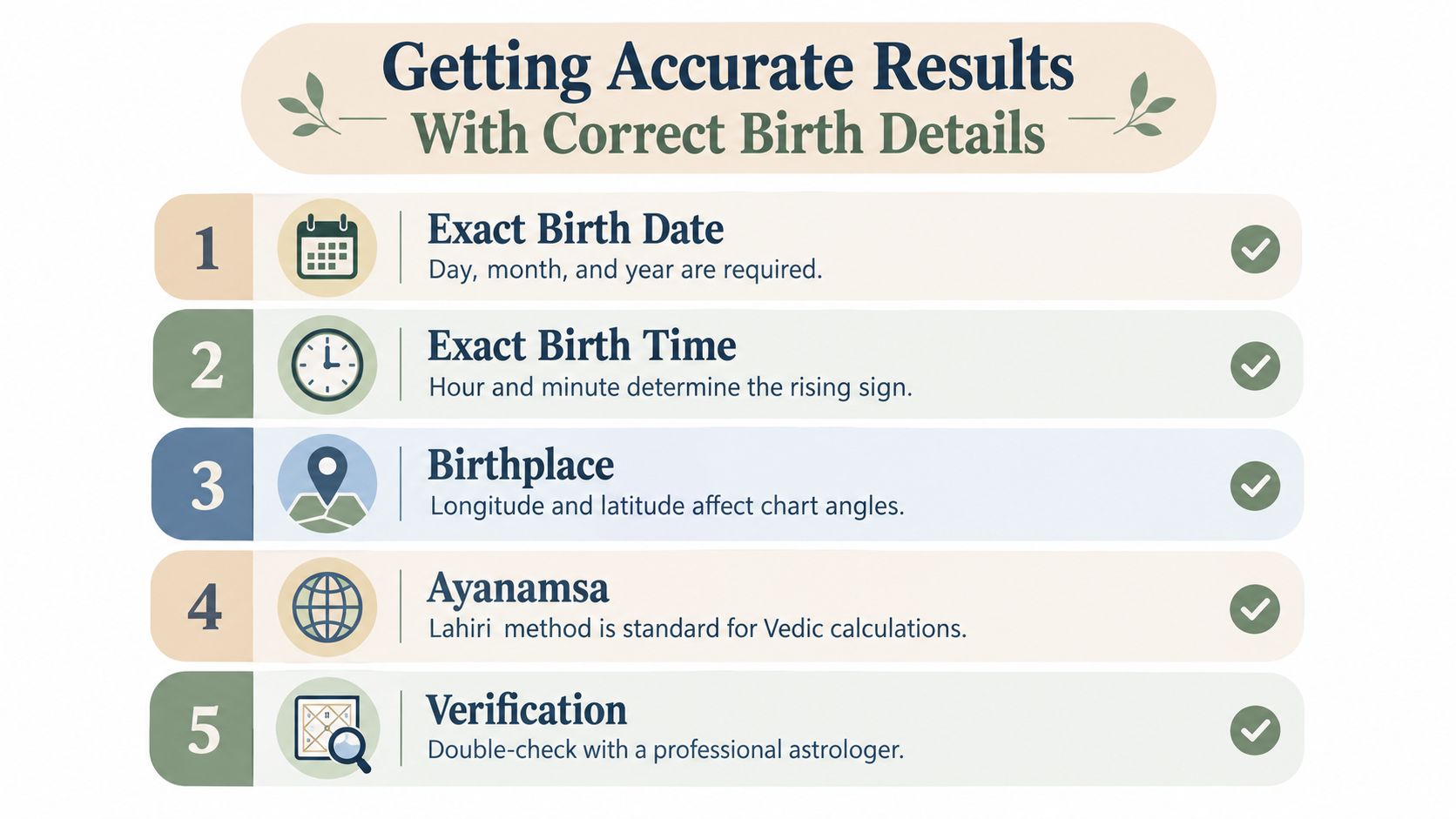
What to verify before submitting
- Birth date: Confirm the day, month, and year from an official record where possible.
- Birth time: Check the hour and minute, including whether the record uses a local clock time.
- Birthplace: Use the actual town or city of birth, not the family's current address.
- Time zone: For an NRI match, confirm the historical time zone and daylight-saving setting that applied at birth.
- Spelling and selection: Make sure the tool has selected the correct location when several places share a name.
A small time difference can change the ascendant and, in some circumstances, shift the Moon sign, nakshatra, or pada. Those changes can alter koota results and the final interpretation. A detailed marriage matching report also highlights the importance of complete birth information and the challenge of matching when records are incomplete.
When the time is unknown
Guessing is rarely the best response. If the birth time is missing, the family can collect hospital documents, ask older relatives for the original record, and tell the astrologer clearly whether the available time is exact, rounded, or approximate.
An astrologer may discuss chart rectification, which is an attempt to test possible birth times against known life events. It should be presented as an assessment with uncertainty, not as a way to manufacture a convenient result.
If two records conflict, keep both records visible. A responsible reading can compare the possible outcomes instead of hiding the uncertainty behind one precise-looking score.
How to Read Your Online Matching Report With Confidence
The report should lead to a calm conversation, not an instant emotional reaction. A family can begin by recording the overall score and the individual koota results, then separate ordinary differences from findings that need a deeper chart review.
The first question is not “Is the score high enough?” It is “Which parts of the report are creating the result?” A lower Yoni score, for example, needs a different conversation from a Nadi or Bhakoot flag. The report should explain the concern in plain language and show whether cancellation or balancing factors are present.
A decision-ready reading method
- Check confidence in the inputs. If either birth time is uncertain, the family should treat the report as provisional.
- Read the koota breakdown. Notice both strong areas and weak areas. A total hides the pattern.
- Ask about dosha severity. A label is not a complete interpretation. The astrologer should explain the planetary placement and relevant exceptions.
- Review timing. Dasha periods and transits may affect the practical experience of marriage, work, relocation, or family duties.
- Compare lived compatibility. The couple's communication, values, expectations, and emotional maturity remain important decision factors.
A mediocre guna score doesn't automatically cancel a respectful and stable relationship. A strong score doesn't remove the need to discuss children, work, location, money, religion, household roles, and care for parents. Astrology can identify themes, but the couple still needs to make clear agreements.
Questions to ask before fixing a date
A useful consultation can focus on two or three priorities rather than asking for a dramatic prediction. The couple may ask whether the dosha is severe, whether the current dasha periods create pressure, and which muhurta windows are suitable if the families decide to proceed.
The online kundli matching service can be used as an initial comparison point, but personalised guidance still depends on both individual birth charts and the quality of the information supplied. Families should ask for reasoning, not only a result.
A report becomes useful when it changes the next conversation. If it doesn't clarify what the couple should discuss or verify, the reading is incomplete.
Choosing Trusted Online Kundali Matching and Next Steps
A trustworthy online service should make the process understandable. It should show how the score was calculated, identify all eight kootas, explain dosha findings without frightening language, and state when the birth data is uncertain.
Families should also check the human support behind the tool. A verified astrologer should be able to explain the report, answer questions in clear language, and distinguish traditional interpretation from certainty. Transparent flat pricing is useful because the family knows the session cost before booking, rather than discovering charges during a long conversation.
Quality checks before a consultation
- Verification: Look for information about qualifications, screening, and quality monitoring.
- Clear reasoning: Choose a reading that explains the chart instead of offering only a pass or fail label.
- Language support: Indian families and overseas Indians may prefer guidance in English or an Indian language they understand comfortably.
- Balanced advice: Avoid anyone who predicts guaranteed success, certain failure, or demands urgent remedies through fear.
- Practical follow-up: The session should end with clear questions to discuss and sensible next steps.
Kismo connects users with verified Indian astrologers through chat or call, including personalised readings for birth charts, marriage compatibility, career questions, and muhurta. The verified astrologers directory allows users to review available practitioners before choosing a consultation.
After receiving a match report, the family can follow a short checklist:
- Confirm both birth records and correct any data errors.
- Review the eight kootas, not only the total.
- Ask for the severity and context of Nadi, Bhakoot, or Manglik indications.
- Discuss dasha timing and possible wedding muhurta.
- Let the couple speak openly about values, location, finances, family roles, and expectations.
Online kundali matching works best as a structured aid to reflection. Used with accurate data, respectful interpretation, and honest relationship conversations, it can support a calmer decision without turning astrology into fear.
Kismo offers chat and call access to verified astrologers for personalised kundli matching, birth-chart interpretation, and muhurta guidance. Families seeking a clearer reading of doshas, timing, and practical compatibility can visit Kismo and choose a consultation that fits their questions.