Peyar Rasi Porutham in Tamil: A Practical Guide
A Tamil bride's family often reaches the same moment at the same dining table. The horoscopes are spread out, someone asks how many poruthams match, and the youngest uncle checks the bride's name against the groom's before anyone says yes or no. In that moment, Peyar Rasi Porutham in Tamil can feel like a fast answer to a very emotional question.
It helps to slow that moment down. Peyar porutham is not the whole marriage decision, and rasi porutham is not a final judgement on two people's future. In Tamil tradition, these checks sit inside a larger marriage-matching system, and they work best when families treat them as guidance, not fear.
Table of Contents
- Why Tamil Families Still Ask About Peyar Rasi Porutham
- What Porutham, Kundli, and Rasi Actually Mean
- How Rasi Porutham Is Calculated Step by Step
- Peyar Porutham and Name-Based Matching Explained
- Calculators vs Astrologer-Led Kundli Matching
- Red Flags Couples Worry About and How to Read Them
- When to Book a Detailed Compatibility Reading
- Bringing It All Together for Your Decision
Why Tamil Families Still Ask About Peyar Rasi Porutham
A Chennai family may have only one evening to decide whether a proposal should move forward. The bride's parents may not yet have the groom's full birth details, or the groom's side may only have shared a name and Moon sign at first. In that situation, the family usually reaches for the quickest traditional filter, name compatibility and rasi compatibility.
That habit is not random. Tamil marriage matching has long used the idea that a child's first letter was chosen to align with a nakshatra. A Tamil guide on peyar porutham says that when stronger matching methods are unavailable or not used, name-based matching becomes the last choice, and another Tamil source notes that modern naming is less tightly tied to star-based naming patterns than it was in earlier generations. That shift matters, because the older system assumed the name carried a close link to the birth star, while many families today do not follow that convention consistently. See the Tamil explanation of peyar porutham and its role as a fallback in Tamil marriage matching practice.
Why the name often comes first
In family groups, the name is often the first detail available. The rasi is next, because it is easier to ask than a full chart, and it lets relatives screen a proposal before deeper questions begin.
Practical rule: treat name and rasi as a first filter, not as the final word.
This is why so many families feel calm only after a first check is done. It gives structure to the conversation, reduces confusion, and helps elders decide whether a match deserves a full chart reading. The important point is simple, Peyar Rasi Porutham in Tamil is a traditional shortlist tool, not a verdict on character, love, or family life.
What Porutham, Kundli, and Rasi Actually Mean
Before the matching rules make sense, the words themselves need to be clear. Porutham means compatibility or match. Kundli is the birth chart, drawn from the person's date, time, and place of birth. Rasi is the Moon sign, the zodiac sign where the Moon sits at birth. Nakshatra is the lunar mansion, one of the 27 star divisions used in Vedic astrology.
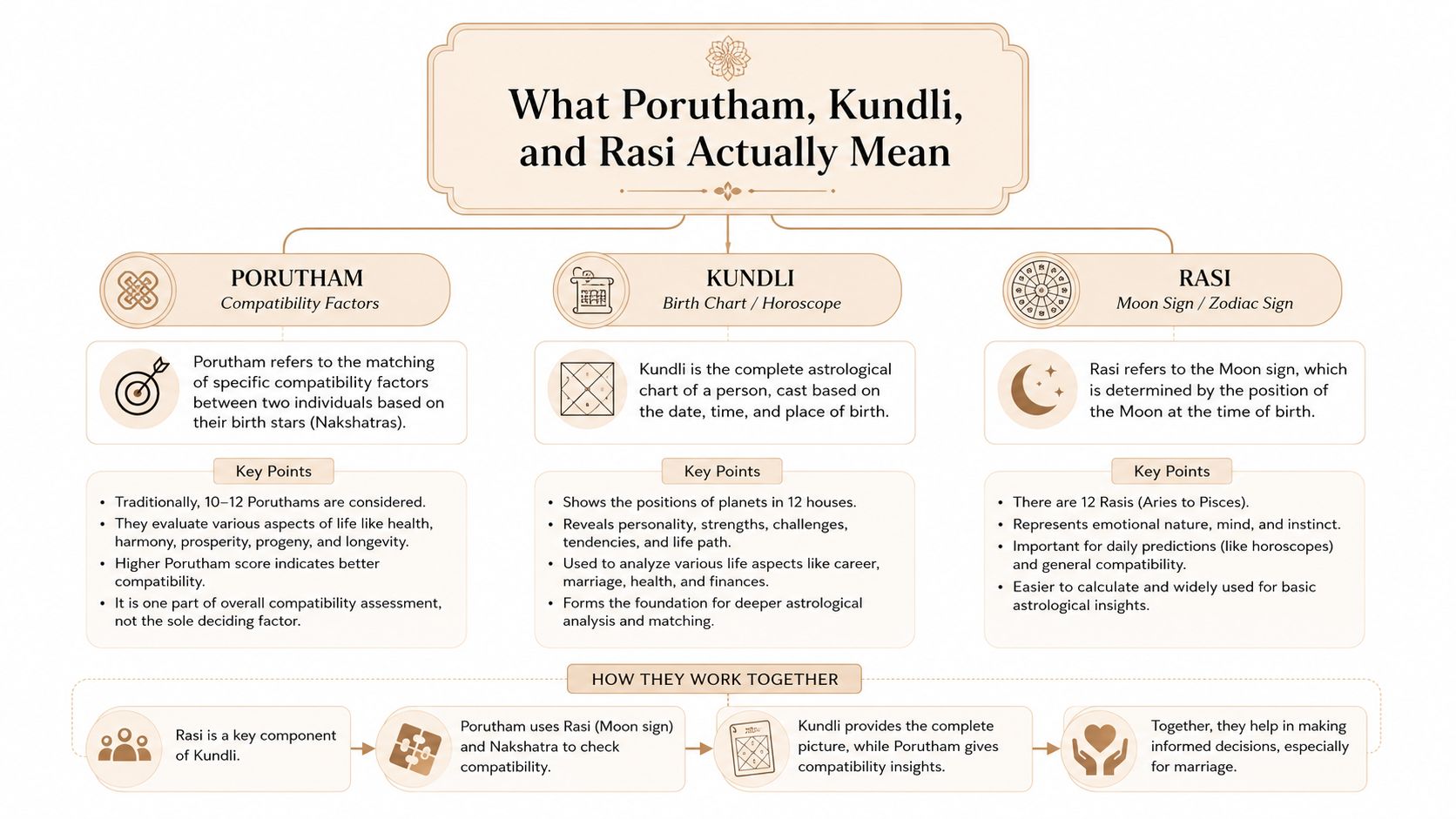
Tamil marriage practice usually checks 10 poruthams together. A South Indian compatibility breakdown also shows that the wider system splits into Moon-nakshatra based factors and Moon-sign based factors, with 21 points attached to four nakshatra factors and 15 points to four rasi factors, which makes it clear that rasi compatibility is only one part of the bigger method Soulyatri compatibility breakdown. That is why peyar and rasi porutham matter, but never stand alone.
The useful way to read these terms
A kundli answers broader life questions from the whole chart. A rasi comparison only checks the Moon sign relationship. A nakshatra link often comes in when families want the star-based layer of matching. A porutham score is the marriage-matching result, not the marriage itself.
The simplest way to think about it is this. Peyar porutham uses name patterns and star associations. Rasi porutham compares Moon signs. Full kundli matching looks deeper and reads the chart as a whole.
For readers who want a fuller chart-based reading, a basic birth-chart entry point is available in kundli reading format. That kind of reading matters because a name match can look neat on paper while the full chart says something more layered.
How Rasi Porutham Is Calculated Step by Step
A family checking rasi porutham is really checking the Moon-sign link between two people. The method looks at how far apart the two rasi positions sit on the zodiac circle, then reads that distance as supportive, mixed, or difficult. Tamil compatibility traditions list 1, 3, 5, and 12 as medium matches, 7, 9, 10, and 11 as good matches, and 2, 6, and 8 as incompatible. The same tradition also marks 6-8 pairings as Shashtashtaka dosham, the classical warning for a difficult house relationship Prokerala's Tamil rasi guide.
The position rule is simple once you see the pattern. One Tamil astrology explanation says same-sign pairs, or the boy's rasi being more than 6 positions from the girl's, are read as Uttamam, while the 3rd and 4th positions are Madhyamam, and 2nd, 5th, 6th, and 8th are treated as unfavourable MPanchang's thirumana porutham article. The idea is not random. It assigns symbolic meaning to angular distance on the zodiac wheel.
A rasi score is a screening tool. It shows where the family should ask more questions.
Rasi Porutham Position Chart
| Count from Bride to Groom | Compatibility Band | Believed Indication |
|---|---|---|
| 1, 3, 5, 12 | Medium | Mixed support, needs other poruthams to confirm ease |
| 7, 9, 10, 11 | Good | Better emotional comfort, family harmony, and stability |
| 2, 6, 8 | Incompatible | Higher caution, especially when other sensitive factors also appear |
For many elders, this score is only one layer inside the wider marriage check. The full system usually includes 10 poruthams, so a good rasi result can support the alliance, while a medium result may still be acceptable if other factors are strong. A difficult rasi position calls for a calmer reading, not instant fear.
For a fuller chart reading after the rasi check, families often move to kundli reading format.
Peyar Porutham and Name-Based Matching Explained
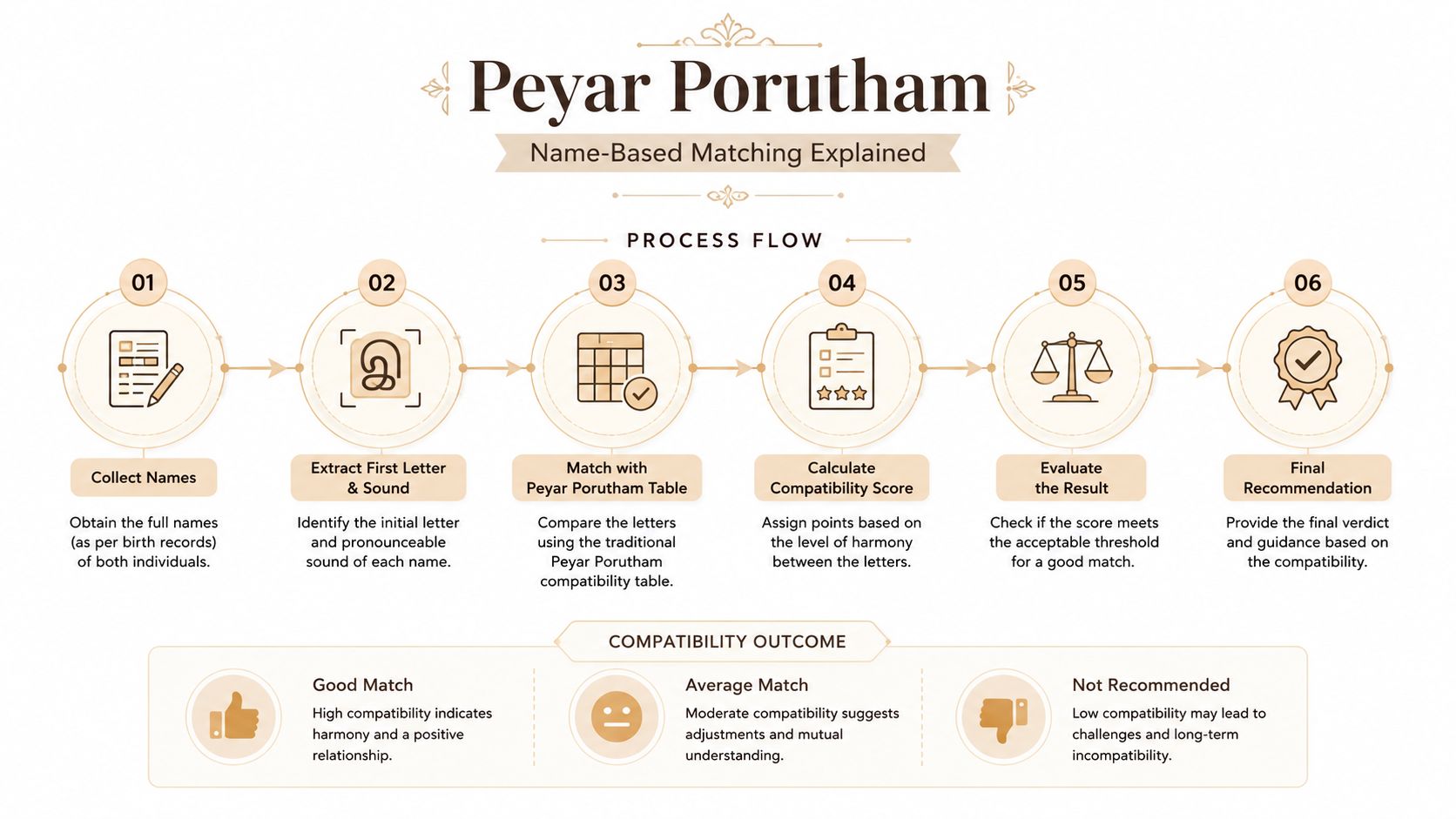
Name-based matching starts with a very Tamil idea, the first sound of a name matters. In traditional practice, the Tamil alphabet is divided into uyir meaning vowels, and mei meaning consonants. The first letter of the boy's and girl's names is then linked to a star pattern, which is why families once used this method when exact birth time was not available.
Modern Tamil sources also show that name-only matching is often a fallback mode. One Tamil matching page says that if birth time is missing, a name-only mode can be used and that this mode relies purely on nakshatra, while another asks for name, date of birth, time of birth, place of birth, and timezone before checking porutham. That contrast shows the hierarchy clearly, name-based matching helps when details are missing, but it does not replace chart-based matching Astrology.TamilCube porutham page.
How families usually read the name side
First, the astrologer or calculator maps the first letter to the birth star group. Next, the nakshatra lord is identified, because traditional matching ties meaning to the star's ruling planet. Then the names are checked for compatibility grouping, often by the sound pattern or by the linked star sequence.
Some families get nervous. They hear that a name has a mismatch and assume the entire alliance is spoiled. That is not how the tradition should be handled. Name-based matching is best read as a soft signal, especially when the birth chart is not yet complete.
Why the fallback status matters
If the family already has full birth details, a name match should not override deeper factors. A full kundli can show timing, temperament, and family dynamics that a name test cannot see. The name check is useful because it is easy, familiar, and fast, not because it knows everything.
For families comparing a name result with a chart result, the better next step is a full kundli matching session, not a rushed rejection.
Calculators vs Astrologer-Led Kundli Matching
Online calculators are useful because they are consistent. They take birth date, time, and place, then apply rule-based matching across the poruthams. That makes them good for a first pass, especially when a family wants a quick picture before discussing the match with elders.
But calculators have a narrow lane. They can score the visible rules, yet they do not sit with the family's concerns, the chart's finer strengths, or the emotional reality behind the proposal. They cannot weigh lagna meaning the ascendant, bhava meaning house, or dasha meaning planetary period in the way a live astrologer does. They also do not carry the family context that often changes how a chart is read.
What each method does best
| Aspect | Online Calculator | Astrologer-Led Reading |
|---|---|---|
| Input | Fixed birth details and rule set | Fixed birth details plus discussion |
| Speed | Fast and immediate | Slower, but more nuanced |
| Strength | Consistent scoring | Context, judgement, and interpretation |
| Limits | Cannot explain family nuance | Depends on the astrologer's quality |
A session-based reading also helps when a calculator shows a problem but offers no road forward. A verified astrologer can discuss parihara meaning remedy, and can explain whether a result needs caution, further chart work, or simple conversation between families. That is especially useful when the score looks neat but the lived situation does not.
Balanced approach: use a calculator to prepare questions, then use a reading to interpret the answer.
For a practical comparison point, families often review an online tool first and then move to free compatibility tools before booking a deeper conversation. That order keeps the process calm. It also prevents families from treating a mechanical score as if it were the whole truth.
Red Flags Couples Worry About and How to Read Them
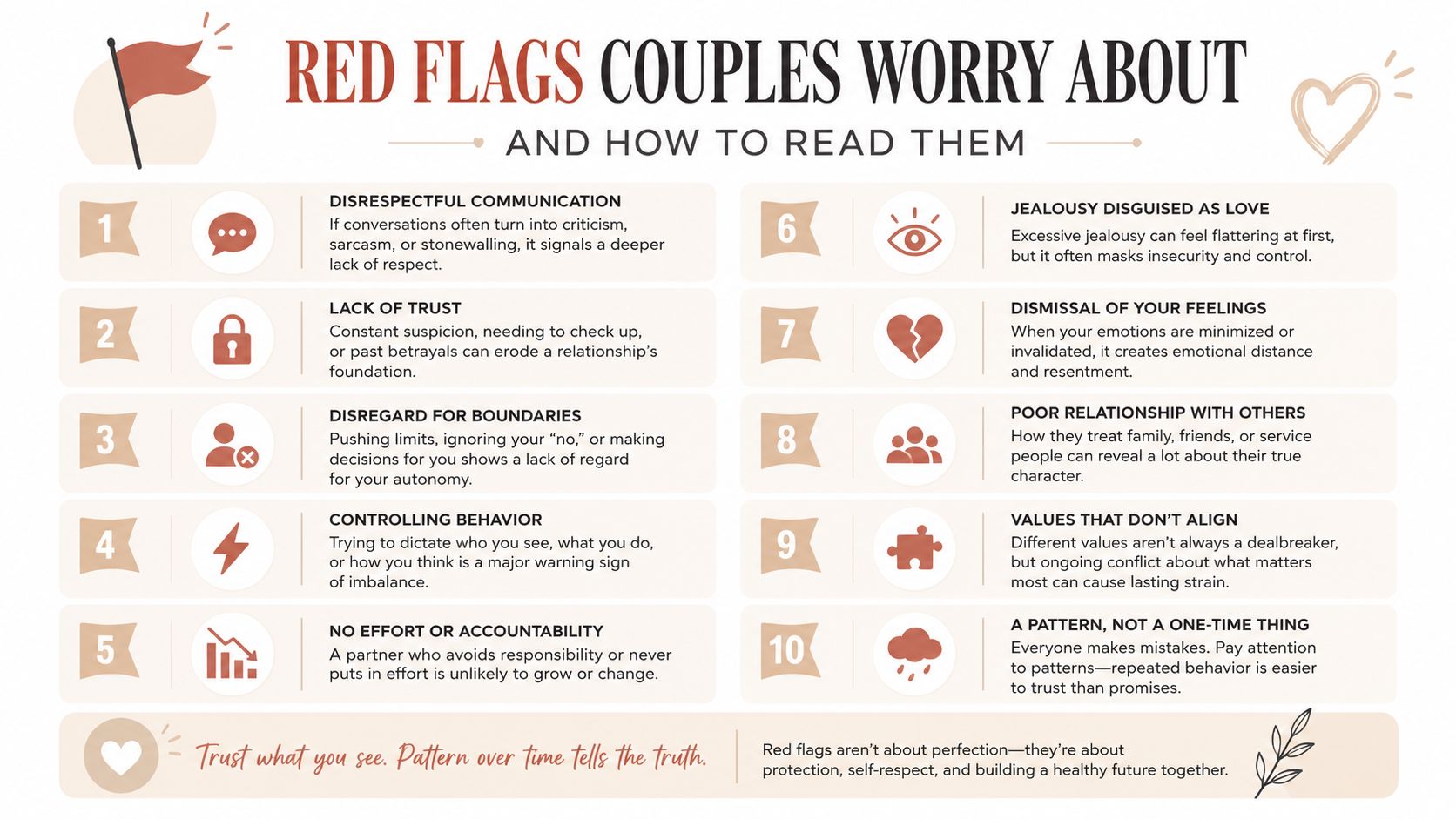
Tamil families often worry most about three patterns, 6/8, 2/12, and Nadi dosham. They sound alarming, but they are better understood as risk indicators than as automatic rejection labels. The question is not “is this doomed,” but “what needs discussion before a decision is made.”
The 6/8 pattern is the classical Shashtashtaka warning, which means a difficult house relationship. The 2/12 pattern is often treated as a money and family-flow concern, because the houses are linked in a way astrologers read cautiously. Nadi dosham is checked in the wider porutham framework because it is tied to birth-star matching and family continuity concerns. These are the kinds of patterns families ask about first because they sound direct and serious.
How to respond without panic
A sensible pandit will not stop at the warning label. The chart needs to be checked for the strength of the relevant houses, the broader poruthams, and any possible parihara. Common remedies mentioned in Tamil marriage practice include Namakulyam, Kumbh Vivah, and specific prayers, but these are support measures, not magic switches.
A family should also ask whether the match is being judged only by one red flag. A chart with one sensitive point can still have other supportive factors, while a chart with neat scores can still need careful handling if the life situation is unstable. The tradition makes more sense when the family treats dosha as something to discuss openly, not something to fear in silence.
The healthiest reading is simple. A flagged issue is a reason for a deeper conversation, not a reason to panic.
When to Book a Detailed Compatibility Reading
A full reading becomes valuable the moment the family stops getting clear answers from the first screening. If one parent remembers the birth time differently from the other, the calculator's neat score can become misleading. If the proposal crosses states, communities, or late-age marriage circumstances, the chart often needs more care than a yes-or-no result can provide.
A session-based reading also helps when a calculator flags a dosha but gives no practical path forward. That is common with sensitive matches, because a family wants to know whether a concern is serious, manageable, or better understood in the context of the whole chart. Cases involving second marriages, child-related concerns, or health-linked questions also deserve a fuller reading, because those themes live in the detail of the chart rather than in a score alone.
What to prepare before the consultation
- Verified birth time: use the most reliable time available, not a guessed one.
- Birth place: the city or town matters for chart calculation.
- Both parents' details: helpful when family history or matching questions need context.
- Any calculator output: useful as a starting point for discussion.
- Specific doubts: write down what worries the family, not just the score.
An astrologer then cross-checks the chart layers, including navamsa meaning the divisional chart used for deeper relationship reading, dasha periods, and the family's practical concerns before giving a view. That is why a live consultation feels different from a score sheet. It does not erase the porutham system, it gives it depth.
A good time to seek that reading is when the family wants clarity, not drama. A careful session can turn a confusing result into a discussion that everyone can understand.
Bringing It All Together for Your Decision
A Tamil family usually needs three things before fixing a match. First, verified birth details should be gathered from both sides, including time and place, because memory alone can be wrong. Second, the family should consult a verified astrologer whose method they trust, and treat that session as a working conversation, not a courtroom verdict.
Third, porutham should stay inside the full decision. Financial readiness, emotional maturity, family values, health, and everyday compatibility all matter in real life. A strong peyar rasi porutham in Tamil result can reassure the family, but it still works best as one part of the picture.
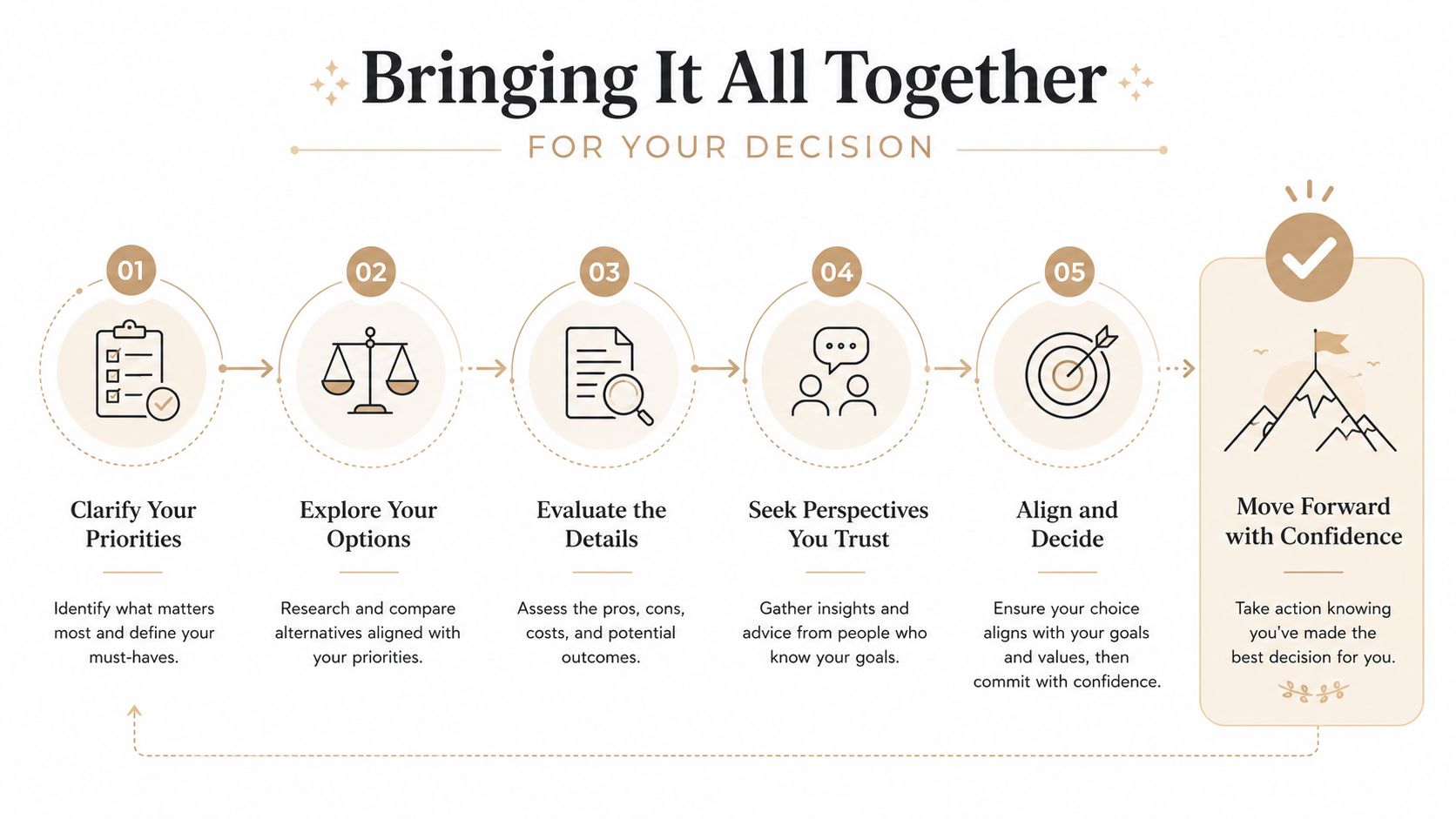
A simple decision flow
- Check the first filter. Use name and rasi matching to shortlist.
- Move to full birth details. If the match feels serious, collect the full chart information.
- Review the stronger poruthams. Ask about the factors that carry more weight in the tradition.
- Discuss dosha calmly. Treat warnings as topics for analysis, not panic.
- Decide with the family's real-life context in mind. Chart, timing, and human compatibility should all be part of the same conversation.
That approach respects tradition without letting fear take over. It also matches how careful astrologers already work, they read the chart, explain the tension, and help the family decide with more confidence.
When a family wants a calm, clear reading for Peyar Rasi Porutham in Tamil, Kismo offers one-on-one guidance with verified astrologers by chat or call. It's a practical place to discuss marriage compatibility, full chart concerns, and auspicious timing in simple English. Visit Kismo when the family is ready for a more complete and reassuring conversation about the match.