Rashi Nakshatra Compatibility: A Practical Guide
A family meeting is underway. Two kundlis, or birth charts, lie open on the table. Before discussing the couple's education, work, or values, a parent points to the Moon-sign column, then to the Nakshatra column. Both details look similar to a new reader, but they answer different questions. That is why Rashi Nakshatra compatibility can't be understood through a single zodiac label or a quick score.
Traditional matching offers a structured way to discuss emotional style, temperament, attraction, family life, and possible areas of strain. It doesn't offer a scientifically validated guarantee of marital happiness. The most useful approach respects the cultural method while also examining communication, consent, finances, health, expectations, and the couple's actual behaviour.
Table of Contents
- Why Two Star Systems Shape a Vedic Match
- Rashi and Nakshatra Explained Side by Side
- How Ashtakoota Scoring Brings Them Together
- Indicators of Harmony and Conflict at a Glance
- What Mixed Signals Look Like in Real Pairings
- Reading a Low Score Without Panic
- When Birth Data Is Uncertain
- Choosing a Detailed Compatibility Reading
Why Two Star Systems Shape a Vedic Match
A Moon-sign pairing can appear easy at first glance, yet a closer reading may raise different questions. In Vedic astrology, Rashi and Nakshatra are two layers of one Moon-based picture. Rashi describes the broader emotional setting. Nakshatra identifies the Moon's more precise position, including its lunar mansion and pada, or quarter.
Rashi sets the weather of the emotional life. Nakshatra names the exact street corner where the Moon stood at birth. Two people may share a similar emotional climate but react differently to pressure, affection, privacy, or family responsibilities because their Nakshatras differ.
Practical rule: A comfortable Moon-sign pairing does not settle the match. Check whether Nakshatra factors support the same picture or introduce a separate concern.
The nakshatra system grew within an ancient Indian lunar and calendrical tradition. Early Vedic practice used stellar or lunar asterisms to follow the apparent movements of the Sun and Moon and organise ritual time. Some historical reconstructions propose successive early stages for the system, while other scholarship connects astronomical evidence with an early nakshatra calendar. These datings remain debated, so they should be presented as interpretations rather than settled historical facts. The marriage hymn Rigveda 10.85 is also discussed in connection with this tradition.
The framework developed a finer way to describe the Moon's place in the zodiac than a Sun-sign horoscope alone. Contemporary kundli matching therefore often considers both the Moon's Rashi and Nakshatra when discussing emotional habits, attachment, and household expectations.
Its cultural importance does not prove that a particular combination predicts divorce, satisfaction, or lasting stability. Indian evidence remains limited, including the Indian couple survey/recent_issues_pdf/2020/September/correlation-of-vedic-matchmaking-and-its-realtime-psychological-effect-on-19-indian-couple-a-survey_September_2020_1598865857_4039297.pdf), which examined only 19 married couples. That sample cannot establish a national success rate or causation. A responsible reading uses the chart as a discussion framework and treats a compatibility score as triage, not a final relationship verdict.
Rashi and Nakshatra Explained Side by Side
Rashi means the zodiac sign occupied by the Moon at birth. In this context, it refers to the Moon's sign, not the Sun sign familiar from many Western horoscope columns. The twelve Rashis provide a broad frame for emotional expression, elemental tone, attachment patterns, and daily rhythm.
Nakshatra means the lunar mansion occupied by the Moon. The zodiac belt is divided into 27 lunar mansions, with some traditions also recognising a 28th division. Each mansion covers about 13 degrees 20 minutes, giving the astrologer more detail than the twelve-sign system.
The map analogy is useful:
- Rashi is the country. It shows the broad environment and general style.
- Nakshatra is the neighbourhood. It adds detail about instinctive reactions, emotional wiring, learning style, symbols, deities, and pada.
- Pada is the local street. It can refine the interpretation further, especially when two birth stars appear similar.
Both factors are anchored to the Moon because traditional Vedic matching gives importance to the mind, feelings, memory, and need for security. A person's Sun sign may describe outward identity, while the Moon's Rashi and Nakshatra are used to discuss how that person experiences closeness and responds within a household.
Rashi vs Nakshatra at a Glance
| Dimension | Rashi, Moon Sign | Nakshatra, Lunar Mansion |
|---|---|---|
| Basic meaning | The zodiac sign occupied by the Moon | The lunar mansion occupied by the Moon |
| Structure | Twelve signs | Twenty-seven mansions, with some traditions recognising twenty-eight |
| Main use | Broad emotional tone, elemental chemistry, and Moon-sign relationships | Finer temperament, instinct, attachment style, and star-based factors |
| Detail level | Wider frame | More precise layer, including pada |
| Matching role | Important for Bhakoot and Graha Maitri | Important for Tara, Yoni, Gana, and Nadi |
| Easy analogy | Country on a map | Neighbourhood inside that country |
A printed horoscope may show both names beside the Moon. Readers who want to explore their own chart can begin with Kismo's free astrology tools, but an automated result should be treated as a starting point. Different calculation settings and uncertain birth data can change the displayed Nakshatra or pada.
How Ashtakoota Scoring Brings Them Together
Ashtakoota, also called Guna Milan, is the traditional eight-part framework used in many North Indian kundli matches. The eight categories carry maximum scores of 1, 2, 3, 4, 5, 6, 7, and 8, adding up to 36 points. A commonly used traditional screening threshold is 18 out of 36, although that line isn't a scientifically validated probability of marital success (an overview of Ashtakoota scoring).
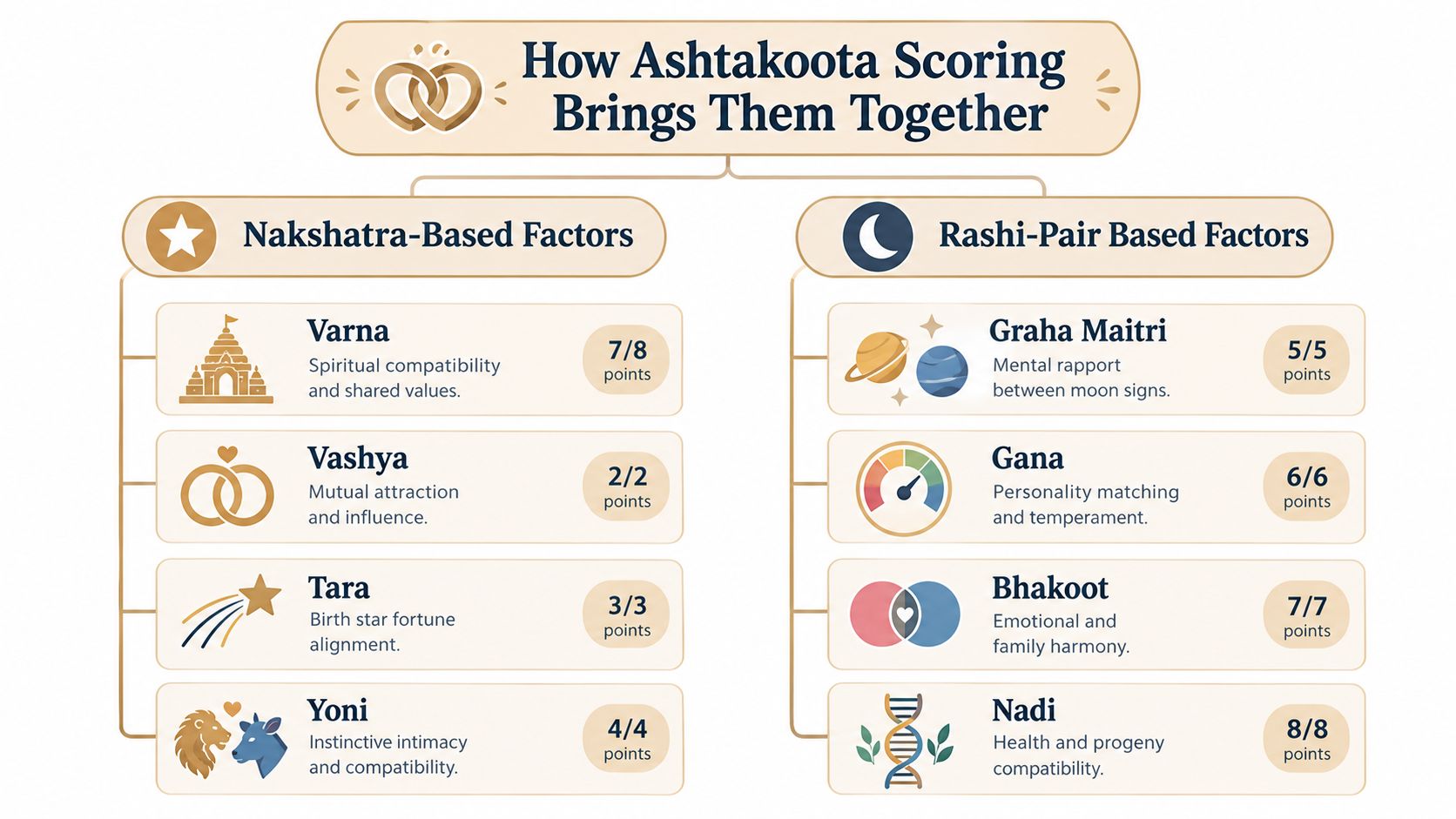
The categories are easier to understand as questions rather than as a memorisation exercise:
- Varna, 1 point: Does the traditional value and outlook comparison appear balanced?
- Vashya, 2 points: How do attraction, influence, and give-and-take operate?
- Tara, 3 points: What does the birth-star relationship indicate within the traditional system?
- Yoni, 4 points: How do instinctive and intimate responses compare?
- Graha Maitri, 5 points: How do the Moon-sign lords relate in terms of mental rapport?
- Gana, 6 points: Do the Nakshatras show compatible temperaments through Deva, Manushya, or Rakshasa groupings?
- Bhakoot, 7 points: What does the relationship between the two Moon signs suggest about emotional and household harmony?
- Nadi, 8 points: Do the two Nakshatras fall into different constitutional groupings, or does traditional Nadi concern arise?
Nakshatra supplies much of the fine-grained information because 27 mansions distinguish emotional styles more closely than 12 signs. Rashi still matters greatly, particularly for Bhakoot and Graha Maitri. A match can therefore score well in one layer and poorly in another.
A calculator needs reliable birth date, time, and place because the Moon's exact position determines the Rashi, Nakshatra, and pada. A score from a kundli matching tool can organise the first conversation, but it can't explain every exception, cancellation rule, or chart-wide influence.
The score is best understood as triage. It shows where a reader should look more carefully. It doesn't replace the full kundli, planetary strength, relevant houses, doshas, or dasha timing.
Indicators of Harmony and Conflict at a Glance
A matching sheet becomes less confusing when each factor is read as a specific question. Gana asks about temperament. Yoni considers instinctive and intimate symbolism. Tara examines the relationship between the birth stars. These indicators may support ease, but none should be treated as a guarantee.
Nadi and Bhakoot often attract more family concern because they can produce a prominent warning in the score. Nadi is one of the eight kootas and contributes the largest single share, 8 points. Traditional practice commonly flags the same Nadi classification as Nadi dosha. Bhakoot, with a maximum of 7 points, examines the relationship between the two Moon signs and is traditionally associated with emotional, financial, and household considerations.
| Factor | Direction | What It Evaluates |
|---|---|---|
| Gana | Harmony indicator | Broad temperament through Deva, Manushya, or Rakshasa groupings |
| Yoni | Harmony indicator | Instinctive, physical, and intimate responses through animal symbolism |
| Tara | Harmony indicator | Birth-star relationship and traditional auspiciousness |
| Nadi dosha | Conflict flag | Same Nadi classification and related traditional health or progeny concerns |
| Bhakoot | Conflict flag | Moon-sign relationship and possible tension around emotional or household life |
Nadi dosha isn't the same as an automatic rejection. The traditional method checks whether recognised cancellation or mitigation conditions apply, then returns to both complete charts. A zero in one koota can be important, but it isn't the entire relationship.
Mangal Dosha is a separate check. It shouldn't be folded into the 36-point total or treated as another name for Nadi dosha. A careful astrologer examines it alongside the Moon-sign relationship, Nakshatra factors, planetary placements, houses, and timing periods.
The practical lesson is simple: a family shouldn't ask only, “What is the score?” A better question is, “Which factor lowered the score, and does the complete chart support or soften that concern?” That question produces a more useful discussion about expectations and conduct.
What Mixed Signals Look Like in Real Pairings
A score can hide the reason behind a result. Consider an illustrative pair where both people have Mesha Rashi, or Aries Moon signs. The shared Rashi may suggest a similar pace and a potentially supportive Moon-sign relationship under the relevant Bhakoot calculation. Yet if both Moons fall into the same Nakshatra and Nadi classification, the match may also raise a traditional Nadi dosha concern.
That isn't a prediction that the couple will fail. It means the reading contains two different messages. The Rashi layer may suggest familiarity, while the Nakshatra layer asks the astrologer to inspect Nadi, pada, and cancellation conditions more carefully. The couple's communication, health discussions, family expectations, and complete chart factors still matter.
A second illustrative pairing uses Karka and Simha Rashis, or Cancer and Leo Moon signs. The Moon-sign relationship may produce a Bhakoot concern in a particular matching calculation, especially around household expectations, money, or emotional expression. Strong Gana and Yoni results could indicate that the two people understand each other's basic temperament and instinctive needs more easily.
That cushioning doesn't erase the Bhakoot question. It changes how the question may be approached. The couple can discuss financial roles, parental responsibilities, public and private behaviour, and responses to criticism before allowing a single flag to dominate the decision.
A third pattern is also possible. A pair may collect a comfortable total while carrying a difficult issue in communication or emotional availability that the score doesn't capture clearly. Traditional chart readers may then examine planetary strength, the seventh house and its lord, Venus, Mars, and current dasha periods.
These examples are illustrative, not deterministic. They show why rashi nakshatra compatibility works better as a layered conversation than as a pass or fail label. A printed total can't describe how two people apologise, share work, protect boundaries, or handle pressure.
Reading a Low Score Without Panic
A result below 18 out of 36 is commonly treated as a reason for further review, not as a guaranteed sign of an unhappy marriage. The threshold belongs to traditional screening practice. It isn't a validated forecast of satisfaction, stability, or divorce.
The first task is to identify the source of the low result. A reader should distinguish between:
- A low total caused mainly by Nadi.
- A Bhakoot concern involving the two Moon signs.
- Difficulties in Gana, Yoni, Tara, or another koota.
- A result produced by uncertain birth data.
- A score that looks weak but is balanced by wider chart factors.
Traditional Nadi analysis includes cancellation or reduction rules in particular combinations. One commonly discussed example involves the same Nakshatra paired with different Rashis, though practices vary by school and a complete chart review remains necessary (a traditional discussion of Nakshatra compatibility). The presence of a dosha therefore starts an investigation. It doesn't end it.
A full reading may also examine the seventh house, its lord, Venus, Mars, Jupiter, planetary strength, and dasha timing. These factors can alter the way a family understands a koota result, but they shouldn't be used to promise that every concern disappears.
A low score should create better questions, not immediate fear.
The modern reader also needs to separate spiritual interpretation from empirical certainty. The available Indian survey evidence is too limited to show that a low rashi or Nakshatra score independently predicts marital outcomes. Couples should therefore place astrology beside direct conversations about consent, money, children, religion, living arrangements, conflict repair, and family boundaries.
When Birth Data Is Uncertain
Birth data can be incomplete in family-arranged matches, intercultural relationships, and records kept by memory rather than documentation. An approximate time may produce a stable-looking Rashi while leaving the exact Nakshatra or pada uncertain. Because several kootas depend on the birth star, that uncertainty can affect the result.
A practical verification protocol keeps the reading honest:
- Confirm the date and place. Check the birth certificate, hospital record, passport record, or family register where available.
- Compare family memories. Note whether relatives remember morning, afternoon, evening, or a specific event around the birth.
- Record uncertainty clearly. A time that is approximate should be labelled approximate rather than entered as if it were exact.
- Recalculate the sensitive factors. Test whether the Moon changes Rashi, Nakshatra, or pada across the plausible time window.
- Seek review near a boundary. If the Moon sits close to a Nakshatra or pada boundary, an experienced astrologer can discuss rectification rather than presenting one output as certain.
The exact effect depends on the chart and calculation method. Readers shouldn't assume that every factor changes in the same way or at the same speed. Rashi-level discussion may remain useful for early conversations, while Nakshatra-sensitive categories should wait for verification.
Different regional traditions and calculation settings can also produce differing results. A couple whose charts were prepared in different schools should ask which ayanamsa and interpretive rules were used before comparing totals.
A birth-chart preparation tool can help organise the data, but software can't recover a missing birth time by itself. The safest report states what is reliable, what is provisional, and what needs an astrologer's review.
Choosing a Detailed Compatibility Reading
A calculator answers, “What result does this formula produce from these details?” A detailed compatibility reading asks a wider question: “What does the full relationship picture require this couple to understand before making a decision?”
Human interpretation becomes especially useful in four situations:
- Nadi or Bhakoot appears difficult. The astrologer can check traditional cancellation conditions and distinguish a genuine chart question from a simple same-category warning.
- Mangal Dosha is present. This separate issue needs comparison across both charts rather than an automatic addition to the Ashtakoota total.
- Dasha timing is important. Marriage may begin during different Mahadasha or sub-period conditions for each person, and those periods form part of the traditional timing discussion.
- The wider charts disagree with the score. The seventh lord, Venus-Moon relationships, planetary strength, relevant houses, and Navamsa harmony may add context that a single total can't show.
A strong consultation should explain the reasoning. It should review both charts together, identify the factors that support the relationship, name the areas that require care, and avoid dramatic predictions. The couple can prepare questions about finances, residence, family involvement, children, faith, work, health, and conflict style.
Birth data should be shared as accurately as possible. If either time is uncertain, that fact should be disclosed at the start. A responsible astrologer can then separate stable observations from conclusions that depend on a narrow timing range.
Rashi nakshatra compatibility has value as a traditional language for discussing emotional patterns and family concerns. Its value becomes weaker when a score replaces consent, character, practical planning, or honest conversation. Tradition can inform the decision, while the couple's lived choices remain central.
Kismo connects users with verified astrologers by chat or call for personalised birth-chart and kundli-matching guidance, including discussion of Rashi, Nakshatra, doshas, and timing. Readers with a mixed score, uncertain birth data, or a difficult Nadi or Bhakoot result can visit Kismo to arrange a reading that explains the chart instead of delivering only a pass or fail label.