Sade Sati Phases Explained for Peace of Mind
A reader may open a Sade Sati calculator after a difficult week at work, a delayed marriage discussion, or an unexpected family responsibility. The result can feel alarming, especially when an online explanation describes the transit as a long period of unavoidable hardship. Fear often grows faster than understanding.
Sade Sati phases are better approached as a structured period of reflection, responsibility, and adjustment in Indian Vedic astrology. The tradition offers a map for observing pressure around emotions, routines, finances, family duties, and speech. It doesn't remove personal choice, and it shouldn't be used to predict doom. A calm reading begins with the chart, the timing, and practical action.
Table of Contents
- Reframing Your Saturn Transit Experience
- The Mechanics of the Seven and a Half Year Cycle
- Navigating the Three Distinct Phases
- Why Exact Start and End Dates Often Shift
- Practical Remedies and Grounding Strategies
- When to Seek Personalised Astrological Guidance
- Your Roadmap for Long-Term Resilience
Reframing Your Saturn Transit Experience
Consider a person whose working life has become heavier at the same time that sleep has become irregular. A parent may need more support, a job may require relocation, or a relationship may enter a serious decision-making stage. After hearing that Saturn has entered a Sade Sati phase, that person may connect every difficulty to the transit and expect the situation to worsen.
That reaction is understandable, but it can create an unhelpful story. Sade Sati is traditionally described through three phases, not as one unbroken sentence of punishment. Each phase brings a different emphasis, so the useful question isn't “How bad will this be?” It is “Which part of life needs more structure, patience, and honest attention now?”
Saturn's symbolism often relates to time, discipline, limits, responsibility, and consequences. In that sense, the transit can be read as a teacher. A teacher may expose an unstable routine, an unmanaged expense, a neglected family duty, or a pattern of harsh speech. The purpose of that observation is growth, not fear.
A grounded reading: A difficult period may call for better systems, clearer boundaries, and support. It doesn't prove that every negative event is caused by Saturn.
The same Sade Sati phase can feel different for different people because the natal chart differs. A person's Moon, other planetary placements, and concurrent dasha, a planetary period used in Vedic astrology for timing life themes, all matter. Even within tradition, the second phase is commonly treated as the pressure peak, but a responsible astrologer considers the whole chart rather than applying one frightening prediction to everyone.
A practical approach starts with three habits. First, identify the phase without assuming its outcome. Second, observe actual events instead of forcing every experience into an astrological explanation. Third, respond with useful actions, such as organising money, protecting sleep, speaking carefully, and seeking help when stress becomes difficult to manage.
The Mechanics of the Seven and a Half Year Cycle
Sade Sati is calculated from the natal Moon, the Moon's position in the birth chart, rather than from the Sun. A kundli is the birth chart used in Vedic astrology. The Moon is given importance in this method because it is associated with the mind, emotions, and everyday sense of wellbeing.
The basic calculation can be learned in a few steps:
- Find the zodiac sign occupied by the natal Moon in the kundli.
- Identify the sign immediately before that Moon sign.
- Observe Saturn's passage through the Moon sign itself.
- Observe Saturn's movement through the sign immediately after the Moon sign.
This three-sign passage is known as Sade Sati. Traditional explanations describe it as a roughly 7.5-year Saturn cycle, with three phases of about 2.5 years each, creating the familiar description of 7 years and 6 months. The structure follows Saturn's average stay of about 2.5 years per sign, as described in this overview of Sade Sati's traditional calculation.
A house analogy makes the method easier to picture. Imagine a house with three rooms placed in a row, and a slow spotlight moving from one room to the next.
- The first room is the 12th sign from the Moon. It is associated in traditional interpretation with expenditure, rest, withdrawal, distance, and the need to release old patterns.
- The middle room is the Moon sign itself, where Saturn's transit is considered most direct. This is the central or peak phase.
- The third room is the 2nd sign from the Moon. Traditional readings connect it with accumulated resources, family responsibilities, speech, and financial organisation.
The spotlight doesn't illuminate all three rooms at once. It moves gradually, which is why the three phases have different practical themes. A reader who knows only the total duration may feel lost, while someone who knows the current room can focus on the relevant area of life.
A nakshatra is a lunar mansion, or a section of the zodiac used in Indian astrology for more detailed transit analysis. Sign-based calculations provide the broad Sade Sati framework, while nakshatra-based tables may offer finer timing interpretations. Those finer details still require accurate birth information and a consistent calculation method.
A transit tool can help a reader see Saturn's position from the natal Moon, but a tool is a starting point rather than a complete prediction. The Planet Transits tool is designed to show the relevant transit position and phase label, while interpretation still depends on the individual kundli.
The cycle is also described as repeating roughly every 30 years, which means a person may encounter it more than once in a lifetime, according to the traditional Sade Sati reference. That recurrence doesn't mean every cycle will produce the same events. Age, responsibilities, dasha periods, health circumstances, and the wider chart can change the way each passage is experienced.
Navigating the Three Distinct Phases
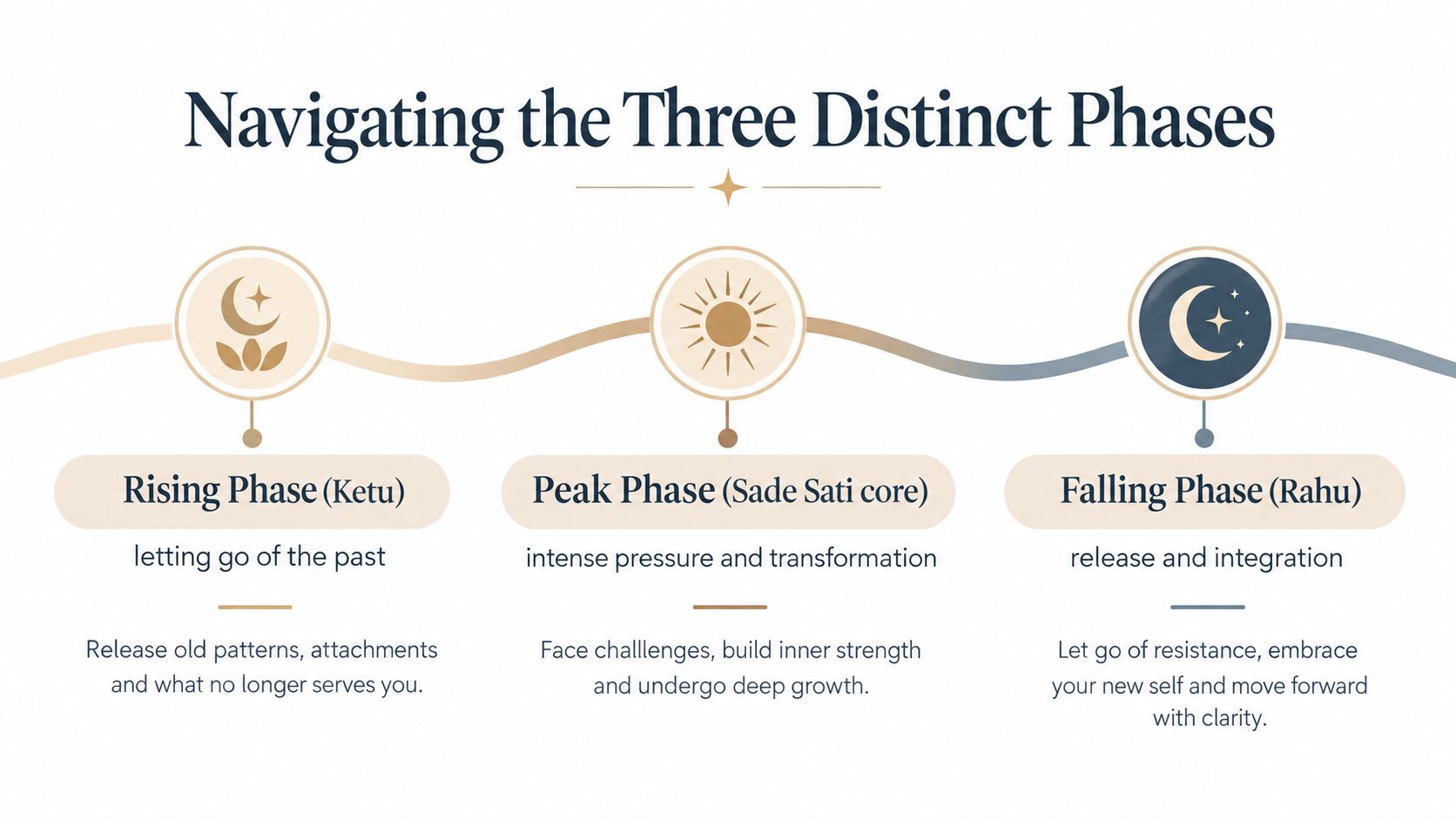
The three Sade Sati phases work like a progression. The first phase often raises awareness of what is unsustainable. The second brings the most concentrated pressure in the traditional framework. The third turns attention towards stabilisation, responsibility, and the careful handling of resources.
The first phase encourages adjustment
The first phase begins as Saturn moves through the sign before the natal Moon. Traditional readings often connect this stage with expenditure, sleep, isolation, travel, relocation, or a growing need to simplify. A person may not experience all these themes, and none should be treated as a guaranteed event.
The practical response is preparation rather than panic. A reader can review recurring expenses, create a more reliable sleep routine, reduce unnecessary commitments, and make space for quiet reflection. Someone facing a possible relocation might keep documents organised and compare practical costs before making a decision. Someone feeling socially withdrawn can maintain a small, dependable support circle instead of treating solitude as a sign of failure.
The first phase can feel like a slow clearing of clutter. Old habits that once seemed manageable may begin to show their cost. That observation can become useful when it leads to a concrete change.
The second phase brings concentrated attention
The second phase occurs when Saturn transits the natal Moon sign itself. Traditional descriptions place the peak pressure here because Saturn is moving directly over the point associated with the mind and emotional experience. The phase-based explanation from Modern Astro links this stage with emotional load, health concerns, and strain in close relationships.
A person in this phase may feel responsible for too many things at once. A salary delay may trigger anxiety about family obligations. A marriage conversation may become tense because both people are already tired. A demanding work schedule may make ordinary health maintenance feel difficult. These examples describe areas for attention, not predictions.
Health concerns deserve sensible care. Astrology shouldn't replace a qualified medical professional, mental health support, or emergency assistance. When worry persists, sleep deteriorates, or daily functioning becomes difficult, practical healthcare matters more than assigning the experience to a planetary label.
The peak phase needs support, not superstition. Rest, honest communication, professional care, and realistic planning are stronger responses than fear-based rituals or absolute predictions.
The third phase supports consolidation
The third phase starts when Saturn moves into the sign after the natal Moon. The focus traditionally shifts towards finances, savings, family duties, accumulated resources, and speech. A person may need to repair a budget, handle an elder's needs, settle an old obligation, or become more thoughtful about promises.
Speech discipline has a very practical meaning. Before sending an angry message, a reader can pause and check whether the words solve the problem or deepen it. During a family disagreement, a shorter and more precise explanation may protect trust better than a long defence. Financial consolidation can involve reviewing commitments, separating essential spending from avoidable spending, and setting realistic priorities.
The third phase is not just a period of automatic relief. It can be a time when earlier lessons become visible in daily choices. A person who established a routine in the first phase and sought support during the second may now be better placed to manage family and financial responsibilities. Another person may need to make those changes later, without treating that delay as failure.
| Phase | Traditional focus | Constructive response |
|---|---|---|
| First | Expenses, sleep, withdrawal, and adjustment | Simplify routines and organise resources |
| Second | Emotional load, health concerns, and relationships | Seek support and reduce avoidable pressure |
| Third | Finances, family duties, and speech | Consolidate, communicate carefully, and honour commitments |
Why Exact Start and End Dates Often Shift
Many readers expect a Sade Sati calculator to provide one permanent start date and one permanent end date. That expectation is too rigid for the way Saturn moves. The broad framework uses Saturn's passage through three signs, but exact boundaries depend on sidereal sign ingress, the point at which Saturn enters a zodiac sign in the sidereal system used by many Indian astrology calculations.
Saturn spends about 2.5 years in each zodiac sign, which is why the full passage through three signs lasts roughly 7.5 years, as explained in this guide to Sade Sati mechanics and retrograde movement. That figure is an average description, not a promise that every phase will fit neatly into a fixed block on a calendar.
Saturn also appears to move backwards during retrograde periods. In astrological calculations, that motion can take Saturn back into a sign it has already crossed. A phase boundary may therefore be revisited, and a theme may feel active again after appearing to have ended. This is one reason a reader can compare several calculators and find dates that differ by months.
Why calculators can disagree
Different tools may use different conventions for sign ingress, retrograde loops, ayanamsha settings, or nakshatra-based transit tables. A calculator that gives a simple sign-to-sign result may show a broad phase, while a detailed table may mark a temporary return during retrograde.
The difference doesn't automatically mean that one calculation is fraudulent. It may reflect a different method or a different level of detail. The useful step is to record the calculation system, birth details, Moon sign, and dates being used. Mixing several systems without understanding their settings creates more confusion than clarity.
A 2026 India-focused example illustrates the issue. Current explainers place Saturn in Pisces, with Aquarius Moon in the third phase, Pisces Moon in the peak phase, and Aries Moon in the first phase. One 2026 Saturn transit explanation also describes Saturn's retrograde from late July to mid-December 2026, showing why exact boundaries may shift rather than follow simple calendar-year labels.
That timing should be treated as a working map. A person making a career move, discussing marriage, or considering relocation can use the phase as one planning input, but shouldn't cancel an important decision solely because a generic calculator shows a transition. Accurate birth data and a consistent sidereal method make the interpretation more coherent.
A free calculator can provide orientation, while a full chart reading may explain why a phase appears more strongly in one life area than another. The free astrology tools collection can be used as an initial reference, with the result interpreted cautiously rather than treated as a fixed verdict.
Dates mark a changing boundary, not a sentence. Retrograde loops can revisit a sign, but practical decisions still require facts, preparation, and sound judgement.
Practical Remedies and Grounding Strategies
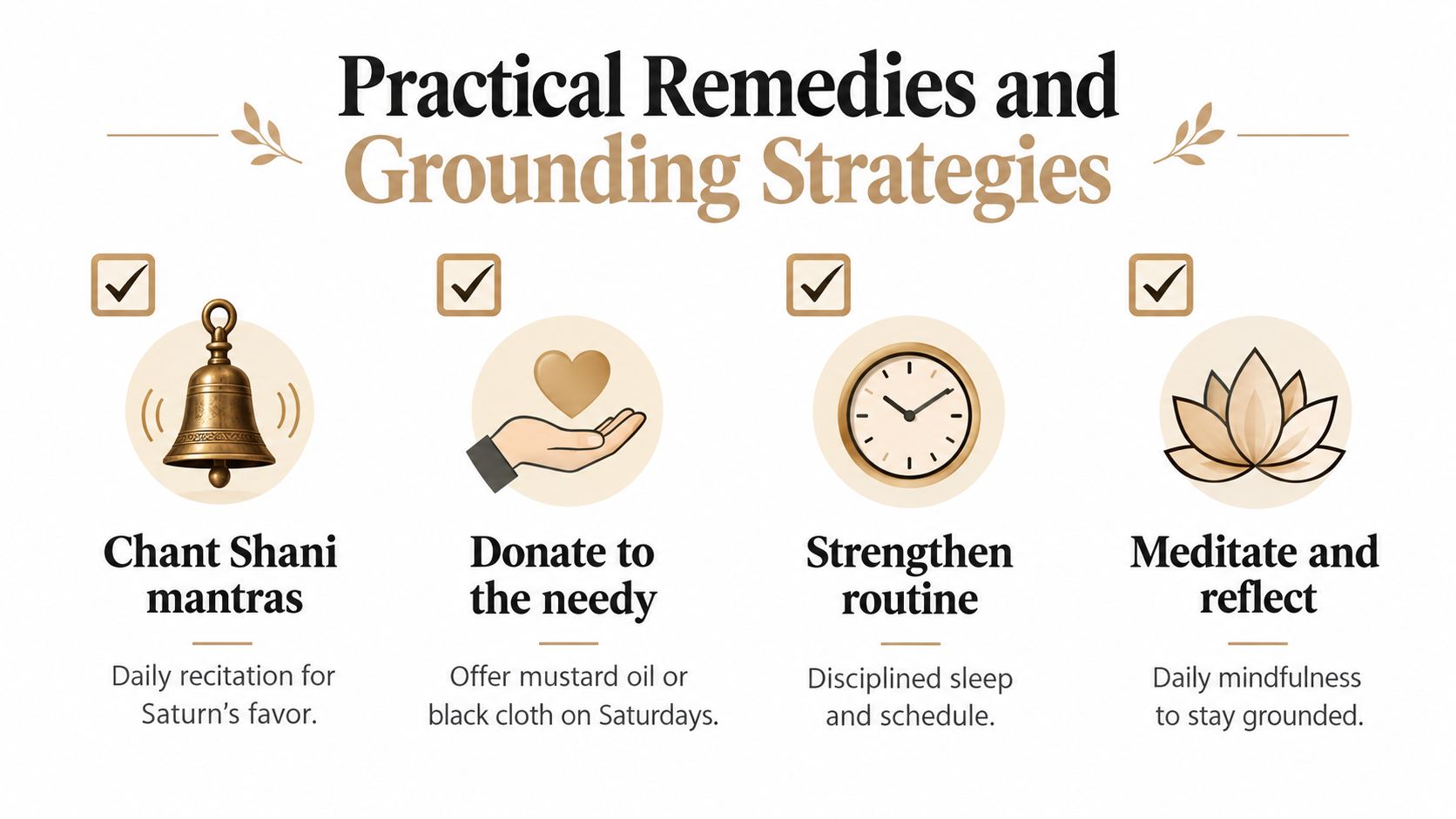
Remedies work best when they strengthen awareness and discipline rather than increase fear. A traditional practice may carry personal or spiritual meaning, while a lifestyle practice can make daily pressure easier to manage. Neither should be presented as a guarantee that a difficult event will disappear.
The first useful remedy is a stable routine. A reader can choose consistent times for sleep, meals, work, movement, and quiet reflection. During the first phase, that structure may help with irregular sleep and scattered spending. During the second, it can reduce decision fatigue. During the third, it can support the patient handling of financial and family responsibilities.
Financial discipline deserves equal attention. A simple written plan can separate essential bills, family commitments, flexible spending, and outstanding obligations. The purpose isn't to create anxiety around every purchase. It is to replace vague worry with visible information and deliberate choices.
Remedies that build steadiness
Traditional Vedic practices can be approached respectfully and without compulsion:
- Mantra recitation: Some practitioners chant Shani mantras, prayers associated with Saturn, as a regular contemplative practice. The value may lie in creating a pause, focus, and sense of devotion, not in promising a specific result.
- Charitable giving: Donating useful items or supporting people in need can express humility and social responsibility. A person should give within affordable limits and shouldn't borrow money for a ritual.
- Mindful speech: Speaking after a pause can reduce conflict during the third phase, especially when family and financial subjects are sensitive.
- Meditation and reflection: A short period of quiet observation can help separate an actual problem from an imagined future disaster.
- Professional support: A doctor, counsellor, financial adviser, or trusted family member may provide the most appropriate help for a practical concern.
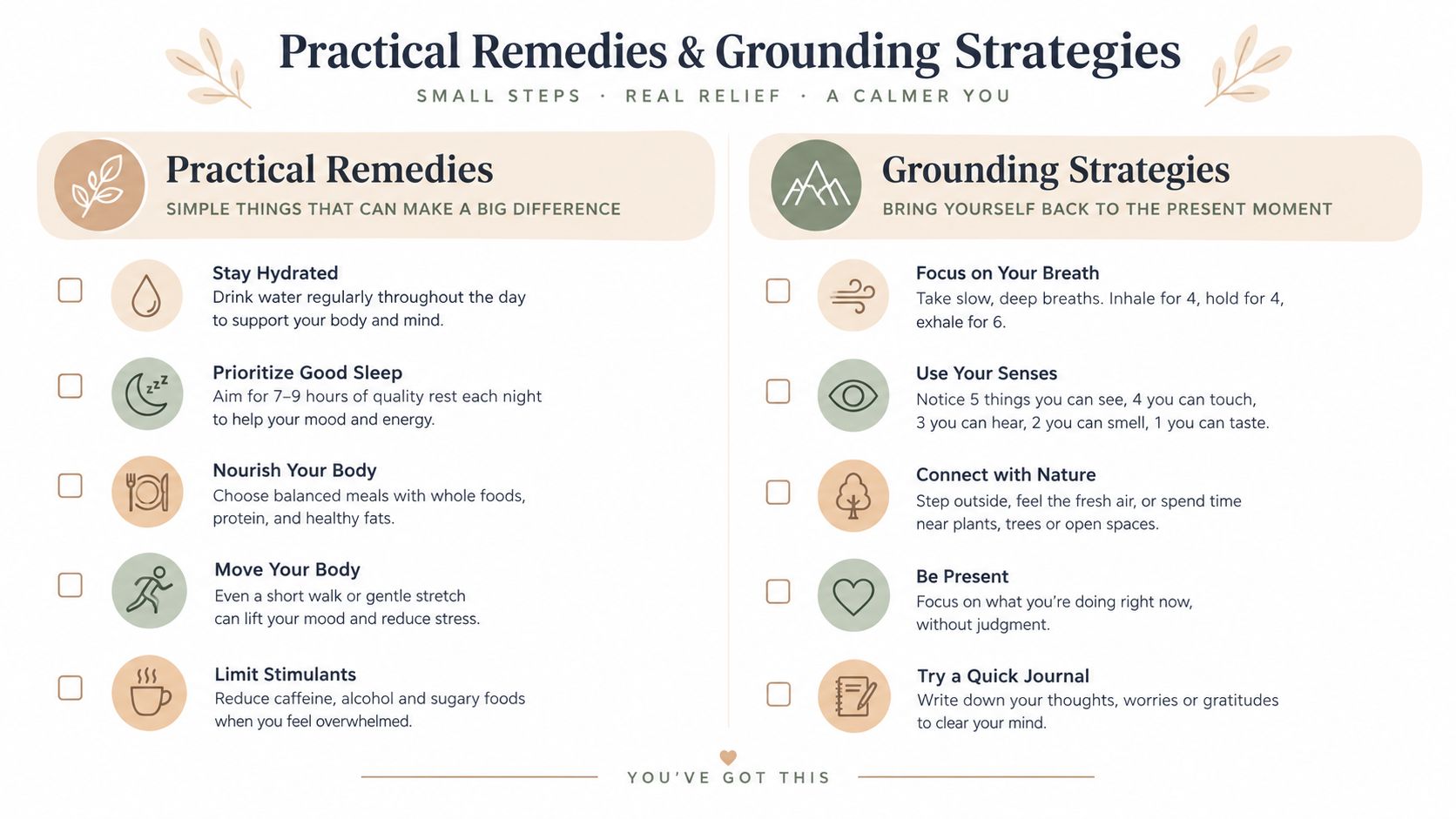
The image below presents common traditional and grounding ideas, but its presence shouldn't be read as a promise of Saturn's favour or protection.
A phase-based personal plan
For the first phase, the priority can be rest and expense awareness. A reader might keep a sleep log, review subscriptions, and make relocation decisions only after checking practical details.
For the second phase, the priority can be emotional and physical support. A person may schedule health appointments, reduce unnecessary arguments, and tell a trusted person when responsibilities feel unmanageable.
For the third phase, the priority can be consolidation and communication. A budget review, a family meeting, and a pause before important messages can turn abstract advice into visible behaviour.
Astrological tradition also includes charity, prayer, oil offerings, and other rituals. Those practices may be meaningful when chosen freely and safely. No reader should be pressured into costly ceremonies, made to fear a curse, or told that refusing a ritual guarantees misfortune.
When to Seek Personalised Astrological Guidance
A general explanation can identify the sign before the Moon, the Moon sign itself, and the sign after it. It can't show the full context of a person's life. The natal Moon's condition, supportive or challenging planetary relationships, house ownership, and active dasha periods can alter how the same Saturn transit is interpreted.
That difference matters in real decisions. One person may be considering a job change while another is handling marriage discussions. A third may be worried about family finances or a move abroad. The same phase label doesn't provide the same advice for all three situations.
A personalised reading should answer practical questions rather than produce fear. Useful questions include:
- Which life areas receive the strongest Saturn emphasis in the kundli?
- Does the active dasha support, intensify, or redirect the transit themes?
- What should receive attention first, career, health, relationships, family, or money?
- Which dates are broadly supportive for a planned action, and what practical conditions still need checking?
- Which traditional remedies are appropriate, affordable, and meaningful for the individual?
A careful astrologer should explain uncertainty and avoid guaranteed outcomes. The reading should leave a person with priorities, not a catalogue of frightening possibilities.
Kismo connects users with verified astrologers by chat or call for services such as birth chart readings, kundli matching, marriage compatibility analysis, career questions, and muhurta, an auspicious time selected for an important beginning. Its kundli reading service can be considered when a reader needs the Sade Sati phases interpreted alongside the full birth chart.
Personal guidance doesn't replace medical, legal, financial, or relationship support. It adds an interpretive perspective for someone who values Vedic astrology and wants a more individual reading than a generic Moon-sign forecast.
Your Roadmap for Long-Term Resilience
Sade Sati becomes less frightening when the label is converted into a plan. The traditional cycle describes a long passage through three signs, but personal growth happens through ordinary choices made repeatedly.
A reader can keep the following roadmap nearby:
- Confirm the Moon sign and calculation method. Birth details and sidereal settings affect the result.
- Identify the broad phase. The first points towards adjustment, the second towards concentrated emotional pressure, and the third towards consolidation.
- Track observable patterns. Note sleep, expenses, health concerns, relationship tension, work demands, and family responsibilities without blaming every event on Saturn.
- Choose one practical priority. A stable routine, a budget review, a health appointment, or calmer communication can create more benefit than trying to change everything at once.
- Use remedies freely and thoughtfully. Prayer, mantra, charity, meditation, and reflection can support meaning and discipline when they don't replace practical care.
- Ask for chart-specific guidance when decisions are significant. A full kundli can add context that a phase calculator can't provide.
The second phase is traditionally treated as the peak, but the most helpful interpretation remains individual and grounded. Saturn's lesson, in this framework, is not helplessness. It is patience, accountability, maturity, and the ability to build something that can endure.
Kismo offers one-to-one astrology guidance by chat or call, including personalised chart readings, marriage compatibility, career questions, and muhurta timing. Readers seeking a clearer interpretation of their Sade Sati phases can visit Kismo and choose a session that fits the question at hand.