Sani Peyarchi for Mesha Rasi: A Complete 2026 Guide
A reader may hear that Saturn has moved into Pisces, receive a family WhatsApp forward saying “Sade Sati has started,” and begin worrying about work, money or marriage. The confusion often comes from forecasts that use “Aries” without saying whether they mean an Aries Moon sign or an Aries ascendant. Those are different chart references, so the same transit won't mean the same thing for every person.
A calm reading of Sani Peyarchi for Mesha Rasi starts with the dates and the birth chart, not a prediction of disaster. The transit can offer a way to reflect on routines, spending and commitments, but it can't guarantee a particular event. The first useful question is simple: is Mesha the person's Janma Rashi, or birth Moon sign, or their Lagna, or ascendant?
Table of Contents
- A Calm Start for an Aries Moon Worried About Saturn
- What Sani Peyarchi and Mesha Rasi Really Mean
- The 2025 to 2028 Saturn Timeline You Should Know
- How the Current Transit Touches Each House
- Mesha Rashi vs Mesha Lagna and Why the Forecast Changes
- How Dasha and Antardasha Change the Story
- Practical Dos, Don'ts, and Remedies for the Next 90 Days
- Common Questions and a Calm Way Forward
A Calm Start for an Aries Moon Worried About Saturn
A friend hears that Saturn entered Pisces and asks whether a job will become difficult. A relative sends a warning about Sade Sati, while another says a temple visit is urgently needed. The reader searches for an answer and finds forecasts that sound certain, even though they may be describing different chart references.
That worry is understandable. In Vedic astrology, Saturn's movement is treated as meaningful, but a transit is only one part of a reading. It doesn't tell the whole story of a person's life, and it can't establish that a marriage will be delayed, a job will be lost or a health problem will appear.
Sani Peyarchi is the traditional name for Saturn moving from one zodiac sign, or rasi, to another. It draws attention because the change is discussed in almanacs, astrology readings and religious observances. At Thirunallar Saneeswaran Temple in Karaikal, approximately 60,000 devotees visited on 29 March 2025 after many believed Saturn's transition had happened that day. Temple authorities clarified that, under the Thirukanitham almanac, Saturn moved from Aquarius to Pisces at 9:44 p.m. that evening. The report illustrates how the timing of a transit can differ by almanac and public understanding, not whether astrological predictions are guaranteed (report on the Thirunallar observance).
A calmer starting point: Before acting on a forecast, check which chart reference it uses and which transit date it means.
This guide sets out the relevant dates, the difference between Moon sign and ascendant readings, and the themes an astrologer may consider. It also offers practical steps for the present, without turning an astrological period into a reason to panic.
What Sani Peyarchi and Mesha Rasi Really Mean
Sani Peyarchi means Saturn's movement from one rasi to another. Mesha Rasi generally refers to Aries as a person's Moon sign in Indian Vedic astrology, where signs are calculated using the sidereal zodiac. That isn't automatically the same as being an Aries in a Western sun-sign horoscope: the Moon sign and the Sun sign are different chart placements.
A few related terms help make a reading easier to follow. A kundli is a birth chart calculated from birth details. A dasha is a planetary period used to assess which influences are active over time. Muhurta means a chosen auspicious time for an important beginning. A nakshatra is a lunar constellation that astrologers use as another layer of chart interpretation.
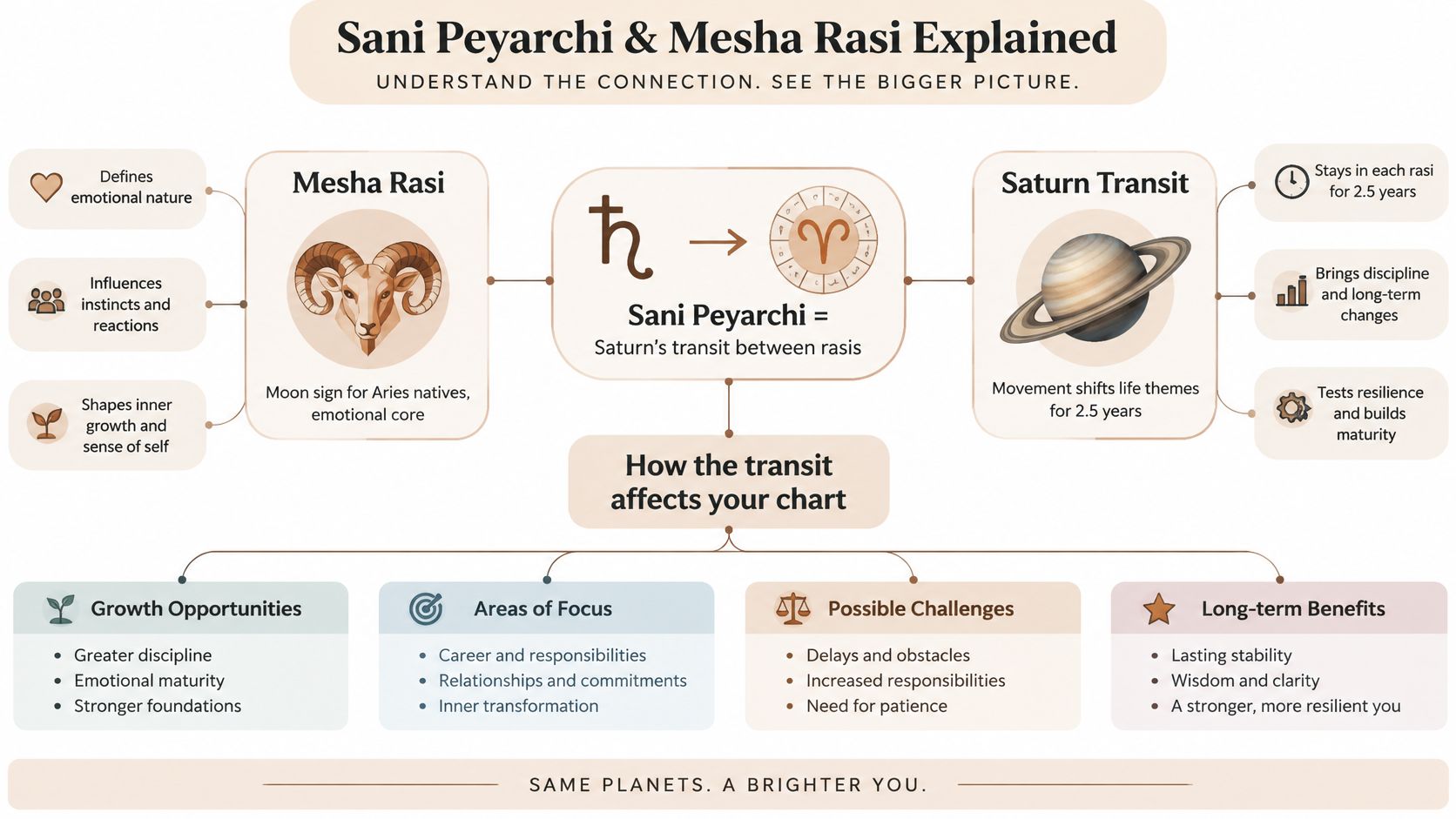
Before applying a forecast, a reader can check which Aries placement it describes:
- Mesha Rasi: Aries is the Moon sign in the birth chart. This is the reference used for the Moon-sign Sade Sati reading.
- Mesha Lagna: Aries is the ascendant, the sign rising at birth. This is used to assess house positions and other chart-specific topics.
The simplest check is to look at a correctly calculated birth chart and identify the sign occupied by the Moon, then identify the ascendant separately. Birth time and place matter for calculating the ascendant, so a person shouldn't assume that an Aries sun sign settles the question.
The distinction changes the interpretation that follows. A general forecast can describe possible themes, but it can't establish a fixed outcome for someone's relationship, work or finances. Those questions need the birth chart and its wider context.
The 2025 to 2028 Saturn Timeline You Should Know
Dates make a transit easier to understand, provided the calendar system is clear. Under the Lahiri sidereal zodiac, Saturn entered Pisces, or Meena, on 29 March 2025. For an Aries Moon, Pisces is the sign immediately before Aries, so astrologers classify this as the first phase of Sade Sati (Saturn's Pisces transit and Aries Moon interpretation).
Saturn turned retrograde on 13 July 2025 at approximately 9:30 a.m. IST and direct on 28 November 2025 at approximately 9:14 a.m. IST. Retrograde describes the planet's apparent backward motion as viewed from Earth. In astrological interpretation, it may be treated as a period for reviewing ongoing matters, not as a promise that a particular event will happen (2025 Saturn retrograde dates and context).
Nakshatra shifts add detail but don't replace the broader chart reading. Saturn entered Uttara Bhadrapada on 27–28 April 2025, depending on the calculation system, moved into Purva Bhadrapada on 4 October 2025, and returned to Uttara Bhadrapada on 20 January 2026. Different calendars may vary slightly because they use different calculation settings or time conventions (Saturn's nakshatra transit chronology).
For a wider view of the planetary movements involved, readers can use this Vedic astrology planet-transits tool. The milestone table gives the main sequence at a glance.
| Date | Transit Event | What It Means for Mesha Rasi |
|---|---|---|
| 29 March 2025 | Saturn enters Pisces | Begins the first phase of Sade Sati for an Aries Moon. |
| 13 July 2025 | Saturn turns retrograde | A transit-level review period, not a guaranteed event. |
| 28 November 2025 | Saturn turns direct | Saturn resumes apparent forward motion. |
| 27–28 April 2025; 4 October 2025; 20 January 2026 | Nakshatra changes and return | Adds a layer to interpretation; dates can vary by calculation system. |
| 2 June 2027 | Saturn is projected to enter Aries | The middle phase begins for an Aries Moon. |
| 23 February 2028 | Saturn is projected to exit Aries | Marks the end of this uninterrupted Aries passage. |
The 2027–2028 Aries passage is projected to last approximately 266 days, or about 8.7 months, and is described as an intermediate passage before Saturn later returns during the broader cycle (200-year Saturn transit chronology). The dates offer a calendar for discussion, not an individual prediction.
How the Current Transit Touches Each House
For an Aries Moon, Saturn in Pisces is read as a 12th-house transit from the Moon sign. In Vedic astrology, the 12th house is associated with expenditure, sleep, solitude, foreign connections and institutional settings. These are topics to review, not events that Saturn must cause. A person considering a move abroad, for example, still needs to check the practical details, such as costs, documents and work arrangements.
The phrase “house by house” can be confusing here. The current Pisces transit doesn't mean Saturn is travelling through all twelve houses at once. It means Pisces is the 12th sign counted from Aries; the other houses provide context when an astrologer assesses the wider birth chart.
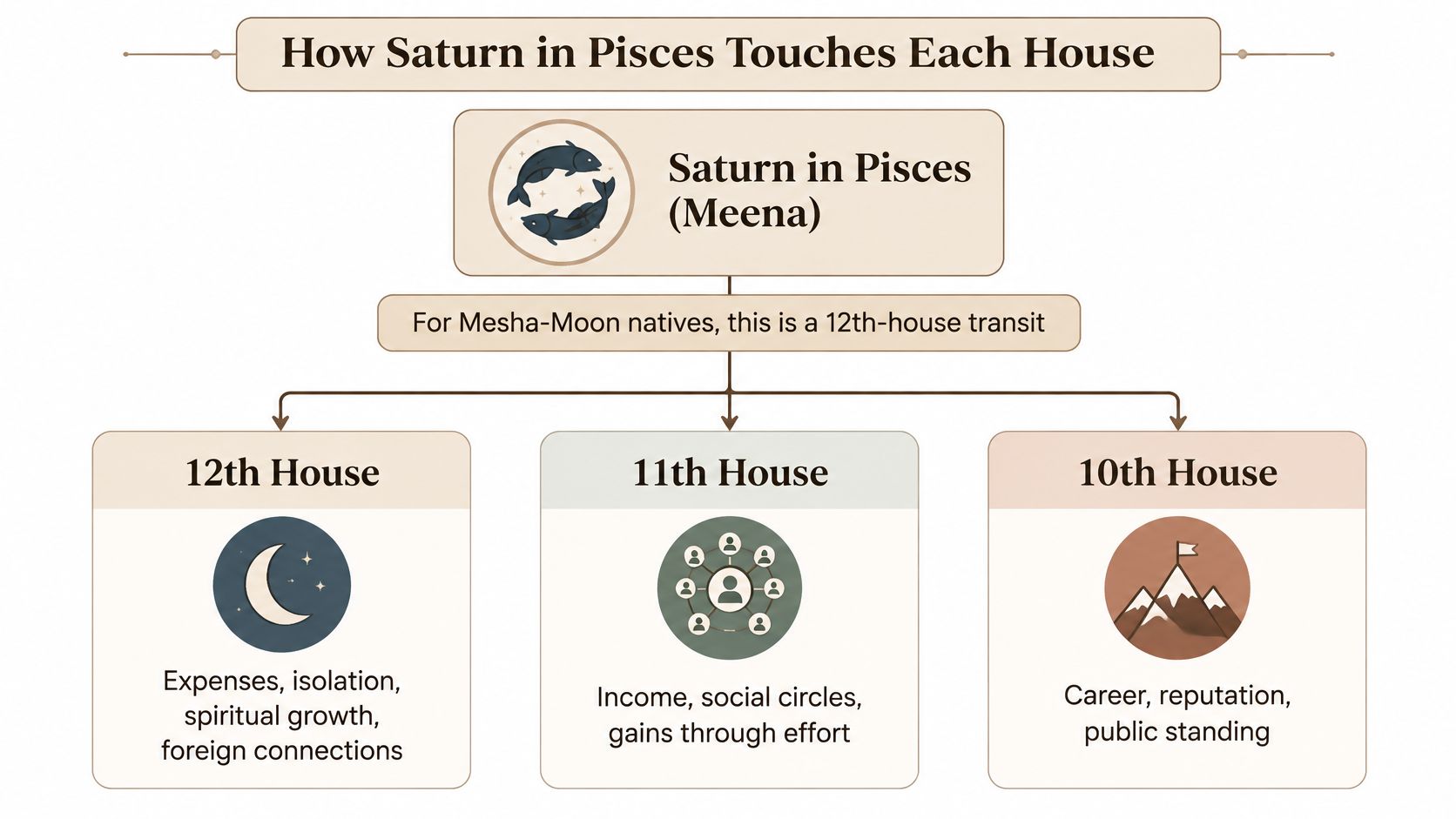
Three phases to keep distinct
- Before the first phase: When Saturn was in Aquarius, it was 11th from an Aries Moon. An astrologer might consider gains, networks and social connections in that period. A reader could use the idea as a prompt to review which friendships and professional contacts remain helpful.
- Pisces, the first phase: From the Moon-sign perspective, this is the current 12th-house emphasis. A person might pay closer attention to recurring expenses, sleep, time alone or paperwork connected with travel. None of those experiences is guaranteed by the transit.
- Aries, the middle phase: The projected 2027 entry places Saturn in the Moon sign itself. Within Sade Sati interpretations, this is the middle phase, so astrologers may examine personal priorities, physical routines and emotional strain more closely. A transit alone still cannot predict illness or another specific outcome.
For an Aries Moon reader, the most useful short-term response is to manage what can be checked directly: keep a clear budget, protect time for rest and plan travel carefully. Hospital or institutional settings and withdrawal are also traditional 12th-house themes, but their appearance in a chart interpretation shouldn't be taken as a diagnosis or a forecast of admission.
A house-based reading works best as a set of questions. Is spending understood? Is sleep being protected? Are travel plans practical? Questions like these can lead to sensible action without treating astrological language as a verdict.
Mesha Rashi vs Mesha Lagna and Why the Forecast Changes
Saturn's Pisces transit is interpreted differently depending on whether Aries is the person's Moon sign or ascendant. A Moon-sign reading counts houses from the Moon; an ascendant reading counts from the Lagna. This is why a general Aries forecast can appear to give mixed messages. It may be blending two chart references without saying so.
For Mesha Rasi, Pisces is the 12th sign from the Aries Moon, bringing traditional attention to expenses, sleep, solitude and foreign connections. For Mesha Lagna, Pisces is the 12th house from the ascendant. But Saturn also rules the 10th and 11th houses for an Aries ascendant, so an astrologer may include career, public standing, gains and networks when judging the full chart. Those house topics don't by themselves predict a promotion, a loss or a move.
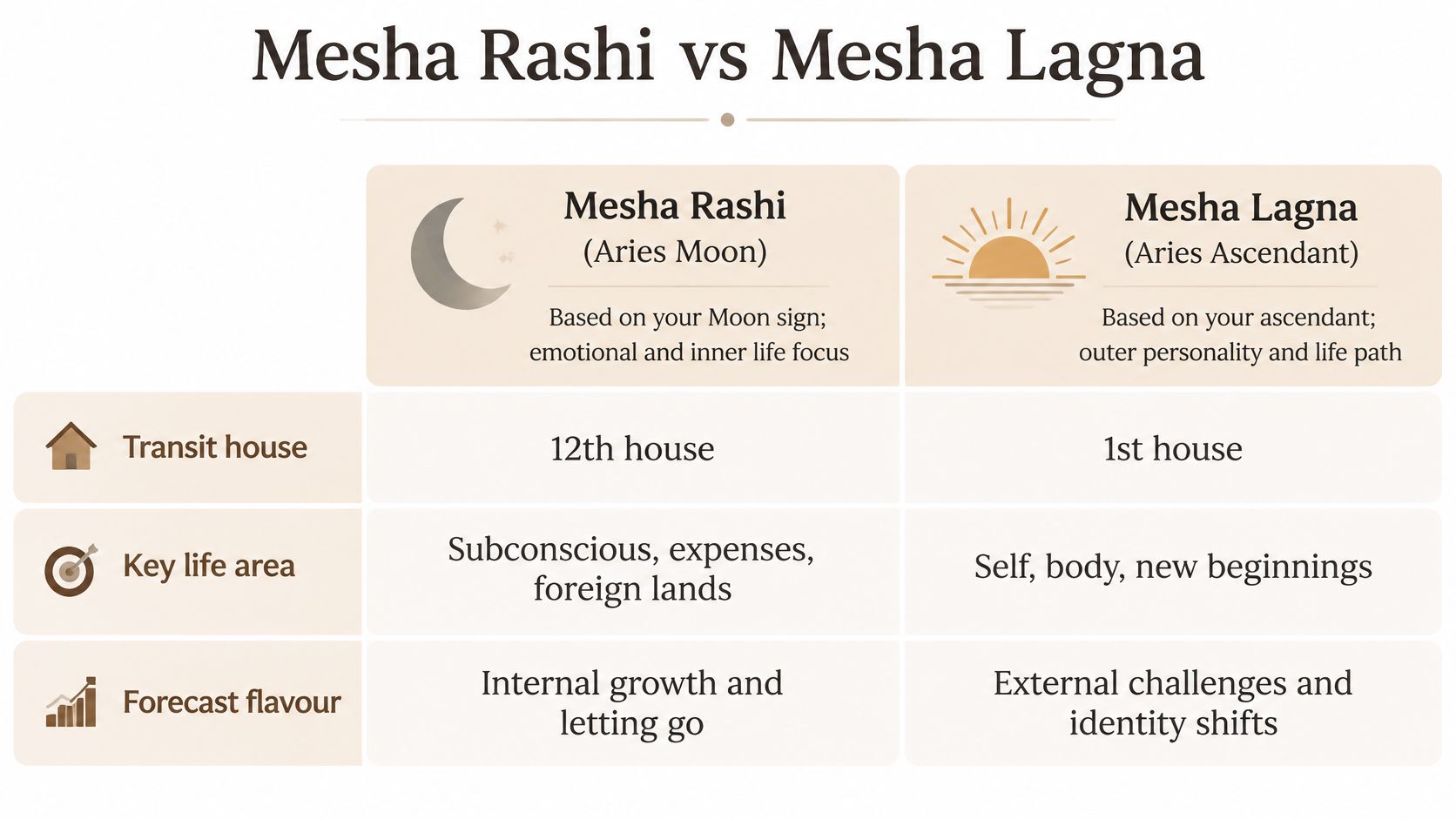
| Theme | Mesha Rashi (Moon Sign) | Mesha Lagna (Ascendant) |
|---|---|---|
| Transit reference | Counted from the Moon; Pisces is 12th from Aries. | Counted from the ascendant; Pisces is the 12th house for Aries Lagna. |
| Main themes to consider | Spending, rest, solitude and foreign connections. | Expenses and travel, alongside career and gains because of Saturn's house ownership. |
| Forecast focus | Inner experience and what may need review or release. | Life areas connected with work, networks and resources, read alongside the full chart. |
A kundli chart can help establish which reference applies, but major decisions still need the chart's other factors.
Three decisions, two chart references
Job change: A Moon-sign forecast may prompt an Aries Moon reader to check expenses and the practical costs of a job move. An Aries ascendant reading may also examine career and gains. Neither one can confirm that a particular offer should be accepted without assessing the full chart and the offer itself.
Marriage timing: Neither an Aries Moon nor an Aries ascendant transit alone is enough to recommend or rule out marriage. Compatibility, the relevant relationship indicators and the running planetary period need individual assessment.
Foreign relocation: A Moon-sign reading may treat overseas plans as part of the 12th-house discussion. For an Aries ascendant, the astrologer may also weigh career and gains. In either case, visas, finances, family needs and professional advice remain essential.
How Dasha and Antardasha Change the Story
A transit describes Saturn's current position; a dasha describes a planetary period in the person's chart. An antardasha is a sub-period within that larger period. Astrologers consider both because two people with the same Moon sign can be in different planetary periods and have different birth charts.
For example, an Aries Moon person experiencing the Pisces transit during a Saturn dasha or antardasha may find that the astrologer gives Saturn's themes more attention. During a Jupiter or Rahu period, Saturn may be treated as background pressure rather than the main timing influence. That is an interpretive framework, not a guarantee that one period will feel easy and another difficult.
A useful reading also checks planetary strength, house ownership and aspects. Divisional charts are specialised charts used alongside the main kundli for topics such as marriage, career or education. They help an astrologer ask more focused questions, but they don't replace practical information about the decision itself.
A transit is one layer of timing. A dasha and the birth chart show why the same transit may be read differently for different people.
If the active period is supportive, an astrologer might describe the transit as a time for steady work and routine-building. If the dasha is difficult, the same transit may be interpreted as added pressure. The practical lesson is not to label either situation as a fixed fate. It's to ask which parts of life need attention and what evidence outside the chart should guide the decision.
For marriage, a job change or relocation, a transit-only answer is too narrow. A reader can ask an astrologer to explain which chart factors support the interpretation and what remains uncertain.
Practical Dos, Don'ts, and Remedies for the Next 90 Days
The next 90 days can be used as a planning window, not as a period to fear. A person can set a simple review routine and adjust it to their actual needs.
- Money: List recurring costs, review subscriptions and build an emergency buffer where possible. Avoid taking on high-interest debt without comparing the terms and considering a qualified financial adviser.
- Sleep: Keep a steady wake-up time and set a screen cut-off that supports rest. If sleep problems persist, seek medical advice rather than assuming a transit explains them.
- Travel: Keep passports and important documents current. Compare the cost, work requirements and family impact before committing to a non-essential trip.
- Health: Arrange a routine check-up if due, and follow a clinician's advice for concerns such as eye or back discomfort.
Traditional practices without promises
Some people find comfort in chanting or prayer on Saturdays, lighting a sesame-oil lamp, or helping elderly or differently abled people. These are traditional supportive practices, not guaranteed ways to change a transit or secure a particular result.
A reader can choose practices that feel meaningful and safe, without spending beyond their means or stopping prescribed care. Avoid making an important signature decision because it falls on a Saturday, and do not delay a sound decision out of astrological fear. Contracts should be checked on their merits, with legal or financial advice where needed.
A practical test: Choose actions that improve everyday care whether or not the astrological interpretation feels relevant.
Medical, financial and legal decisions belong with qualified professionals. Astrology may provide a reflective framework, but it shouldn't replace evidence, professional care or a careful review of the options.
Common Questions and a Calm Way Forward
When does Sade Sati end for Mesha Rasi?
The timing depends on Saturn's movement relative to the Aries Moon and on the calculation tradition used. The projected entry into Aries on 2 June 2027 marks the beginning of the middle phase, not the end. The 2027–2028 Aries passage is projected to end on 23 February 2028, but that doesn't by itself mark the end of the full Sade Sati period. A reader can check a general Aries horoscope for broad context, while remembering it isn't a personal chart reading.
Is marriage advised during the 2027 Aries transit?
A transit alone can't answer that. Marriage timing needs the individual chart, relevant planetary periods and compatibility considerations. The date shouldn't be treated as an automatic yes or no.
Can a foreign job move be considered during the Pisces phase?
Yes, it can be considered. Astrological themes around foreign connections don't establish that a move will succeed or fail. The person should weigh the offer, visa requirements, finances and family circumstances, and may seek career or immigration advice.
When is a full chart reading useful?
It may help when a decision concerns marriage, relocation, business, a job change or another choice with lasting consequences. A personalised reading on Kismo can clarify the person's dasha, house ownership and divisional charts, so the discussion is based on the individual kundli rather than a generic Mesha-Rasi forecast.
The central reassurance is simple: a Saturn transit is not a verdict. Readers can use the dates to organise questions, take practical steps and seek qualified advice when a decision calls for more than a general forecast.
For readers who want to discuss how Saturn's transit relates to a personal birth chart, Kismo offers chat and call sessions with verified astrologers. They can ask about the chart, marriage compatibility, career questions or auspicious timing, then use that guidance alongside practical and professional advice.