8 Signs of Love Marriage in Astrology
In Vedic astrology, love marriage is more plausibly indicated when the 5th house or its lord connects with the 7th and 11th houses, supported by Venus, Moon, Mars, relevant dashas, and transits. No single placement guarantees an outcome.
Can a kundli point to marriage with someone already loved, or does it only describe personality and attraction? That question matters for someone in a committed relationship who wants to know whether romance can become a formal partnership, especially when family approval, religion, caste, distance, finances, or timing may influence the decision.
A kundli, or birth chart, maps planetary positions at birth. A dasha is a planetary period used for timing life themes. A nakshatra is a lunar constellation used in several Vedic astrology calculations, while muhurta means an auspicious date or time chosen for an important event.
The most useful approach examines connected patterns rather than hunting for one “love marriage yoga.” The eight signs below cover Venus, the 5th, 7th, and 11th houses, Moon and Mars, Jupiter, kundli matching, the Navamsha chart, dashas, transits, and practical timing. Traditional astrology can provide a reflective framework for relationship patterns and possible periods, but marriage also depends on consent, communication, shared values, family circumstances, and personal choices.
Table of Contents
- 1. Venus Placement and Strength in the Natal Chart
- 2. The 7th House of Partnership and Marriage
- 3. Dasha Periods for Timing Marriage Through Planetary Cycles
- 4. Kundli Matching and Compatibility Between Birth Charts
- 5. The Navamsha Chart and Long-Term Partnership
- 6. Jupiter's Role in Wisdom and Expansion
- 7. Mangal Dosh and Its Marriage Impact
- 8. Transits and Muhurta for Current Marriage Timing
- 8-Point Comparison: Love-Marriage Indicators in Astrology
- Read the Pattern, Not Just One Placement
1. Venus Placement and Strength in the Natal Chart
Venus, called Shukra in Vedic astrology, represents attraction, affection, pleasure, relationship values, and the desire to create harmony. A strong Venus can support warmth and romantic expression, but it doesn't independently prove that a person will marry for love. The sign, house, dignity, aspects, conjunctions, and planetary periods all change the interpretation.
The house occupied by Venus shows where relationship themes become visible. Venus in the 5th house can support romantic interest and emotional involvement. Venus in the 7th house places relationship and partnership themes close to the marriage area. Venus joined with Jupiter may combine affection with generosity and shared principles, while Saturn's influence can describe a more serious relationship that develops slowly and seeks commitment.
Consider a person with Venus in the 7th house in a supportive sign. That person may attract proposals naturally or value partnership strongly. Another person with Venus influenced by Saturn may prefer a dependable bond over casual romance and may take longer to formalize a relationship. These are interpretive possibilities, not fixed outcomes.
What to inspect in Venus
- House and sign: The placement can describe relationship style, expectations, and the settings in which affection develops.
- Planetary support: Benefic influence may make expression easier, while combustion, affliction, or difficult associations can require closer examination.
- Connection to the 5th and 7th houses: This helps distinguish general charm from a pattern in which romance may move toward marriage.
- Dasha relevance: A strong Venus becomes more practically important when its dasha or antardasha activates relationship houses.
A person seeking a complete kundli reading should ask for Venus to be assessed alongside both partners' charts, not as a standalone sign. The reading can then connect attraction, expectations, compatibility, and timing without turning one placement into a promise.
2. The 7th House of Partnership and Marriage
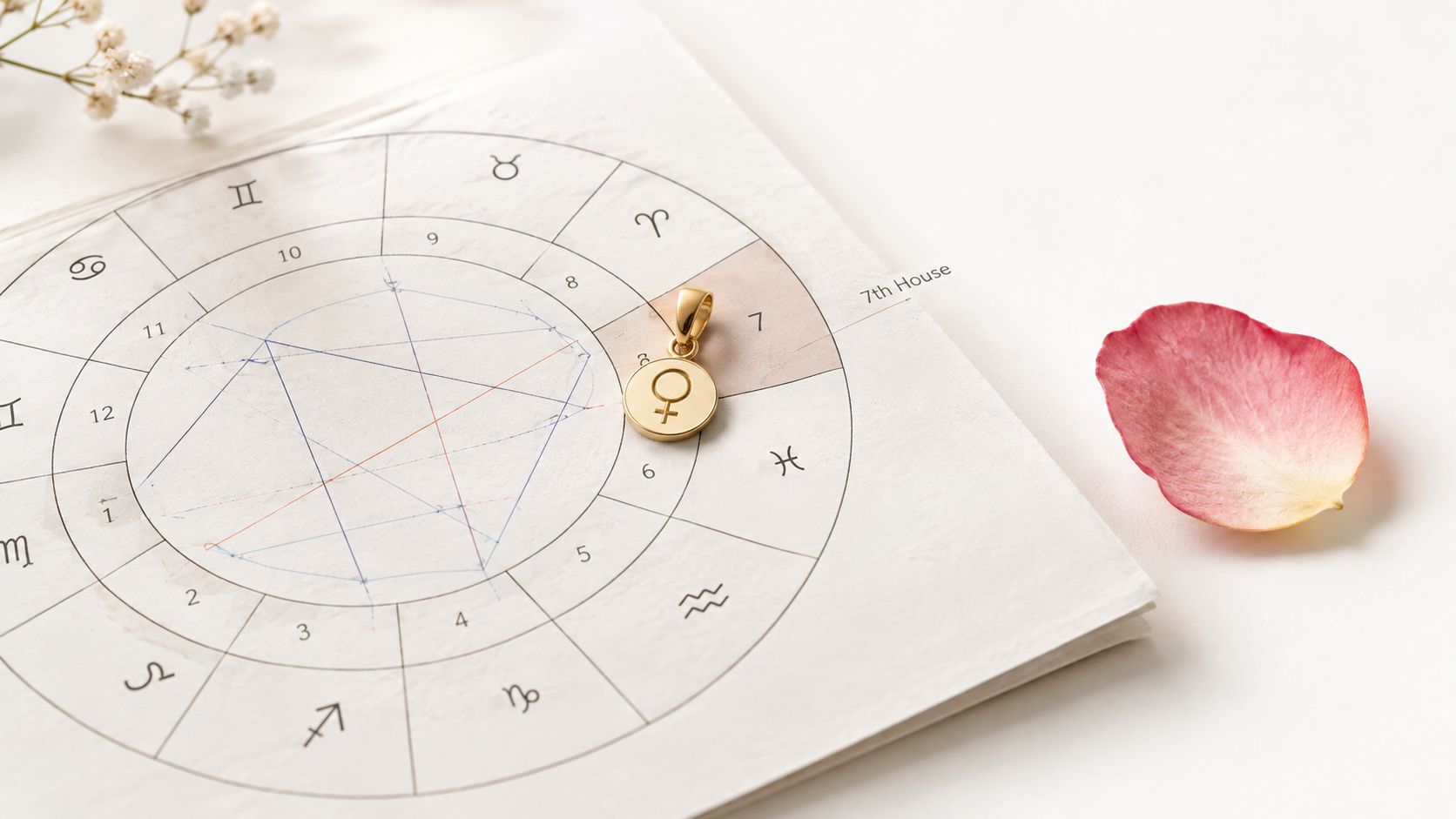
The 7th house is the central marriage and long-term partnership area in a Vedic chart. It describes the person's approach to formal partnership, qualities sought in a spouse, and the circumstances that may shape commitment. Astrologers examine the sign in the 7th house, planets placed there, aspects received by it, and the condition of its ruling planet, known as the 7th lord.
A love-marriage reading becomes more specific when the 7th house connects with the 5th house of romance. Traditional methods include conjunction, mutual aspect, exchange of house lords, or placement of the 5th lord in the 7th and the 7th lord in the 5th. The same relationship can also be strengthened when the 11th house of fulfilment, networks, and gains connects with these houses. This combination can describe romance becoming a socially recognised partnership, sometimes through friends, work groups, community circles, or family networks.
For example, a 7th lord placed in the 11th house may link marriage with friends, social networks, or a wider community. Jupiter as the 7th lord may describe a partner associated with learning, ethics, or respect. Mars as the 7th lord can bring strong chemistry and initiative, but the couple may need direct conflict-management habits.
How the 7th house changes the question
The 7th house doesn't answer only “love or arranged.” It can help separate several possibilities:
- Romance becoming marriage: A clear 5th and 7th connection supports this traditional interpretation.
- Marriage through networks: An 11th-house connection may bring introductions through friends, communities, or shared goals.
- Family-approved love marriage: A relationship may begin independently but become formal after family involvement.
- Delay with eventual commitment: Saturn or other challenging influences may slow formalisation without denying partnership.
Practical rule: The 7th house shows the partnership framework, while the 5th house helps explain how affection may enter that framework.
A chart review should identify the 7th lord, assess its strength, and compare its condition with the 5th and 11th houses. Current transits can add timing context, but no favourable house placement can replace consent or a realistic conversation about marriage.
3. Dasha Periods for Timing Marriage Through Planetary Cycles
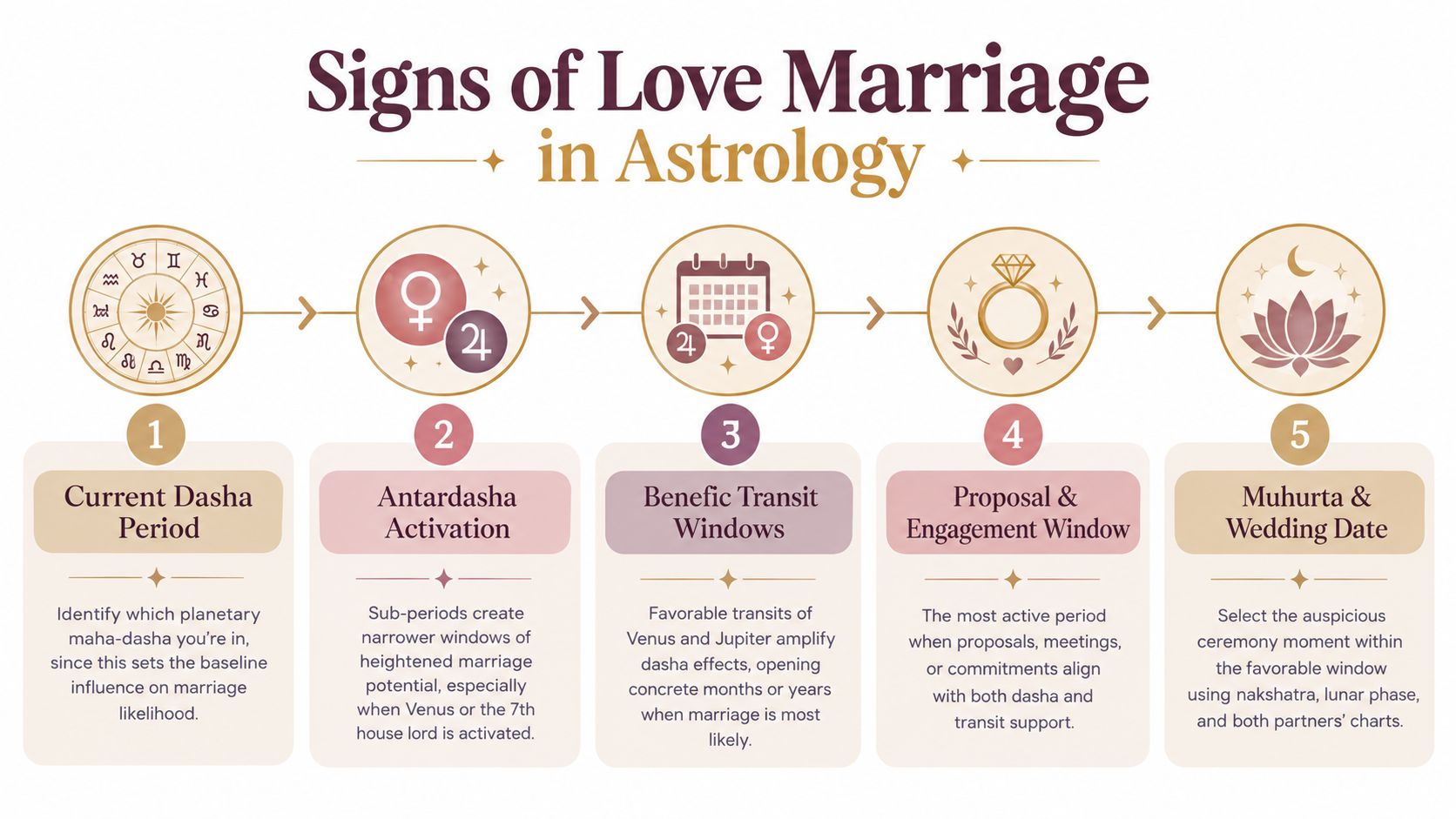
Timing in Vedic astrology works like a clock layered over the birth chart. The chart may show a connection between romance, partnership, or social circles, while a dasha indicates when those themes may become more active. Astrologers commonly examine the Vimshottari sequence, especially the maha-dasha and antardasha of Venus, the 5th-house lord, the 7th-house lord, or planets linked with these factors.
A relevant dasha may bring an existing relationship closer to formal commitment. For example, a period connected with the 5th and 7th houses can support romance becoming marriage, while an 11th-house connection may coincide with introductions through friends, communities, or shared goals. The same chart can show potential without immediate action if the operating period centres on education, work, family duties, or another priority.
The planetary symbolism adds context. Venus periods may increase attention to affection and partnership. Jupiter periods can support growth, family conversations, and serious proposals when Jupiter connects positively with marriage factors. Saturn periods may bring delay, responsibility, or careful commitment. Saturn alone does not deny marriage, and a supportive Venus or 7th-lord sub-period within a broader Saturn period may still matter.
Read the timing in layers
Start with the current maha-dasha. It describes the broader life theme. Then examine the current antardasha, which can show the issue becoming more immediate. Check each planet's links with the 5th, 7th, and 11th houses, Venus, and the Navamsha chart. These connections help distinguish a private romance from a relationship gaining social or family support.
Traditional practice gives more weight to a dasha window when relevant transits point in the same direction. Planet transit guidance can help place that discussion in a wider timing context, but it cannot establish a guaranteed wedding date.
A dasha suggests a period to observe, discuss, and prepare. Personal choices, mutual agreement, family circumstances, and the full kundli still shape the outcome.
After identifying a suitable period, muhurta may help select an auspicious ceremony date and time. It supports the event's timing, but it cannot repair a relationship without trust, readiness, or consent.
4. Kundli Matching and Compatibility Between Birth Charts
Kundli matching, also called guna milap, compares two birth charts to explore compatibility. It has a long association with family-led marriage discussions, but it can also help couples in an existing relationship examine emotional habits, communication patterns, expectations, and areas that may need attention.
The traditional Ashtakoota system uses eight compatibility categories based largely on Moon signs and nakshatras. The categories carry different weights, Varna 1 point, Vashya 2, Tara 3, Yoni 4, Graha Maitri 5, Gana 6, Bhakoot 7, and Nadi 8, for a maximum of 36 gunas. Eighteen out of 36 is commonly treated as a working threshold, with 18 to 24 often described as fair, 25 to 32 as good, and 33 to 36 as excellent in traditional summaries. These ranges should guide discussion, not function as an automatic pass-or-fail decision. Traditional Ashtakoota scoring also needs to be read alongside the full charts.
Why a score isn't enough
Nadi and Bhakoot together account for 15 of the 36 points, so astrologers often inspect them carefully. They also examine the 7th house, Venus, Mars, Jupiter, dasha compatibility, and the Navamsha chart. Mangal dosh should be assessed in context rather than treated as an automatic rejection factor.
A couple may have strong romantic chemistry but different conflict styles. Another couple may have a modest score yet share practical values and communicate well. A detailed reading should explain those dynamics in plain language and suggest conversations or habits that may strengthen the relationship.
5. The Navamsha Chart and Long-Term Partnership
The Navamsha, or D-9 chart, is a divisional chart used in Vedic astrology to examine marriage, spouse qualities, and the deeper strength of relationship factors. The main birth chart, or rasi chart, provides the wider life picture. The Navamsha adds detail about how partnership themes may mature over time.
Astrologers commonly inspect the Navamsha 7th house, its lord, Venus, and the condition of planets connected with marriage. A strong D-9 can support the expression of relationship potential seen in the natal chart. A challenging D-9 may point to areas requiring patience, communication, or realistic expectations. Neither chart should be read in isolation.
For example, Venus may appear weak in the natal chart but gain dignity or support in the Navamsha. Traditional interpretation may treat that as a reason to avoid a premature negative conclusion. If Saturn influences the Navamsha 7th house, the relationship may develop slowly or carry substantial responsibilities, yet that influence can also describe seriousness and endurance when both partners act with maturity.
Compare potential with lived experience
A person already in a relationship can ask:
- Does the D-9 support the natal chart's relationship promise?
- What does the Navamsha say about emotional availability and commitment?
- Do both charts show compatible expectations about family, work, home, and responsibility?
- Are apparent delays timing issues, or do they reflect unresolved practical concerns?
A collection of astrology tools may help someone gather basic chart information, but a personalised interpretation still requires accurate birth details and an astrologer who can explain the reasoning. A strong Navamsha is reassuring, but it isn't permission to ignore unhealthy behaviour or lack of consent.
6. Jupiter's Role in Wisdom and Expansion
Jupiter, or Guru, is traditionally associated with wisdom, ethics, learning, optimism, protection, and expansion. In marriage analysis, its condition can show how a person approaches shared principles, growth, family guidance, and long-term responsibility. Jupiter becomes especially relevant when it rules or influences the 7th house, supports Venus, or connects with the 5th, 7th, or 11th houses.
A strong Jupiter may help a couple approach disagreements with perspective and may support constructive family involvement. Jupiter in the 7th house is traditionally read as a possible indicator of a principled or knowledgeable partner, especially when Jupiter has dignity and receives supportive influences. Jupiter as the 7th lord in the 1st house may make marriage a visible and important part of the person's identity, while also bringing proposals or partnership themes directly into personal life.
Jupiter's support has limits
Jupiter's influence doesn't guarantee a harmonious marriage. A chart with strong Jupiter can still show emotional distance, poor communication, incompatible goals, or delayed timing elsewhere. The astrologer should check whether Jupiter is strong in the natal chart and Navamsha, whether it is connected to the relevant houses, and whether its dasha or transit is active.
A Jupiter transit involving the 7th house may be treated as a period for serious relationship developments. Couples may use such a window to discuss engagement, family introductions, or practical planning. Singles may become more open to meeting someone who shares their values, but a transit alone can't identify a particular person or promise marriage.
If Jupiter appears weak, traditional practitioners may discuss spiritual practices or symbolic remedies. Such remedies should remain optional and should never replace medical, financial, legal, or relationship support. The most useful Jupiter lesson is practical: shared values, generosity, honesty, and willingness to learn often matter more than a single planetary label.
7. Mangal Dosh and Its Marriage Impact
Could Mars in a particular house really decide whether a love marriage will work? Mangal dosh, also called Manglik dosh, is a traditional Vedic astrology consideration involving Mars in commonly cited houses such as the 1st, 4th, 7th, 8th, or 12th. Mars represents energy, assertion, courage, desire, and conflict. Its placement can therefore prompt questions about anger, urgency, independence, and the way disagreements enter a partnership.
The label is only one thread in the kundli. An astrologer should examine Mars's sign, house, aspects, planetary strength, possible cancellation or moderation conditions, the Navamsha, and connections with Venus, the 7th house, and its lord. The partner's chart matters too. For example, Mars in the 4th house may point more toward household tension, family routines, or domestic decisions than toward a lack of romantic feeling.
A love marriage involving one Manglik and one non-Manglik partner can remain stable when both people understand their conflict habits and practise active listening. Two people with strong Mars influences may recognise each other's directness, yet shared intensity still calls for boundaries and respectful repair. These combinations suggest themes to discuss, not fixed outcomes.
Read Mars through behaviour
Rather than treating Mangal dosh as a verdict, connect the chart with daily life:
- Request the full assessment: Ask how Mars relates to its sign, house, aspects, dignity, Venus, the 7th house, and the Navamsha.
- Check moderation factors: A Manglik label does not show severity by itself.
- Discuss practical pressure points: Partners should talk about anger, personal space, family decisions, money, and how they repair disagreements.
- Keep remedies voluntary: Puja, mantra, or gemstones may have spiritual meaning for some people, but they are not compulsory purchases or guarantees.
A dosha is a reason for closer examination, not a verdict on a person's ability to love or marry.
Some traditional families give weight to matching Manglik status. A responsible reading also respects informed consent, direct conversation, and the couple's wellbeing, while separating traditional belief from proven causation. The full kundli and personal choices remain more informative than one planetary label.
8. Transits and Muhurta for Current Marriage Timing
Could a relationship become marriage-ready during a particular planetary period? In Vedic astrology, transits and Muhurta help examine that question, but they work as timing layers rather than standalone proof. The natal chart shows the broader pattern, while the Navamsha and dashas add context. Current transits indicate when that pattern may become more active.
Begin by checking whether Venus, Jupiter, Saturn, or the 7th-house lord is activating the 5th, 7th, or 11th house. These houses connect romance, partnership, and social networks. A Venus transit through the 7th house may coincide with greater interest in commitment, proposals, or relationship harmony. If the 7th lord moves through the 5th house, romantic attention may become stronger. These signals can describe a favourable phase, though they do not promise marriage.
Timing becomes more persuasive when several links agree. For example, a supportive Venus transit may encourage affection, while Jupiter's influence can support growth or family discussions. If a relevant dasha is active at the same time, the period may suit engagement or marriage planning. Saturn can add seriousness, responsibility, or delay, so its role requires careful interpretation rather than a simple positive or negative label.
Muhurta is the selection of an auspicious date and time for a ceremony. An astrologer may review both partners' birth details, the Moon, nakshatra, planetary strength, and the purpose of the event. A chosen time still needs to fit the venue, family arrangements, travel, health, finances, and the couple's readiness.
Use the timing as a practical calendar, not a verdict. Compare current transits with the active dasha, then keep several ceremony dates available. A supportive window may suit family introductions, serious conversations, engagement planning, or counselling. A nakshatra may be considered because it describes the Moon's lunar constellation at that time. Accurate birth date, time, and location improve the calculation, while mutual agreement and practical readiness should guide the final decision.
8-Point Comparison: Love-Marriage Indicators in Astrology
| Item | Implementation complexity | Resource requirements | Expected outcomes | Ideal use cases | Key advantages |
|---|---|---|---|---|---|
| Venus Placement and Strength in the Natal Chart | Moderate, sign, house, aspects interpretation | Accurate birth data; natal-chart tool or astrologer | Clarity on love style, partner type, timing clues (not absolute) | Individual relationship profiling; pre-compatibility insight | Direct view of romantic tendencies; guides timing and partner matching |
| The 7th House: House of Partnership and Marriage | Moderate to high, need house-cusp and lord analysis | Exact birth time; chart calculation; optional divisional charts | Direct indicators of marriage timing, spouse traits, quality of partnership | Marriage timing, spouse-character assessment, kundli matching | Most direct chart factor for partnerships; can pinpoint timing via 7th lord |
| Dasha Periods: Timing Marriage Through Planetary Cycles | High, layered period calculations and sub-period study | Precise birth details; dasha calculator or experienced astrologer | Specific windows (often within 1–2 years) for marriage; explains past timing | Planning marriage timing; scheduling muhurta; anticipating windows | Provides narrow, actionable timeframes for marriage planning |
| Kundli Matching (Guna Milap): Compatibility Between Birth Charts | High, dual-chart, navamsha and dasha synthesis | Accurate birth data for both partners; detailed astrologer review | Compatibility score, friction points, mitigation strategies | Arranged-marriage assessments; pre-engagement decisions | Deep compatibility insight; highlights areas to strengthen or manage |
| The Navamsha Chart (D-9): The Marriage Chart | Moderate to high, divisional chart derivation and nuanced reading | Exact birth time; navamsha calculation; skilled interpretation | Refined marriage quality assessment; spouse character and hidden outcomes | When main chart is ambiguous; detailed marriage prognosis | Marriage-specific refinement; explains discrepancies with the main chart |
| Jupiter's Role: Wisdom, Luck, and Expansion in Marriage | Low to moderate, assess placement, aspects, dashas/transits | Birth chart; transit and dasha data | Indications of fortune, growth, spouse qualities, favorable periods | Evaluating marital luck; timing during Jupiter dasha/transit | Signals optimism, protection, and auspicious timing for marriage |
| Mangal Dosh: Mars Affliction and Its Marriage Impact | Low to moderate, locate Mars and evaluate cancellations/aspects | Natal charts (both partners for matching); expert nuance | Flags potential conflict tendencies; suggests remedies or management | Screening for marital friction risk; compatibility checks in tradition | Identifies conflict triggers; enables targeted remedies and preparation |
| Transits and Muhurta: Current Planetary Windows and Auspicious Wedding Timing | Moderate, ongoing monitoring and muhurta selection | Ephemeris/transit tools; both partners' birth data; muhurta expert | Short-term marriage windows; precise auspicious ceremony timings | Scheduling weddings, selecting auspicious dates, last-mile planning | Practical, date-specific guidance; aligns ceremony with favorable planetary positions |
Read the Pattern, Not Just One Placement
The clearest reading of the signs of love marriage in astrology follows an order. First, confirm the birth date, time, and place because inaccurate details can change houses, divisional charts, and timing calculations. Then inspect the 5th house and its lord for romance, the 7th house and its lord for marriage, and the 11th house for fulfilment, social support, and the possibility that a relationship becomes publicly accepted.
Next, assess Venus, Moon, Mars, and Jupiter together. Venus describes attraction and relationship values, the Moon adds emotional bonding and mental comfort, Mars shows passion and conflict style, and Jupiter contributes wisdom, shared principles, and growth. The meaning comes from their connections with the 5th, 7th, and 11th houses, not from a single sign or conjunction.
The Navamsha then helps test the depth and durability of marriage factors. A strong natal indication may need supportive D-9 confirmation, while a difficult natal placement shouldn't be judged without seeing how the Navamsha modifies it. Kundli matching can add a second-person perspective by comparing Moon-based compatibility, Venus and Mars, the 7th houses, dashas, and relationship expectations.
A practical order for a reading
- Confirm the foundation: Use accurate birth details for both partners.
- Trace romance to marriage: Look for structural links among the 5th, 7th, and 11th houses and their lords.
- Assess relationship planets: Review Venus, Moon, Mars, and Jupiter for strength, support, and affliction.
- Verify the Navamsha: Check whether the D-9 reinforces or qualifies the natal chart.
- Review timing: Examine dashas, antardashas, and relevant transits.
- Discuss real life: Consider consent, communication, family expectations, financial readiness, location, religion, caste, work, and shared values.
India's social context makes this distinction especially important. A BBC report on marriage patterns in India described a 2018 survey of more than 160,000 households in which 93% of married Indians called their marriage arranged, 3% called it a love marriage, and 2% described it as love-cum-arranged. The same reporting noted that arranged marriage remained above 90% even among couples in their twenties. These figures describe social patterns, not planetary causation, but they explain why a Vedic reading may ask whether a relationship is fully self-selected, later accepted by family, or arranged with meaningful consent.
A separate analysis using the 2005 India Human Development Survey, which covered 41,554 households across 33 states, classified first marriages among women aged 25 to 49 who married at ages 15 to 24. It reported 35% arranged by parents without the respondent's consent, 23% parent-arranged with some consent, 36% jointly determined by the couple and family, and about 5% fully self-arranged or self-choice marriages. The analysis also reported an urban education gradient, with love-marriage shares of approximately 25% among women with no education and 44% among women with secondary education, while cautioning that these subgroup figures shouldn't be generalised to all India. The India Human Development Survey analysis reinforces the value of asking what “love marriage” means in a particular family.
Astrology is best used as reflective guidance alongside communication, consent, shared values, and practical readiness. It can help organise questions about attraction, commitment, family negotiation, and timing, but it can't make a decision for either partner. A detailed chart or kundli matching reading with a qualified astrologer can connect the factors without reducing a complex relationship to a score or a promise. Kismo offers one-on-one guidance by chat or call for birth-chart interpretation and marriage compatibility, so couples can ask for the reasoning behind a reading and discuss practical concerns respectfully.
Kismo connects users with verified astrologers for one-on-one chat or call guidance on birth charts, love-marriage questions, kundli matching, and muhurta selection. Couples can bring both birth details and ask for a clear explanation of the 5th, 7th, and 11th houses, dashas, Navamsha, compatibility, and timing through Kismo.