Sun in Gemini: Personality, Transits, and Growth
In Indian Jyotisha, Sun in Gemini means the Sun is in Mithuna rāśi, the zodiac's sector from 60° to 90°, usually during approximately 15 June to 15 July in the sidereal calendar. Meaningful guidance still depends on the Moon sign, house placement, and current dasha, not this placement alone.
That immediately challenges the most popular advice about this placement. A short horoscope may call a Gemini Sun communicative, curious, and adaptable, but those words don't answer the questions that matter in daily life. Does the placement help a person handle marriage conversations? Is a job change sensible during a particular period? Should education, business, relocation, or a relationship decision happen now?
In Vedic astrology, the Sun in Gemini is better treated as a starting point for enquiry. The sign shows a style of expression, while the house, Mercury, Moon, nakshatra, dasha, and transits show where that style operates and when it becomes important.
Table of Contents
- Why Sun in Gemini Is More Than a Personality Label
- Understanding Sidereal Gemini in Indian Jyotisha
- Core Personality Traits of a Gemini Sun
- How House Placement Changes Everything
- Transit Effects Across Different Moon Signs
- Practical Growth Advice for Gemini Suns
- Putting It All Together in Your Kundli
Why Sun in Gemini Is More Than a Personality Label
Calling someone “a Gemini Sun” can be as incomplete as judging a whole house by its front door. The sign gives an entrance, but the rest of the kundli shows the rooms, occupants, and timing. A person may communicate brilliantly at work yet avoid difficult emotional conversations at home, or may be curious about many careers but remain steady once the tenth house and dasha support one direction.

From adjectives to useful questions
A practical reading begins with the situation. For marriage, the useful question isn't whether Gemini makes a person talkative. It is whether the Sun's house and Mercury's condition support clear discussion, listening, and respectful disagreement. For career, the question becomes whether communication, teaching, writing, sales, consulting, analysis, or business coordination is supported by the whole chart.
The Financial Express reports that marriage and relationships are the most common concerns raised on astrology apps, followed by career and finance, while 70% of users prefer quick, personalised guidance over generalised horoscopes according to its report on Indian astrology-app use. That preference makes sense. A reader facing a job offer needs a framework for comparing timing, responsibilities, relocation, and financial pressure, not a list of personality adjectives.
Practical rule: Treat Sun in Gemini as a question about how identity and authority are expressed, then test that pattern against the full chart.
Sign-only language can also create unnecessary self-doubt. Gemini's dual quality doesn't prove indecision, and intellectual flexibility isn't the same as superficiality. A person may gather several options before choosing carefully. The more useful interpretation identifies what evidence in the kundli supports commitment, change, or a pause.
Understanding Sidereal Gemini in Indian Jyotisha
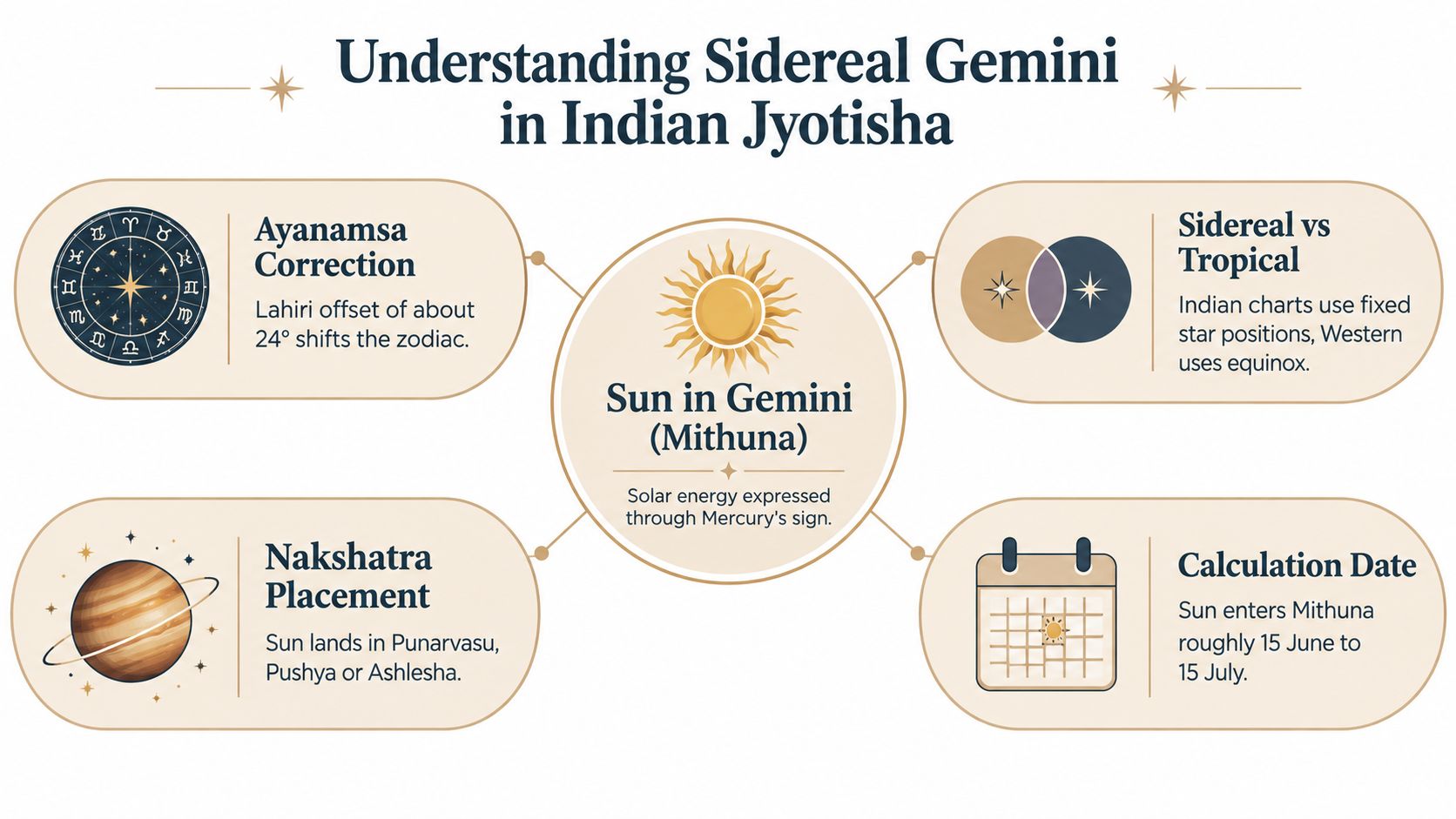
Indian Jyotisha uses a sidereal zodiac, anchored to stellar reference points. Most modern Western astrology uses a tropical zodiac, linked to the equinoxes. Because Earth's axial precession gradually changes the relationship between these reference systems, they are currently separated by roughly 23–24 degrees as described in this overview of Hindu astrology.
In the sidereal system, Mithuna is the third of the 12 rāśis. It begins at 60° and ends at 90°, covers a 30-degree sector, and is traditionally associated with Budha, or Mercury. Its symbol is the twins, its element is air, and its modality is dual or mutable. These are building blocks, not a complete verdict.
Why dates can confuse readers
For India-focused sidereal astrology, the Sun usually travels through Mithuna from approximately 15 June to 15 July. The ingress and exit may shift by about a day according to the year, time zone, and calculation method as explained in this sidereal astrology guide. Tropical Gemini is commonly placed around 21 May to 20 June, so someone identified as Gemini in a Western chart may have the Sun in Taurus in a sidereal Indian chart.
Birth date alone can't settle the matter. Accurate calculation requires the date, exact time, location, and ayanāṃśa convention, along with confirmation that the astrologer is using a sidereal rāśi chart. The Sun's sign then has to be combined with houses, nakshatras, dashas, and planetary aspects.
This is why “Sun in Gemini” in Indian astrology isn't merely a birthday label. It identifies the Sun's position in a calculated chart, and the chart supplies the context needed for interpretation.
Core Personality Traits of a Gemini Sun
The traditional association with Budha gives Mithuna Sun a strong connection with language, learning, classification, and exchange. The air element supports movement through ideas, while the dual or mutable quality helps a person compare viewpoints and adjust to changing information.
In ordinary life, this can appear as someone who asks several questions before accepting a proposal, explains a complicated process in simple words, or moves comfortably between a client call, a family discussion, and a new course. Such a person may enjoy teaching, writing, sales, consulting, media, research, or entrepreneurship because these fields reward mental agility and communication.

The useful side and the difficult side
The same flexibility can make routine feel limiting. A Gemini Sun might begin several courses, business ideas, or applications with genuine enthusiasm, then lose interest when the work becomes repetitive. During conflict, the person may explain feelings logically instead of acknowledging the emotional experience of a spouse or parent. Overthinking can then look like indecision, even when the actual issue is an excess of competing information.
A healthier expression keeps curiosity but adds completion. One clear task, a written decision rule, and time for quiet reflection can prevent mental movement from becoming scattered action. In relationships, asking a partner what support is needed before offering analysis often improves communication.
Readers can compare these themes with a Gemini horoscope perspective, but a general horoscope can't replace a kundli reading. House placement and Mercury's condition may strengthen, soften, or redirect the sign's qualities. These tendencies aren't a promise of success or failure. They describe possible habits that become more or less visible through the individual chart.
How House Placement Changes Everything
The Sun in Gemini can speak through different life areas depending on its house. A second-house placement may make speech, family values, savings, and food-related decisions central to identity. In the seventh house, communication becomes part of partnership and marriage dynamics. In the tenth, public reputation and professional authority take priority.
| House | Life Area | Key Expression |
|---|---|---|
| 2nd | Family, speech, resources | Communication shapes family values and financial decisions |
| 7th | Marriage and partnerships | Identity is expressed through negotiation and one-to-one dialogue |
| 10th | Career and public role | Mercury-style communication supports visibility and reputation |
| 11th | Networks, gains, ambitions | Connections and group activities influence long-term goals |
A simple way to locate the meaning
First, identify the ascendant in the sidereal kundli. Next, locate Mithuna and note the house occupied by the Sun. Then examine Mercury, because the sign's traditional ruler helps describe how the Sun's expression functions. Finally, check the current dasha before making a timing judgement.
A second-house Sun may make a family business discussion important, while a tenth-house Sun may make a presentation, promotion, or professional rebranding more prominent. A seventh-house placement doesn't guarantee either marital harmony or conflict. It indicates that communication and personal authority may require attention within close partnerships.
A sign describes the style. A house identifies the life department. Timing shows when the theme becomes active.
This approach also prevents a common mistake. A person shouldn't decide to resign, marry, relocate, or launch a business solely because a Gemini Sun sounds adaptable. The full chart must show whether the relevant house, Mercury, dasha, and transit support that choice.
Transit Effects Across Different Moon Signs
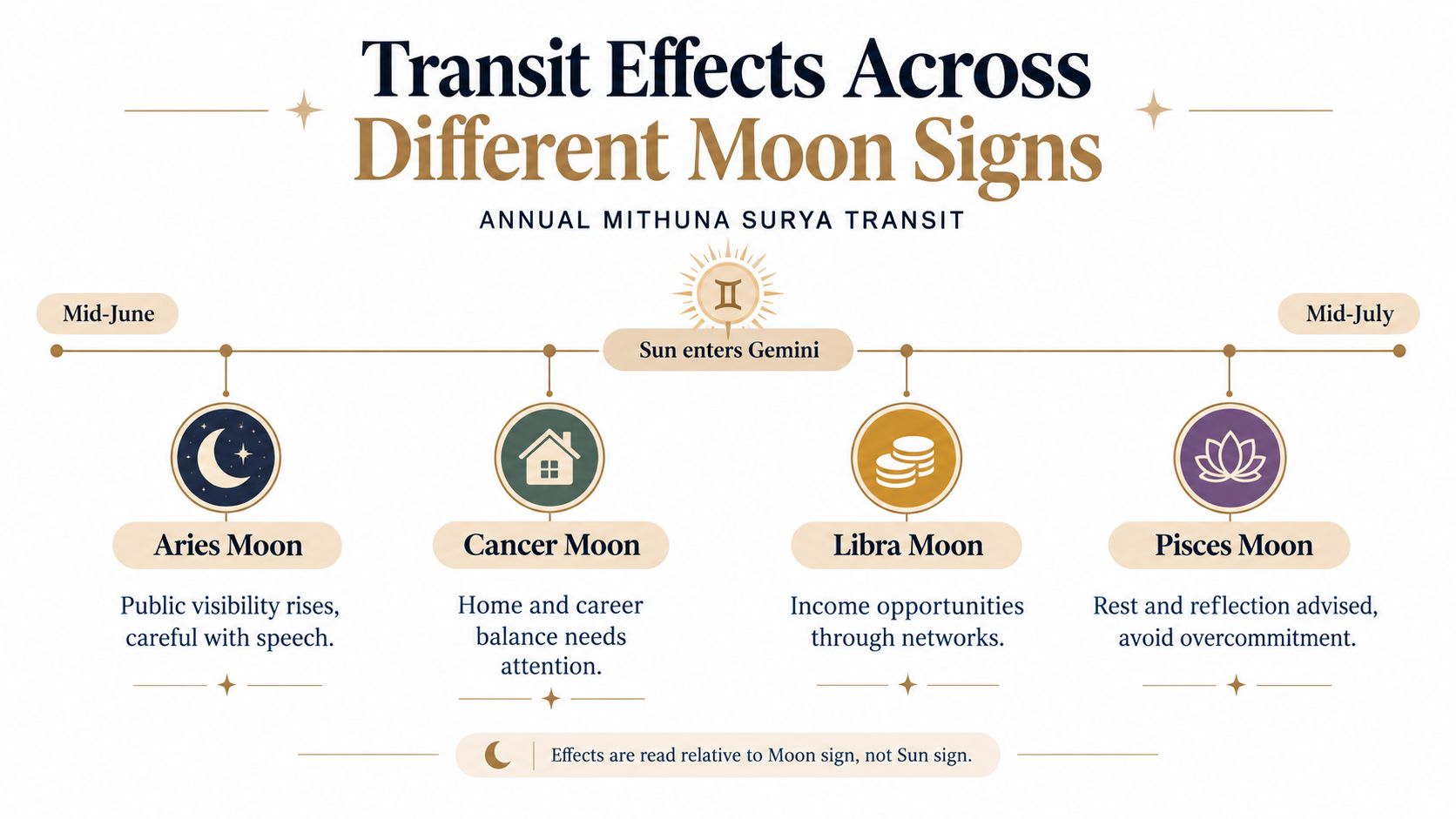
Transit interpretation begins with the janma rashi, the Moon sign at birth, rather than the Sun sign. During the annual Sun transit through Mithuna, the Sun occupies comparatively favourable third, sixth, tenth, and eleventh positions from the natal Moon. For Gemini transit, these correspond to Aries, Capricorn, Virgo, and Leo Moon signs respectively according to this Vedic transit explanation.
For an Aries Moon, the third-house relationship can support initiative, communication, and practical courage. A Capricorn Moon may experience the sixth-house emphasis through problem-solving, competition, work routines, or handling obstacles. Virgo Moon natives may examine professional visibility and responsibility through the tenth-house position, while Leo Moon natives may focus on networks, gains, and wider ambitions through the eleventh.
Why the same transit feels different
A Virgo Moon professional considering a new role might use the Mithuna period to review visibility, responsibilities, and communication with senior colleagues. A Capricorn Moon employee might instead focus on resolving workplace problems, improving routines, and managing competitive pressure. Neither example proves an outcome. Each shows how the Moon sign changes the question.
Other Moon signs require their own house-based reading. The transit source cautions that no transit has a standalone verdict. Natal Sun, Mercury's condition, current dasha or antardasha, and relevant aspects must be considered before choosing a date for a job move, marriage conversation, relocation, or launch.
The annual period generally falls around 15 June to 15 July, with possible date movement according to calculation factors, as noted earlier. Readers seeking transit-focused discussion can review planetary transit guidance, while decisions should remain grounded in the individual kundli.
Practical Growth Advice for Gemini Suns
A Gemini Sun works best when curiosity receives a container. Without structure, a person may collect ideas, courses, contacts, and plans without giving any one of them enough time to mature. With structure, the same mental range can support useful learning and flexible problem-solving.
Turning variety into follow-through
A practical routine can include:
- Choose one active priority: Keep one central project for the current period, even when other ideas remain interesting.
- Use small commitments: Break a large goal into a clear action that can be completed and reviewed.
- Schedule reflection: Set aside quiet time to ask whether a new option is genuinely better or merely more exciting.
- Record decisions: Write the reason for choosing a job, course, or launch date so later doubt doesn't erase the original evidence.
In marriage conversations, communication skill becomes stronger when listening comes before explanation. A Gemini Sun partner may be quick to analyse a disagreement, but the other person may first need acknowledgement, patience, or a direct answer. Emotional presence is not the opposite of intelligence. It gives intelligence a more appropriate role.
Career choices can also benefit from this balance. Teaching, writing, consulting, sales, research, and entrepreneurship may suit a Mercury-linked style, but constant job changes aren't automatically growth. The house placement, strength and condition of Mercury, and active dasha help show whether a period favours exploration, consolidation, or responsibility.
Growth practice: Keep the mind open, but make commitment visible through completed actions.
Astrology can help a person notice priorities, not avoid responsibility. A difficult decision still benefits from financial planning, honest conversations, and practical research alongside chart interpretation.
Putting It All Together in Your Kundli
A complete Sun in Gemini reading combines several layers. The Sun shows identity, confidence, authority, and purpose. Mithuna adds a Mercury-linked style of learning and expression, while the Moon shows the emotional and transit reference point. The house identifies the life area, and Mercury's condition helps describe the quality of communication and judgement.
A nakshatra is a lunar mansion used in Vedic astrology. The sidereal zodiac contains 27 nakshatras, each spanning 13 degrees and 20 minutes, with four padas, or quarters. The Moon's natal nakshatra helps determine the starting dasha in Vimshottari astrology, so accurate birth time matters when interpreting life periods as outlined in this explanation of dasha).
Three checks before a decision
- Verify the chart: Confirm birth date, exact time, location, sidereal setting, and ayanāṃśa.
- Locate the placement: Note Mithuna, the Sun's house, nakshatra, Mercury's condition, and relevant aspects.
- Check timing: Compare the active dasha and antardasha with current transits and the specific question.
A kundli is a birth chart calculated from date, exact time, and place of birth. For marriage, Ashtakoota or Guna Milan compares eight factors and produces a maximum of 36 points, but the score is only a traditional screening aid. Individual charts, dashas, planetary placements, and the couple's circumstances still require interpretation as described in this Vedic astrology reference.
For auspicious beginnings, muhurta means selecting a suitable time for an activity such as a wedding, housewarming, registration, or launch. A traditional muhurta is a 48-minute interval, but the usable window depends on location, sunrise, lunar factors, and the activity, so a time calculated for one city shouldn't be copied elsewhere as explained in this muhurat guide.
Sun in Gemini doesn't guarantee indecision, marriage success, career change, or any other result. It becomes meaningful when the full kundli connects the sign with a real question, a real life area, and a defensible timing method. Readers can use a kundli reading to organise those details before seeking personal guidance.
Kismo connects users with verified astrologers for personalised birth-chart readings by chat or call, including marriage compatibility, career decisions, and muhurta questions. Readers can bring the Sun in Gemini placement, Moon sign, house position, and current dasha to a focused session by visiting Kismo.