Taurus and Cancer Compatibility: Love, Marriage and Family
If a dating app calls two people Taurus and Cancer, does that mean an Indian kundli will read the same pair? Often it doesn't. A Western Sun-sign label follows the seasons. A kundli, the birth chart used in Vedic astrology, follows the fixed stars and, more significantly, the Moon at the exact minute of birth. Two people can share a warm, loyal style and still hold different rashis once both charts are drawn. Taurus and Cancer can form a caring bond. That possibility is a starting point, not a verdict, and it only becomes useful when both charts use the same method.
Table of Contents
- Taurus and Cancer Compatibility at a Glance
- Emotional Strengths and Friction Points in Love
- Western and Indian Dates for Taurus and Cancer
- What a Full Kundli Match Checks Beyond Sun Signs
- How to Time a Wedding With Dashas and Muhurta
- Family, Relocation and Money Questions to Settle Early
- Decide Together After the Chart Reading
Taurus and Cancer Compatibility at a Glance
Taurus and Cancer can form a warm, loyal pair when both value home, routine and emotional safety. They clash when one partner wants a fixed plan and the other needs to feel heard before anything moves. The pattern below is a sketch of that trade-off, not a prediction.
| Area | Strengths the pair often shares | Friction points to watch | Verdict |
|---|---|---|---|
| Love | Loyalty, warmth and shared comfort | Taurus keeps routine while Cancer wants more emotional check-ins | Good when both make time for talk |
| Marriage | Shared love of home, savings and family rituals | Money habits and change of plans can cause stress | Strong with clear money and home roles |
| Friendship | Patient, reliable and caring | Taurus may seem slow to respond while Cancer may feel overlooked | Lasting when both keep in touch |
| Family | Loyalty to relatives and a strong sense of duty | Taurus may resist change while Cancer can be very protective | Workable with agreed boundaries |
These lines come from symbolism. Taurus is linked with Venus, which points toward comfort, loyalty and a settled home. Cancer is linked with the Moon, which points toward care, memory and a need for reassurance. A symbol describes a tendency. It doesn't lock a personality, and it doesn't promise a marriage.
How to use the sketch
Read each row as a question, not a score. In love, the shared comfort helps, and the missed check-in is the risk. In marriage, a love of home helps, and unspoken money roles create stress. Friendship lasts when contact is kept. Family duty works when boundaries are named.
The daily pattern for one sign is only background. A Taurus horoscope can show the week's mood. It can't replace two birth charts. The sections below show how to test this sketch against those charts.
Emotional Strengths and Friction Points in Love
Think of Taurus as a well-built house that stays steady in any weather, and Cancer as the warm hearth that makes the house feel like home. The house offers calm presence, consistent affection and practical care: a ride arranged, a bill paid, a meal that appears at the usual hour. The hearth offers attentiveness, remembered dates and deep emotional support. One partner notices the hard week. The other keeps the plan from falling apart.
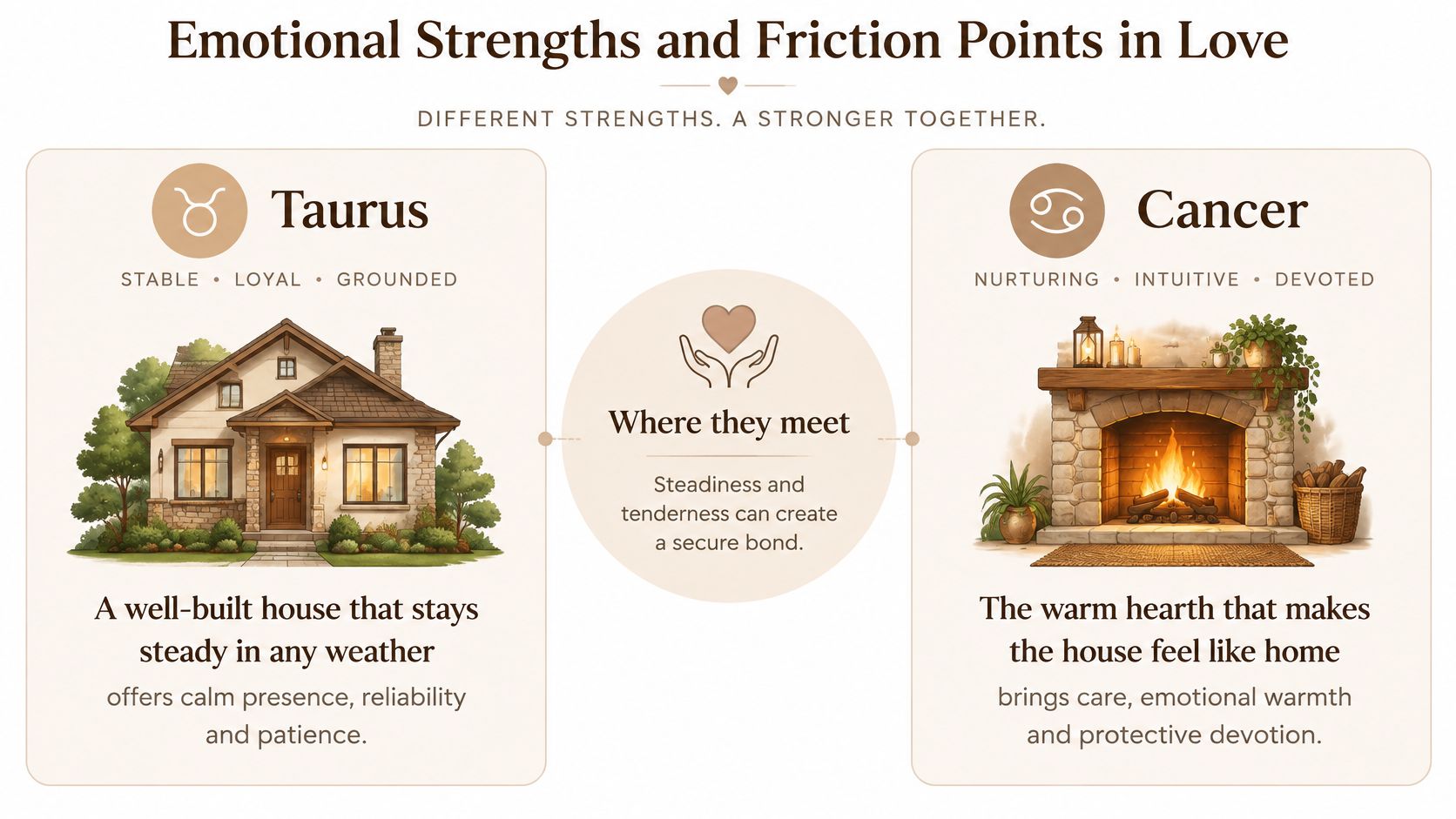
Steadiness and tenderness can create a secure bond. That bond frays in a very ordinary way. When Cancer is hurt, they may go quiet. Taurus may read that silence as calm and keep to the routine, missing the signal. Later, Cancer feels unseen, and Taurus feels accused for doing what usually helps. A second snag sits beside it. Taurus resists a sudden change of plan. Cancer wants reassurance before the change, not a lecture about why the old plan was better.
Taurus gives calm, Cancer gives care, and the pair works best when each learns to recognise the other's way of showing love.
Four repair steps
- Name the mood before a conflict starts. A short line such as "I'm quiet because I'm hurt" stops silence from being filed as peace.
- Set a short weekly talk slot for feelings. Twenty minutes is enough. The point is a known time, not a long speech.
- Split the job. Let Taurus choose the calm hour for a hard talk, and let Cancer choose the words. One person protects the timing. The other protects the feeling.
- Agree on one small shared ritual. A weekend walk or a meal cooked together gives the bond a place to land when words fail.
The same pattern in friendship
Friendship follows the same house-and-hearth shape, with lower stakes and the same misread. Say the Taurus friend keeps the Sunday plan and arrives on time. The Cancer friend remembers the hard week and hopes someone will ask about it. If neither speaks, the steady friend looks cold and the caring friend looks demanding. A monthly shared meal stops that silence from being read as rejection. The four repair steps still apply. The talk slot can be shorter than in a romance, even ten minutes after the meal, because friendship needs contact more than a formal review.
Western and Indian Dates for Taurus and Cancer
| Sign | Western tropical dates | Indian sidereal dates | Traditional ruler |
|---|---|---|---|
| Taurus (Vrishabha) | 20 April to 20 May | 15 May to 14 June | Venus |
| Cancer (Karka) | 21 June to 22 July | 17 July to 16 August | Moon |
The two date columns don't describe two personalities. They describe two measuring systems. In Indian astrology, Taurus is Vrishabha and Cancer is Karka. Each sign is a 30-degree slice of the 360-degree circle, exactly one-twelfth of the zodiac, or 8.33% of the total arc, as set out in this comparison of Vedic and Western Sun signs. The sidereal system used in Jyotisha anchors those slices to the fixed stars, not to the seasonal equinoxes.
Why the dates move
Under typical Indian sidereal dates, the Sun passes through Vrishabha from about 15 May to 14 June and through Karka from about 17 July to 16 August. Those dates aren't pinned to the same calendar day every year. The Sun's apparent motion and calendar calculations can shift the ingress by about one day. The two zodiacs differ by roughly 23 to 24 degrees because of precession, which is why a Western date range and an Indian date range don't line up.
What the Moon changes
Indian astrologers generally don't take the main rashi from the Sun sign alone. The Janma Rashi comes from the Moon's exact position at the time and place of birth. A person born in the Western Taurus or Cancer window may receive a different Indian sidereal sign.
Say someone is born near the start of the Western Cancer period. Under a sidereal calculation that birth can fall in Gemini, depending on the exact date, time, place and ayanamsa. A date-only lookup can't settle it.
Write down three facts for each partner: the birth date, the clock time, and the city or town. Then ask for both charts to be calculated in the same system. Mixing a tropical Sun sign with a sidereal Moon sign produces a match that neither method supports.
What a Full Kundli Match Checks Beyond Sun Signs
A Taurus Sun and a Cancer Sun can look tidy on a Sun-sign compatibility grid. A full kundli match asks a more exact question: what do the two birth charts say to each other? The traditional core is Ashtakoota, an eight-part system with a maximum of 36 points. Those eight factors examine temperament, mutual influence, health or family continuity, and the wider bond. Sun-sign descriptions cannot stand in for that comparison.
| Koota | What it examines | Maximum points |
|---|---|---|
| Varna | Work attitude and ego | 1 |
| Vashya | Mutual influence | 2 |
| Tara | Health and wellbeing | 3 |
| Yoni | Intimacy and physical compatibility | 4 |
| Graha Maitri | Friendship between the Moon signs | 5 |
| Gana | Temperament | 6 |
| Bhakoot | Emotional bond and family prosperity | 7 |
| Nadi | Health and family continuity | 8 |
| Total | Overall compatibility score | 36 |
What each point is asking
The eight kootas work like eight questions asked of the two charts, each with a different weight. Varna looks at work attitude and ego, a small slice worth one point. Vashya asks who influences whom, and whether that pull feels mutual. Tara turns toward health and wellbeing. Yoni concerns intimacy and physical comfort, not a moral grade.
Graha Maitri checks the friendship between the two Moon signs. For a Taurus and Cancer pair, that Moon-sign comparison can carry more emotional detail than the Sun labels do. Gana sorts temperament, the pace at which two people settle an argument. Bhakoot weighs the emotional bond and family prosperity. Nadi, the largest single share at eight points, concerns health and family continuity.
Traditional guidance treats a fairly high total as favourable, but no total guarantees a successful marriage. It should not be used as a stand-alone decision rule. A pair with a modest total and kind house placements can live more peacefully than a pair with a strong total and a harsh 7th house. The total is one input, not the verdict.
What sits outside the total
The astrologer also reads each chart on its own: the Moon's nakshatra (lunar mansion), the ascendant, the house placements, and the planetary periods. Mangal dosha, also called Manglik, is the traditional check for Mars placed in certain houses counted from the ascendant, the Moon or Venus. It is read on both charts. It can be softened when both partners have it, or when other placements ease it. A single Mangal dosha flag does not by itself reject a Taurus and Cancer match.
Practical rule: A high Ashtakoota score doesn't replace a conversation. The two people still have to like how they talk, spend and live.
The kundli matching result is only as good as the birth details behind it. Users need to enter an accurate birth date, time and place for each person, because those details feed every chart the astrologer prepares. The same ayanamsa and the same ephemeris should be used for both people. Mixing systems makes the 36-point total look precise while comparing two different skies.
How to Time a Wedding With Dashas and Muhurta
A sign-only reading can't show which planetary period is active for each person. Vimshottari dasha is the timing frame Vedic astrologers use for that question. Muhurta is the practice of choosing an auspicious time for an important action, such as a wedding. One tool reads the life period. The other reads the ceremony clock. They answer different questions, and a date needs both.
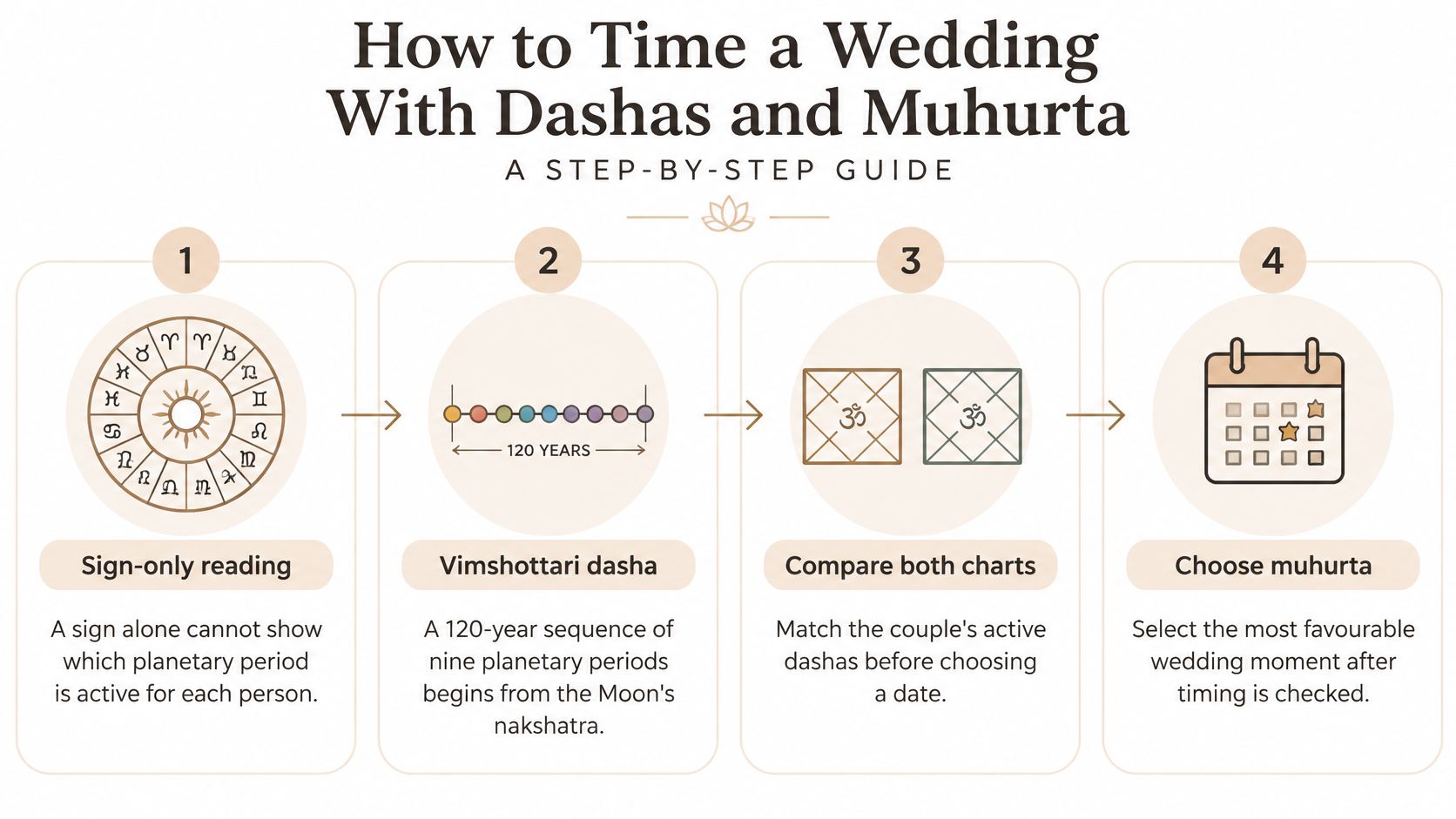
As Astrolium's Vedic guide sets out, Vimshottari divides a full predictive sequence into 120 years across nine planetary periods: Sun 6, Moon 10, Mars 7, Rahu 18, Jupiter 16, Saturn 19, Mercury 17, Ketu 7 and Venus 20. The sequence starts from the planetary ruler of the birth nakshatra, and the first period can already be partly finished.
A nakshatra is a lunar mansion. The usual modern system splits the 360-degree zodiac into 27 equal parts, so each covers 13 degrees and 20 minutes, the division described in the Encyclopaedia Britannica's nakshatra entry. The Moon's nakshatra at birth names the planet that opens the sequence.
| Planet | Period length |
|---|---|
| Sun | 6 years |
| Moon | 10 years |
| Mars | 7 years |
| Rahu | 18 years |
| Jupiter | 16 years |
| Saturn | 19 years |
| Mercury | 17 years |
| Ketu | 7 years |
| Venus | 20 years |
| Full sequence | 120 years |
Six steps to a shortlist
- Collect accurate birth date, time and place for both partners. A wrong city or a rounded hour shifts the Moon's mansion and the opening dasha.
- Ask for the active mahadasha and sub-period of each person. The long period sets the climate. The sub-period sets the season inside it.
- Note which periods are supportive and which need extra care. Neither label is a guarantee. A supportive period still needs a workable plan.
- Shortlist muhurta dates from the Panchang. Use tithi (lunar day), vara (weekday), nakshatra, yoga and karana together.
- Check each shortlisted date against both kundlis, the ceremony location and the local time zone. A window that suits one chart and misses the other isn't a joint muhurta.
- Confirm the shortlist with the astrologer and keep one backup date. Families, venues and travel fail for ordinary reasons.
For marriage, lunar tithis 2, 3, 5, 6, 7, 10, 11, 12 and 13 are traditional candidates, as noted in this muhurta selection guide. They're candidates only. Weekday, nakshatra, yoga, karana, the local ascendant and both kundlis still have to agree. The day's panchang is the checklist for that pass, not a substitute for the two charts.
Say one partner is in a Venus mahadasha and the other in a Moon mahadasha. Shortlist a 5th or 10th tithi in a month both families can travel, then drop any date that clashes with either chart. The chosen window is a planning aid. It isn't a promise about the marriage.
Family, Relocation and Money Questions to Settle Early
Personality sketches rarely decide an Indian marriage. Parents, a job in another city, and the monthly budget do. A 2025 Jeevansathi report covering more than 21,000 Indian singles, reported by Businessworld, found that 40% were willing to relocate abroad for the right partner, while 70% of parents preferred their children to marry within India or return after marriage. The same reporting found that only 4% said parents alone would choose their life partner. The couple is deciding, and the family still has a strong view about where that life sits.

Taurus often wants a fixed base and a clear savings plan. Cancer often wants emotional security and a say for the people they love. Those wishes can support each other, or they can stall a move, a budget and a wedding guest list. A chart reading can sit beside the conversation. It isn't the decision maker.
Questions worth settling before a date is booked
- How involved will parents be? A balanced answer gives parents a real hearing and leaves the final yes with the two people.
- Would either partner relocate, and who decides? Name the city, the length of the stay, and the review date, so "for the right partner" doesn't become an open-ended promise.
- How will money be shared, saved and spent? Agree one joint amount, one personal amount, and who pays the recurring bills.
- Who will care for elders or children? Write the weekly load, not a vague offer to "help when needed".
- Which language will be used at home and with relatives? Pick a home language and a visitors' language so nobody is shut out of the room.
- How large should the wedding be, and who pays? Set a guest range and a payer for each part before relatives start the list.
Astrology can highlight a tense period or a supportive one. Communication still has to carry the actual choice. Couples who answer these six questions in writing argue less later, because the argument has somewhere specific to land.
Decide Together After the Chart Reading
Both partners bring three facts to one reading: the date of birth, the clock time from a hospital note or a family record, and the city or town of birth. Those three are the input for every chart an astrologer prepares. Say the recorded time is off by about four minutes. That slip can move the ascendant and change the houses holding Venus and the Moon, even when the Sun sign stays put. Agree the time source before the session, and say so if the time is only an estimate.
Ask for four outputs in the same sitting, reported together rather than as a single number.
- Each Moon nakshatra, so the emotional timeline has a starting point.
- The Ashtakoota total out of 36, with Bhakoot and Nadi named, not buried in a total.
- Whether Mangal dosha shows on either chart, read on both, not used as a lone rejection.
- The mahadasha and the sub-period active this year, for each person.
Kismo is one place to book that marriage and compatibility reading. A verified astrologer walks through both kundlis, for the two people or for a proposal a family has brought, instead of returning only a score. The matching itself gives the Ashtakoota score out of 36 with all eight kootas, and it checks Mangal dosha on both charts.
In the same week, answer the family and money questions already on the table: the parents' role, relocation, shared savings, elder or child care, the home language, and who pays for the wedding. Choose a wedding window only after the muhurta shortlist is checked against both charts, the venue and the local time zone, and keep one backup date.
The chart maps patterns and timing. The yes or no stays with the two people.
Kismo connects people with verified astrologers by chat or call for a Taurus and Cancer kundli match, a full birth-chart reading, and muhurta timing that uses both birth details rather than Sun-sign dates alone. Sessions cover marriage compatibility, career questions and wedding windows, with the reasoning explained. Visit Kismo to book a reading with accurate birth date, time and place for both partners.