Tula Lagna Kundali: Libra Ascendant Houses and Dashas
A birth chart says Libra rising, but a familiar Libra personality description doesn't explain a delayed job decision, a marriage discussion or a recurring disagreement about money. That's often where learning astrology becomes confusing: the sign sounds familiar, while the houses and planetary periods seem like a different language.
A Tula Lagna kundali, or Libra ascendant birth chart, becomes easier to understand when treated as a map rather than a personality label. Kundali, also written as kundli, means a birth chart. In the traditional framework described by Sanatana Rahasya's introduction to Jyotisha, Tula Lagna means Libra was rising on the eastern horizon at the recorded moment of birth.
The useful question isn't whether Libra is favourable. It's which planet manages the life area being considered, where that planet sits, and when its themes become active. Astrology offers a traditional interpretive framework, not a guarantee of events.
Table of Contents
- Tula Lagna House Lords at a Glance
- Read Your Tula Lagna Kundali Step by Step
- When Birth Time Is Uncertain
- Personality Traits Behind the Libra Ascendant
- Marriage, Partnership and Family Life
- Career, Money and Dashas to Watch
- Muhurta, Chart Checks and Next Steps
Tula Lagna House Lords at a Glance
Libra rising makes Libra the first house. The other signs follow in zodiac order, giving each part of life a sign and a planetary ruler. This is the basic arrangement used for the whole-sign house map.
A house can be compared to a department, while its ruling planet acts like the department manager. The manager may be working elsewhere in the chart, connecting the department's concerns with another area of life.
The house sequence and planetary ownership below follow the ascendant-based framework described in Wikipedia's overview of Jyotisha. These are traditional chart assignments, not measured predictions about everyone born with Libra rising.
Tula Lagna houses, signs and ruling planets
| House | Sign on Tula Lagna | Ruling planet | Life area |
|---|---|---|---|
| 1st | Libra | Venus | Self, body and temperament |
| 2nd | Scorpio | Mars | Wealth, family and speech |
| 3rd | Sagittarius | Jupiter | Courage, siblings and short journeys |
| 4th | Capricorn | Saturn | Home, mother and property |
| 5th | Aquarius | Saturn | Children, education and creativity |
| 6th | Pisces | Jupiter | Health, debts and daily work |
| 7th | Aries | Mars | Marriage and partnerships |
| 8th | Taurus | Venus | Longevity and inheritance |
| 9th | Gemini | Mercury | Fortune, faith and higher learning |
| 10th | Cancer | Moon | Career and public standing |
| 11th | Leo | Sun | Gains and fulfilled wishes |
| 12th | Virgo | Mercury | Expenses, foreign lands and rest |
Venus, Mars, Jupiter, Saturn and Mercury each manage paired houses. This explains why a planet's interpretation can involve apparently different subjects. Mercury, for example, connects higher learning with expenses or foreign settings, while Saturn connects home and property with education and creativity.
Ownership isn't the same as occupation. Venus remains the ruler of Libra even when Venus is placed in another sign. Likewise, a planet sitting in the career house doesn't automatically become that house's ruler.
Reading rule: Find the house connected with the question, identify its ruler, then locate that ruler in the chart.
For an education question, the reader starts with the education house and Saturn, then examines Saturn's placement and condition. For an inheritance question, Venus becomes relevant through its additional ownership, not just because it governs the ascendant.
A complete interpretation also considers planetary dignity, meaning how comfortably a planet is traditionally placed, and aspects, meaning planetary influences across the chart. The house map identifies the relevant factors; it doesn't settle the outcome.
Read Your Tula Lagna Kundali Step by Step
A reliable reading begins with calculation, not interpretation. The Indian Astronomical Ephemeris from the Positional Astronomy Centre provides planetary positions and lagna-related tables used in Indian astronomical and Panchang calculations.
That distinction matters: astronomical positions can be calculated consistently, while the meanings assigned to them belong to astrology. A correctly calculated chart is the starting point, not proof that a particular prediction will happen.
The essential chart checks
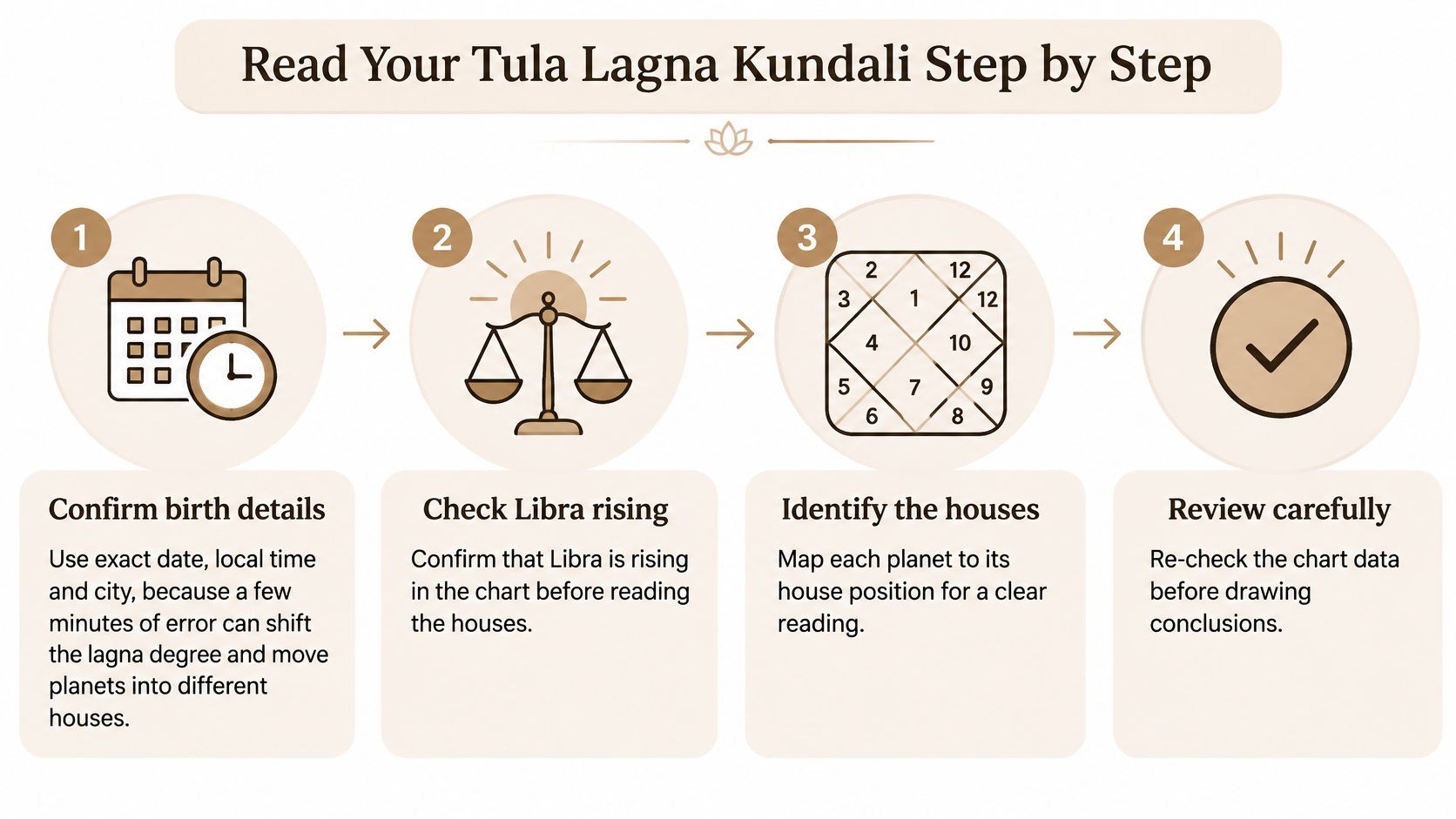
Confirm the birth details. The record needs the birth date, local clock time and city. The calculation should account for geographical coordinates, time zone and daylight-saving status where relevant, especially for an overseas birth.
Verify Libra rising. The ascendant must be Libra in the calculated chart. The Moon sign and Sun sign should be recorded separately rather than assumed to match it.
Examine Venus. As lagna lord, meaning ruler of the ascendant, Venus is central to the reading. Its sign, house, planetary associations and traditional strength matter more than a generic statement that Venus is favourable.
Check Mars. Its placement helps connect partnership questions with family resources and communication. A reading should distinguish what Mars rules from where Mars is placed.
Study the career house and Moon. The astrologer considers planets occupying the career house alongside the Moon's condition. A prominent career theme isn't automatically a promise of a particular profession.
Identify the current dasha and sub-period. A dasha is a planetary period used in traditional timing. The main period and its smaller sub-period are interpreted together, rather than treating a planet's influence as constant throughout life.
Cross-check the Navamsa. The Navamsa, commonly labelled D9, is a divisional chart used to examine planetary condition and marriage or dharma themes. Dharma refers broadly to purpose, principles and meaningful responsibilities.
Keep calculation settings consistent. Record the ayanamsha, the offset used in converting tropical positions to the sidereal framework. Note whether the reading uses whole-sign houses or bhava-chalit, a house-based chart adjustment, and avoid mixing tropical and Nirayana, or sidereal, coordinates.
The visual guide provides a compact reminder of the calculation checks.
A hypothetical chart in practice
Consider a sample whole-sign chart with Venus in Libra, the Moon in Cancer and Mars in Capricorn. These placements are an illustration, not a reading for every Libra ascendant.
Venus in the ascendant's own sign could be interpreted as supporting refinement and sociability. The Moon in its own sign in the career house could suggest sustained emotional investment in work and reputation. Mars in the home and property house could direct effort towards domestic responsibilities rather than occupying the partnership house itself.
The connected themes might be a career built through reputation, a partnership helped by family understanding, and a period worth examining when relevant planetary timings overlap. No date can be inferred from those placements alone.
A practitioner tests each theme against the person's circumstances. Accurate birth date, time and place are inputs for every chart prepared, while the person's actual situation helps distinguish a useful interpretation from a broad description.
When Birth Time Is Uncertain
An uncertain birth time doesn't make every part of a chart useless, but it changes how confidently house-based conclusions can be discussed. The first task is to separate a documented time from a family estimate.
A hospital record, birth certificate or horoscope prepared near the birth may help. Records can disagree, so the original wording matters: a time remembered as early morning shouldn't be recorded as an exact clock entry.
Evidence before interpretation
- Check original records. A photograph of the document is more useful than a time repeatedly copied between apps.
- Describe the uncertainty. An astrologer should know whether the time is recorded, rounded or remembered.
- Compare nearby possibilities. Candidate charts should use the same location and calculation settings so only the time changes.
- Mark unstable conclusions. House placements or divisional-chart features that change across the possible interval need cautious interpretation.
A rising-sign calculator can help compare possible birth times. It can calculate the ascendant for an entered time, but it can't establish whether that entered time is historically correct.
What rectification can and can't do
Birth-time rectification means comparing possible charts with dated life events. An astrologer may examine education milestones, marriage, relocation or employment changes to judge which candidate time appears to fit the traditional framework.
This takes more work than reading an existing chart and depends partly on the person's memory and records. A proposed rectified time remains an interpretation, not a recovered hospital timestamp.
Near a sign boundary, a possible Virgo or Scorpio ascendant would alter the house map used for marriage and career questions. Even when Libra remains rising, degree-sensitive details may change.
An honest range is more useful than an exact-looking time entered without evidence.
The practical approach is to distinguish themes that remain consistent across the possible birth-time window from those that change. Fine dasha dates and narrow event windows deserve particular caution when the underlying degrees remain uncertain.
Personality Traits Behind the Libra Ascendant
A simple analogy separates the main chart factors: the ascendant resembles the way a person enters a room, the Moon sign describes emotional processing, and the Sun sign relates to identity and direction. These are teaching comparisons within astrology, not psychological diagnoses.
Libra ascendant descriptions commonly emphasise diplomacy, aesthetics and partnership. However, Dekho Panchang's Libra lagna guide provides a chart-based context in which planetary rulership and placement matter alongside those broad associations.
Strengths and their less comfortable sides
- Balance and hesitation. Considering different viewpoints can support fair decisions. The same habit can make a close choice feel unnecessarily difficult.
- Charm and people-pleasing. Social awareness can help someone make others comfortable. It can also encourage agreement when an honest refusal would be healthier.
- Aesthetic judgement and comfort-seeking. An eye for colour, proportion or presentation can support creative work. Comfort can become a distraction when an awkward task needs attention.
- Harmony and conflict avoidance. A calm approach can reduce unnecessary arguments. Avoiding every disagreement can leave important needs unspoken.
These pairs are more useful than calling a person charming or indecisive. They suggest skills that can be practised, such as setting a decision deadline or stating a boundary without hostility.
Venus doesn't explain the whole person
Venus's role as ascendant ruler gives traditional interpretations their emphasis on refinement, relationships and enjoyment. Mars introduces another strand through its connection with family speech and partnership: a person who usually seeks agreement may become surprisingly direct when a close relationship feels strained.
That doesn't mean every Libra-rising person has the same temperament. Planets occupying the ascendant, their aspects and the condition of Venus can produce quite different readings.
A Libra-rashi profile isn't interchangeable with a Tula Lagna chart. In common Indian usage, rashi often refers to the Moon sign, so familiar sign descriptions may be discussing a different chart factor altogether.
The reassuring interpretation is that these are tendencies, not permanent labels. Fairness can become thoughtful leadership, and sensitivity to others can coexist with a clear, respectful no.
Marriage, Partnership and Family Life
For Libra rising, partnership is examined through Aries and its ruler, Mars. Because Mars also manages family wealth and speech, an astrologer considers how the couple handles resources and disagreement, not merely whether attraction is present.
A consultation can help make those connections easier to discuss.
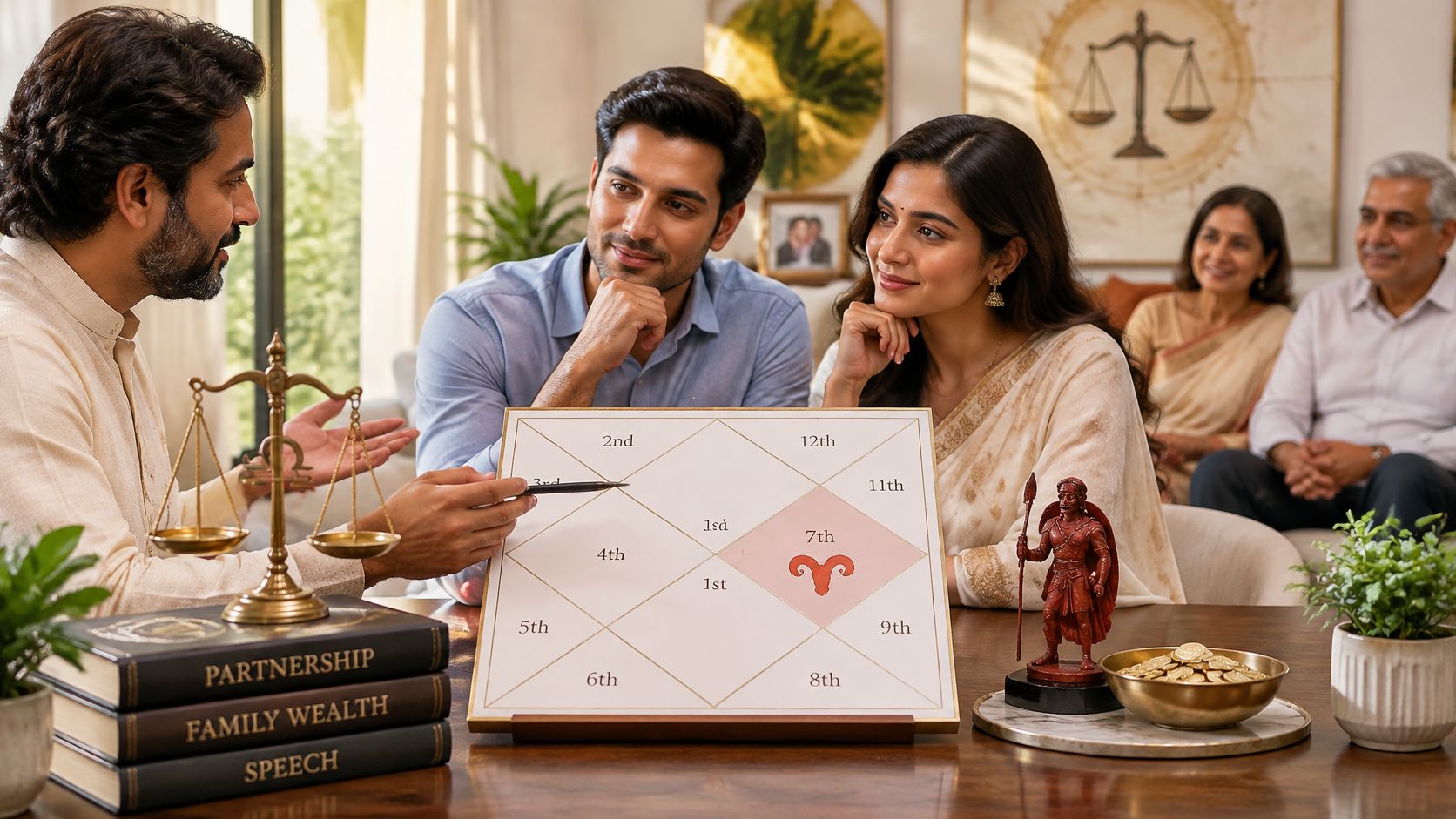
Chart factors and everyday compatibility
The traditional assessment considers the partnership house, Mars's condition, Venus and planets occupying or aspecting the partnership house. Supportive or strained configurations require context; a single placement shouldn't become a frightening verdict about marriage.
Indian families also differ in how much weight they give matching. A reported 2025 survey of more than 21,000 Indian singles, discussed in O3 Capital's Digital Sector Note, found kundli matching essential to roughly one in three Delhi respondents, while singles in Mumbai and Bengaluru increasingly prioritised personal compatibility; only 4 per cent said parents alone would choose their partner.
Traditional Ashtakoota matching uses a 36-point score across eight kootas, or compatibility categories, with 18 points often cited as a threshold. A kundli-matching assessment can organise those categories, but the total isn't a complete account of a relationship.
A score can't establish whether a partner respects consent, handles debt responsibly or accepts family boundaries. Nor should astrology override either person's freedom to accept or decline a proposal.
The accompanying video offers another format for exploring the topic.
Conversations that belong beside matching
- Conflict style. Does each person prefer immediate discussion, or some quiet time before returning to an issue?
- Money management. How will saving, borrowing, spending and support for relatives be handled?
- Autonomy. What space will each partner have for work, friendships and personal decisions?
- Family boundaries. Who will communicate decisions to relatives, especially when expectations differ?
- Timing. Are both people ready for marriage, relocation or shared financial commitments?
These questions matter in family-proposed matches, intercaste or interfaith relationships, and relationships where parental expectations differ from the couple's preferences. A two-person reading is most constructive when both partners can explain their concerns.
The chart can inform the conversation. The couple still makes the decision, with attention to behaviour, shared values and practical readiness.
Career, Money and Dashas to Watch
The Moon deserves attention in career questions because it governs the career house, while the Sun connects with gains and personal goals. Their planetary periods are therefore relevant starting points, but neither automatically promises promotion or higher income.
In the Vimshottari system, astrologers examine a sequence of planetary periods and their sub-periods. A period is interpreted through the planet's ownership, placement, associations and condition in the individual chart.
Vimshottari dasha lords and their roles in Tula Lagna
The table gives the traditional themes to investigate. Period lengths should be checked against the person's calculated schedule rather than used to infer a starting date from the ascendant alone.
| Dasha lord | Length | Houses ruled for Tula Lagna | Themes it tends to bring up |
|---|---|---|---|
| Venus | 20 years | 1st and 8th | Love, comfort, marriage and shared finances |
| Sun | 6 years | 11th | Recognition, income and personal goals |
| Moon | 10 years | 10th | Career direction, public image and home life |
| Mars | 7 years | 2nd and 7th | Energy, property, partnership and decisions |
| Rahu | 18 years | None, shadow planet | Ambition, foreign links and sudden shifts |
| Jupiter | Read the calculated period schedule | 3rd and 6th | Growth, teaching, health and service |
| Saturn | 19 years | 4th and 5th | Responsibility, property, education and slow progress |
| Mercury | Read the calculated period schedule | 9th and 12th | Study, communication, travel and fortune |
| Ketu | 7 years | None, shadow planet | Detachment, spirituality and unexpected endings |
Rahu and Ketu, the lunar nodes traditionally called shadow planets, aren't assigned sign ownership in this table. Their interpretation centres on placement, associated planets and the signs they occupy.
Turning a period into a practical question
Saturn's period may be examined for sustained effort involving property, education or responsibility. That could mean studying while employed, organising a household or completing a long project, rather than experiencing a single dramatic event.
Jupiter's general association with growth doesn't remove its chart-specific connection with daily effort and service. Mercury's connection with learning and foreign settings can likewise be relevant to training or relocation, but neither establishes that travel will occur.
A dasha calculator helps identify the running period and sub-period from the birth details. An astrologer then compares those periods with transits, the current movement of planets relative to the natal chart.
Decision safeguard: A planetary period is context for evaluating a choice, not a substitute for checking an offer letter, budget or contract.
A dated question is more useful than a general request for career predictions. For example, a person considering an overseas role can bring the proposed joining date, relocation costs and family constraints, allowing the discussion to focus on a real decision.
Muhurta, Chart Checks and Next Steps
Muhurta means an auspicious time selected for a ceremony or beginning. Traditional authorities don't all prioritise the same factors, so an explanation of the selection method matters more than a bare list of favourable dates.
Panchang Shuddhi is the traditional checking of the almanac elements before a date is finalised. Drik Panchang's marriage-muhurta guidance describes the five-element assessment, including nakshatra, one of the Moon's 27 stellar divisions.
The five panchang elements checked for muhurta
| Element | What it measures | What to check |
|---|---|---|
| Tithi | Lunar day, based on the Moon's phase | Confirm the day is listed as suitable in the local panchang |
| Vara | Weekday | Check the weekday against family tradition |
| Nakshatra | A stellar division along the Moon's path | Note whether the Moon's star supports the ceremony |
| Yoga | Combined longitude of the Sun and Moon | Check that the yoga is not marked inauspicious |
| Karana | Half of a lunar day | Confirm the karana at the ceremony hour |
A calendar date that looks generally suitable isn't automatically appropriate for every couple. Personal assessment may also consider both partners' birth details, the local city and the relevant solar or lunar month.
The ceremony chart needs its own check
In Drik Panchang's Vivaha Lagna guidance, the first and seventh houses of the ceremony chart should be free from dosha, meaning an affliction or adverse condition within the traditional system. This is an event-chart assessment, not the same task as comparing natal kundalis.
The usable window may be narrower than the full day because the ceremony ascendant changes. A timing window shouldn't be copied from another city, including for an overseas wedding.
Before a consultation, the couple can prepare:
- Birth records. Both partners' birth dates, times, places and any uncertainty.
- Venue details. The ceremony city and proposed venue.
- Ceremony sequence. The intended start and the specific ritual for which timing is needed.
- Practical constraints. Travel, venue availability and family requirements that affect feasible options.
Optional practices such as prayer, mantra, charity or service may offer personal or spiritual support. They shouldn't be presented as compulsory purchases or guaranteed ways to change events, and gemstones deserve caution rather than an automatic recommendation.
An astrologer may never ask a customer for a gift or make a reading depend on one. Kismo's Marriage and compatibility reading covers kundli matching for two people or a family-proposed match, and profiles show each astrologer's languages, specialities and rate before a customer chooses or spends anything.
Useful questions for the session include:
- Chart confidence. Which conclusions remain dependable if the birth time is approximate?
- Relationship priorities. Which chart themes deserve discussion alongside everyday compatibility?
- Timing choices. Which ceremony windows fit the location and practical constraints, and why?
For an individual Tula Lagna interpretation, Kismo connects users with verified astrologers by chat or call for birth-chart readings, marriage compatibility, career questions and muhurta. A visit can begin with accurate birth details and a specific question about the house, planetary period or decision that needs clarification.