Varshphal in Hindi: What Your Year Ahead Means
Varshphal is the Tajika year-ahead chart that starts when the Sun returns to its birth sidereal longitude, not on 1 January or automatically on the civil birthday. A good reading of Varshphal in Hindi therefore begins by naming that start, not by opening a New Year list.
Popular advice gets this backwards. It tells readers to find their sign, read January to December, and treat a line like nayi naukri yog or dhan labh as a ready answer. That approach skips the work that makes a yearly chart useful.
A personal Varshphal is narrower and more honest. It separates what a theme could mean, which decision it touches, which months it may cover, and what modest action still makes sense if the theme stays weak. Words like sambhav, meaning possible, do better work than nishchit, meaning certain.
Table of Contents
- When a Varshphal Year Begins
- How the Solar Return Chart Is Cast
- Five Signals That Shape the Year
- Sample Reads and Hindi Words That Change Meaning
- Limits of a Year Ahead Forecast
- Book a Hindi Year Ahead Reading
When a Varshphal Year Begins
A reader opens a yearly forecast on 1 January and finds a line about career mein badlav, a change in work. Which twelve months does that line cover? The answer depends on which clock the astrologer used, and Varshphal, also written Varshaphala, runs on its own clock inside Tajika astrology.
One chart covers the interval from one solar return to the next, the moment the Sun reaches the same sidereal zodiacal longitude it held at birth. That interval is roughly a solar year, with the start fixed by the Sun's position alone.
Four Clocks People Mix Up
The astronomical start can land hours away from the birthday, or on a neighbouring calendar day. The city used for the return matters too, because a different place can give a different rising sign at that same moment.
India's official calendar adds one more clock that readers often confuse with the astrological one. The National Calendar follows the Saka Era, treats Chaitra as its first month, and places Chaitra 1 on 22 March in a normal year and 21 March in a leap year.
Four clocks people confuse with a Varshphal year
| Year type | When it starts | What it organises |
|---|---|---|
| Gregorian civil year | 1 January | Offices, diaries and New Year plans |
| Saka national calendar | Chaitra 1, 22 March, or 21 March in a leap year | India's official civil calendar |
| Birthday anniversary | Clock time of birth on the civil birthday | A popular expectation, not the Varshphal start |
| Solar return Varshphal | Moment the Sun regains its natal sidereal longitude | One year of Tajika annual themes |
The table matters because the Hindi word varsh, meaning year, covers four different beginnings. A civil year helps plan holidays and school terms. The Saka calendar keeps India's official dates in step with the Gregorian count. Neither casts a personal annual chart.
A birthday comes closer, yet still misses. A person may cut a cake on the civil date while the Sun has not yet reached its birth degree, or has already passed it earlier that morning. The gap sounds small until the rising sign shifts.
Why the Start Decides the Window
Once the true start is fixed, every theme in the chart gains a real span of months. A line about dhan, money, stops floating over the whole year and attaches to a season the reader can check. That is the practical payoff: each theme can be read as a set of possible outcomes, narrowed by one honest question, placed inside one time window, and answered with one modest action rather than twelve months of worry.
The Clock to Write Down
A Hindi forecast for 2026 should name its clock before January or a birthday month is treated as the start. Write down the birth date, the exact birth time, and the birth city first. Those three details let the astrologer locate the return moment instead of guessing it from a calendar.
Start check: If a yearly page doesn't state whether it begins on 1 January, on the birthday, or at the solar return, it isn't yet a personal Varshphal.
How the Solar Return Chart Is Cast
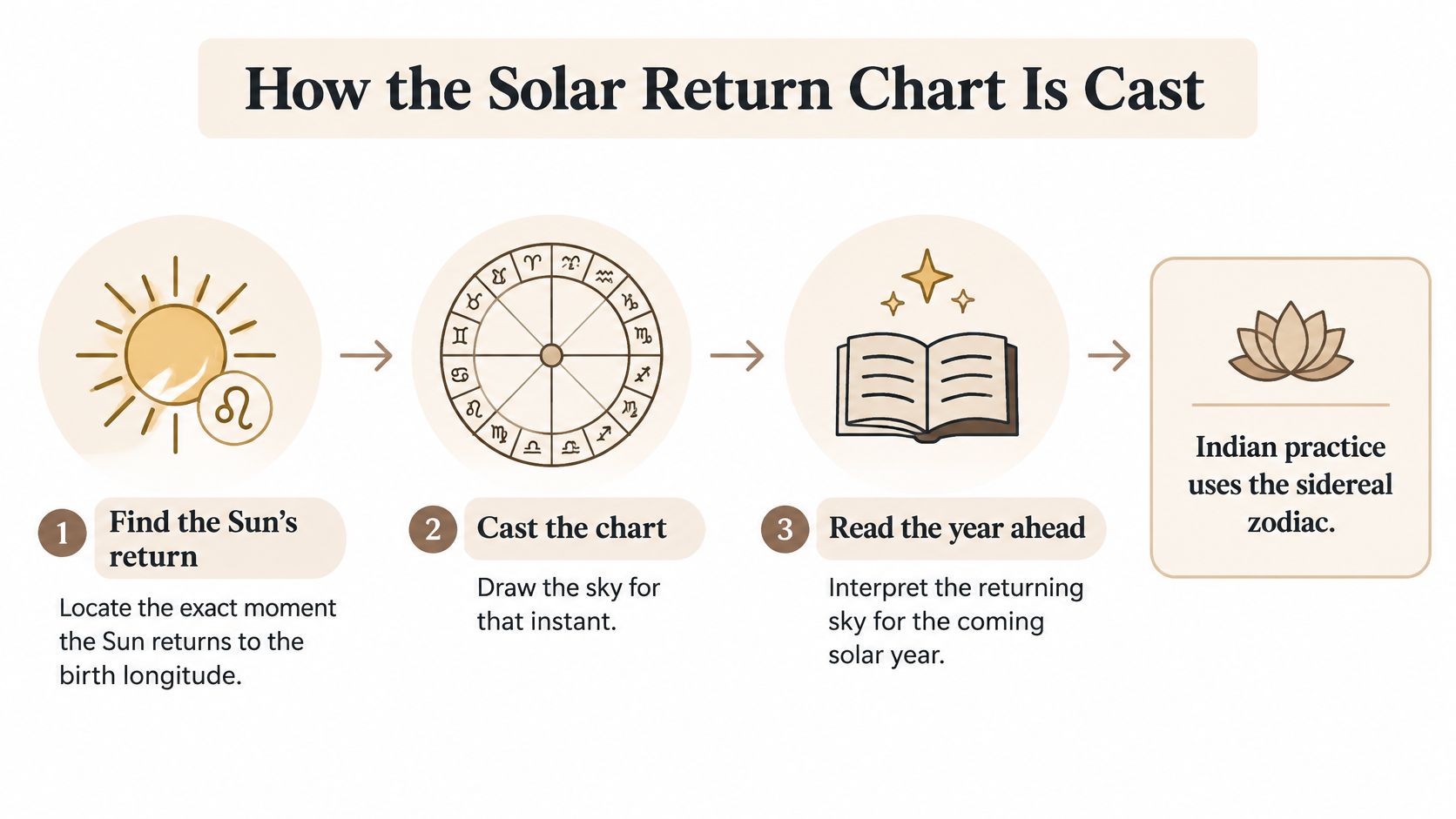
Casting a Varshphal chart means finding the instant the Sun returns to the exact sidereal longitude it held at birth, then reading that sky for the coming solar year. The Tajika Solar Return learning page describes Varshphal as calculated for the moment when the Sun returns to the exact sidereal longitude it occupied at birth, with the resulting chart interpreted for the following solar year.
Indian practice uses the nirayana, or sidereal, zodiac. It doesn't use a tropical Western return, and it doesn't set the chart for midnight on the civil birthday. Those are different skies, not small formatting choices.
The diagram below shows the basic movement from finding the return to reading the year.
Why Time and City Change the Chart
The astrologer needs the birth date, a reliable birth time, the birth city, and the city of the solar return. Coordinates change the ascendant, also called the lagna or rising sign, and they change the house cusps that divide one life area from another.
A time rounded to the hour can move the lagna into another sign when the true moment falls near a cusp. That one shift can reassign the houses for work, marriage, money, or family, so an approximate time doesn't produce a slightly weaker version of the same chart. It can produce a different frame.
City-based almanac work shows why place belongs in the file. National calendar publications give sunrise, tithi, meaning lunar day, nakshatra, meaning one of 27 lunar-star sectors, and nirayana positions for Indian locations. That background helps with timing, but a national almanac doesn't replace this person's return chart.
Readers who don't yet have a reliable birth chart can start with a personal kundli, where kundli means the birth chart drawn from date, time, and place. The nakshatra in that chart comes from the Moon's birth position, not from the birthday month alone.
Five Moves in Order
- Write the birth record: Record the date, exact time, and birth city before any calculation begins.
- Find the sidereal return: Compute the moment the Sun regains its natal longitude for the year being read, such as 2026.
- Cast for the return place: Draw the chart for that moment at the city where the return is taken.
- Record the frame: Note the return date and time, the lagna, and the house cusps on the chart itself.
- Keep the natal kundli beside it: Read the annual chart against the birth chart, not as a replacement for it.
The finished note should name the return date and city, the main annual themes, and the decision each theme applies to. That turns a chart into something a reader can question and use. It stays traditional guidance, not a scientific forecast or a promise.
A Varshphal note that doesn't state its return date, return city, and lagna gives the reader no way to check what was actually calculated.
Five Signals That Shape the Year
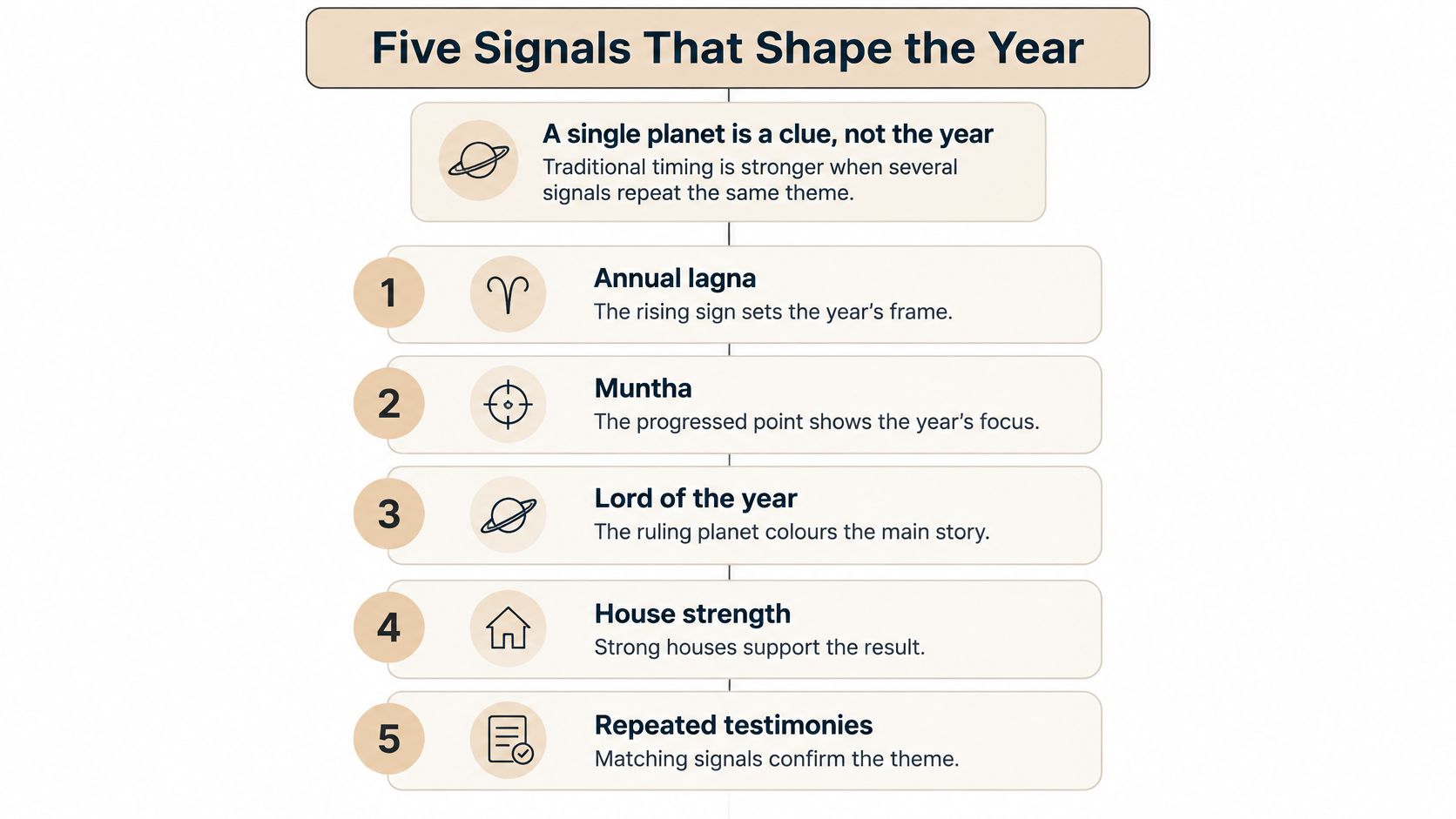
A single planet in the return chart is a clue, not the year. Traditional timing grows stronger when several signals repeat the same theme in different ways.
The hierarchy below puts those signals in reading order, from the annual frame down to repeated agreement.
The Five Signals in Order
1. Annual lagna. The rising sign of the solar return chart sets the year's tone and shows which houses, or bhavas, speak loudly. A house is a life topic, such as work, partnership, money, or home, so the lagna decides which topics sit in which part of the chart.
2. Muntha. The Muntha is the Tajika progressed ascendant, counted one sign a year from the birth lagna. Its sign and its lord show where effort concentrates during the year. Read it as emphasis, a place where attention gathers, rather than as a verdict on what must happen.
3. Solar return houses. Busy houses point to busy life areas such as career, marriage, income, health routines, or a move. They shouldn't be read alone, because the same planet means something different when it supports a natal house than when it contradicts the birth chart's pattern.
4. Vimshottari dasha. A dasha is a planetary period system taken from the birth chart, and it shows the longer season the year sits inside. A short, cheerful transit shouldn't overrule a dasha that's asking for patience, just as one difficult month shouldn't erase a supportive longer period.
5. Gochar. Gochar means the current movement of planets, often called transit, and readers can follow the broad movement through current planet transits. A transit can time a window inside the year, but it needs the dasha or the return chart to agree before it deserves weight.
How Agreement Changes the Reading
Two people born in the same month can receive different yearly readings for ordinary reasons. Their birth times, places, lagna, nakshatra, and dasha differ, so the same calendar year lands on different houses and different periods. A sign-based page can't see any of that.
The 2025 Jyotisha Journal study on marriage timing concludes that combining several astrological parameters is more informative than relying on a single factor. That finding fits the practical rule here, even outside marriage questions. Repetition across techniques is the threshold.
- One signal active: Call the theme possible and ask a follow-up question before planning around it.
- Two signals agreeing: Treat it as a watch area and name the months or trigger to review.
- Three or more agreeing: Treat it as a planning priority, still not as a guaranteed event.
Repetition rule: One row of the five signals is a possibility. Planning weight comes from agreement, not from a dramatic single placement.
That rule protects readers from the most common misuse of Varshphal in Hindi pages, which is taking one strong planet as permission to resign, borrow, or fix a wedding date. The chart can rank attention. It can't carry a decision by itself.
Sample Reads and Hindi Words That Change Meaning
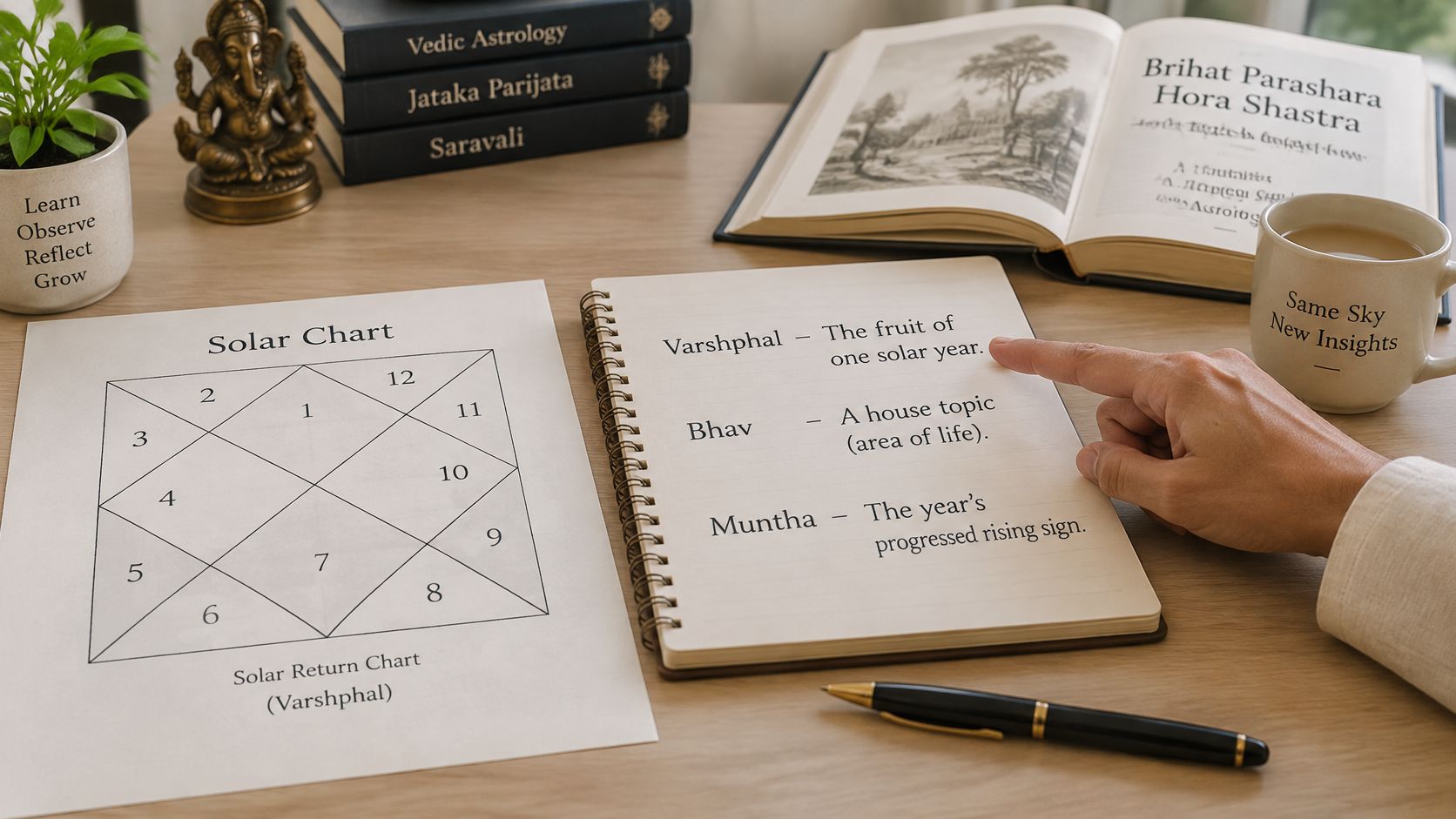
Start with the spoken gloss. Varshphal is varsh ka fal, the fruit or result of one solar year. A bhav is a house topic, and the Muntha is the year's progressed rising sign.
The notebook image below captures the habit that helps most, which is writing the plain meaning beside each technical term before acting on it.
Hindi wording doesn't automatically make a forecast easy to use. The Indian Express report on the IAMAI Kantar internet study reports that 57% of urban Indian internet users prefer regional-language content and 98% of users accessed Indic-language content in 2024. Readers may search in Hindi, think in mixed Hindi and English, or want the same gloss in Marathi, Bengali, or Tamil.
Lines That Sound Clear but Aren't
Nayi naukri yog may mean a new job, a new team, added responsibility, or only a better season for applications and interviews. Shaadi ke yog may mean meeting someone, family talks, engagement, or wedding timing, and those are four different life events with four different costs.
Dhan labh, often heard as money gain, may describe a chance to earn through effort rather than a promised sum arriving. Pareshani, often translated as trouble, may describe a busy or demanding spell rather than a disaster. The soft word and the frightening word can hide inside the same phrase.
A useful rewrite asks three plain questions. Who does this theme affect, what decision does it touch, and which months does it cover? Until those answers exist, the Hindi line is a heading, not guidance.
How to split a broad Hindi year theme
| Theme people hear | Possible meanings to separate | Do not decide from this alone |
|---|---|---|
| Career change | Extra workload, interviews, or an actual role change | Quitting with no next step |
| Shaadi yog | Meeting someone, family talks, engagement, or wedding timing | Breaking or fixing a match |
| Money growth | Income effort, delayed payment, or higher expenses | Taking a large debt |
| Health concern | Rest, check-ups and routine care | Stopping prescribed treatment |
The short video below gives another way to hear these distinctions aloud before turning them into questions for a personal reading.
Turning Each Theme Into a Decision Check
Career support in the return houses, backed by dasha, can justify updating a CV, preparing for interviews, or asking for a clearer role. It doesn't prove that resignation is wise this month. The action stays useful even if the job change waits.
Marriage emphasis is also separate from kundli matching, or kundli milan, the compatibility comparison of two birth charts. In popular North Indian practice, the Ashtakoota system compares eight factors for a score out of 36 gunas, but that score isn't the same question as whether this year supports talks, engagement, or a wedding date. Mixing the two questions produces a confident answer to neither.
Money lines need the same split. A year can support earning effort while expenses also rise, or a payment can arrive late after real work. Building a small cash buffer and clarifying a wedding or household budget are actions that don't need the prediction to come true.
Health lines belong to routines and check-ups, never to diagnosis. A yearly chart shouldn't name an illness, promise recovery, or give a reason to stop prescribed treatment. A reader with symptoms needs a qualified medical professional, not a stronger interpretation of a house.
For each theme, leave with one question, one time window, and one modest action. If the factors don't repeat, say sambhav, possible, not nishchit, certain. That wording isn't weak. It's the difference between traditional belief stated plainly and a claim presented as verified fact.
- Career example: Question, interviews or workload. Window, the named active months. Action, update the CV and practise answers.
- Marriage example: Question, talks or wedding timing. Window, the months both charts support. Action, agree the budget and family expectations early.
- Money example: Question, new income or delayed payment. Window, the expected payment period. Action, keep a buffer before taking any new commitment.
Limits of a Year Ahead Forecast
Varshphal has a history that encourages humility about what it can claim. The Tajika Jyotish history page records that scholarship places Tajikaśāstra in the 13th century, traces some doctrines to the 9th-century Arabic astrologer Sahl ibn Bishr, and associates the mature Sanskrit presentation with Nilakantha's Tajika Nilakanthi, dated to 1544 CE.
Tajika is therefore a medieval Perso-Arabic system adapted into Sanskrit and Indian practice, not an ancient Vedic technique in its current form. That history doesn't make the practice worthless. It does mean readers shouldn't treat its annual rules as timeless certainty beyond questioning.
What the Chart Can and Can't Carry
The method describes likely themes and emphasis for one solar year. The birth chart still describes broader, longer patterns, so the annual chart shouldn't be stretched into a lifelong verdict. A strong year inside a difficult longer period may bring relief and opportunity, not a complete reversal.
Confidence rises only when the annual lagna, Muntha, houses, dasha, and a transit tell a similar story. It falls when the birth time is rounded, the return city is unknown, or the reader is using a sign-based page instead of a personal return chart. More planetary detail isn't always more useful than a clear threshold for action.
A Varshphal is a traditional map of emphasis for one solar year, not a guarantee of what will happen.
Readers shouldn't use a yearly page alone to resign, end an engagement, refuse a medical plan, or borrow heavily. Those decisions need contracts, conversations, professional advice, and money in hand, not only chart agreement. A forecast that pushes someone toward those steps from one house or one transit is asking the method to do work it wasn't built to do.
Used within its limits, the chart helps a reader choose a priority, a patient season, and a better question for a full reading. That's a modest promise, and it's the honest one.
Book a Hindi Year Ahead Reading
Once the clocks, signals, and sample splits are clear, the next step is a reading of this person's own chart rather than another general rashifal. Preparation decides whether the session produces usable months and actions, or another set of broad Hindi lines.
Prepare Before the Session
- Birth details: Write the birth date, exact birth time, and birth city exactly as recorded.
- Return city: Note the city for the coming solar return if the person will be living elsewhere.
- Live decisions: Choose one or two decisions only, such as a job offer, wedding timing, or a move.
- When and what questions: Ask when a window may open and what form the theme may take, not for a verdict.
In the session, ask the astrologer to name the return date, the annual lagna, the Muntha, and the dasha in force. Ask which months support pushing forward and which suit waiting, preparing, or finishing old work. Then ask for the split in plain words, meeting separate from marriage, and workload separate from a job change.
Kismo serves people across India and abroad who chat or talk with astrologers in their own language, and readers can review available verified astrologers before choosing one. Sessions are offered in users' own language, including Hindi, Tamil, Bengali, Marathi and more, so the language should be confirmed before booking.
The Year ahead (Varshphal) reading gives a year-by-year forecast from the solar return, with a month-by-month picture and periods to push and periods to wait out. Expect traditional guidance tied to the individual kundli, not a promise of wealth, marriage, or health. Medical, legal, and financial choices stay with the qualified professional for that field, while the session orders questions and timing.
Bring the exact return date, annual lagna, Muntha, and dasha questions to a Year ahead reading at Kismo, where a verified astrologer can map the solar return month by month in Hindi or another preferred language. It turns a broad Varshphal in Hindi search into named windows to push, periods to wait out, and one modest next action for the decision in front of the reader.