Vedic Astrology Birth Chart Explained
A person may open an astrology app after receiving a confusing marriage proposal, feeling stuck between two career paths, or wondering whether the time is right to start a business. The question usually isn't a desire for a dramatic prediction. It's a wish to understand the situation clearly and make a calmer decision.
A Vedic astrology birth chart, traditionally called a kundli, can offer a structured way to examine personality, circumstances, recurring patterns, and timing. It doesn't need to be treated as a fixed script. Used thoughtfully, Jyotisha, the traditional Indian system of astrology, can function more like a map that helps a person notice strengths, prepare for challenges, and choose favourable moments while remaining responsible for their own actions.
Table of Contents
- Understanding Your Vedic Astrology Birth Chart
- The Three Pillars of Chart Creation
- Core Components of the Kundli Explained
- Navigating Life Cycles with Planetary Dashas
- Practical Applications for Modern Life Decisions
- What to Expect from a Professional Consultation
- Using Your Chart as a Tool for Empowerment
Understanding Your Vedic Astrology Birth Chart
Consider someone named Ananya who is unsure whether to accept a job in another city. One part of her wants professional growth, while another worries about family responsibilities and an unsettled relationship. A generic daily horoscope might offer encouragement, but it can't show how her individual chart describes work, home, partnership, and timing together.
A kundli is more personal. It records the positions of the Lagna, or rising sign, the nine grahas, or planetary influences, and other chart factors at the moment of birth. Astrologers then interpret how those factors relate to different areas of life. The reading may point towards a period suited to professional movement, a need for more careful communication, or a reason to delay a major commitment until circumstances become clearer.
Practical rule: A birth chart can support reflection and planning, but it shouldn't replace judgement, medical care, legal advice, financial planning, or honest conversation.
The tradition behind the chart is known as Jyotisha. Historical summaries connect its earliest textual roots with the Vedic period. The Rigveda contains references to planets and the zodiac, while the Atharvaveda mentions constellations, or nakshatras. Scholarly histories commonly associate the formalisation of Vedanga Jyotisha with Lagadha in the late Vedic era, often dated to the 12th century BCE in historical summaries of Indian astrology's early development.
This background matters for modern readers because a kundli is not an online personality quiz. It belongs to a long tradition involving planetary positions, lunar mansions, calculations, and time-sensitive interpretation. Yet age alone doesn't prove every prediction. A respectful reading combines cultural knowledge with accurate data, careful reasoning, and practical language.
For Ananya, the useful question isn't “Will the planets force her to move?” It's “What does the chart suggest about work, home, partnership, and the timing of a possible move, and what real-world information should she consider alongside that reading?” That shift turns astrology from a source of fear into a tool for self-awareness.
The Three Pillars of Chart Creation
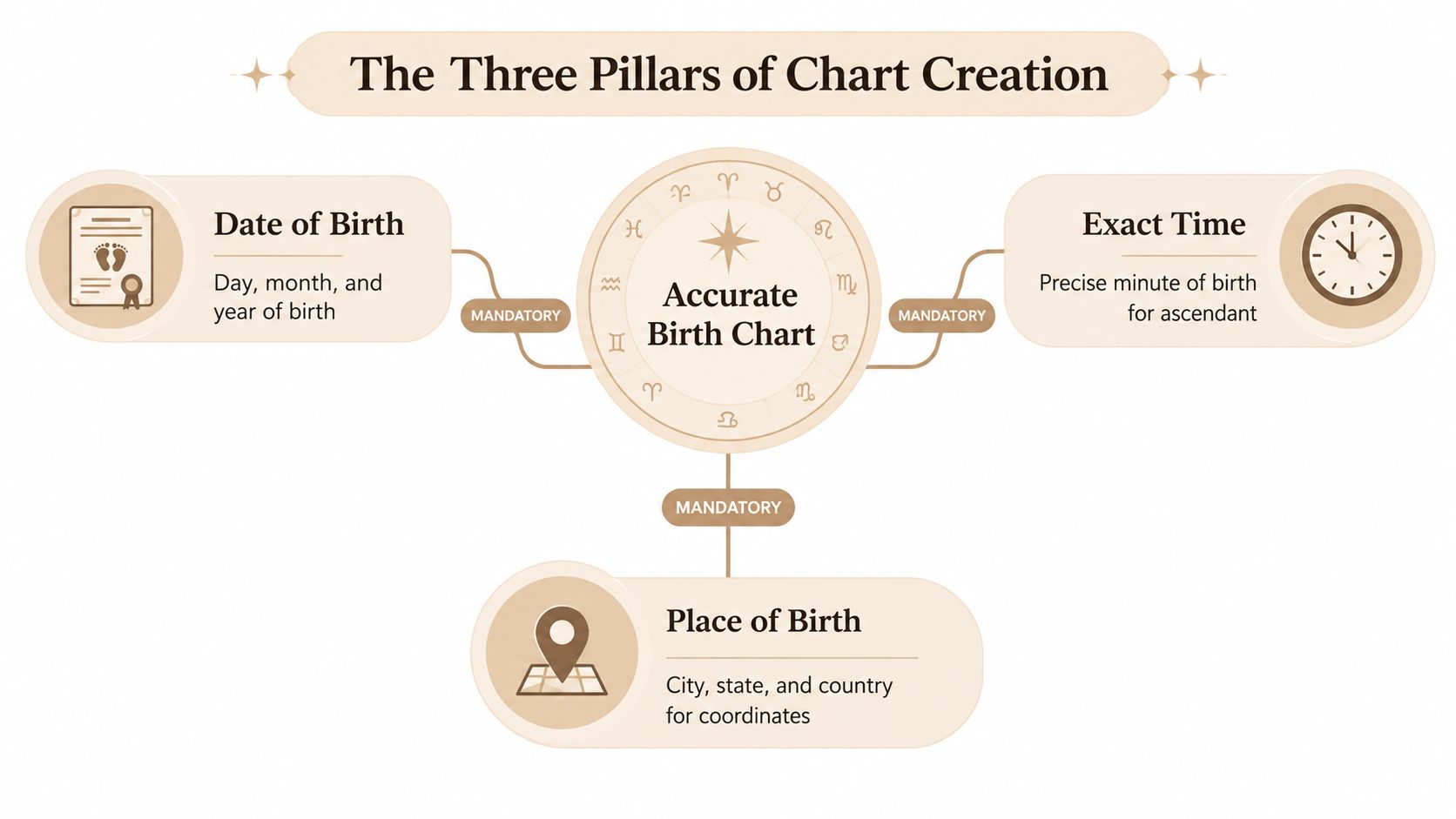
A chart depends on three essential birth details. If one is missing or incorrect, the interpretation may become unreliable, especially when the reading involves the ascendant, houses, or timing.
Date of birth
The date identifies the calendar position of the birth. It allows the calculation to place the Sun, Moon, and planets in their relevant zodiac signs. A birth certificate, hospital record, or family register may provide the starting point, but the information should be checked carefully if different documents show different dates.
Exact time of birth
The time helps establish the Lagna, the sign rising on the eastern horizon. The ascendant is especially important because it organises the houses of the chart. A recorded time that is rounded or remembered only approximately may affect house placement and timing analysis.
A person who knows only that the birth occurred “in the morning” shouldn't treat an exact-looking chart as certain. An astrologer may discuss birth-time rectification, but that process requires careful examination of significant life events and shouldn't be presented as an unquestionable correction.
Place of birth
The birthplace supplies the geographical reference needed for the calculation. An independent kundli calculator describes the chart as using the date, exact time, and place of birth to calculate the rising sign and the nine planets in the birth chart. The city, state, and country should be entered accurately, particularly when a person was born abroad or in a location with a similar name.
These details connect a modern chart to an old mathematical and observational tradition. The practice has developed through long engagement with celestial cycles, calendars, nakshatras, and planetary motion. Its survival across generations shows cultural continuity, while its modern academic status has also been debated. In 2001, the University Grants Commission issued a circular on 23 February proposing undergraduate, postgraduate, and doctoral study in Vedic Astrology, later named Jyotirvigyan in parentheses in the documented academic history.
That history doesn't remove the need for critical thinking. It does show why a birth chart should be approached as a structured system rather than a casual internet trend. The stronger the birth information, the more responsibly an astrologer can discuss the chart.
Core Components of the Kundli Explained
A kundli becomes easier to understand when it's treated as a house rather than a page filled with symbols. The houses are the rooms, the planets are the actors, and the zodiac signs describe the style or conditions in which those actors operate.
The twelve houses, also called bhavas, give an area of life to each placement:
| House | Main area |
|---|---|
| 1st | Self, body, identity, and appearance |
| 2nd | Wealth, speech, food, and family |
| 3rd | Siblings, courage, communication, and skills |
| 4th | Home, emotional security, and mother |
| 5th | Creativity, romance, learning, and children |
| 6th | Health, service, work routines, and obstacles |
| 7th | Marriage, committed partnership, and business agreements |
| 8th | Transformation, shared resources, and hidden matters |
| 9th | Beliefs, teachers, father, travel, and fortune |
| 10th | Career, reputation, responsibility, and status |
| 11th | Gains, networks, friendships, and aspirations |
| 12th | Expenditure, retreat, foreign connections, and liberation |
The same planet can express differently depending on its house and sign. For example, Mercury connected with communication and learning may be useful for a writing career, but its practical meaning depends on the whole chart. A single placement rarely provides enough information for a serious conclusion.
Planets as active influences
Vedic astrology commonly works with nine grahas. These include the visible planets used in the system as well as the lunar nodes, Rahu and Ketu. Each graha carries symbolic themes. Jupiter may relate to learning, guidance, and expansion, while Saturn may bring structure, responsibility, patience, or pressure. These are interpretive themes, not guaranteed events.
The sign tells the astrologer how a planet behaves. A planet placed in a supportive context may express its themes more smoothly, while a difficult combination may describe an area requiring discipline. This is why “good planet” and “bad planet” are often too simplistic.
The Moon and Janma Nakshatra
The Janma Nakshatra is the lunar mansion occupied by the Moon at birth. One source describes the nakshatra system as 27 lunar mansions through which the Moon travels, with the Moon remaining roughly 24 hours in each nakshatra in traditional timing and naming practices. In Vedic astrology, the Moon is often given special attention because it represents the mind, emotional responses, habits, and felt experience.
The Sun sign may describe a broad expression of identity, but the Moon sign and Janma Nakshatra can add detail about how a person processes change, seeks safety, forms attachments, and reacts under pressure. For a marriage reading, that emotional layer can be as important as outward compatibility. For career guidance, it may reveal whether a person thrives on public responsibility, independent work, routine, or constant variety.
A careful interpretation connects house, sign, planet, Moon, and timing. It doesn't select one dramatic symbol and turn it into a life sentence.
Navigating Life Cycles with Planetary Dashas
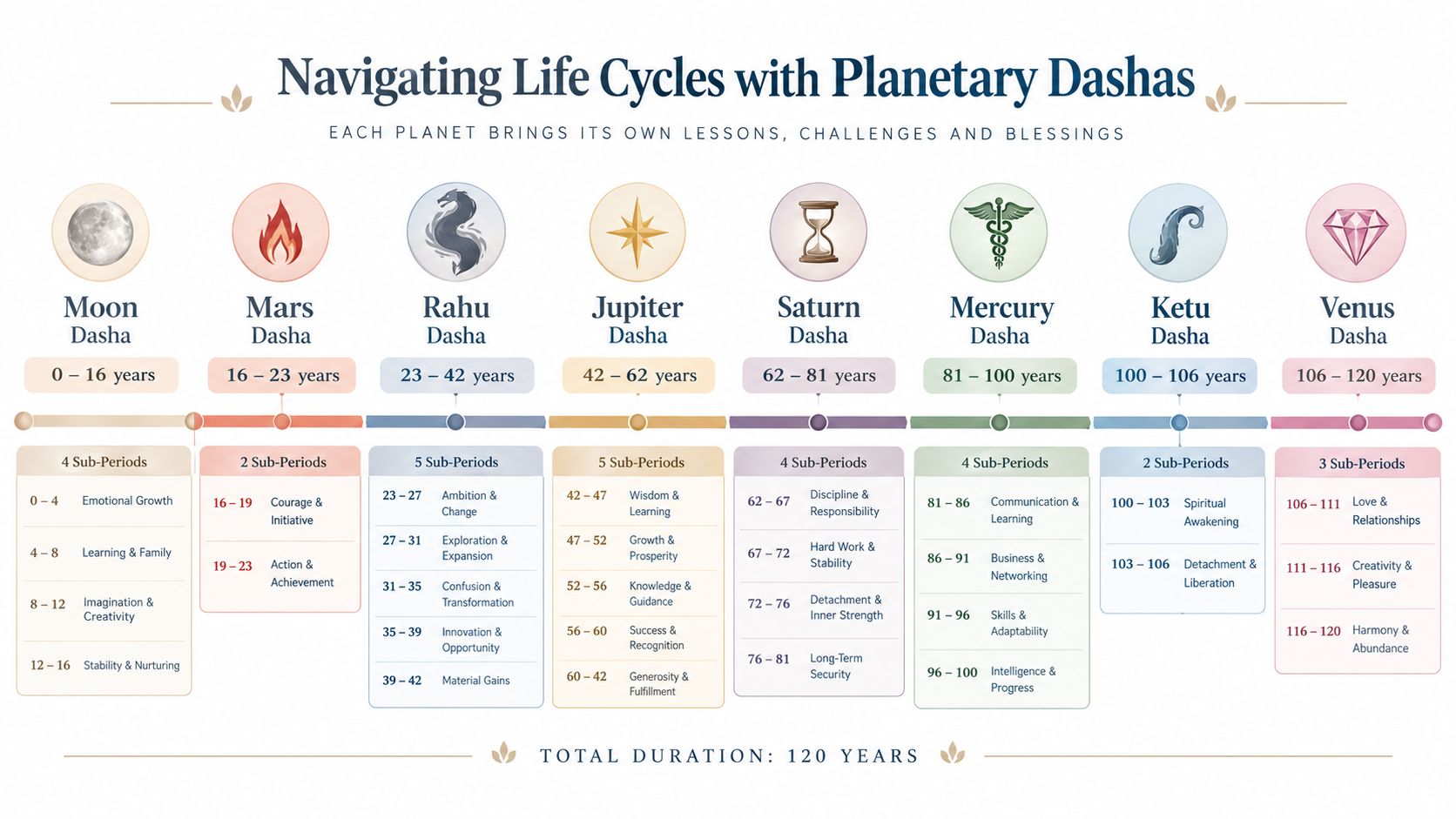
A chart describes tendencies, but Vedic astrology also asks when those tendencies may become more noticeable. The main tool for this is Vimshottari Dasha, a planetary timing system covering 120 years. It is divided into major periods ruled by the nine planets, with shorter sub-periods nested inside them as described in this kundli guide.
How the dasha clock works
The birth nakshatra helps determine where the dasha sequence begins. The main period is called the Mahadasha, while a smaller period within it is the Antardasha. An astrologer reads both in relation to the houses, signs, planetary strength, and current transits.
A Jupiter period may bring attention to education, teaching, family growth, guidance, or wider opportunities if the chart supports those themes. A Saturn period may make responsibility, patience, work structure, and long-term commitments more prominent. Neither interpretation guarantees success or difficulty. The natal chart determines how a planetary period should be understood.
A practical dasha reading might help a person organise priorities:
- Career planning: Review whether a job change supports the current period rather than acting only from frustration.
- Relationships: Separate temporary emotional pressure from deeper compatibility questions.
- Education: Use a favourable learning period to build skills instead of waiting for motivation.
- Personal wellbeing: Recognise when rest, therapy, spiritual practice, or simpler routines deserve more attention.
The value lies in timing and preparation. Someone considering a business launch might compare the dasha with market research, available funds, legal requirements, and the readiness of partners. Astrology can offer a symbolic timing perspective, but practical due diligence remains essential.
For readers who want to compare planetary movement with their personal chart, Kismo's planet transit resource can sit alongside a fuller dasha discussion. Transits describe current planetary movement, while dashas describe the individual sequence that begins from the birth chart. They answer related but different questions.
The key question is not “Is this dasha lucky or unlucky?” It's “Which life themes are asking for attention, and what responsible action fits this period?”
Practical Applications for Modern Life Decisions
The usefulness of a birth chart becomes clearer when it is connected to a real decision. A reader may want to know whether a relationship has long-term potential, whether a career change is well timed, or which date supports a wedding or housewarming. Each question uses different parts of the chart.
Marriage and kundli matching
Kundli matching compares the charts of two people. Many families begin with Guna matching or another compatibility score, but a serious reading shouldn't stop there. It may examine the Moon and nakshatras, the seventh house, the condition of relationship significators, emotional patterns, family expectations, and the timing of marriage-related periods.
A published Indian study based on 150 case studies reported a 63% “happy married life” outcome among marriages associated with kundli matching, compared with 37% among marriages without horoscope matching in the reported comparison. That finding comes from a limited, non-randomised case-study design, so it shouldn't be treated as proof that matching guarantees marital happiness.
The practical lesson is more modest and more useful. A couple can use the reading to identify areas that deserve honest discussion, such as conflict style, financial expectations, family involvement, emotional needs, or differing views about timing.
Career and money decisions
For career questions, astrologers may examine the tenth house, the second and eleventh houses, relevant planetary periods, and transits. A reading may help frame whether the present phase suits skill-building, leadership, relocation, entrepreneurship, or consolidation.
That doesn't mean the chart should make the decision alone. A person considering a move abroad still needs to evaluate visas, employment terms, housing, safety, family needs, and finances. Astrology can add a reflective layer to the decision, not remove the need for evidence.
Muhurta and important beginnings
Muhurta means electional timing, or choosing a favourable moment for an important beginning. Traditional sources describe 30 muhurtas within a nakshatra ahoratra, a sidereal day-night cycle from sunrise to sunrise. Another explanation describes one muhurta as approximately 48 minutes, or one-thirtieth of that cycle in the traditional timing framework.
A practitioner may use muhurta for a wedding, housewarming, registration, contract signing, launch, or religious ceremony. The selected window should still work in real life. A favourable time that creates unsafe travel, excludes essential family members, or conflicts with a legal deadline isn't automatically a wise choice.
Readers looking for a starting point can explore Kismo's free astrology tools, then bring specific questions to a qualified human reader if the decision requires context.
What to Expect from a Professional Consultation
A free automated report and a live consultation serve different purposes. An automated report can calculate placements and provide standard meanings quickly. It may help a beginner learn where the houses, planets, and nakshatra appear.
A professional astrologer interprets relationships between those factors. Instead of reading one placement in isolation, the astrologer may compare the ascendant with the Moon, assess the relevant houses, examine dashas and transits, and ask whether the birth time is reliable. The result should be a reasoned interpretation, not a list of alarming labels.

Prepare useful information
A consultation becomes more focused when the client arrives with accurate details and a clear purpose.
- Confirm birth records: Share the date, exact time, and place, and identify any uncertainty instead of hiding it.
- Write practical questions: “Should this job be accepted?” is less useful than asking about the role, location, deadline, and competing responsibilities.
- Bring relevant context: A relationship reading benefits from the couple's actual situation, not only their names and chart data.
- Request reasoning: The astrologer should explain which houses, dashas, or transits support the conclusion.
Oxford Bibliographies notes that academically reliable secondary sources on Indian astrology are scarce, so an expert reading needs source criticism, validated birth time, and internally consistent logic in the overview of scholarship on Indian astrology. This is a useful standard for clients. Tradition deserves respect, but a consultation should still distinguish interpretation from certainty.
Judge the quality of the output
A constructive session usually gives the client a clear summary, the main factors behind it, a reasonable period of focus, and practical actions. Remedies may include charitable work, prayer, reflection, behavioural changes, or other culturally meaningful practices. They shouldn't be used to create panic or pressure someone into buying costly objects.
A modern platform such as Kismo connects users with verified astrologers through chat or call, including consultations for birth charts, marriage, career, and timing. Readers comparing available practitioners can review Kismo's astrologer options and choose a session that fits their question and preferred communication style.
Using Your Chart as a Tool for Empowerment
A birth chart becomes most helpful when it encourages better questions. Instead of asking whether a planet is “bad”, a person can ask which habits, relationships, responsibilities, or decisions need more awareness.
A difficult house may describe an area where effort is required. A demanding planetary period may invite patience, organisation, boundaries, or support from trusted people. A challenging combination shouldn't be used to label someone as cursed, doomed, or incapable of love and success.
The same principle applies to remedies. A remedy should make a person more attentive and grounded, not more frightened. If a reading suggests relationship tension, a practical response might include honest communication and counselling. If it points towards career pressure, the person might improve skills, clarify expectations, and create a realistic financial plan.
The planets may describe the weather, but the person still chooses how to prepare and where to steer.
A thoughtful consultation also respects uncertainty. Indian astrology has a long cultural history and a living practice, yet the academic literature is fragmented and not consistently standardised. That makes clear birth data, transparent reasoning, and modest language especially important.
For someone facing a marriage decision, the chart can prompt deeper conversations rather than replace consent. For someone considering a new role, it can help organise timing and priorities rather than override qualifications or practical facts. For someone choosing a muhurta, it can honour tradition while keeping safety and feasibility at the centre.
The most beneficial use of a Vedic astrology birth chart is therefore collaborative. The astrologer offers a framework, the client supplies lived context, and the final decision remains with the person whose life is being discussed. Guidance becomes valuable when it increases clarity, responsibility, and confidence instead of creating dependence.
For a personalised birth chart reading, marriage compatibility discussion, career question, or muhurta consultation, Kismo lets users connect with verified astrologers by chat or call. Readers can bring their exact birth details and one clear life question to receive practical guidance grounded in their individual chart.